


| Issue |
A&A
Volume 711, July 2026
|
|
|---|---|---|
| Article Number | L11 | |
| Number of page(s) | 6 | |
| Section | Letters to the Editor | |
| DOI | https://doi.org/10.1051/0004-6361/202660202 | |
| Published online | 22 July 2026 | |
Letter to the Editor
Fast-spinning massive black holes from slowly rotating low-metallicity stars: Implications for GW231123
1
Department of Physics, Faculty of Science, University of Malaya, 50603 Kuala Lumpur, Malaysia
2
Center of Astronomy and Astrophysics, Faculty of Science, Universiti Malaya, 50603 Kuala Lumpur, Malaysia
3
Astrophysics Research Centre, Lennard-Jones Laboratories, Keele University, Keele ST5 5BG, UK
4
Kavli IPMU (WPI), University of Tokyo, 5-1-5 Kashiwanoha, Kashiwa 277-8583, Japan
5
Departament d’Astronomia i Astrofísica, Universitat de València, Av. Vicent Andrés Estellés 19, E-46100 Burjassot, València, Spain
6
Observatori Astronòmic, Universitat de València, 46980 Paterna, Spain
7
Geneva Observatory, University of Geneva, Chemin Pegasi 51, CH-1290 Sauverny, Switzerland
★ Corresponding author: This email address is being protected from spambots. You need JavaScript enabled to view it.
Received:
2
April
2026
Accepted:
22
June
2026
Abstract
Context. The origin of massive black holes in the early Universe remains uncertain and is still unexplored. Population III (Pop III; zero-metallicity) stars are among the first stellar sources capable of producing such remnants, but their evolution is very sensitive to rotation.
Aims. We explore how slow initial rotation affects the evolution and black hole formation of very massive Pop III stars and assess their potential to become massive fast-spinning black holes consistent with gravitational-wave events such as GW231123.
Methods. We computed a grid of non-rotating and slowly rotating Pop III stellar models with initial masses of 80, 85, and 90 M⊙ using the GENEC stellar evolution code. Our models included rotation-induced mixing and angular momentum transport by magnetic torques (Taylor-Spruit dynamo and the magneto-rotational instability). We analysed the CO core masses and their volume-averaged adiabatic index ⟨Γ1⟩ to assess stability against electron-positron pair creation. From the angular momentum profiles of the stellar models by the end of He-burning, we estimated the resulting black hole masses and dimensionless spins under the assumption of a direct collapse.
Results. Our non-rotating and slowly rotating 80 and 85 M⊙ models developed carbon-oxygen core masses between 31 and 36 M⊙ and had an adiabatic index ⟨Γ1⟩, which remained above 4/3 (i. e. they avoided pair instability). Our models thus predict that Pop III stars can keep most of their mass and collapse directly to form black holes of 80–85 M⊙ with dimensionless spins up to aBH ≲ 0.7.
Conclusions. Initially slowly rotating massive Pop III stars can form very massive rapidly spinning black holes just below the pair-instability regime. This supports an interpretation of the lower boundary of the pair-instability supernova mass gap as a smooth, structure-dependent transition and identifies single-star Pop III evolution as a possible component channel for the population of massive fast-spinning black holes observed by gravitational-wave detectors, subject to the uncertain efficiency of internal angular momentum transport and mass-loss prescriptions.
Key words: stars: evolution / stars: massive / stars: mass-loss / stars: Population III
© The Authors 2026
 Open Access article, published by EDP Sciences, under the terms of the Creative Commons Attribution License (https://creativecommons.org/licenses/by/4.0), which permits unrestricted use, distribution, and reproduction in any medium, provided the original work is properly cited.
This article is published in open access under the Subscribe to Open model. This email address is being protected from spambots. You need JavaScript enabled to view it. to support open access publication.
1. Introduction
The gravitational-wave event GW231123 has been interpreted as the merger of two black holes (BHs) with source-frame masses of  and
and  , and with high inferred spins,
  and
and  (Abac et al. 2025). These properties make GW231123 particularly challenging to interpret within standard stellar evolution channels. In conventional models, BH formation is expected to be strongly suppressed in the pair-instability mass gap (PIMG), which is commonly placed at roughly ∼55 − 130 M⊙ (Heger et al. 2003; Giacobbo et al. 2018; Woosley 2019; Woosley & Heger 2021). The physical origin of this gap lies in the development of sufficiently massive carbon–oxygen (CO) cores. Within such cores, pair creation softens the equation of state, triggering contraction and explosive oxygen burning, which can either eject part of the stellar envelope in pulsational pair-instability (PPI) episodes or disrupt the star completely in a pair-instability supernova (PISN), leaving no compact remnant (Heger et al. 2003; Farmer et al. 2019; Woosley & Heger 2021).
GW231123 is especially intriguing in this context. Its secondary component lies well within the canonical PIMG, while the primary lies within or above its upper edge, depending on the true source parameters. In addition to their high masses, both components appear to be spinning rapidly (Abac et al. 2025). It is therefore a non-trivial challenge for single-star evolutionary models to simultaneously explain such high masses and high spins.
A number of scenarios have been proposed to explain BHs in the mass gap, including growth of lower-mass BHs through accretion or repeated mergers (Roupas 2025; Stegmann et al. 2025; Kıroğlu et al. 2025; Liu et al. 2025; Gottlieb et al. 2025), premature collapse before pair instability fully develops (Baumgarte & Shapiro 2025), and a primordial origin (Nojiri & Odintsov 2025; Yuan et al. 2025). These possibilities suggest that the PIMG is not an immutable prediction, but the outcome of competing effects involving core growth, mass loss, rotational mixing, angular momentum transport, and the thermodynamic response of the stellar interior (Farmer et al. 2019; Renzo et al. 2020; Woosley & Heger 2021).
The difficulty of forming BHs in the mass gap through classical stellar evolution stems from the relation between the final stellar mass and the CO-core mass, since the latter determines the onset of pair instability (PI). This relation is sensitive to mass loss, chemical mixing, rotation, convection, and nuclear reaction rates.
Recent work suggested that the lower edge of the PPI regime is set primarily by a critical CO-core mass, with residual dependence on rotation and mass loss (Winch et al. 2025). Using the same stellar evolution code as in the present work, Farrell et al. (2021) found that Population III stars may form BHs of up to about 85 M⊙; this was later supported by Hirschi et al. (2025) for very low-metallicity models (Z = 10−5).
Population III stars are particularly relevant here as their primordial composition implies extremely weak radiatively driven winds, allowing them to retain most of their mass and potentially much of their angular momentum throughout their evolution. They are therefore promising progenitors of very massive possibly rapidly spinning BHs, and they are natural candidates for probing the lower edge of the PIMG (Heger et al. 2003; Farrell et al. 2021; Hirschi et al. 2025).
This motivated us to re-examine the lower edge of the PIMG at zero metallicity, with special emphasis on the role of slow rotation and angular momentum retention. Instead of determining the highest BH mass attainable below the onset of PI, we determine the maximum mass of a fast-spinning BH that can be produced by a single very low-metallicity star. To address this issue, we computed new stellar-evolution models of massive Pop III stars with initial masses of 80, 85, and 90 M⊙ using the GENEC code. We followed the evolution of non-rotating and slowly rotating models and analysed their mass retention, core growth, angular momentum budget, and stability against PI using their CO-core masses and volume-averaged adiabatic index. Our aim was to determine whether stars in this mass range can avoid pair-instability disruption and collapse into massive BHs, and whether the resulting remnants can retain sufficiently high spins to be relevant for systems such as GW231123.
The paper is organised as follows. In Sect. 2 we describe the stellar models and summarise their main evolutionary properties. In Sect. 3 we discuss their predicted fate and the implications for BH masses and spins near the pair-instability boundary. The summary of the evolutionary properties is presented in Appendix A. An approximate treatment of collapse, fallback, and BH growth is presented in Appendix B.
2. Stellar models
We computed the evolution of massive stars for three initial masses (80, 85, and 90 M⊙) at zero metallicity (Z = 0) from the zero-age main sequence (ZAMS) to at least the end of core-helium burning and generally until oxygen burning using the stellar evolution code GENEC (Eggenberger et al. 2008). The models were evolved with varying degrees of initial rotation, from non-rotating to a critical velocity of 20% at most. The specific initial values and nomenclature for all models we computed can be found in Table A.1. The choice of masses and rotation was motivated by the predicted high mass and high spin of the BH remnant inferred from the event GW231123 (and the expected lower boundary of the PIMG). We used zero-metallicity models to minimise mass loss from stellar winds and to explore first stellar generation BHs.
In metal-free stars, line-driven winds are extremely weak, so any significant loss of mass, and thus, of total angular momentum, can only occur through mechanical mass shedding triggered by proximity to the critical surface rotation. The initial rotational velocities we chose are relatively low to avoid such mechanical mass loss. This is in contrast with previous studies with GENEC (cf. Murphy et al. 2021 uses ω = vini/vcrit = 0.4, where vcrit is the critical velocity). The suppression of mechanical and wind-driven mass loss left our models with a high final mass and total angular momentum, making them good candidates to produce heavy BHs that can be spun up by the late accretion of angular-momentum-rich outer layers.
We used the version of GENEC described in Griffiths et al. (2025), including the same physics as in Ekström et al. (2012) and the recent grid of Sibony et al. (2024), except for three key aspects. These consist of updates to the equation of state (EoS), opacity calculations, and nuclear reaction network (we employed GeValNet25 ; for further details on the differences, see Sections 2, 3, and 4 of Griffiths et al. 2025). These updates, particularly that of the EoS, are critical to correctly determine the evolution of the core of the massive stars under thermodynamic conditions where the pair-instability becomes important.
Our models that evolved with rotation also included angular-momentum transport induced by all standard shear instabilities, meridional circulation, convection (see, Eggenberger et al. 2008, for a complete list of mechanisms included in GENEC), and local magnetic torques. The magnetic mechanisms of angular momentum transport we used are the Tayler-Spruit (TS) dynamo, as described in Eggenberger et al. (2022), and the magneto-rotational instability (MRI), as described in Griffiths et al. (2022). These two instabilities can transport angular momentum outwards within the stellar interior during the main sequence and core-helium burning. The efficiency of these prescriptions remains uncertain, and there is no observational evidence that these magnetic instabilities operate in Pop III stars. Therefore, the models should be interpreted as exploring one possible (perhaps extreme) scenario of angular- momentum transport rather than establishing the probability of this channel. Angular momentum transport shapes the final distribution of angular momentum within the stellar interior since our baseline models effectively lost no mass (see below), and hence, conserved the total angular momentum.
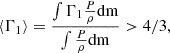
In Table A.1 we provide the values for the initial, Mini, and final mass, Mfin (i.e. at the end of core-helium burning) and the variation with respect to the initial mass, ΔM. Only the models with Mini > 85 M⊙ and ω ≥ 0.20 underwent appreciable mass loss due to high surface rotation during the stellar expansion after the main sequence. Mechanical mass loss is therefore avoided provided the initial rotation stays below ≈20% of the critical velocity. We also report the total angular momentum at the ZAMS and at the end of core-helium burning, which again only decreased appreciably for models with ω = 0.20, as all other models retained nearly all of their mass, and consequently, their angular momentum. Finally, we provide the values of the helium core mass, Mα, defined as the location where the hydrogen mass fraction falls below 0.01 and of the CO core mass, MCO, defined as the location where the helium mass fraction falls below 0.01. These two masses are evaluated at the end of core-helium burning. The carbon-oxygen core mass might grow slightly during later evolutionary phases, but the values we report approximately correspond to the final core masses at collapse. Mα and MCO are commonly used to predict whether a star will undergo a PISN. CO core masses below 60 M⊙ (Hirschi 2017; Woosley 2017) are not expected to produce a full PISN. For cores in the range ∼40 − 60 M⊙, violent pair-instability pulsations can occur, leading to eruptive mass loss, but the pulsations are not strong enough to completely disrupt the core. In our models, Mα and MCO were below the lower limit of 40 M⊙, except for Mα in models with Mini = 90 M⊙, for which they were marginally above 40 M⊙. We further assessed whether the models presented here were globally dynamically stable to pulsations. To do this, most of our models were evolved beyond core-helium burning (see Table A.1). The models were globally stable when the adiabatic index Γ1 satisfied the following inequality:
 (1)
(1)
as already used in Renzo et al. (2020) and based on the original derivation of this stability criterion by Ledoux (1945) and Stothers (1999). The models that remained globally stable (became globally unstable) until oxygen burning are labelled with an N (Y) in Table A.1. In Appendix B we describe the method for predicting the final remnant parameters of our models.
Figure 1 shows the Kippenhahn diagram of the 80 M⊙, with an initial velocity ratio ω = 0.05, illustrating the internal structure evolution from the main sequence to core oxygen burning. The total stellar mass remains nearly constant throughout the evolution, as previously discussed. Convective regions are confined to the core during H and He core burning, while the envelope stays radiative. This internal structure is consistent with the moderate helium and carbon-oxygen core masses reported in Table A.1 and characterises an evolution that avoids strong structural instabilities prior to core collapse. By retaining most of its mass and angular momentum, especially in the outer layers (50% of the angular momentum is contained in the outer 4–5 M⊙; see the vertical line in Fig. B.1), the star can evolve towards direct collapse and subsequently spin the BH up through fallback accretion.
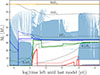 |
Fig. 1. Kippenhahn diagram of the 80 M⊙ model with an initial rotation set to 5% of the critical velocity. The black lines denote radius contours at 0.1, 0.3, 1, 10, and 50 R⊙, and the orange line marks the total mass of the star, which is constant for this model. The light blue shaded regions correspond to convective zones. The coloured lines show the locations of the peak (solid lines) and of 10% of the peak (dotted lines) in the nuclear energy generation rate for hydrogen burning (blue), helium burning (green), and advanced burning (carbon, neon, or oxygen; red). |
3. Discussion and conclusions
The PPI boundary sets the maximum stellar mass that can collapse to a BH without being disrupted (below the PIMG). This limit is not determined by a unique initial mass, but by the onset of dynamical instability when electron–positron pair production softens the EoS in sufficiently massive CO cores. Early stellar evolution and hydrodynamical studies placed the onset of pulsational pair instability at CO-core masses of roughly 35 − 40 M⊙ (Heger & Woosley 2002; Farmer et al. 2019; Woosley 2019), while more recent systematic grids suggest a nearly constant critical value of MCO, crit ≈ 35 − 36 M⊙ (Winch et al. 2025), with remaining uncertainties linked to nuclear reaction rates and convection modelling (Renzo et al. 2020; Farag et al. 2022; Woosley & Heger 2021). Below this threshold, stars are expected to collapse directly to BHs; above it, they can enter a transitional regime in which weak or moderate pulsational pair-instability (PPI) episodes can occur before final collapse, whereas complete PISN disruption requires substantially larger cores (60 M⊙ ≲ MCO ≲ 130 M⊙).
Within this framework, our Pop III models approached the PPI boundary from below. The 80 and 85 M⊙ sequences developed CO-core masses between ≈31 and 35.9 M⊙, that is, at or below the nominal instability threshold.
For these 80 and 85 M⊙ models, the volume-averaged adiabatic index satisfies ⟨Γ1⟩> 4/3, and they thus show no evidence of global dynamical instability. These models are therefore expected to collapse directly, producing BHs with masses up to ∼80 − 85 M⊙.
By contrast, the 90 M⊙ models reach CO-core masses of ∼36.5 − 38 M⊙, placing them in the transitional regime commonly associated with the onset of pulsational pair-instability mass ejection episodes or supernovae (sometimes referred to as PPISNe, which are less violent than the full PISNe; Farmer et al. 2019; Winch et al. 2025). Although global instability has not been explicitly confirmed for all our models, their core masses fall within the range where PPISN is expected, depending on the details of the late evolutionary stages. We stress that placing these models near the lower PI boundary does not imply complete disruption; rather, it indicates that pulsational pair-instability effects can begin to affect the final mass and structure. This reinforces the view that the PPI boundary is better interpreted as a structural transition region and not as a sharp cut-off.
The most distinctive result of this work concerns angular momentum retention and its effect on the final BH spin. Because metal-free models have negligible ordinary wind-driven mass loss, angular momentum transported toward the surface cannot be efficiently removed and instead accumulates in the outer envelope. These layers remain bound provided the star does not rotate rapidly enough, ω ≲ 0.15, for centrifugal ejection to occur. As a consequence, the BH that forms is initially close to non-rotating because the inner stellar regions have been efficiently drained of angular momentum; magnetic torques are crucial for this redistribution. The high final BH spin is therefore not inherited from an initially rapidly rotating core, but is produced later by the accretion of outer layers where most of the stellar angular momentum is stored (Fig. A1 illustrates this point for the model with Mini = 85 M⊙ and ω = 0.15; a qualitatively similar behaviour is found in the other models). This strongly limits the feedback exerted by the newly formed BH until the outermost layers, in which most of the angular momentum is stored, begin to accrete. The BH can therefore grow substantially in mass before its spin increases significantly. This behaviour contrasts with that of rapidly rotating progenitors, for which collapse can produce fast-spinning BHs whose feedback can strongly reduce the final remnant mass or even disrupt the star (e.g. Shibata & Fujibayashi 2026).
Using the simplified one-dimensional collapse and feedback model (Appendix B), we estimated the fraction of mass and angular momentum retained during disk formation and fallback. Even under extreme assumptions, disk-driven outflows remove 10% of the stellar mass at most. The final BH mass therefore retains most of the progenitor mass.
The final spin reflects the interplay between three factors: (i) outward angular momentum redistribution during stellar evolution, (ii) weak angular momentum loss at zero metallicity, and (iii) late accretion of material with high angular momentum. In our model grid, the dimensionless spin parameter aBH increased with the initial rotation parameter ω to a maximum and then decreased, reaching peak values of aBH ≃ 0.7 for Mini ≃ 85 M⊙. This non-monotonic behaviour shows that rapid BH rotation does not require extreme initial stellar rotation. Rather, even moderately rotating Pop III stars can produce high-mass and rapidly spinning remnants when winds are negligible and the progenitor remains below the PPI boundary.
While the inferred redshift of GW231123 is moderate (z ∼ 0.4 see Abac et al. 2025) and the metallicity of its BHs might be higher than zero, the findings of this study are consistent with stellar grids predicting BH masses up to ∼80 − 90 M⊙ just below the PPI regime at very low metallicity (Hirschi et al. 2025). These results thus provide a useful point of comparison with GW231123 (assuming its BHs formed from very low-metallicity stars), whose components have inferred masses and spins of  ,
,  , and
, and  ,
,  (Abac et al. 2025).
We stress, however, that our calculations are single-star models and do not address the binary assembly of GW231123. In particular, we did not model tidal interactions, mass transfer, envelope stripping, or the orbital separations required to preserve the hydrogen envelope while still producing a binary black hole that merges within a Hubble time.
Within the mass range we explored, only the properties of the secondary BH can be approached, and only from the lower-mass side. Our models produce BHs with masses up to ∼80 − 90 M⊙ and spin them up to aBH ≃ 0.7, which is slightly below but still broadly consistent within present uncertainties with the inferred spin of the secondary. The substantially more massive primary component lies beyond the progenitor masses considered here and likely requires either more massive progenitors above the PIMG or a different formation channel. The connection between such single-star remnants and a merging binary system, whether through isolated binary evolution or dynamical pairing, must therefore be investigated in future work. More generally, gravitational-wave population studies suggest a downturn in the BH mass distribution between ∼45 and 60 M⊙, commonly associated with the PI mass gap (Fishbach & Holz 2017; Farr et al. 2019), although more recent analyses do not require a sharp cut-off below ∼40 − 50 M⊙ (Ray & Kalogera 2026). This is consistent with interpreting the PPI boundary as a transition region and not as an abrupt limit.
In summary, the PPI boundary acts as a physical ceiling for single-star BH formation. Below this ceiling, however, slowly rotating metal-free stars can naturally produce high-mass and rapidly spinning BHs, provided that mass loss remains negligible and angular momentum is efficiently retained. The combination of weak mass loss, the internal angular momentum redistribution, and the retention of most of the stellar mass during collapse suggests that within the prescriptions for angular momentum transport we adopted, high-mass fast-spinning BHs in the early Universe did not require extreme initial rotation, but might arise from massive Pop III progenitors evolving just below the PPI boundary.
Acknowledgments
NY and NHI acknowledges the Fundamental Research Grant Scheme grant number FRGS/1/2021/STG07/UM/02/4 under Ministry of Higher Education, Malaysia. MAA and AG have been supported from the grant PID2021-127495NB-I00 and PID2025-171322NB-C22, funded by MCIN/AEI/10.13039/501100011033 and by the European Union under “NextGenerationEU”, the Astrophysics and High Energy Physics program of the Generalitat Valenciana ASFAE/2022/026 funded by MCIN and the European Union “NextGenerationEU” (PRTR-C17.I1), and the Prometeo excellence program grant CIPROM/2022/13 funded by the Generalitat Valenciana. RH acknowledges support from STFC, the World Premier International Research Centre Initiative (WPI Initiative), MEXT, Japan, the IReNA AccelNet Network of Networks (NSF, Grant No. OISE-1927130), CeNAM (grant DE-SC0026204) and the Wolfson Foundation that part-funded the greenHPC facility at Keele.
References
- Abac, A. G., Abouelfettouh, I., Acernese, F., et al. 2025, ApJ, 993, L25 [Google Scholar]
- Bardeen, J. M. 1970, Nature, 226, 64 [Google Scholar]
- Batta, A., & Ramirez-Ruiz, E. 2019, arXiv e-prints [arXiv:1904.04835] [Google Scholar]
- Baumgarte, T. W., & Shapiro, S. L. 2025, Phys. Rev. Lett., 135, 191401 [Google Scholar]
- Eggenberger, P., Meynet, G., Maeder, A., et al. 2008, Ap&SS, 316, 43 [Google Scholar]
- Eggenberger, P., Moyano, F. D., & Den Hartogh, J. W. 2022, A&A, 664, L16 [NASA ADS] [CrossRef] [EDP Sciences] [Google Scholar]
- Ekström, S., Georgy, C., Eggenberger, P., et al. 2012, A&A, 537, A146 [Google Scholar]
- Farag, E., Renzo, M., Farmer, R., Chidester, M. T., & Timmes, F. X. 2022, ApJ, 937, 112 [NASA ADS] [CrossRef] [Google Scholar]
- Farmer, R., Renzo, M., de Mink, S. E., Marchant, P., & Justham, S. 2019, ApJ, 887, 53 [Google Scholar]
- Farr, W. M., Fishbach, M., Ye, J., & Holz, D. E. 2019, ApJ, 883, L42 [NASA ADS] [CrossRef] [Google Scholar]
- Farrell, E., Groh, J. H., Hirschi, R., et al. 2021, MNRAS, 502, L40 [NASA ADS] [CrossRef] [Google Scholar]
- Fishbach, M., & Holz, D. E. 2017, ApJ, 851, L25 [NASA ADS] [CrossRef] [Google Scholar]
- Giacobbo, N., Mapelli, M., & Spera, M. 2018, MNRAS, 474, 2959 [Google Scholar]
- Gottlieb, O., Metzger, B. D., Issa, D., et al. 2025, ApJ, 993, L54 [Google Scholar]
- Griffiths, A., Eggenberger, P., Meynet, G., Moyano, F., & Aloy, M.-A. 2022, A&A, 665, A147 [NASA ADS] [CrossRef] [EDP Sciences] [Google Scholar]
- Griffiths, A., Aloy, M.-Á., Hirschi, R., et al. 2025, A&A, 693, A93 [NASA ADS] [CrossRef] [EDP Sciences] [Google Scholar]
- Heger, A., & Woosley, S. E. 2002, ApJ, 567, 532 [Google Scholar]
- Heger, A., Fryer, C. L., Woosley, S. E., Langer, N., & Hartmann, D. H. 2003, ApJ, 591, 288 [CrossRef] [Google Scholar]
- Hirschi, R. 2017, Very Massive and Supermassive Stars: Evolution and Fate (Cham: Springer), 567 [Google Scholar]
- Hirschi, R., Goodman, K., Meynet, G., et al. 2025, MNRAS, 543, 2796 [Google Scholar]
- Kıroğlu, F., Kremer, K., & Rasio, F. A. 2025, ApJ, 994, L37 [Google Scholar]
- Ledoux, P. 1945, ApJ, 102, 143 [NASA ADS] [CrossRef] [Google Scholar]
- Liu, S., Wang, L., Tanikawa, A., Wu, W., & Fujii, M. S. 2025, ApJ, 993, L30 [Google Scholar]
- McKinney, J. C., Tchekhovskoy, A., & Blandford, R. D. 2012, MNRAS, 423, 3083 [Google Scholar]
- Murphy, L. J., Groh, J. H., Ekström, S., et al. 2021, MNRAS, 501, 2745 [NASA ADS] [CrossRef] [Google Scholar]
- Nojiri, S., & Odintsov, S. D. 2025, Phys. Dark Univ., 50, 102104 [Google Scholar]
- Ray, A., & Kalogera, V. 2026, ApJ, 998, L20 [Google Scholar]
- Renzo, M., Farmer, R., Justham, S., et al. 2020, A&A, 640, A56 [NASA ADS] [CrossRef] [EDP Sciences] [Google Scholar]
- Roupas, Z. 2025, A&A, 702, A208 [NASA ADS] [CrossRef] [EDP Sciences] [Google Scholar]
- Shibata, M., & Fujibayashi, S. 2026, ApJ, 996, 57 [Google Scholar]
- Sibony, Y., Shepherd, K. G., Yusof, N., et al. 2024, A&A, 690, A91 [NASA ADS] [CrossRef] [EDP Sciences] [Google Scholar]
- Stegmann, J., Olejak, A., & de Mink, S. E. 2025, ApJ, 992, L26 [Google Scholar]
- Stothers, R. B. 1999, MNRAS, 305, 365 [NASA ADS] [CrossRef] [Google Scholar]
- Thorne, K. S. 1974, ApJ, 191, 507 [Google Scholar]
- Winch, E. R. J., Sabhahit, G. N., Vink, J. S., & Higgins, E. R. 2025, MNRAS, 540, 90 [Google Scholar]
- Woosley, S. E. 2017, ApJ, 836, 244 [Google Scholar]
- Woosley, S. E. 2019, ApJ, 878, 49 [Google Scholar]
- Woosley, S. E., & Heger, A. 2021, ApJ, 912, L31 [NASA ADS] [CrossRef] [Google Scholar]
- Yuan, C., Chen, Z.-C., & Liu, L. 2025, Phys. Rev. D, 112, L081306 [Google Scholar]
Appendix A: Stellar grid summary
This appendix provides comprehensive summary of the evolutionary outcomes and predicted black hole (BH) remnants for both non- rotating and rotating stellar models at zero metallicity Z = 0. Table A.1 tracks key parameters of Population III stars, from the zero-age main sequence (ZAMS) through the end of core-helium burning.
Evolutionary outcomes and BH remnant predictions for non-rotating and rotating Z = 0 stellar models.
Appendix B: BH growth and feedback model
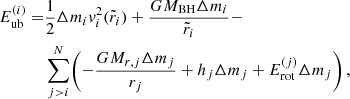
In stellar models whose helium core mass hints at the formation of a BH, we follow the BH growth and feedback onto the rest of the star adopting the semi-analytic framework of Batta & Ramirez-Ruiz (2019), with minor modifications. Accretion proceeds shell-by-shell. Material with equatorial specific angular momentum, jeq above the last stable orbit (LSO) threshold forms a disk and can power winds; otherwise, it accretes quasi-radially. Feedback is compared to the binding energy of the exterior layers to determine whether the envelope is unbound and BH growth terminates.
From stellar profiles (r, ρ, P, Γ, Ω) we compute shell masses Δmi = Mr, i − Mr, i − 1 and jeq, i = Ωiri2. For a BH of mass MBH and spin aBH, shells with jeq, i ≤ jLSO plunge into rLSO, while those with jeq, i > jLSO circularize at rcirc = jeq, i2/(GMBH) and form a disk spanning  . Following Bardeen (1970) and Thorne (1974), disk-accreted mass Δmdisk, i adds energy, eLSO(aBH) and specific angular momentum, jLSO, whereas the quasi-radial fraction Δmradial, i adds mass and specific spin angular momentum Apjeq, i, with Ap = (2/3)(1 − cos3θd, i)/(1 − cos θd, i). We assume BH formation at MBH, 0 = 3 M⊙ with aBH, 0 = GJ0/(c2MBH, 02), where J0 is the total angular momentum enclosed in MBH, 0. In our models this seed spin is small; the substantial spin-up occurs later, as higher-angular-momentum outer shells are accreted.
Disk winds inject energy at a rate  , where ηw ≃ 0.05 + 0.35aBH2 (McKinney et al. 2012) and ε = (vwind/c)2 with vwind = ℳwindcs, ℳwind the wind Mach number and cs the sound speed in the vicinity of the BH. Only disk-accreted mass contributes to feedback, so shell i injects
  .
.
We use a dynamic energy barrier, in which shell i is assumed to have fallen from its original radius ri to an arrival radius  before being stalled by feedback. The feedback must therefore both cancel the infall kinetic energy of shell i and lift it out of the potential from
  , in addition to unbinding the exterior layers. The corresponding barrier is
 (B.1)
(B.1)
where hj = Γj/(Γj − 1) Pj/ρj,  , and the summation extends over shells exterior to shell i. We take
  for quasi-radial infall and
  when a disk forms.
If  (feedback with losses) or if the cumulative energy
  exceeds
  (without losses), accretion halts. The model depends parametrically on the value of ℳwind and offers two possible modes to handle the feedback, with and without losses. The larger the value of ℳwind, the stronger the BH feedback. Here we consider ℳwind ∼ 3 or 10. For ℳwind ∼ 3 we reproduce the same efficiency parameter as in Batta & Ramirez-Ruiz 2019, i.e., ε ≃ 10−3, whereas ℳwind = 10 increases ε to ≃10−2. In the models with losses, a fraction of the BH energy released will be advected back onto it. Hence, this case, along with ℳwind = 3, estimates a lower bound of the ejected mass,
  and an upper bound for the final BH mass (
 ) and spin (
 ) before the outer layers of the star are unbound. In contrast, models without losses and ℳwind = 10 provide an approximate lower bound for both the final
  and
and  , and a correspondingly larger estimate of the ejected mass
  . As illustrated in Fig. B.1, both
  and
and  remain well below the dimensionless stellar spin because only part of the progenitor angular momentum can be incorporated into the BH during the collapse and subsequent accretion. The close overlap between
  and
and  over most of the star indicates that both feedback prescriptions produce a very similar spin-up history while the same inner shells are being accreted. Noticeable differences appear only in the outermost layers, where the different feedback efficiencies mainly determine the mass coordinate at which the collapse is halted.
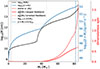 |
Fig. B.1. Radial structure and angular-momentum content of the stellar model with Mini = 85 M⊙ and ω = 0.15 as functions of enclosed mass Mr, together with the corresponding stellar and black-hole spin parameters. The adopted initial BH mass, MBH, 0 = 3 M⊙, is marked by the vertical dotted line. The black curve shows the radius R(Mr), the blue curve the cumulative angular momentum J(< Mr), the red dashed curve the stellar dimensionless spin a★(Mr), and the red solid curve the BH spin |


All Tables
Evolutionary outcomes and BH remnant predictions for non-rotating and rotating Z = 0 stellar models.
All Figures
|
Fig. 1. Kippenhahn diagram of the 80 M⊙ model with an initial rotation set to 5% of the critical velocity. The black lines denote radius contours at 0.1, 0.3, 1, 10, and 50 R⊙, and the orange line marks the total mass of the star, which is constant for this model. The light blue shaded regions correspond to convective zones. The coloured lines show the locations of the peak (solid lines) and of 10% of the peak (dotted lines) in the nuclear energy generation rate for hydrogen burning (blue), helium burning (green), and advanced burning (carbon, neon, or oxygen; red). |
| In the text | |
|
Fig. B.1. Radial structure and angular-momentum content of the stellar model with Mini = 85 M⊙ and ω = 0.15 as functions of enclosed mass Mr, together with the corresponding stellar and black-hole spin parameters. The adopted initial BH mass, MBH, 0 = 3 M⊙, is marked by the vertical dotted line. The black curve shows the radius R(Mr), the blue curve the cumulative angular momentum J(< Mr), the red dashed curve the stellar dimensionless spin a★(Mr), and the red solid curve the BH spin |
| In the text | |
Current usage metrics show cumulative count of Article Views (full-text article views including HTML views, PDF and ePub downloads, according to the available data) and Abstracts Views on Vision4Press platform.
Data correspond to usage on the plateform after 2015. The current usage metrics is available 48-96 hours after online publication and is updated daily on week days.
Initial download of the metrics may take a while.