


- Details
- Published on 08 April 2026
Vol. 708
7. Stellar structure and evolution
Radio timing constraints on the orbital orientation and component masses of PSR J1455-3330
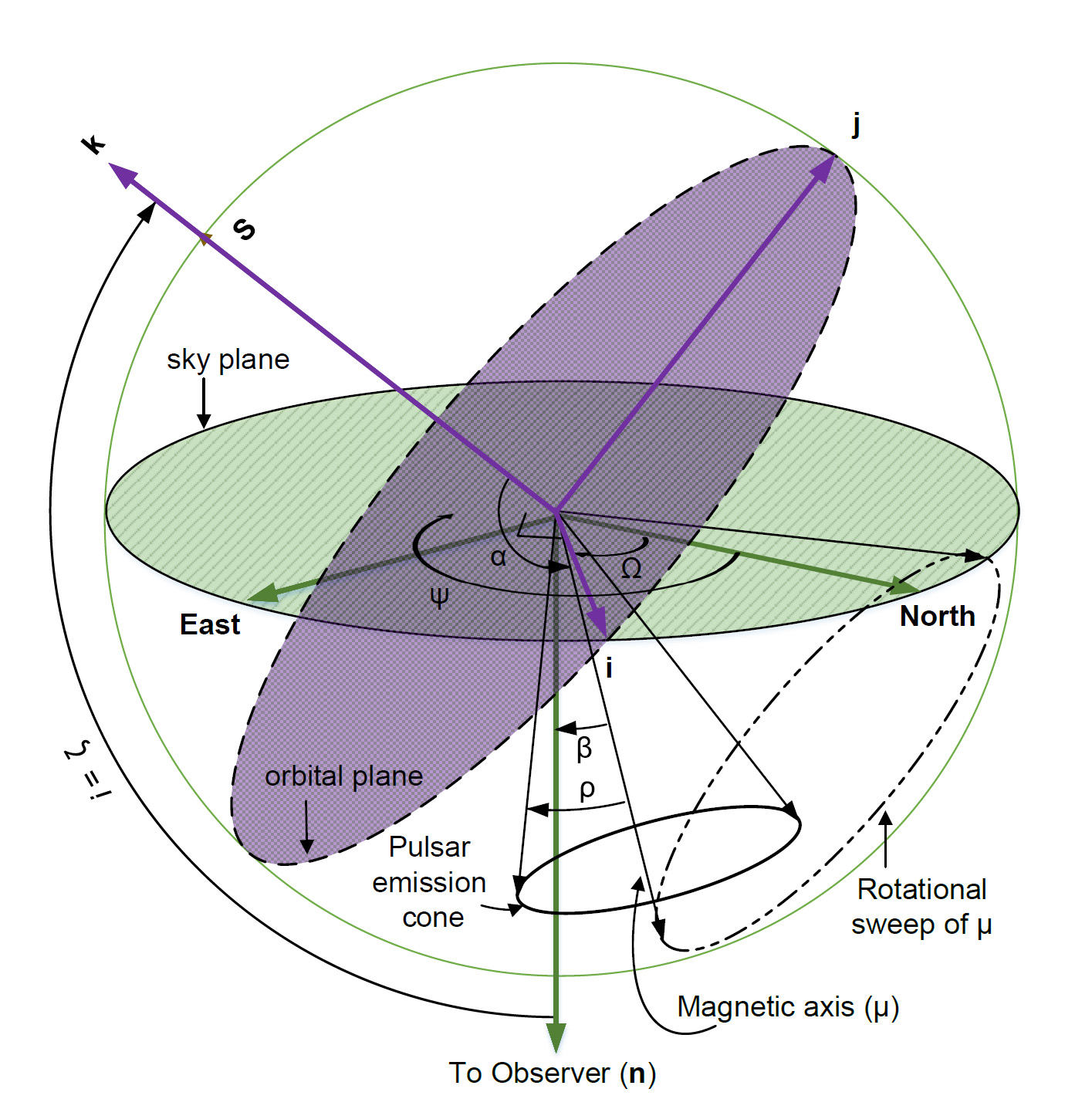
PSR J1456–3330 is a millisecond pulsar with a long orbital period of about t 2 1/2 months and a continuous observational record spanning several decades. Since it is also included in the Pulsar Timing Array sample, it benefits from a particularly rich archive of multisite, multifrequency, high-timing-resolution observations. PSR J1456–3330’s orbit is so nearly circular that only upper limits have been obtained for apsidal precession and period change. However, in this work, through a detailed solution of the pulsar’s polarization properties and spin down, its geometric parameters were obtained. The viewing effect of proper motion on the projected semimajor axis was also obtained, along with the relativistic time delay known as the Shapiro effect. The combined orbital and rotational solutions produce a superb determination of the orbital inclination and therefore provide masses for both the neutron star and its white dwarf companion through the orbital solution and the change in projected separation. The pulsar’s parallax was directly obtained and is about 1/3 larger than the distance inferred from the dispersion measure, a result that will prove useful for interstellar medium studies. The proper motion yields a relatively low transverse velocity of about 35 km/s. This study presents a step-by-step analysis, notably including parameters that remain below detectability—such as orbital period change, annual orbital parallax, and possible dynamical orbital variations—which are expected to become attainable through continuing scrutiny.