


| Issue |
A&A
Volume 710, June 2026
|
|
|---|---|---|
| Article Number | L8 | |
| Number of page(s) | 4 | |
| Section | Letters to the Editor | |
| DOI | https://doi.org/10.1051/0004-6361/202659914 | |
| Published online | 28 May 2026 | |
Letter to the Editor
Redshift dependence of type Ia supernova standardization parameters and implications for cosmological inference
1
Byurakan Astrophysical Observatory (BAO) after V. Ambartsumian, NAS of the Republic of Armenia Byurakan, Aragatzotn Province, 0213, Republic of Armenia
2
Institute of Applied Problems of Physics, NAS of the Republic of Armenia 25 Hrachya Nersissian Str., Yerevan, 0014, Republic of Armenia
3
George Brown College, 175 Kendal Ave, Toronto, ON, M5R 3S8, Canada
★ Corresponding author: This email address is being protected from spambots. You need JavaScript enabled to view it.
Received:
17
March
2026
Accepted:
5
May
2026
Abstract
Context. Type Ia supernovae (SNe Ia) are fundamental probes of cosmic expansion, whose luminosities are empirically standardized using correlations with light-curve stretch and color. A common assumption in cosmological analyses is that the standardization coefficients are independent of redshift.
Aims. We test the internal consistency of this assumption by searching for a possible redshift dependence in the effective empirical calibration of SNe Ia.
Methods. We analyzed a compilation of type Ia supernovae, Pantheon+. We allowed the stretch and color coefficients of the SALT2 framework to vary linearly with redshift and performed a full covariance likelihood analysis using Markov chain Monte Carlo sampling. The model comparison was carried out using χ2 statistics and information criteria.
Results. The redshift-dependent model yields a statistically significant improvement in the goodness of fit relative to the constant-coefficient scenario. Allowing for redshift dependence introduces a non-negligible degeneracy between empirical calibration parameters and the inferred matter density parameter Ωm.
Conclusions. Our results highlight the sensitivity of precision supernova cosmology to assumptions about redshift-independent standardization. The detected trends should be interpreted phenomenologically and may reflect astrophysical evolution, selection effects, or residual systematics. Future analyses combining forward simulations and independent cosmological probes will be essential to clarify their origin and implications.
Key words: cosmological parameters / cosmology: observations / cosmology: theory / dark matter / dark energy / distance scale
© The Authors 2026
 Open Access article, published by EDP Sciences, under the terms of the Creative Commons Attribution License (https://creativecommons.org/licenses/by/4.0), which permits unrestricted use, distribution, and reproduction in any medium, provided the original work is properly cited.
This article is published in open access under the Subscribe to Open model. This email address is being protected from spambots. You need JavaScript enabled to view it. to support open access publication.
1. Introduction
Type Ia supernovae (SNe Ia) are key distance indicators in observational cosmology. The discovery of cosmic acceleration (Riess et al. 1998; Perlmutter et al. 1999) relied on the empirical standardization of SN Ia light curves, in which the observed peak magnitude is corrected for based on correlations with the light-curve shape and color. In the widely used Spectral Adaptive Lightcurve Template 2 (SALT2) light-curve model (Guy et al. 2007, 2010), the distance modulus is written as
 (1)
(1)
where mB is the observed peak magnitude, X1 is the stretch parameter, C is the color parameter, M is the absolute magnitude, and α and β quantify the luminosity–stretch and luminosity–color correlations, respectively.
A central assumption in most cosmological analyses is that the standardization coefficients α and β are independent of redshift. This assumption underlies the construction of large compilations such as the Pantheon and Pantheon+ samples (Scolnic et al. 2018), which provide some of the most precise constraints on the matter density parameter Ωm within the Lambda Cold Dark Matter (ΛCDM) framework.
However, there are several reasons to question the strict redshift invariance of the empirical standardization relation. First, the properties of SN Ia host galaxies evolve with cosmic time, including stellar mass, metallicity, and star formation rate. Second, previous studies have reported correlations between Hubble residuals and host-galaxy properties (e.g., Kelly et al. 2010; Sullivan et al. 2010), suggesting that the effective luminosity calibration may depend on environment. Third, observational selection effects and population drift may introduce apparent redshift trends in the effective standardization parameters.
The possibility of a redshift evolution in α and β has been explored in various forms in the literature, typically yielding constraints consistent with no strong evolution but not always ruling out mild trends. Given the statistical precision achieved by modern supernova compilations such as Pantheon+ (Scolnic et al. 2022), even percent-level deviations from redshift independence can propagate into shifts in cosmological parameters comparable to current statistical uncertainties. Testing this assumption therefore represents an important internal consistency check of SN Ia cosmology.
We allowed the SALT2 stretch and color coefficients to vary linearly with redshift and performed a full covariance likelihood analysis. We find that the redshift-dependent model provides a statistically significant improvement in the fit and introduces a measurable degeneracy with the cosmological parameter Ωm.
Our goal was not to identify a specific physical mechanism, but to test the internal consistency of the standard SN Ia calibration framework and to quantify its effect on cosmological parameter inference. In particular, we investigated whether allowing for a redshift dependence in the empirical calibration modifies the inferred value of Ωm and improves the statistical description of the data.
Recent studies have investigated the possible redshift dependence of the standardization parameters. In particular, Scolnic et al. (2018) analyzed the Pantheon sample and found no statistically significant evidence for an evolution of α and β with redshift.
At the same time, other works have reported indications of possible redshift evolution, especially for the color–luminosity parameter β (e.g., Wang & Wang 2013; Lane et al. 2025), although the statistical significance and the physical interpretation of these trends remain under debate. To our knowledge, a dedicated analysis of the redshift evolution of the standardization parameters using the Pantheon+ sample has not yet been explicitly presented by the collaboration.
2. Data and method
2.1. Supernova sample
We analyzed the Pantheon+ compilation (Brout et al. 2022), which currently represents one of the most comprehensive SN Ia datasets, including 1701 objects with a full statistical and systematic covariance matrix. The datasets provide for each supernova the redshift z, the observed peak magnitude mB, and the SALT2 light-curve parameters X1 (stretch) and C (color).
The Pantheon+ covariance matrix includes statistical and systematic uncertainties from calibration, light-curve modeling, and survey systematics. However, it does not explicitly enforce redshift-independent standardization parameters.
2.2. Standardization framework
Within the SALT2 formalism, the distance modulus is written as
 (2)
(2)
where M, α, and β are global parameters. In standard cosmological analyses, these coefficients are assumed to be independent of redshift.
This relation corresponds to the standard empirical luminosity correction commonly referred to as the Tripp relation (Tripp 1998). To test this assumption, we proceeded in two complementary ways. First, we reconstructed the effective absolute magnitude
 (3)
(3)
adopting a fiducial ΛCDM cosmology. We then searched for correlations between Meff and redshift, which we quantified using the Pearson correlation coefficient (see Section 4.4). Second, we performed a direct-likelihood analysis in which the standardization coefficients were allowed to vary with redshift through a phenomenological parameterization.
2.3. Likelihood analysis
For the Pantheon+ sample, we performed a full covariance likelihood analysis. Given a set of model parameters θ, the residual vector is defined as
 (4)
(4)
and the likelihood is written as
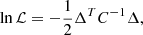 (5)
(5)
where C is the total covariance matrix. The covariance matrix C includes the statistical and systematic uncertainties provided with the Pantheon+ compilation.
Parameter constraints were obtained using Markov chain Monte Carlo sampling. We adopted broad non-informative flat priors on all nuisance and cosmological parameters. Convergence was verified through inspection of the chains and stability of the posterior summaries. We compared the models using the minimum χ2 and information criteria Akaike Information Criterion (AIC) and Bayesian Information Criterion (BIC) to assess whether additional redshift-dependent parameters are statistically justified.
3. Redshift-dependent standardization
To test the assumption of redshift-independent standardization coefficients, we introduced a minimum phenomenological extension in which the stretch and color coefficients varied linearly with redshift,
 (6)
(6)
 (7)
(7)
This parameterization can be interpreted as the first-order Taylor expansion of the standardization parameters around z = 0, where the coefficients α1 and β1 quantify the leading-order redshift dependence of the empirical standardization relations. This choice captures smooth monotonic trends without introducing unnecessary functional complexity. The parameterization is therefore intended as a phenomenological diagnostic of a possible redshift dependence rather than a specific physical model. A possible interpretation of these redshift trends is related to the population drift in the type Ia supernova sample, where the relative contribution of different progenitor environments may evolve with cosmic time.
The model-predicted peak magnitude can then be written as
 (8)
(8)
The corresponding parameter vector is
 (9)
(9)
The constant-coefficient model is recovered by imposing α1 = 0 and β1 = 0. This nested structure allowed us a direct statistical comparison between the two scenarios using Δχ2 and information criteria.
In this framework, nonzero values of α1 or β1 would indicate a statistically significant redshift dependence of the effective standardization coefficients. This behaviour may reflect astrophysical evolution, observational selection effects, or residual systematic uncertainties. We therefore interpreted the extended model strictly as a phenomenological probe of internal consistency and not as evidence of a specific physical mechanism. We did not consider a higher-order redshift dependence because the constraining power of current supernova samples is statistically limited.
4. Results
4.1. Constant-coefficient model
We first analyzed the data under the standard assumption of redshift-independent standardization coefficients. The parameter constraints were obtained by minimizing the χ2 function.
The best-fit parameters were found to be
 (10)
(10)
 (11)
(11)
 (12)
(12)
 (13)
(13)
The minimum χ2 value was
 (14)
(14)
for 1697 degrees of freedom, corresponding to
 (15)
(15)
These results are consistent with those from previous analyses of the Pantheon+ dataset.
4.2. Redshift-dependent model
We then allowed for a linear redshift dependence in α and β. The resulting constraints were
 (16)
(16)
 (17)
(17)
 (18)
(18)
 (19)
(19)
 (20)
(20)
 (21)
(21)
The best-fit value of the chi-square became
 (22)
(22)
for 1695 degrees of freedom, yielding
 (23)
(23)
The improvement in the fit quality is therefore
 (24)
(24)
for two additional parameters.
4.3. Statistical significance
The reduction in χ2 corresponds to a statistically significant preference for the redshift-dependent model under a nested model comparison. For two additional parameters, the observed Δχ2 = 29.41 formally corresponds to a statistically significant improvement under a nested χ2 test, with a p value of approximately p ≃ 4 × 10⁻⁷ under the null hypothesis of constant coefficients.
However, this improvement should be interpreted in the context of the additional model flexibility introduced by the redshift-dependent parameterization. Information criteria likewise favor the extended model. For the Pantheon+ sample (Scolnic et al. 2022) (N = 1701), we obtained
 (25)
(25)
 (26)
(26)
indicating that the improvement in fit quality cannot be attributed to overfitting due to the additional parameters.
The parameters α1 and β1 differ from zero at approximately the ∼3–4σ level. We emphasize that the extended model remains phenomenological. Nonzero values of α1 and β1 indicate a redshift dependence of the effective empirical calibration, which might arise from astrophysical evolution, population drift, selection effects, or residual systematic uncertainties.
4.4. Effect on cosmological parameters
When we allowed for a redshift dependence, the inferred matter density parameter shifted from Ωm = 0.36 to Ωm = 0.42, corresponding to a displacement that exceeds the marginalized statistical uncertainty of the constant-coefficient model. This illustrates a direct degeneracy between empirical standardization assumptions and cosmological parameter inference at the current precision level. This indicates that assumptions about calibration can propagate into cosmological parameter estimates.
This result does not imply a failure of the ΛCDM model, but rather highlights the sensitivity of precision cosmology to the adopted standardization framework. The results indicate a statistical preference for models that include redshift-dependent standardization parameters. However, the physical origin of this behavior remains uncertain.
We quantified the correlation between Meff and redshift using the Pearson correlation coefficient, defined as
 (27)
(27)
We also verified the robustness of the result using the Spearman rank correlation coefficient.
For the constant-parameter model, we found a weak indication of a correlation (r = −0.043, p = 0.075), although this is not statistically significant. When we allowed for redshift-dependent α(z) and β(z), this trend disappeared (r = 0.010, p = 0.67), indicating that the extended parameterization successfully accounts for potential redshift-dependent systematics.
The adopted parameterization is intended as a phenomenological description designed to test deviations from the standard assumption of redshift-independent standardization parameters. Our goal was not to model the physical origin of this evolution, but to quantify its possible effect on cosmological inference.
5. Discussion
The detected redshift dependence of the standardization parameters also has implications for cosmological inference. In particular, when α and β are allowed to vary with redshift, a noticeable shift occurs in the inferred matter density parameter, from Ωm ≈ 0.36 in the constant-parameter model to Ωm ≈ 0.42 in the redshift-dependent framework. This behavior illustrates a degeneracy between empirical standardization relations and cosmological parameters. If this evolution is present but neglected, it might lead to systematic shifts in cosmological constraints derived from type Ia supernova observations.
The analysis presented above indicates a statistically significant preference for a redshift-dependent empirical standardization within the Pantheon+ dataset. In particular, the linear model yields a substantial reduction in χ2 relative to the constant-coefficient scenario and shifts the inferred value of Ωm.
Possible redshift trends in the standardization parameters might also arise from observational selection effects. In magnitude-limited surveys, the detected supernova population changes with redshift, which might introduce an apparent evolution in the light-curve properties. A detailed assessment of these effects requires survey simulations and mock catalogs and is left for future work.
These results should be interpreted with caution. The extended model is purely phenomenological and does not assume a specific physical mechanism. Nonzero values of α1 and β1 indicate a redshift dependence of the effective calibration coefficients, but do not by themselves distinguish between possible underlying causes.
Several mechanisms can contribute to an apparent redshift dependence. First, the SN Ia population might evolve with cosmic time due to changes in progenitor properties, metallicity, or host-galaxy environments. Second, selection effects and Malmquist bias might induce redshift-dependent shifts in the observed distributions of stretch and color. Third, residual systematic uncertainties in photometric calibration or light-curve modeling might introduce coherent trends with redshift.
The Pantheon+ analysis incorporates detailed simulations and bias corrections, and our results do not contradict that framework. Our study instead explored whether residual redshift-dependent trends remain when the standardization coefficients are treated as global constants. In this sense, the detected signal should be viewed as a test of the internal consistency of the empirical calibration.
An important outcome of our analysis is the observed degeneracy between the evolution parameters and Ωm. A redshift dependence in α and β leads to a shift in the inferred matter density parameter that exceeds the marginalized uncertainty of the constant-coefficient model. This demonstrates that assumptions regarding standardization can propagate directly into a cosmological parameter inference.
We emphasize that the extended model does not imply a breakdown of the ΛCDM framework. Instead, it highlights the sensitivity of precision cosmology to empirical calibration assumptions at the few-percent level. Future analyses combining supernovae with independent cosmological probes will be essential to disentangle potential calibration evolution from cosmological effects. A detailed investigation of potential selection effects and survey-specific systematics is required to determine whether the detected trends reflect a genuine astrophysical evolution or residual observational biases.
These results highlight the importance of testing the stability of empirical supernova standardization relations when using large high-precision datasets. As supernova samples continue to grow in size and statistical precision, even small deviations from redshift independence can become relevant for precision cosmology. If confirmed by future analyses, a redshift dependence of the standardization parameters might represent an additional source of systematic uncertainty in type Ia supernova cosmology.
Our findings are qualitatively consistent with previous claims of a redshift-dependent behavior of supernova standardization parameters (e.g., Wang & Wang 2013; Lane et al. 2025) while differing slightly with earlier results based on the Pantheon sample (Scolnic et al. 2018). This difference might reflect differences in data calibration, sample size, or analysis method, and it highlights the importance of continued investigation. We also note that similar indications of redshift evolution in effective absolute magnitude have been discussed in previous works (e.g., Perivolaropoulos & Skara 2023), although the interpretation remains debated.
6. Conclusions
We have investigated the assumption of redshift-independent empirical standardization coefficients in type Ia supernova cosmology. Using several historical compilations and, in particular, the recent Pantheon+ dataset, we tested a minimum linear redshift dependence of the SALT2 stretch and color coefficients.
For the Pantheon+ sample, a linear evolution in α(z) and β(z) results in a statistically significant improvement in the fit quality relative to the constant-coefficient model. The extended model reveals a non-negligible degeneracy between empirical calibration parameters and the inferred matter density parameter Ωm. In particular, relaxing the assumption of constant standardization coefficients leads to a shift in Ωm that exceeds the marginalized statistical uncertainty of the baseline model.
We emphasize that the adopted redshift-dependent parameterization is purely phenomenological and does not imply a specific physical mechanism. The detected trends might reflect astrophysical evolution, selection effects, or residual systematic uncertainties. Our results therefore highlight the importance of carefully testing empirical calibration assumptions in precision cosmology.
Our analysis demonstrates that empirical calibration assumptions in SN Ia cosmology are directly testable at current precision levels and can affect the cosmological parameter inference at a statistically significant level. Explicitly relaxing the assumption of redshift-independent standardization provides a useful internal consistency test for future high-precision supernova surveys.
Further progress requires detailed forward simulations, alternative light-curve models, and joint analyses with independent cosmological probes in order to clarify whether the detected redshift dependence originates from astrophysical evolution, selection effects, or residual systematics. Future large supernova samples from surveys such as the The Legacy Survey of Space and Time (LSST) will provide improved opportunities to test the stability of the standardization relations across cosmic time.
References
- Brout, D., Scolnic, D., Popovic, B., et al. 2022, ApJ, 938, 110 [NASA ADS] [CrossRef] [Google Scholar]
- Guy, J., Astier, P., Baumont, S., et al. 2007, A&A, 466, 11 [NASA ADS] [CrossRef] [EDP Sciences] [Google Scholar]
- Guy, J., Sullivan, M., Conley, A., et al. 2010, A&A, 523, A7 [NASA ADS] [CrossRef] [EDP Sciences] [Google Scholar]
- Kelly, P. L., Hicken, M., Burke, D. L., et al. 2010, ApJ, 715, 743 [Google Scholar]
- Lane, Z. G., Arjona, R., Wang, L., et al. 2025, MNRAS, 536, 1752 [Google Scholar]
- Perivolaropoulos, L., & Skara, F. 2023, MNRAS, 520, 5110 [NASA ADS] [CrossRef] [Google Scholar]
- Perlmutter, S., Aldering, G., Goldhaber, G., et al. 1999, ApJ, 517, 565 [Google Scholar]
- Riess, A. G., Filippenko, A. V., Challis, P., et al. 1998, AJ, 116, 1009 [Google Scholar]
- Scolnic, D. M., Jones, D. O., Rest, A., et al. 2018, ApJ, 859, 101 [NASA ADS] [CrossRef] [Google Scholar]
- Scolnic, D., Brout, D., Carr, A., et al. 2022, ApJ, 938, 113 [NASA ADS] [CrossRef] [Google Scholar]
- Sullivan, M., Conley, A., Howell, D. A., et al. 2010, MNRAS, 406, 782 [NASA ADS] [Google Scholar]
- Tripp, R. 1998, A&A, 331, 815 [NASA ADS] [Google Scholar]
- Wang, S., & Wang, Y. 2013, Phys. Rev. D, 88, 043511 [Google Scholar]
Current usage metrics show cumulative count of Article Views (full-text article views including HTML views, PDF and ePub downloads, according to the available data) and Abstracts Views on Vision4Press platform.
Data correspond to usage on the plateform after 2015. The current usage metrics is available 48-96 hours after online publication and is updated daily on week days.
Initial download of the metrics may take a while.