


Fig. 1
Download original image
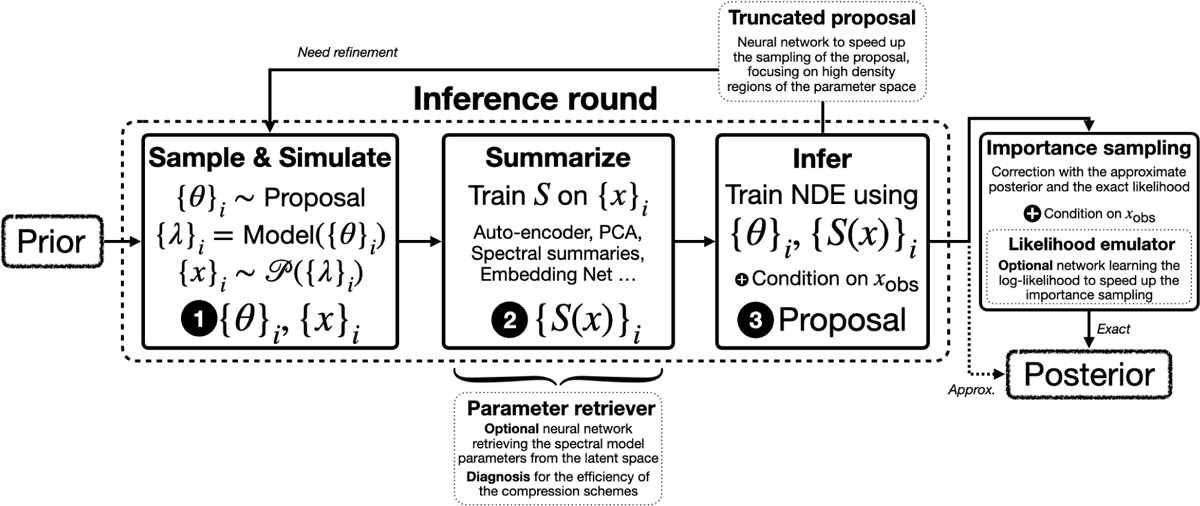
SIXSA pipeline, with the process beginning with sampling parameters {θ}i from a proposal distribution, followed by generating synthetic observations {x}i (including Poisson statistics) by passing these parameters to the spectral model. These spectra have their dimension reduced using various summarization techniques such as PCA, spectral summaries, or neural architectures like embedding networks and auto-encoders, yielding {S(x)}i. {S(x)}i, along with the corresponding parameters {θ}i are used to train a NDE. The inference round is delimited with a dashed line. An optional parameter retriever neural network might be trained to learn the mapping between the latent space and the model parameters, aiding in the interpretation. For the observation, denoted as xobs, a truncated proposal network selectively focuses the sampling on high-density regions of the parameter space. At each round, an approximated posterior can then be generated. A likelihood-based importance sampling can be applied to the approximated posterior. A likelihood emulator can also be used to approximate with high accuracy the true likelihood and accelerate the importance sampling. This iterative process leads to the final posterior distribution for xobs.
Current usage metrics show cumulative count of Article Views (full-text article views including HTML views, PDF and ePub downloads, according to the available data) and Abstracts Views on Vision4Press platform.
Data correspond to usage on the plateform after 2015. The current usage metrics is available 48-96 hours after online publication and is updated daily on week days.
Initial download of the metrics may take a while.