


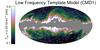
Fig. 4

Left column, top: recovered amplitude of the low-frequency component at 23 GHz from our simplest Commander fit to the Planck data alone, CMD1. As shown in Pietrobon et al. (2012), while this model provides an excellent description of the data, this low-frequency component is a combination of free-free, spinning dust, and synchrotron emission (top). Left column, middle: four-component template model of this component (see Table 2). Left column, bottom: haze residual. The residuals are low outside the haze region, indicating that the templates are a reasonable morphological representation of the different components contained in the Commander solution. The haze residual is strikingly similar to that found for the template-only approach in Fig. 3 (though there does seem to be a residual dipole in the Commander solution). Right column: the same, but for the CMD2 low-frequency, hard spectrum component. While there is still some leakage of dust-correlated emission in the solution, the softer synchrotron emission (mostly correlated with the 408 MHz template see, Fig. 7) has been separated by Commander. The resulting map is dominated by free-free and the haze emission, and the regressed haze residual (bottom panel) shows a morphology very similar to both the template fitting and CMD1 results, indicating that the haze has been effectively isolated.




Current usage metrics show cumulative count of Article Views (full-text article views including HTML views, PDF and ePub downloads, according to the available data) and Abstracts Views on Vision4Press platform.
Data correspond to usage on the plateform after 2015. The current usage metrics is available 48-96 hours after online publication and is updated daily on week days.
Initial download of the metrics may take a while.