


| Issue |
A&A
Volume 708, April 2026
|
|
|---|---|---|
| Article Number | A346 | |
| Number of page(s) | 9 | |
| Section | Galactic structure, stellar clusters and populations | |
| DOI | https://doi.org/10.1051/0004-6361/202558003 | |
| Published online | 24 April 2026 | |
Not all nitrogen-rich field stars originate from globular clusters
1
Dipartimento di Fisica e Astronomia, Universitá degli Studi di Bologna,
Via Gobetti 93/2,
40129
Bologna,
Italy
2
INAF – Osservatorio Astrofisico di Arcetri,
Largo E. Fermi 5,
50125
Firenze,
Italy
3
INAF – Osservatorio di Astrofisica e Scienza dello Spazio di Bologna,
Via Gobetti 93/3,
40129
Bologna,
Italy
4
School of Physics & Astronomy, University of Birmingham,
Edgbaston,
Birmingham
B15 2TT,
UK
5
INAF – Osservatorio Astrofisico di Catania,
Via S. Sofia, 78,
95123
Catania,
Italy
6
Stellar Astrophysics Centre, Department of Physics & Astronomy, Aarhus University,
Ny Munkegade 120,
8000
Aarhus C,
Denmark
★ Corresponding author: This email address is being protected from spambots. You need JavaScript enabled to view it.
Received:
6
November
2025
Accepted:
27
February
2026
Abstract
Globular clusters (GCs) are important tracers of the early Galactic assembly process, with some of their stars showing distinct chemical abundance patterns. When such stars are found in the Galactic field rather than within GCs, they are assumed to have originated from clusters. We expand the search for these chemically enriched stars in the Kepler field, targeting stars located in the halo, thin and thick disc, to show the potential in using asteroseismology to link the inferred masses, and hence, ages, with chemical abundances and kinematics. Using data from APOGEE DR17, Gaia DR3, and the Kepler mission, we identify primordial stars as those with chemical signatures typical of field stars, and enriched stars as those exhibiting strong nitrogen enrichment, with corresponding carbon and oxygen depletion. We present our sample of 133 red giant branch and core-He-burning stars, 92 of which have measured masses and inferred age estimates from asteroseismology. Of the 20 enriched stars we identified, 13 have precise asteroseismic ages, of which 3 at most are old enough (>8 Gyr) to plausibly originate from globular clusters. The inferred asteroseismic ages indicate that most enriched stars found in the field appear too young to have originated from GCs; however, these apparently young ages are likely the result of assuming single-star evolution, rather than accounting for binary interactions or mergers. This indicates alternative enrichment and evolutionary scenarios, such as mass transfer or coalescence, rather than a globular-cluster origin for most field nitrogen-rich stars.
Key words: asteroseismology / stars: abundances / globular clusters: general
© The Authors 2026
 Open Access article, published by EDP Sciences, under the terms of the Creative Commons Attribution License (https://creativecommons.org/licenses/by/4.0), which permits unrestricted use, distribution, and reproduction in any medium, provided the original work is properly cited.
This article is published in open access under the Subscribe to Open model. This email address is being protected from spambots. You need JavaScript enabled to view it. to support open access publication.
1 Introduction
One of the most distinctive features of globular clusters (GCs) is the presence of multiple stellar populations (MPs), which are characterised by unique chemical abundance spreads. Of particular interest are nitrogen-rich stars, which often also exhibit an enhancement in aluminium and sodium, but depletions in carbon, oxygen, and sometimes magnesium (Gratton et al. 2012; Bastian & Lardo 2018; Gratton et al. 2019; Mészáros et al. 2020; Milone & Marino 2022), although the enrichment in aluminium does not necessarily coincide with nitrogen enrichment (Fernández-Trincado et al. 2022). These abundance patterns are characteristic of enriched stars in GCs and are sometimes referred to as P2 or second-generation stars. However, we refer to these stars simply as enriched. In comparison, GCs also contain primordial stars, whose light element abundances are consistent with those of field stars of the same metallicity. Currently, the formation and evolution history of MPs in GCs is uncertain, but the correlations and anti-correlations of light element abundances displayed by MPs are a distinct feature of GCs that allows us to identify field stars that may once have belonged to a GC. Although primordial stars are chemically indistinguishable from field stars of the same metallicity, when enriched stars are found wandering alone in the Galactic field and are not bound to GCs or are part of their extra-tidal structures, most theories assume that they originated from GCs. These stars are either the remnants of dissolved clusters or were ejected from surviving clusters via tidal stripping and evaporation, processes that can disperse stars into the Galactic halo, disc, or bulge. For example, one of the most massive GCs in the Milky Way (MW), Terzan 5, is proposed to have an extensive history of expelling stars into the Galactic bulge and bar (Ferraro et al. 2009; Massari et al. 2014), as supported by the chemo-dynamical tracing of an enriched star that was proposed to have been stripped from Terzan 5 approximately 350 Myr ago (Souza et al. 2024). The identification of enriched stars in large-scale spectroscopic surveys, such as the Apache Point Observatory Galaxy Evolution Experiment (APOGEE), has opened new avenues for investigating the early dynamical and chemical history of the MW (Schiavon et al. 2017). Of the present-day total stellar mass of the Galactic halo, 2–3% is attributed to existing and intact GCs (Forbes et al. 2018), while current estimates of the percentage of stars that originated from a GC and now populate the Galactic halo range from ~4 to ~70% (Horta et al. 2021; Belokurov & Kravtsov 2023). The methods, datasets, and abundances used to identify these enriched stars vary between works, contributing to this wide range of estimates.
For example, Martell et al. (2016) identified enriched stars using APOGEE DR12, determining that 2% of the halo giants in their sample appeared to be enriched stars once belonging to GCs, and extrapolating that 13% of all halo stars originated from GCs. Similarly, using SDSS-IV DR14 low-resolution spectroscopy, Koch et al. (2019) determined that ~11 ± 1% of the metal-poor (−1.8 ≤ [Fe/H] ≤ −1) halo giants originated from disrupted GCs, with enriched stars contributing approximately 3.7% of the Galactic halo. Hanke et al. (2020) associated field stars with GCs by studying their seven-dimensional chemo-dynamical information, tentatively estimating that 11.8 ± 0.2% of halo stars once belonged to MW GCs, and classifying the stars as ~80% primordial and ~20% enriched. Horta et al. (2021) then concluded that disrupted GC stars contributed  of the field population at galactocentric distances of 1.5 kpc, with
  attributed to enriched stars. At a distance of 10 kpc, these percentages dropped to
  of the total stars and
  of the enriched stars. Finally, by analysing stars with high [N/O] ratios belonging to the oldest MW stellar population, Aurora, Belokurov & Kravtsov (2023) estimated that 50–70% of in situ stars with [Fe/H] ≤ −1.5 originated from bound GCs at high redshift. For stars with [Fe/H] = −1, their estimate reduced to 4–5%, suggesting that star formation in GCs contributed significantly to the early star formation of the MW. Building on this foundation, we have extended the search for chemically enriched stars into the Galactic halo and disc regions, which were also observed by the Kepler mission, with asteroseismic measurements that produce accurate masses and consequent age estimates of the individual stars.
2 Selection and analysis of the data sample
We searched for red giant stars in the Kepler field with chemical abundances from APOGEE DR17 and kinematic information from Gaia DR3. The metallicity range of our selection was −1.8 < [Fe/H] < −0.5, following the metallicity distribution observed in MW GCs, which peaks at [Fe/H] ~ −1.5 (Harris 2010). The models of Kruijssen (2015) show that for two clusters of the same mass (i.e. M ~ 105M⊙), the cluster with [Fe/H] ≥ −0.7 can lose 90% of its initial mass, while the cluster with [Fe/H] < −0.7 can lose only 50%, suggesting that the stars that originated from evaporated GCs and are now lost in the halo might be more metal rich than the surviving GCs themselves. Our selection of red giant branch (RGB) and core-He-burning (CHeB) stars is based on the well-defined correlations and anti-correlations observed in MPs (e.g. Carretta et al. 2009).
2.1 APOGEE DR17
We used data from data release 17 of SDSS-IV (Abdurro'uf et al. 2022), including stellar parameters and elemental abundances determined using the APOGEE Stellar Parameters and Chemical Abundance Pipeline (ASPCAP; García Pérez et al. 2016). The allStarLite catalogue was used to supply the abundances after we removed stars from the sample based on the flags STAR_BAD, TEFF_BAD, LOGG_BAD, VERY_BRIGHT_NEIGHBOR, LOW_SNR, PERSIST_JUMP_NEG, PERSIST_JUMP_POS, SUSPECT_RV_COMBINATION and we removed duplicate observations according to the EXTRATARG bitmask. We did not remove stars with PERSIST_HIGH, as persistence affects faint stars (H > 11) more than brighter stars (Holtzman et al. 2015), while our sample included only red giant stars with H < 11. We did not enforce an ASPCAPFLAG == 0 condition either as this restriction is not recommended by SDSS and solely removes primordial stars with weak CN features, mainly due to the N_M_WARN flag. Stars with abundance errors >0.25 dex were removed for the elements C, N, O, Mg, and Al, as well as for the metallicity values, for which we relied on the calibrated ASPCAP values. Red giants were then isolated using cuts in Teff < 5300 K, with S/N > 70, following the same general criteria as Belokurov & Kravtsov (2023), isolating the metal-poor stars with [Fe/H] < −0.5. Additionally, we implemented cuts in surface gravity to isolate the range of 1.5 < log(g) <3.5 for the stars in our sample. The cut of log(g) < 3.5 follows the method of Belokurov & Kravtsov (2023) for selecting red giants, while a cut of 1 .5 < log(g) represents the limit below which global asteroseismic observables (Δv, vmax) become less reliable for inferring stellar properties such as mass and age, owing to increased uncertainties and less well-tested calibrations (see the discussions in Willett et al. 2026, Miglio et al. 2021, and Montalbán et al. 2021).
2.2 Gaia
We cross-matched stars common to Kepler and APOGEE DR17 with Gaia DR3 (Gaia Collaboration 2016, 2023) to obtain precise proper motions, radial velocities, and parallaxes. We implemented cuts to ensure that the sample contained reliable astrometry by removing stars with RUWE > 1.4, ipd_frac_multi_peak > 2 and ipd_gof_harmonic_amplitude > exp [0.18(G – 33)], following the cuts specified by Fabricius et al. (2021) to remove non-single objects and to ensure the value of parallax_over_error > 5. We then applied the parallax zero-point correction to account for the known systematic offsets in Gaia parallaxes, as characterised by Lindegren et al. (2021), using the zpt package and only stars with reliable astrometric solutions (astrometric_params_solved > 30) for the analysis. Previously, Kane et al. (2025) identified candidate stars that were predicted to originate from GCs in the Galactic field using a trained neural network on low-resolution Gaia BP/RP spectra, based on which, they predicted [N/O] and [Al/Fe] abundances. We cross-matched this new abundance catalogue from Kane et al. (2025) with the Kepler catalogue, adding another 29 stars to our sample without abundances in APOGEE. We discuss this further in Appendix A.
Using astrometry and radial velocities from Gaia DR3, we calculated the angular momentum (Lz) and energy (E) for each star using galpy and assuming the potential model from McMillan (2017). We then converted the 3D velocity components from the Galactic reference frame into the local standard of rest (LSR) frame using parallax, proper motions, and radial velocities from Gaia DR3 to calculate the U, V, and W components of the velocity in the LSR frame. Using these parameters, we constructed the integrals of motion (IoM) and Toomre diagrams for all stars in our sample, as shown in the middle panels of Figure 1. We note that this model including non-axisymmetric terms may cause stars to clump on overdensities, but we mainly reference the IoM plots in terms of whether specific stars have prograde or retrograde orbits, which are not affected by the over-density clumping (see e.g. Woudenberg & Helmi (2025), De Leo et al. (2025)). In the upper middle panel of Figure 1, the Toomre diagram shows that these stars are located within the halo and the thin and thick disc. The lower middle IoM plot shows that most stars display orbital energy E and Lz values that are consistent with prograde orbits corresponding to in situ formation. A small subset is also located at higher orbital energies with lower Lz, and some stars show retrograde orbits.
2.3 Kepler seismology
We considered red giant stars observed by the Kepler mission (Borucki et al. 2010) with average seismic parameters vmax and Δv available in Yu et al. (2018). These parameters provide insight into the stellar structure, enabling precise measurements of stellar radii and masses, and hence, of stellar ages. The asteroseismic parameters described above were used as inputs by Willett et al. (2026), applying the Bayesian estimation code PARAM (da Silva et al. 2006; Rodrigues et al. 2014, 2017) and using as constraints the metallicity and Teff from APOGEE (with minimum uncertainties of 0.05 dex and 50 K, respectively; see Willett et al. (2026) for details), vmax, and either Δv or luminosity in order to infer precise masses, distances, radii, and consequent age estimates. This yielded masses with associated uncertainties of ~6%, while the age estimates have uncertainties of ~23%. We note that age estimates for low-mass CHeB stars are affected by the poorly constrained efficiency of the mass loss during the preceding RGB phase. We followed Miglio et al. (2021) and Willett et al. (2026) and adopted a Reimers mass-loss parameter of η = 0.2. However, the true efficiency of the mass loss likely depends on metallicity (Brogaard et al. 2024), so the derived ages for CHeB stars should be interpreted with caution. Additionally, for RGB stars, we sourced the masses and ages from Montalbán et al. (2021), who used the Bayesian stellar parameter estimation tool AIMS with individual mode frequencies from asteroseismology, with uncertainties of ~2% for the masses and ~11% for the ages. We increased this sample by including newly analysed stars (Montalbán et al., (in prep.)), using the same method as Montalbán et al. (2021) and Casali et al. (2025). We preferentially used the masses and ages obtained through AIMS when available. Of the 13 enriched stars in our sample, only KIC 8110538 shows a significant difference (~2.5σ significance, with error propagation) in the calculated age between these methods, which is explored further in Appendix C.
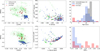 |
Fig. 1 Primordial (blue) and enriched (red) field stars in the Kepler sample, with the sample of GC stars identified by Schiavon et al. (2024) (green), both using APOGEE DR17 abundances. Stars in the Kepler sample with ages determined through asteroseismology are shown with black borders. Upper left panel: [N/Fe] vs. [C/Fe] anti-correlation. Lower left panel: [N/Fe] vs. [O/Fe] anti-correlation. Upper middle panel: Toomre diagram. Lower middle panel: integral of the motion plot. Upper right panel: histogram of the ages estimated from asteroseismology against GC ages from Forbes & Bridges (2010) (grey histogram). Lower right: histogram of the masses derived from asteroseismology. |
2.4 Classification of primordial and enriched stars
We compared two main samples of stars in the Kepler field: those whose chemical abundance patterns are consistent with the enriched stars found in Galactic GCs, and a control sample that is representative of the primordial stars. Using the sample of cleaned and combined Kepler, Gaia DR3, and APOGEE DR17 data, we identified candidate GC stars based on well-known correlations and anti-correlations such as [C/Fe] versus [N/Fe], [O/Fe] versus [N/Fe], and [Mg/Fe] versus [Al/Fe]. The abundance limits we adopted to isolate primordial stars in the Kepler sample are as follows: [N/Fe] < 0.2, [Al/Fe] < 0.1, −0.2 < [C/Fe] < 0.2, and [O/Fe] > 0.1. We defined the candidates for enriched stars using a cut in nitrogen ([N/Fe] > 0. 4), as the separation between primordial and enriched stars occurs for each abundance distribution at around [N/Fe] = 0.4, which is most clearly seen for [O/Fe] versus [N/Fe] in the lower left panel of Figure 1. This threshold agrees well with the distinction seen in MPs, where enriched stars display enrichment in nitrogen due to the products of hydrogen burning through the C-N-O cycle. To better constrain the selection, we incorporated additional cuts in abundances that are consistent with the signatures of enriched GC stars. These signatures include enrichment in aluminium ([Al/Fe] ≥ 0.1), with a depletion in carbon ([C/Fe] ≤ 0.2) due to the high-temperature proton-capture reactions that likely occurred in their progenitor environments. We further justify the specific cuts we made to separate stars into a primordial and enriched sample in Appendix B. The 113 primordial stars meeting the criteria are shown in blue for all panels of Figure 1, with the 20 enriched stars shown in red, alongside confirmed GC stars using APOGEE abundances, as identified by Schiavon et al. (2024) (green), to illustrate the general abundance trends observed in MW GCs.
Although sodium abundances are available in APOGEE and there is a well-known anti-correlation between [Na/Fe] and [O/Fe] for the MPs in GCs (Carretta et al. 2009), we did not use these Na abundances to classify the stars into populations because the Na lines in the H band obtained from the infrared spectra of APOGEE cannot be measured reliably. This means that this anti-correlation cannot be reproduced (Masseron et al. 2019).
3 Discussion
The relative age distribution of GCs in the Galactic thick disc and halo was compiled by Forbes & Bridges (2010), using ages obtained by multiple other works such as Marín-Franch et al. (2009), Dotter et al. (2008), De Angeli et al. (2005), Catelan et al. (2002), and Salaris & Weiss (1998). The sample contained 76 Galactic GCs, in which the lowest age on this scale belongs to Eridanus (8.9 Gyr, with a metallicity [Fe/H] = −1.2), while the oldest is Lyngå 7 (14.5 Gyr, with [Fe/H] = −0.6). In the upper right panel of Figure 1, we show this distribution in grey, against the ages determined through asteroseismology for 92 stars in our sample, divided into primordial (blue) and enriched (red). The 79 primordial stars in the lower right panel of Figure 1 have masses typical of old field giants (0.8–1.1M⊙). However, the resulting age distribution is then younger than GC stars and more consistent with the age distribution of thick-disc field stars (Helmi 2020). This sample also includes a few apparently young stars (<6 Gyr), similar to previously flagged overmassive field stars with asteroseismic masses that are higher than expected for their metallicity and evolutionary stage (i.e. Montalbán et al. (2021); Miglio et al. (2012)). These apparently young overmassive stars have already been identified in open clusters (Brogaard et al. 2021) and the [α/Fe]-enhanced population (Grisoni et al. 2024; Chiappini et al. 2015), and they are thought to be a result of mass transfer from a binary companion.
However, the most interesting result arises from the distribution of ages and masses for the 13 enriched stars with age estimates from asteroseismology, shown in red in the right panels of Figure 1 and listed in Table D.1. The masses derived from asteroseismology for the enriched stars span a much wider range than the primordial stars, with a median and standard deviation of 1.5 ± 0.4M⊙. Consequently, the median age of the enriched sample is 1.9 Gyr (between 0.8 < and < 18.1 Gyr), suggesting that the majority of enriched field stars in the Kepler field are apparently too young to have originated from GCs (i.e. <8 Gyr) and would therefore require an alternative enrichment origin. One such alternative is enrichment due to mass transfer in a binary system (see e.g. Fernández-Trincado et al. (2019), Kravtsov et al. (2025), and references therein), which might reproduce the majority of the enrichment signatures seen in enriched GC stars, while also allowing for the primary star merger products to appear younger than those typically found in Galactic GCs. As the primordial and enriched samples follow similar distributions in the Toomre diagram and IoM, but not in mass and age, this might be naturally explained if the enriched sample contained mostly post-mass-transfer binaries. Most of the massive and therefore apparently young (<8 Gyr) enriched stars in our sample are classified as CHeB, as demonstrated in Table D.1, with seven classified as CHeB stars and three as RGB stars. This provides additional evidence that supports a masstransfer binary scenario, as the population synthesis simulations of Mazzi et al. (2025) demonstrated that post-mass-transfer products are more likely to be CHeB stars than RGB stars in the Kepler field. Within our enriched star sample, we already confirmed that one star was identified as a spectroscopic binary SB1 (KIC 10796857), as described further in Appendix C. We aim to expand the sample of stars and thoroughly investigate potential signs of binarity in the primordial and enriched samples.
We also considered the scenario in which the enriched stars of our sample formed within a young GC before they were relocated to the field. To explore this case, we compared our enriched sample with the youngest known MW GCs. Our sample contains ten enriched stars with apparent ages <8 Gyr. Currently, <2–3% of the Galactic GCs are shown to have ages <8 Gyr (Marín-Franch et al. 2009; VandenBerg et al. 2013; Massari et al. 2023). This includes for example Terzan 7 ([Fe/H] averaged as −0.45) with an age of 7.75 Gyr (Leaman et al. 2013), the bulge/disc GC Palomar 1 ([Fe/H] = −0.7) with an age of 7.3 Gyr (Marín-Franch et al. 2009), the disc GC 2MASS-GC01 ![Mathematical equation: $\left( {\left[ {{\rm{Fe}}/{\rm{H}}} \right] = - 0.85_{ - 0.06}^{ + 0.07}} \right)$](/articles/aa/full_html/2026/04/aa58003-25/aa58003-25-eq5.png) with an age of
with an age of  Gyr (Massari et al. 2025), and Whiting 1 ([Fe/H] = −0.58 ± 0.05) with an age of 5.0 ± 0.5 Gyr (Huang et al. 2024). There has been no spectroscopic investigation of multiple stellar populations within any of these four young MW GCs, and therefore, there are no enriched stars for a comparison with our sample. Then, there are the cases of the bulge fossil fragment candidate systems Terzan 5 and Liller 1, which are more complicated as they both contain multiple stellar populations, but with a bimodal distribution of metallicities accompanied by a spread in stellar ages. More specifically, the stars of Terzan 5 and Liller 1 can be separated into an old metal-poor population with metallicity peaks around [Fe/H] ~ −0.5 and a young metal-rich population with [Fe/H] ~ +0.3 (Crociati et al. 2023). This is explained as being due to bursts of star formation activity, possibly through interactions with other bulge substructures, with the latest star formation events occurring around 4–5 Gyr ago in Terzan 5 and 1–2 Gyr ago for Liller 1. In the stars of Liller 1, the metal-poor group has apparent ages >10 Gyr, while the metal-rich group has apparent ages between 1 and 3 Gyr (Ferraro et al. 2021). Therefore, the old metal-poor stars in Liller 1 alone lie are in a metallicity range that is compatible with our enriched sample. In terms of enriched stars found in Liller 1, Liptrott et al. (2025) classified primordial and enriched populations using APOGEE DR17 abundances, identifying one enriched star with [N/Fe] = 0.82 and [Fe/H] = −0.59, which is within the same metallicity and nitrogen abundance range as our enriched sample. However, this star is again in the metallicity regime of the older stars in Liller 1, not the younger stars. When we consider that our sample contains 10 (out of 13) enriched stars with ages <8 Gyr, the likelihood that they originated from a young GC and that this former GC still exists without having been dissolved is very low. In the case of a young GC that dissolved recently, there should be evidence of a cold stream, in which unbound stars are expected to follow a similar orbit (Balbinot & Gieles 2018). Furthermore, it would be expected that if very young GCs were dissolved in the MW, we would have discovered a large population of apparently young and massive primordial stars that also once belonged to the dissolved GC. We indeed discovered young, massive primordial stars in our sample, but not to the same degree as the enriched stars, as shown in the right panels of Figure 1. The likelihood of an enriched star in our sample that once belonged to a young GC is therefore very low for stars with asteroseismic ages between 6 and 8 Gyr, that is, ages more consistent with the youngest GCs in the MW. This likelihood then decreases rapidly for lower ages, especially for the 7 enriched stars with ages <2 Gyr.
We considered the case in which the asteroseismic ages derived for the enriched stars in our sample are not actually their true ages, but are instead a result of mass transfer in a binary system. That is, mass transfer enriched the RGB or CHeB star of the binary system, causing it to become more massive and consequentially appear younger than it actually is. We have proposed the idea that these binary systems exist in the field, but we can also consider the case in which they are formed within a GC before being ejected into the field. In the latter case, the mechanism ejecting the enriched stars from the GC into the field would need to be related to the binary itself via dynamical encounters. If it were not related to the binary, we would have discovered more single-star counterparts in the enriched sample whose ages are consistent with MW GCs. However, even when we consider the age range of the youngest MW GCs mentioned above, only four stars in our sample have ages >6 Gyr, while nine stars have ages <6 Gyr. These numbers might be the result of a small sample size, so a follow-up investigation on stars in the K2 and TESS fields is in preparation, using the same method. In addition, when we also consider that some enriched stars in our sample have masses greater than twice the turn-off, it becomes necessary for three stars to be involved in the evolution of the binary. The dynamical simulations of Fragione et al. (2020) showed that while more than 15% of the field stars have at least two stellar companions, GCs only host some dozen of these systems, which means that the likelihood that this occurred is much lower in GCs than in the field.
Our results affect the previous estimates made for the fraction of GC stars assumed to have contributed to the field star population of the MW. A conservative fraction of only 23% (3 out of 13) of the enriched stars in our sample exhibits ages consistent with GC formation when we only consider the enriched stars with ages > 8 Gyr, consistent with the age distribution of Galactic thick disc and halo stars (Forbes & Bridges 2010). Future investigations into nitrogen-rich field stars would benefit from combining age estimates from asteroseismology with their samples, where available, and from performing follow-up spectroscopic observations to obtain additional abundances and radial velocity measurements to further identify and classify these apparently young stars.
4 Conclusions
We have identified 133 metal-poor halo and thin- and thick-disc red giant stars in the Kepler field, 92 of which have precise masses and estimated ages determined through astero-seismology. Using stellar abundances from APOGEE DR17, we chemically tagged stars as either primordial or enriched, following the expected correlations and anti-correlations associated with Galactic GC stars. Of the 13 enriched stars with asteroseismic age estimates, we identified only 3 stars that are consistent with the age range expected for MW GCs (older than −8 Gyr) that might have undergone enrichment within a GC before they were relocated into the field either via ejection or the dissolution of their GC. However, the majority of enriched field stars in our sample exhibit apparent ages that are too young for this scenario to be plausible. This result presents a counter-claim to the assumption that all nitrogen-rich stars in the field must have originated from GCs, which has implications for the estimated fraction of GC stars that have contributed to the Galactic field. It also highlights the necessity of exploring alternative enrichment scenarios that might mimic the enrichment observed in GC stars, in particular, binary interaction products.
Acknowledgements
We thank the referee for their useful comments which helped to improve this manuscript. E.L. thanks Elena Pancino for her discussions and support. E.L., A.M., and W.E.v.R. acknowledge support from the ERC Consolidate»- Grant funding scheme (project ASTEROCHRONOMETRY, https://www.asterochronometry.eu, G.A. n. 772293). Co-funded by the European Union (ERC-2022-AdG, "StarDance: the non-canonical evolution of stars in clusters", Grant Agreement 101093572, PI: E. Pancino). Views and opinions expressed are however those of the author(s) only and do not necessarily reflect those of the European Union or the European Research Council. Neither the European Union nor the granting authority can be held responsible for them. A.M. and J.S.T. acknowledge financial support from the "MUR FARE Grant Duets CUP J33C21000410001". Part of the calculations described in this paper were performed using the University of Birmingham BlueBEAR HPC service (http://www.birmingham.ac.uk/bear). D.M. acknowledges financial support from PRIN-MIUR-22: CHRONOS: adjusting the clock(s) to unveil the CHRONO-chemo-dynamical Structure of the Galaxy" (PI: S. Cassisi).
References
- Abdurro’uf, Accetta, K., Aerts, C., et al. 2022, ApJS, 259, 35 [NASA ADS] [CrossRef] [Google Scholar]
- Balbinot, E., & Gieles, M. 2018, MNRAS, 474, 2479 [NASA ADS] [CrossRef] [Google Scholar]
- Bastian, N., & Lardo, C. 2018, ARA&A, 56, 83 [Google Scholar]
- Belokurov, V., & Kravtsov, A. 2023, MNRAS, 525, 4456 [NASA ADS] [CrossRef] [Google Scholar]
- Borucki, W. J., Koch, D., Basri, G., et al. 2010, Science, 327, 977 [Google Scholar]
- Brogaard, K., Arentoft, T., Jessen-Hansen, J., & Miglio, A. 2021, MNRAS, 507, 496 [NASA ADS] [CrossRef] [Google Scholar]
- Brogaard, K., Miglio, A., van Rossem, W. E., Willett, E., & Thomsen, J. S. 2024, A&A, 691, A288 [NASA ADS] [CrossRef] [EDP Sciences] [Google Scholar]
- Carretta, E., Bragaglia, A., Gratton, R. G., et al. 2009, A&A, 505, 117 [NASA ADS] [CrossRef] [EDP Sciences] [Google Scholar]
- Casali, G., Montalbán, J., Miglio, A., et al. 2025, MNRAS, 541, 2631 [Google Scholar]
- Catelan, M., Borissova, J., Ferraro, F. R., et al. 2002, AJ, 124, 364 [NASA ADS] [CrossRef] [Google Scholar]
- Chiappini, C., Anders, F., Rodrigues, T. S., et al. 2015, A&A, 576, L12 [NASA ADS] [CrossRef] [EDP Sciences] [Google Scholar]
- Crociati, C., Valenti, E., Ferraro, F. R., et al. 2023, ApJ, 951, 17 [NASA ADS] [CrossRef] [Google Scholar]
- da Silva, L., Girardi, L., Pasquini, L., et al. 2006, A&A, 458, 609 [NASA ADS] [CrossRef] [EDP Sciences] [Google Scholar]
- De Angeli, F., Piotto, G., Cassisi, S., et al. 2005, AJ, 130, 116 [NASA ADS] [CrossRef] [Google Scholar]
- De Leo, M., Massari, D., Bellazzini, M., et al. 2026, A&A, 707, A310 [NASA ADS] [CrossRef] [EDP Sciences] [Google Scholar]
- Dotter, A., Sarajedini, A., & Yang, S.-C. 2008, AJ, 136, 1407 [NASA ADS] [CrossRef] [Google Scholar]
- Fabricius, C., Luri, X., Arenou, F., et al. 2021, A&A, 649, A5 [NASA ADS] [CrossRef] [EDP Sciences] [Google Scholar]
- Fernández-Trincado, J. G., Mennickent, R., Cabezas, M., et al. 2019, A&A, 631, A97 [NASA ADS] [CrossRef] [EDP Sciences] [Google Scholar]
- Fernández-Trincado, J. G., Beers, T. C., Barbuy, B., et al. 2022, A&A, 663, A126 [NASA ADS] [CrossRef] [EDP Sciences] [Google Scholar]
- Ferraro, F. R., Dalessandro, E., Mucciarelli, A., et al. 2009, Nature, 462, 483 [Google Scholar]
- Ferraro, F. R., Pallanca, C., Lanzoni, B., et al. 2021, Nat. Astron., 5, 311 [Google Scholar]
- Forbes, D. A., & Bridges, T. 2010, MNRAS, 404, 1203 [NASA ADS] [Google Scholar]
- Forbes, D. A., Bastian, N., Gieles, M., et al. 2018, Proc. R. Soc. London Ser. A, 474, 20170616 [Google Scholar]
- Fragione, G., Martinez, M. A. S., Kremer, K., et al. 2020, ApJ, 900, 16 [NASA ADS] [CrossRef] [Google Scholar]
- Gaia Collaboration (Prusti, T., et al.) 2016, A&A, 595, A1 [NASA ADS] [CrossRef] [EDP Sciences] [Google Scholar]
- Gaia Collaboration (Vallenari, A., et al.) 2023, A&A, 674, A1 [NASA ADS] [CrossRef] [EDP Sciences] [Google Scholar]
- García Pérez, A. E., Allende Prieto, C., Holtzman, J. A., et al. 2016, AJ, 151, 144 [Google Scholar]
- Gratton, R. G., Carretta, E., & Bragaglia, A. 2012, A&A Rev., 20, 50 [Google Scholar]
- Gratton, R., Bragaglia, A., Carretta, E., et al. 2019, A&A Rev., 27, 8 [Google Scholar]
- Grisoni, V., Chiappini, C., Miglio, A., et al. 2024, A&A, 683, A111 [NASA ADS] [CrossRef] [EDP Sciences] [Google Scholar]
- Handberg, R., Brogaard, K., Miglio, A., et al. 2017, MNRAS, 472, 979 [CrossRef] [Google Scholar]
- Hanke, M., Koch, A., Prudil, Z., Grebel, E. K., & Bastian, U. 2020, A&A, 637, A98 [EDP Sciences] [Google Scholar]
- Harris, W. E. 2010, arXiv e-prints [arXiv:1012.3224] [Google Scholar]
- Helmi, A. 2020, ARA&A, 58, 205 [Google Scholar]
- Holtzman, J. A., Shetrone, M., Johnson, J. A., et al. 2015, AJ, 150, 148 [Google Scholar]
- Horta, D., Mackereth, J. T., Schiavon, R. P., et al. 2021, MNRAS, 500, 5462 [Google Scholar]
- Huang, R., Tang, B., Li, C., et al. 2024, Sci. China Phys. Mech. Astron., 67, 259513 [Google Scholar]
- Kane, S. G., Belokurov, V., Cranmer, M., et al. 2025, MNRAS, 536, 2507 [Google Scholar]
- Koch, A., Grebel, E. K., & Martell, S. L. 2019, A&A, 625, A75 [NASA ADS] [CrossRef] [EDP Sciences] [Google Scholar]
- Kravtsov, V., Dib, S., & Calderon, F. A. 2025, A&A, 703, A191 [NASA ADS] [CrossRef] [EDP Sciences] [Google Scholar]
- Kruijssen, J. M. D. 2015, MNRAS, 454, 1658 [Google Scholar]
- Leaman, R., VandenBerg, D. A., & Mendel, J. T. 2013, MNRAS, 436, 122 [Google Scholar]
- Lindegren, L., Bastian, U., Biermann, M., et al. 2021, A&A, 649, A4 [EDP Sciences] [Google Scholar]
- Liptrott, A., Schiavon, R. P., Mason, A. C., et al. 2025, arXiv e-prints [arXiv:2510.07411] [Google Scholar]
- Marín-Franch, A., Aparicio, A., Piotto, G., et al. 2009, ApJ, 694, 1498 [Google Scholar]
- Martell, S. L., Shetrone, M. D., Lucatello, S., et al. 2016, ApJ, 825, 146 [Google Scholar]
- Massari, D., Mucciarelli, A., Ferraro, F. R., et al. 2014, ApJ, 791, 101 [NASA ADS] [CrossRef] [Google Scholar]
- Massari, D., Aguado-Agelet, F., Monelli, M., et al. 2023, A&A, 680, A20 [NASA ADS] [CrossRef] [EDP Sciences] [Google Scholar]
- Massari, D., Bellazzini, M., Libralato, M., et al. 2025, A&A, 698, A197 [NASA ADS] [CrossRef] [EDP Sciences] [Google Scholar]
- Masseron, T., García-Hernández, D. A., Mészáros, S., et al. 2019, A&A, 622, A191 [NASA ADS] [CrossRef] [EDP Sciences] [Google Scholar]
- Matsuno, T., Aoki, W., Casagrande, L., et al. 2021, ApJ, 912, 72 [NASA ADS] [CrossRef] [Google Scholar]
- Matteuzzi, M., Hendriks, D., Izzard, R. G., et al. 2024, A&A, 691, A17 [NASA ADS] [CrossRef] [EDP Sciences] [Google Scholar]
- Mazzi, A., Thomsen, J. S., Miglio, A., et al. 2025, A&A, 699, A39 [NASA ADS] [CrossRef] [EDP Sciences] [Google Scholar]
- McMillan, P. J. 2017, MNRAS, 465, 76 [NASA ADS] [CrossRef] [Google Scholar]
- Mészáros, S., Masseron, T., García-Hernández, D. A., et al. 2020, MNRAS, 492, 1641 [Google Scholar]
- Miglio, A., Brogaard, K., Stello, D., et al. 2012, MNRAS, 419, 2077 [Google Scholar]
- Miglio, A., Chiappini, C., Mackereth, J. T., et al. 2021, A&A, 645, A85 [NASA ADS] [CrossRef] [EDP Sciences] [Google Scholar]
- Milone, A. P., & Marino, A. F. 2022, Universe, 8, 359 [NASA ADS] [CrossRef] [Google Scholar]
- Montalbán, J., Mackereth, J. T., Miglio, A., et al. 2021, Nat. Astron., 5, 640 [Google Scholar]
- Rodrigues, T. S., Girardi, L., Miglio, A., et al. 2014, MNRAS, 445, 2758 [Google Scholar]
- Rodrigues, T. S., Bossini, D., Miglio, A., et al. 2017, MNRAS, 467, 1433 [NASA ADS] [Google Scholar]
- Salaris, M., & Weiss, A. 1998, A&A, 335, 943 [NASA ADS] [Google Scholar]
- Schiavon, R. P., Zamora, O., Carrera, R., et al. 2017, MNRAS, 465, 501 [Google Scholar]
- Schiavon, R. P., Phillips, S. G., Myers, N., et al. 2024, MNRAS, 528, 1393 [CrossRef] [Google Scholar]
- Souza, S. O., Valentini, M., Chiappini, C., et al. 2024, ApJ, 977, L33 [Google Scholar]
- Thomsen, J. S., Miglio, A., Brogaard, K., et al. 2025, A&A, 699, A152 [NASA ADS] [CrossRef] [EDP Sciences] [Google Scholar]
- VandenBerg, D. A., Brogaard, K., Leaman, R., & Casagrande, L. 2013, ApJ, 775, 134 [Google Scholar]
- Willett, E., Miglio, A., Khan, S., et al. 2026, arXiv e-prints [arXiv:2602.06870] [Google Scholar]
- Woudenberg, H. C., & Helmi, A. 2025, A&A, 700, A240 [NASA ADS] [CrossRef] [EDP Sciences] [Google Scholar]
- Xu, C., Tang, B., Li, C., et al. 2024, A&A, 684, A205 [NASA ADS] [CrossRef] [EDP Sciences] [Google Scholar]
- Yu, J., Huber, D., Bedding, T. R., et al. 2018, ApJS, 236, 42 [NASA ADS] [CrossRef] [Google Scholar]
Asteroseismic masses and ages for these 13 enriched stars were determined using PARAM, except for KIC 10796857 using AIMS. Age > 13.0 Gyr for KIC 4920997 likely due to underestimated RGB mass-loss efficiency at low metallicity (see Section C.5).
Appendix A Population classification using the new abundance catalogue from Kane et al. (2025)
In Section 2.2, we briefly introduced the new abundance catalogue produced by Kane et al. (2025), which added an extra 29 stars to our sample. The catalogue included predicted [N/O] and [Al/Fe] abundances, which we used to separate the stars into primordial and enriched. After cross-matching the new abundance catalogue with the Kepler catalogue, we defined primordial stars as those with [N/O] < 0.55 and [Al/Fe] < −0.1, as shown as blue points in Figure A.1. Enriched stars were then categorised by [N/O] > 0. 65 and [Al/Fe] > 0. 1 and are shown as red points in Figure A.1. These criteria for primordial and enriched stars follow the general cuts outlined in Kane et al. (2025), which were used for the same purpose of tagging primordial and enriched stars. The added sample of stars with new abundances were then cleaned to remove stars with unreliable astrometry as detailed in Section 2.2, resulting in an additional three enriched stars and 26 primordial stars, three of which also have age estimates from asteroseismology as shown in Figure A.1.
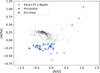 |
Fig. A.1 Primordial (blue) and enriched (red) stars identified in Kepler sample using abundances from the Gaia BP/RP catalogue (Kane et al. 2025) with [Fe/H] < −0.5 dex (black points). Stars in the Kepler sample with ages (three primordial stars) determined through asteroseismology are shown with black borders. |
Appendix B Population classification using APOGEE DR17
In Section 2.4, we introduced the APOGEE abundances for which we classify stars in our sample as either primordial or enriched. In this appendix section, we will further describe and justify these classifications.
The abundance limits which define our enriched sample are consistent with the sample presented in Schiavon et al. (2017), in which nitrogen-rich stars were selected as those with nitrogen abundances greater than 4σ above the bulk of stars in the bulge, for the metallicity range −1.8 ≲ [Fe/H] ≲ 0.4. This distinction between nitrogen-rich stars and bulge stars can most effectively be observed in Figure B.1, in which we include the bulge (black) and nitrogen-rich (green) samples from Schiavon et al. (2017), as well as our primordial (blue) and enriched (red) samples for comparison. We note that Schiavon et al. (2017) used APOGEE DR12 abundances, so in order to maintain consistency with our sample, we cross-matched their bulge and nitrogen-rich sample with the newest APOGEE DR17 abundance catalogue, in order to remove the systematic differences between data releases. Despite the difference between our classification method and that of Schiavon et al. (2017), our enriched sample shows consistency with their nitrogen-rich sample, mostly due to the metallicity regime of our sample. It becomes necessary to account for the increase in nitrogen exhibited by red giants for the metallicity regime [Fe/H] > −0.5, but as our sample lies in the [Fe/H] < −0.5 region, a simple cut in nitrogen is sufficient.
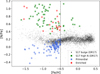 |
Fig. B.1 Nitrogen abundance versus metallicity for our primordial (blue stars) and enriched (red stars) samples, as well as the bulge stars (black points) and nitrogen-rich stars (green squares) presented in Schiavon et al. (2017) (S17 - updated from APOGEE DR12 to DR17 abundances). The vertical dashed line represents the metallicity limit of our sample ([Fe/H] < −0. 5). |
We note that APOGEE DR17 also provides information on the velocity dispersion (VSCATTER) of stars with multiple measurements of high S/N spectra, in which potential binaries are flagged as those with VSCATTER > 1 km s−1. Within our sample, we have identified six stars which meet this criterium, including one enriched star (KIC 10796857) which is described further in C.2, and five primordial stars. One of these primordial stars, KIC 10001167, has a VSCATTER = 19.7 km s−1 and is an old (10 Gyr), confirmed eclipsing binary hosting an oscillating RGB star (Thomsen et al. 2025). KIC 8914297 (VSCATTER = 3 . 0 km s−1 ) is a G = 12.4 magnitude RGB star which has been flagged as a potential binary candidate (Mazzi et al., in prep), with a G = 17.3 magnitude neighbour star detected < 3″ away in Gaia DR3 (Gaia Collaboration 2016, 2023). The remaining primordial stars are KIC 3553435 (VSCATTER = 9. 2 km s−1 ), KIC 7265189 (VSCATTER = 3.7 km s−1 ) and KIC 10857579 (VSCATTER = 1.1 km s−1 ). Based on the low number of stars (6/133) which have VSCATTER > 1 km s−1, we conclude that the primordial and enriched samples are not biased towards stars which have obvious flags of binarity.
Finally, we note that the APOGEE DR17 catalogue provides calibrated and uncalibrated versions of parameters such as Teff, log(g) and [Fe/H]. In order to derive the masses and hence ages of the enriched stars in our sample, the works of Montalbán et al. (2021) and Willett et al. (2026) used the calibrated versions of these parameters, as the calibrated values minimise systematic biases. For the stars in our sample, and especially those listed in Table D.1, the differences between calibrated and uncalibrated values for log(g) and [Fe/H] are negligible. However, there are discrepancies between calibrated and uncalibrated Teff values of up to ~ 160K for the stars in our enriched sample. We investigated the potential effects of these discrepancies for our sample, with the main concern being that this difference could increase the ages of the stars which are apparently too young to have originated from GCs. In the Montalbán et al. (2021) method, individual mode frequencies dominate the fit for age determinations, rather than Teff. The ages determined through AIMS were therefore unburdened by the degree of difference between calibrated and uncalibrated Teff values. Then, Miglio et al. (2021) found that a change of 100K when using average seismic parameters to determine ages with PARAM results in a negligible change to the mean age and an increase of ~ 3% in the intrinsic age spread. This is shown by comparing the results of the reference run R3 against R6 (Teff + 100K) in Table 1 of Miglio et al. (2021). As a worst-case scenario, we calculated the error propagation of a larger difference of Teff = 160K using the asteroseismic scaling relations, which uses inputs of Δv, vmax and Teff. We determined that this could affect the age estimate by up to ~ 15% when using calibrated versus uncalibrated Teff values. However, we also note that the enriched stars in our sample with the largest discrepancies (> 100K) are: KIC 5184073 ( Gyr), KIC 10398120 (
 Gyr), KIC 8350894 (
 Gyr) and KIC 3946701 (
 Gyr), two of which already have ages consistent with the age distribution of MW GCs. For all enriched stars with ages that appear too young to have originated from GCs, a difference of ≤ 15% in the asteroseismic age when using calibrated versus uncalibrated Teff values is not sufficient to categorise them as old enough to have originated from GCs, therefore not affecting the main result of this work.
Appendix C Possible origins of individual enriched stars
In this appendix we take a closer look at five of the enriched stars in our sample in order to investigate whether evidence suggests these stars originated from GCs, and if not, what the alternative origins could be. Currently, the alternative origin theory we will explore is that of enrichment through either past or current involvement in a mass-transfer binary system. Of the 13 enriched stars in our sample with asteroseismic ages, we explore the cases of KIC 5184073, KIC 10796857, KIC 8350894, KIC 8110538 and KIC 4920997 in more detail for the remainder of this section, using additional information from previous literature results where possible.
We will refer to the abundances of halo red giants which were derived from high resolution optical spectra from the High Dispersion Spectrograph on the Suburu Telescope by Matsuno et al. (2021). Our sample has seven RGB stars in common with Matsuno et al. (2021). This cross-match added many elements which can be used as indicators of binary mass transfer. For example, a red giant star with an AGB companion can show enrichments in elements such as barium (Ba), lanthanum (La), cerium (Ce) and neodymium (Nd), while a neutron star/black hole companion could be indicated by enrichments in europium (Eu), which are not available in the APOGEE DR17 abundances. However, while enrichments in these specific elements is potentially a sign of binary mass transfer between RGB and AGB stars, this is only one of many combinations in terms of binary pairs. Mass transfer in a binary system will not necessarily leave traceable evidence in terms of specific chemical enrichments, so we are only able to chemically trace those which do leave evidence. A lack of these specific enrichments in any star in our sample therefore does not necessarily rule out binarity. In Figure C.1, we show the abundances from Matsuno et al. (2021) for the two enriched stars and five primordial stars, in terms of the elements mentioned above, as well as the sodium (Na) abundance, confirming that these two enriched stars which were selected due to enrichment in N and Al from APOGEE DR17, are also enriched in Na, in comparison to the primordial stars which are all Na-poor.
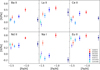 |
Fig. C.1 Abundances of two enriched (shades of red) and five primordial (shades of blue) stars in our sample with abundances obtained by Matsuno et al. (2021). |
C.1. KIC 5184073
KIC 5184073 has an asteroseismic age of  Gyr, which is mostly consistent with the expected age distribution of MW GCs (see the upper right panel of Figure 1), but with substantial enough errors on the lower age estimate to also push the star into the ‘too young to have originated from a GC’ age range. This enriched RGB star has orbital properties consistent with the thick disc, while its orbital energy of E = 1.6 × 10⁵ [km2/s2]) and angular momentum Lz = 734 [km/s kpc] could be indicative of an accreted origin. It also lacks enrichment in terms of Ba, La, Ce and Nd (Matsuno et al. 2021). Enrichment in these elements is strong evidence of mass transfer with an AGB companion, but we also note that a lack of enrichment in these elements does not necessarily rule out mass transfer. We conclude that for this star, the evidence suggests this may be a star which originated and was enriched within a GC before being ejected or dissolved to the thick disc.
C.2. KIC 10796857
The asteroseismic age of this enriched RGB star is  Gyr, which is not consistent with the age of any MW GC, indicating this is extremely unlikely to be its origin. The asteroseismic age of this star has been determined using the two methods outlined in Section 2.3, producing consistently young ages. For example, we quote the age estimate using AIMS (Montalbán et al. 2021), but the star was also analysed using PARAM with Δv as an input, producing an age estimate of
  Gyr, as well as using luminosity as an input, producing an age of
  Gyr, showing consistency across all age estimation methods. This star is located in the halo, with its orbital energy of E = 1 .8[km2/s2] combined with a positive value of Lz = 205 [km/s kpc], indicating prograde motion, and therefore an in-situ origin.
The release of APOGEE DR17 included the velocity dispersion of targets that were observed multiple times: VSCATTER, in which a target star with VSCATTER > 1 km s−1 from multiple visits of high S/N visit spectra can indicate that the target is a binary. For KIC 10796857, the VSCATTER = 1.5 km s−1, with RV = −222.73, −220.53, −219.56 (all with uncertainties ±0.04) km s−1, from three visits in May of 2013, showing indications of a binary system.
Additionally, with the newest release of Gaia DR3, an additional parameter: non_single_star was introduced, in which a non-zero value indicates either an astrometric, spec-troscopic (single-lined SB1; and double-lined SB2) or eclipsing binary (Gaia Collaboration 2023). KIC 10796857 has a non_single_star value of 2, indicating that it has been flagged as a spectroscopic binary SB1 with a period of 149.1 ± 0.5 days, based on radial velocity variations. This evidence of binarity from APOGEE DR17 and Gaia DR3, together with an astero-seismic age of  Gyr, support the conclusion that this star was enriched through mass transfer with a companion, in such a way as to mimic the same enrichment patterns observed in GC enriched stars. The combination of confirmed binarity and an asteroseismic age of
  Gyr supports the idea that the star has undergone binary mass-transfer.
C.3. KIC 8350894
KIC 8350894 is an RGB star located in the Galactic halo, but with higher orbital energy (E = 1.6 × 10⁵ [km2/s2]) and lower angular momentum (Lz = 436 [km/s kpc]), in comparison to stars formed in-situ in the MW, suggesting it could have had an accreted origin. This star is also in common with Matsuno et al. (2021), allowing insight into additional chemical abundances such as Eu, Na, Ba, La, Ce and Nd. In Figure C.1, we show that KIC 8350894 is also enriched in Na - a distinctive chemical enrichment which, when paired with the depletion in O, validates the selection of this star as similar in chemistry to an enriched GC star. However, this star is also enriched in every element expected for binary mass transfer with an AGB star, that is: Ba, La, Ce and Nd at levels > 0.5 dex, as seen in Figure C.1.
This star was also included in the sample of Xu et al. (2024), in which they use full action distributions in combination with metallicities and abundances from LAMOST to trace the origins of halo field RGB stars. They analysed KIC 8350894, giving a confidence value of p = 0.36 that it once belonged to the 12.7 Gyr old GC NGC 6352; however, due to the low confidence value, they did not conclude NGC 6352 as the origin. The apparent asteroseismic age of this star is  Gyr, but as this star shows chemical signatures of mass-transfer with an AGB companion, this age estimate might be affected by the assumption of single stellar evolution models. We conclude that this star is most likely the product of mass-transfer with an AGB companion, but as the asteroseismic age is affected by this process, we cannot rule out that the star originated in a cluster, as it is also possible that it underwent mass-transfer with an AGB companion while within a cluster, before being ejected into the field.
C.4. KIC 8110538
We present here the case of a CHeB thick disc star with kinematics consistent with in-situ formation. The asteroseismic age determined for this star using PARAM with the Δv constraint (see Sec. 2.3) is  Gyr (
Gyr ( ); however, the age estimate changes to
  Gyr (
Gyr ( ) using the luminosity. The difference in the masses derived with the two sets of parameters indicates that the constraints are not compatible, and in particular the luminosity of the star could suffer from contamination by a nearby star that is not resolved with 2MASS photometry (Mazzi et al. 2025). These aspects will be explored further in a follow-up investigation.
C.5. KIC 4920997
This enriched CHeB star is located in the thick disc and exhibits kinematics consistent with in-situ formation within the MW. The asteroseismic age of  Gyr results from the mass estimate of
  using PARAM with the Δv constraint. Since this is a low-mass CHeB star that went through a helium flash, the derived age is highly dependent on the RGB mass loss assumed in the models. The PARAM grid used in the present case assumed η = 0.2, which is less than inferred from observations at this metallicity (e.g. Brogaard et al. 2024). The adoption of a mass loss in line with other stars at the same mass and metallicity would likely result in an age, which is still old, but not older than the universe. Thus, the star could be consistent with having a GC origin. However, the star could also be younger, but having lost a larger-than-average amount of mass during evolution in a masstransfer binary similar to the evolution of KIC 4937011 suggested by Matteuzzi et al. (2024); Handberg et al. (2017).
Appendix D Table data
All Tables
All Figures
|
Fig. 1 Primordial (blue) and enriched (red) field stars in the Kepler sample, with the sample of GC stars identified by Schiavon et al. (2024) (green), both using APOGEE DR17 abundances. Stars in the Kepler sample with ages determined through asteroseismology are shown with black borders. Upper left panel: [N/Fe] vs. [C/Fe] anti-correlation. Lower left panel: [N/Fe] vs. [O/Fe] anti-correlation. Upper middle panel: Toomre diagram. Lower middle panel: integral of the motion plot. Upper right panel: histogram of the ages estimated from asteroseismology against GC ages from Forbes & Bridges (2010) (grey histogram). Lower right: histogram of the masses derived from asteroseismology. |
| In the text | |
|
Fig. A.1 Primordial (blue) and enriched (red) stars identified in Kepler sample using abundances from the Gaia BP/RP catalogue (Kane et al. 2025) with [Fe/H] < −0.5 dex (black points). Stars in the Kepler sample with ages (three primordial stars) determined through asteroseismology are shown with black borders. |
| In the text | |
|
Fig. B.1 Nitrogen abundance versus metallicity for our primordial (blue stars) and enriched (red stars) samples, as well as the bulge stars (black points) and nitrogen-rich stars (green squares) presented in Schiavon et al. (2017) (S17 - updated from APOGEE DR12 to DR17 abundances). The vertical dashed line represents the metallicity limit of our sample ([Fe/H] < −0. 5). |
| In the text | |
|
Fig. C.1 Abundances of two enriched (shades of red) and five primordial (shades of blue) stars in our sample with abundances obtained by Matsuno et al. (2021). |
| In the text | |
Current usage metrics show cumulative count of Article Views (full-text article views including HTML views, PDF and ePub downloads, according to the available data) and Abstracts Views on Vision4Press platform.
Data correspond to usage on the plateform after 2015. The current usage metrics is available 48-96 hours after online publication and is updated daily on week days.
Initial download of the metrics may take a while.