


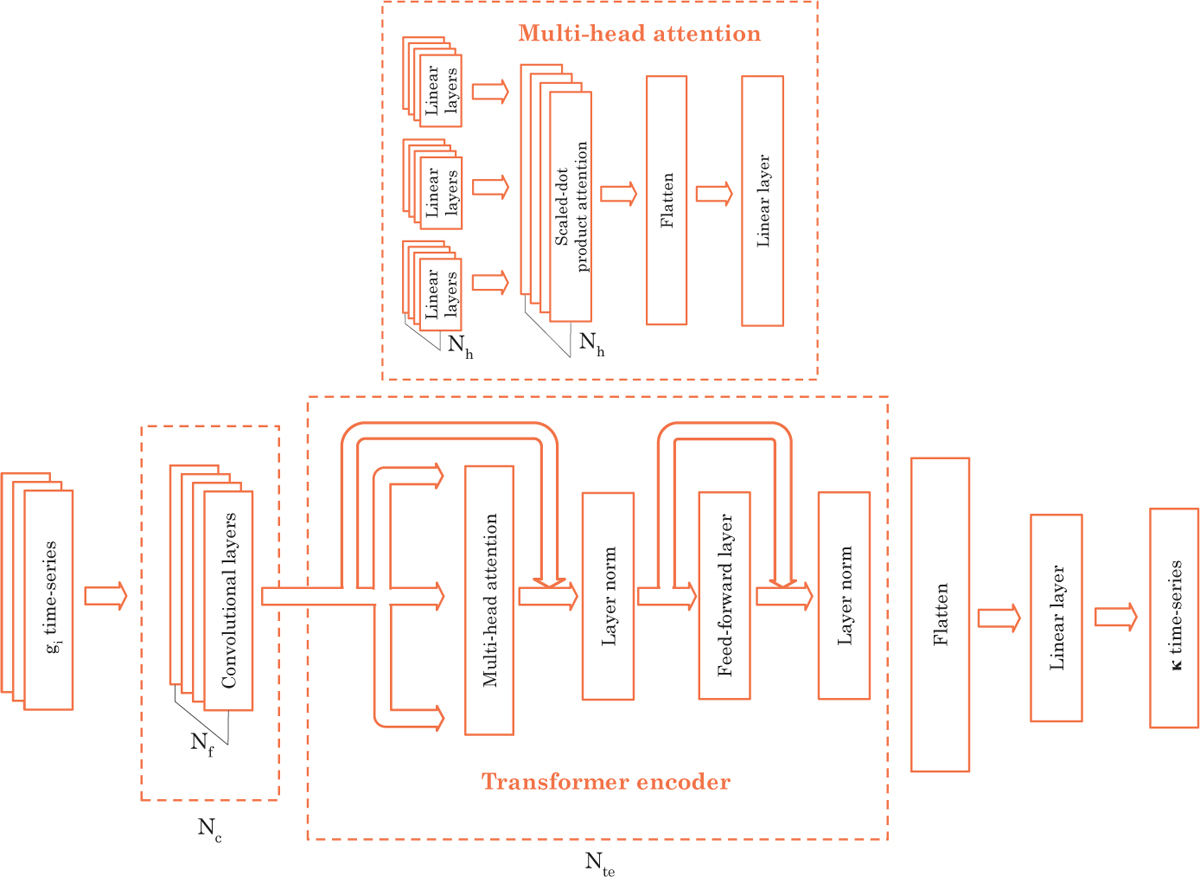
Fig. 8
Download original image
Schematic representation of CANSTAR (bottom), a convolutional attention network designed to predict the stellar activity contribution to line shifts, κ(t), from the time series of distortion coefficients, gi(t). The input coefficients are treated as independent channels and processed through a series of one-dimensional convolutional layers that extract local temporal features. The convolutional outputs are then passed to a transformer encoder module, which consists of a multi-head self-attention part (top) with different ‘heads’, where each one of them focuses on different temporal dependencies within the data, and their outputs are combined, normalised, and propagated through additional attention layers. Finally, the resulting features are flattened and projected through a linear layer to produce the predicted κ(t) time series.
Current usage metrics show cumulative count of Article Views (full-text article views including HTML views, PDF and ePub downloads, according to the available data) and Abstracts Views on Vision4Press platform.
Data correspond to usage on the plateform after 2015. The current usage metrics is available 48-96 hours after online publication and is updated daily on week days.
Initial download of the metrics may take a while.