


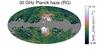
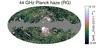
Fig. 3

Left column: Planck haze (i.e., the same as the bottom right panel of Fig. 2), for the Planck 30 and 44 GHz channels using a full-sky template fit to the data. A scaling of ν2.5 yields roughly equal brightness residuals, indicating that the haze spectrum is roughly Tν ∝ ν-2.5, implying that the electron spectrum is a very hard dN/dEe ∝ E-2. Note that the haze appears more elongated in latitude than longitude by a factor of two, which is approximately consistent with the Fermi gamma-ray haze/bubbles (Dobler et al. 2010). For frequencies above ~40 GHz, striping in the HFI channels (which contaminates our CMB estimate) begins to dominate over the haze emission. Right column: the same but for the “regional” fits described in Sect. 4.1. The overall morphology of the haze is the same, but the residuals near the mask and in the Ophiuchus complex in the north GC are improved.


Current usage metrics show cumulative count of Article Views (full-text article views including HTML views, PDF and ePub downloads, according to the available data) and Abstracts Views on Vision4Press platform.
Data correspond to usage on the plateform after 2015. The current usage metrics is available 48-96 hours after online publication and is updated daily on week days.
Initial download of the metrics may take a while.