


Fig. 13.
Download original image
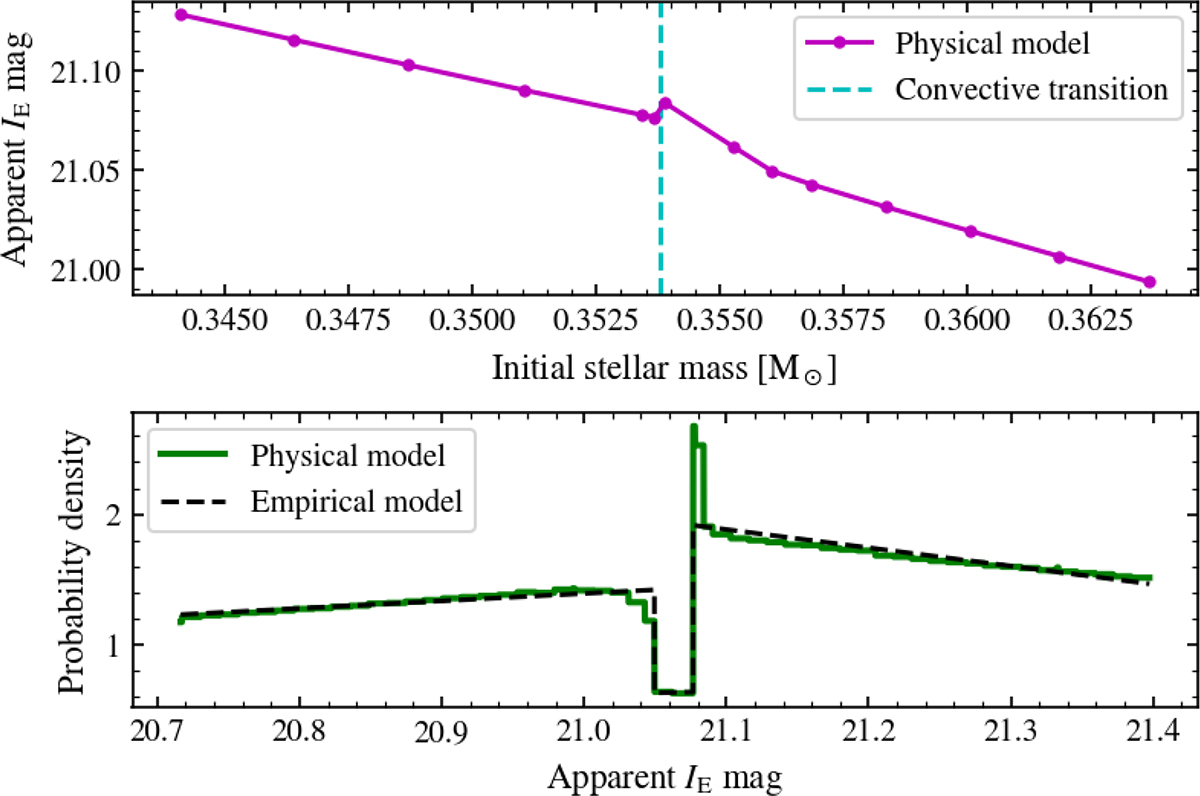
Top: Predicted mass-luminosity relationship near the convective transition for the nominal parameters of NGC 6397 ([M/H]= − 1.9, [O/M] = 0.3, Y = 0.25, T = 12.6 Gyr, αMLT = 1.82, E(B − V) = 0.22, distance of 2.458 kpc, and α = 0). The points represent individual MESA models. Bottom: Corresponding predicted luminosity function. The best-fit empirical model introduced in Sect. 7.1 is also shown. The physical model of the luminosity function features a spike in star counts at the faint edge of the gap due to the abrupt discontinuity in the mass-luminosity relationship. It does not matter whether the spike is a genuine feature of the cluster or a modelling artefact, as its range of magnitudes is too narrow to be detected in the observed luminosity function.
Current usage metrics show cumulative count of Article Views (full-text article views including HTML views, PDF and ePub downloads, according to the available data) and Abstracts Views on Vision4Press platform.
Data correspond to usage on the plateform after 2015. The current usage metrics is available 48-96 hours after online publication and is updated daily on week days.
Initial download of the metrics may take a while.