


Fig. 10.
Download original image
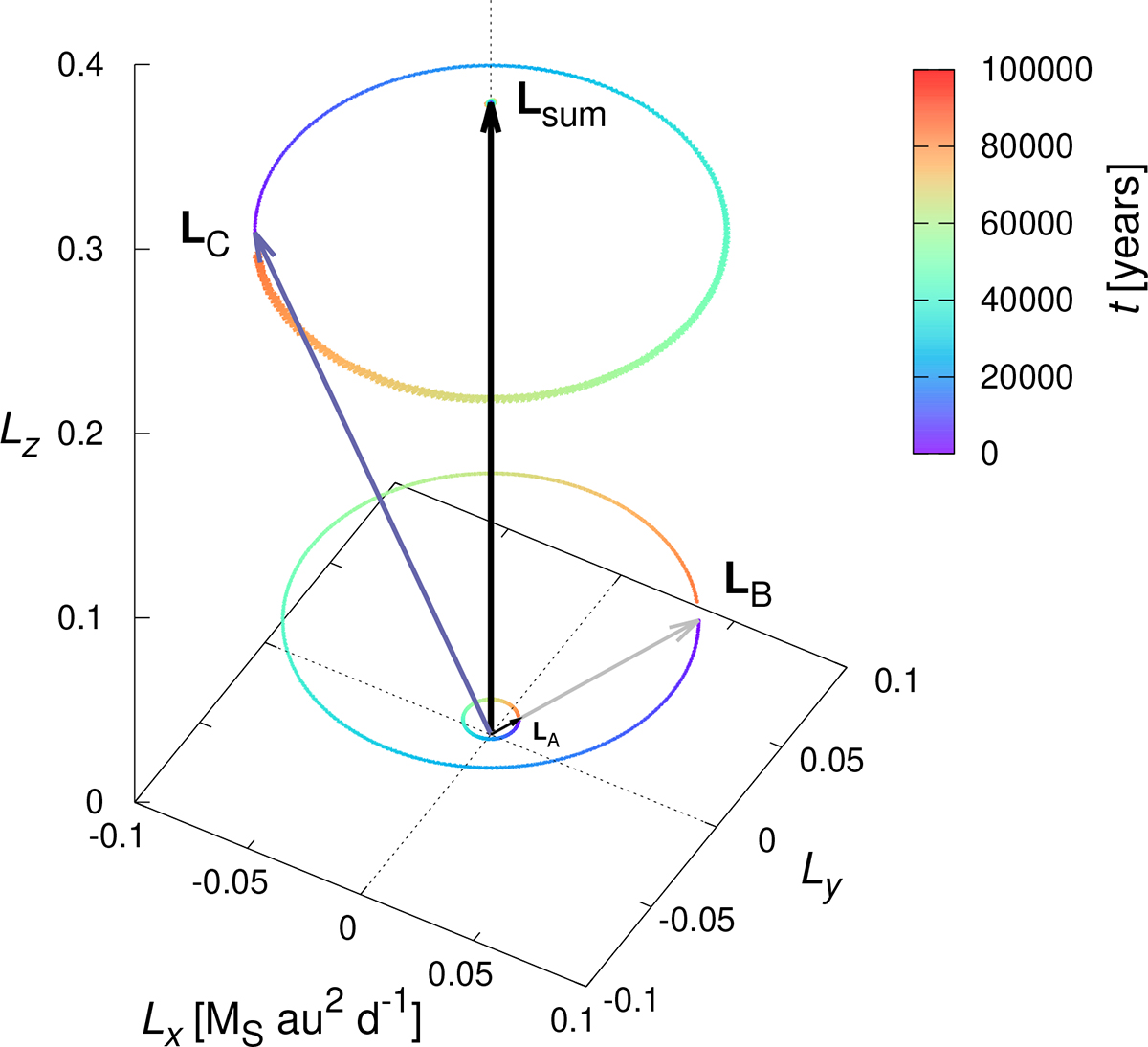
Angular-momentum vectors of the ξ Tau sub-systems (Aa+Ab, B, C) and their long-term evolution. The coordinates were rotated to the Laplace reference frame, with the z-axis along the total angular momentum, Lsum, of the whole ξ Tau system (in absence of external torques Lsum is constant). The individual contributions were obtained as  , where mA′ denotes the reduced mass, rA and ṙA the Jacobi coordinate and velocity of the Aa+Ab binary (and similarly for the B and C parts, LB and LC). The (2+1)+1 hierarchy of the system implies that (i) LC and LAB ≡ LA + LB regularly precess about Lsum with a period of ≃85000 y (see colours showing the time in the course of simulation), preserving their mutual angle J2 ≃ 71°; (ii) LA and LB regularly precess about LAB with a period of ≃7000 d, preserving their mutual angle of J1 ≃ 0.5°. Since LC holds the largest share of Lsum, its angular distance from Lsum is only 23°, while that of LAB is more than 47°. As a result, the observed inclinations with respect to the sky plane, i1 and i2, exhibit large variations over millennia.
Current usage metrics show cumulative count of Article Views (full-text article views including HTML views, PDF and ePub downloads, according to the available data) and Abstracts Views on Vision4Press platform.
Data correspond to usage on the plateform after 2015. The current usage metrics is available 48-96 hours after online publication and is updated daily on week days.
Initial download of the metrics may take a while.