


| Issue |
A&A
Volume 709, May 2026
|
|
|---|---|---|
| Article Number | A45 | |
| Number of page(s) | 4 | |
| Section | Cosmology (including clusters of galaxies) | |
| DOI | https://doi.org/10.1051/0004-6361/202558395 | |
| Published online | 01 May 2026 | |
The contribution of galaxies to the magnetic field in cosmic voids
II. Institut für Theoretische Physik, University of Hamburg, Luruper Chaussee 149, 22761 Hamburg, Germany
★ Corresponding authors: This email address is being protected from spambots. You need JavaScript enabled to view it.
; This email address is being protected from spambots. You need JavaScript enabled to view it.
Received:
4
December
2025
Accepted:
22
March
2026
Abstract
Context. Astrophysical processes can contribute to magnetic fields within cosmic voids either through magnetized outflows from the astrophysical large-scale structure or through the superposition of dipolar contributions from individual galaxies. Such astrophysical magnetic fields represent a foreground to possible space-filling primordial magnetic fields seeded in the early Universe.
Aims. In this paper, we provide a qualitative description of the diffusion of magnetic fields by intergalactic plasmas.
Methods. Using nonrelativistic magnetohydrodynamics, we derived general, analytic formulae for the magnetic field strength subject to diffusion in the presence of intergalactic plasma.
Results. We find that contributions from the superposition of static dipoles are highly suppressed and cannot explain indications for the lower bounds based on observations of γ-ray cascades from high-energy sources such as blazars.
Key words: magnetohydrodynamics (MHD) / plasmas / galaxies: magnetic fields
© The Authors 2026
 Open Access article, published by EDP Sciences, under the terms of the Creative Commons Attribution License (https://creativecommons.org/licenses/by/4.0), which permits unrestricted use, distribution, and reproduction in any medium, provided the original work is properly cited.
This article is published in open access under the Subscribe to Open model. This email address is being protected from spambots. You need JavaScript enabled to view it. to support open access publication.
1. Introduction
The large-scale distribution of cosmic magnetic fields is neither experimentally mapped out in great detail, nor completely understood theoretically (Beck 2015; Shukurov & Subramanian 2021; Durrer & Neronov 2013; Subramanian 2016; Vachaspati 2021). This is particularly true for magnetic fields in cosmic voids, which are thought to be rather pristine and uncontaminated by astrophysical “pollution”. Such voids could therefore serve as potential probes of primordial magnetic fields created in the early Universe; see the reviews cited above.
Space-filling, large-scale cosmic magnetic fields can be bound from above through their effect on the cosmic microwave background, which limits them to below ∼1 nG (Minoda et al. 2021). Furthermore, the deflection of ultrahigh-energy cosmic rays from the direction of the Perseus-Pisces galaxy cluster has been used to constrain the magnetic field strength in the void between this source and Earth to below ∼10−10 G (Neronov et al. 2023).
Electromagnetic cascades at 𝒪(10 − 100) GeV, initiated by γ rays from active galactic nuclei, are influenced by magnetic fields in cosmic voids, leading to (i) time delays of bursts (Plaga 1995), (ii) angular broadening of the source images (Elyiv et al. 2009), and (iii) change in the observed photon spectrum (Neronov & Vovk 2010). Based on these, multiple lower limits and estimates of magnetic field strengths in voids have been claimed over the last 15 years (Neronov & Vovk 2010; Taylor et al. 2011; Dolag et al. 2011; Essey et al. 2011; Finke et al. 2015; Ackermann et al. 2018; Alves Batista & Saveliev 2020; Acciari et al. 2023; Aharonian et al. 2023; Vovk et al. 2024; Tjemsland et al. 2024; Blunier et al. 2025; Webar et al. 2025). Under conservative assumptions on the duty cycle of the sources, the currently strongest of those lower bounds can be approximated as (Acciari et al. 2023).
 (1)
(1)
We note in passing that the lower bounds in (1) may be modified by possible plasma instabilities acting on the electron–positron pairs in the electromagnetic cascades (Broderick et al. 2012). Such instabilities could provide at least a partial alternative to magnetic fields for explaining the γ-ray observations. As recent investigations suggest these effects are weak (see, e.g., Alawashra et al. 2025a), we ignore them here, even though the case is not yet completely settled (Alawashra et al. 2025b).
It is interesting whether the magnetic fields suggested by the lower bounds mentioned above can be explained by purely astrophysical processes. One possible explanation is that magnetic fields are transported into the voids through galaxy and quasar outflows (Furlanetto & Loeb 2001; Garcia et al. 2021; Aramburo-Garcia et al. 2023). These studies found that the volume filling factor of fields of sufficient strength is unlikely to exceed ∼20%, unless a homogeneous (and thus primordial) magnetic field of comparable strength was already present initially.
A recent alternative explanation argues that magnetic fields in the strength range of (1) need not be primordial but could simply result from the superposition of magnetic dipoles from individual galaxies (Garg et al. 2025). However, this requires a magnetostatic approximation in the absence of plasma. Highly ionized plasmas throughout the Universe produce diffusive effects that can substantially suppress magnetic fields over large distances from their sources.
Motivated by this, the present paper provides a qualitative description of magnetic field diffusion in the presence of intergalactic plasmas. The results presented here are in part based on Jedamzik & Sigl (2011).
2. Magnetic field diffusion
In Jedamzik & Sigl (2011) the evolution of the magnetic field is discussed in plasmas where the plasma flow is neglected. This can be a reasonable first approximation for nonrelativistic plasmas that constitute the intergalactic medium (see Ghosh et al. (2026) for a recent discussion also including turbulence). With this approximation, in Fourier space the evolution equation reads
![Mathematical equation: $$ \begin{aligned} \partial _z\mathbf{B}_\mathbf{k}(z)=\frac{2\mathbf{B}_\mathbf{k}(z)}{1+z}+\eta (z)\frac{1+z}{H(z)}\mathbf{k}^2\big [\mathbf{B}_\mathbf{k}(z)-4\pi \mathbf{M}_\mathbf{k}^\perp (z)\big ], \end{aligned} $$](/articles/aa/full_html/2026/05/aa58395-25/aa58395-25-eq2.gif) (2)
(2)
where z is the redshift, H(z) is the Hubble rate, and η(z) is the resistivity. The value Mk denotes the magnetization vector describing external sources via the external current jex(x, t) = ∇×M(x, t) in direct space. We use the shorthand notation fk(z)≡f(z, k) for Bk and Mk. The orthogonal part of magnetization is defined as  with the unit vector
  . The analytic solution to this differential equation is (Jedamzik & Sigl 2011)
 (3)
(3)
where we introduce an effective wave number accounting for magnetic diffusion in the redshift range [z, z′] as
![Mathematical equation: $$ \begin{aligned} {K_r}(z,z\prime )=\Bigg [\int _z^{z\prime }\mathrm{d}\tilde{z}\,\frac{\eta (\tilde{z})(1+\tilde{z})}{H(\tilde{z})}\Bigg ]^{-1/2}. \end{aligned} $$](/articles/aa/full_html/2026/05/aa58395-25/aa58395-25-eq6.gif) (4)
(4)
We note that Eq. (2) has the form of a diffusion equation rather than static screening; thus, we refer to the solutions as diffusive magnetic fields rather than screened ones.
With proper assumptions the nested integral in Eq. (3) is easily solvable without much loss of generality. The assumptions and approximations used in this paper are as follows:
-
(a)
Resistivity depends only on temperature through a simple power law, η(T)∝T−nη. This can be rewritten as a redshift dependence using the relation Tp(z) = Tp, 0(1 + z)nT, where the value nT depends on the nature of the plasma (i.e., relativistic or nonrelativistic). The general evolution of the resistivity is then
 (5)
(5)where η0 denotes the present-day plasma resistivity. As a specific example, we used Spitzer resistivity for an electron plasma (see, e.g., Choudhuri 1998), where nη = 3/2 and
 (6)
(6)An undetermined dimensionless constant C ∼ 10 was used as a fudge factor to account for uncertainties. Moreover, in natural units e2 ≈ 4π/137, me ≈ 511 keV is the electron mass, and Te, 0 is the temperature of the present-day electron-plasma.
-
(b)
The Universe is in a single-component-dominated era (e.g., dark energy-dominated or matter-dominated). The Hubble parameter is then defined as
 (7)
(7)where H0 ≈ 1.4 × 10⁻³³ eV is the present-day Hubble parameter in natural units. Analytic results only exist in this approximation; however, using a realistic Hubble parameter does not effect the qualitative results we present below.
-
(c)
We approximated the z-scaling of the magnetization as
 (8)
(8)This follows from the magnetic energy density scaling as EM ∝ |Bk|2 ∝ (1 + z)−4.
The values of the exponents nη, nT, and nH depend on the properties of the intergalactic medium and the era of the Universe. In particular, nT = 1 (nT = 2) for relativistic (nonrelativistic) plasmas, while nH = 3/2 (nH = 0) for a matter-dominated (cosmological constant-dominated) Universe. The radiation-dominated Universe is not a relevant era for structure formation; thus, we did not consider it. Regardless, the actual values of {nη, nT, nH} are largely irrelevant for the qualitative behavior of Bk.
A useful quantity, introduced in Jedamzik & Sigl (2011), is the critical wave number kr defined via kr(z)≡Kr(z, ∞); see Eq. (4). Using our prior assumptions (a) and (b), we find in general that the critical wave number is
![Mathematical equation: $$ \begin{aligned} k_r(z)=\sqrt{\frac{H_0}{\eta _0}}\Bigg [\frac{(1+z)^{2-n_H-n_\eta n_T}}{n_H+n_\eta n_T-2}\Bigg ]^{-1/2}, \end{aligned} $$](/articles/aa/full_html/2026/05/aa58395-25/aa58395-25-eq11.gif) (9)
(9)
if nH + nηnT > 2. Integrating to the present day (z = 0) and up to 𝒪(1) factors, one has  . As an example, let us look at the Spitzer resistivity given in Eq. (6) for a nonrelativistic plasma at Te, 0 = 10 eV in a matter-dominated Universe. Today, the critical wave number is
 (10)
(10)
The diffusion length, defined as the inverse of the critical wave number, is then extremely small compared to the astrophysical distances relevant in voids:
 (11)
(11)
Consequently, we do not expect sufficiently strong magnetic fields to propagate to 𝒪(Mpc) distances within voids and reproduce the lower bounds in Eq. (1).
To complete our argument, we returned to Eq. (3) and integrated it analytically using all three assumptions of (a)–(c) to find explicit formulae for the field strength. At z = 0, we find
![Mathematical equation: $$ \begin{aligned} \mathbf{B}_\mathbf{k}(0)=4\pi \bigg [1-\exp \bigg (-\frac{k^2}{k_{r,0}^2}\bigg )\bigg ]\mathbf{M}_\mathbf{k}^\perp (0). \end{aligned} $$](/articles/aa/full_html/2026/05/aa58395-25/aa58395-25-eq15.gif) (12)
(12)
This formula is the same irrespective of what nH, nT, and nη are, at least as long as the integrals remain finite at the chosen values (see the condition below Eq. (9) in particular). These parameter values are only important when determining the critical wave number kr, 0, and the presented form for the magnetic field in Eq. (12) is in practice quite general. For short distances k ≫ kr, 0, the exponential term is negligible, and we re-obtain the bare magnetic field:
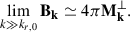 (13)
(13)
For long distances k ≪ kr, 0, we expect diffusion to have considerable effects and find
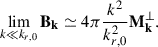 (14)
(14)
For the Fourier component with λ ≃ lvoid ∼ 1 Mpc, the diffusion results in a suppression of about 10−20 compared to the vacuum result when considering kr, 0, as in Eq. (10). The limiting cases given in Eqs. (13)–(14) are in agreement with Jedamzik & Sigl (2011).
To obtain a tractable real-space representation suitable for numerical simulations of multiple galaxies, as performed in Garg et al. (2025), we specialized the general diffusive solution of Eq. (12) to the case of a localized magnetic dipole. This approximation is well motivated on sufficiently large scales, where galactic magnetic fields are dominated by their lowest-order multipole (i.e., dipole) moment. The magnetization vector for a single localized dipole in Fourier space is simply  ; thus, its component perpendicular to the wave-vector k is
![Mathematical equation: $$ \begin{aligned} \big [\mathbf{M}_\mathbf{k}^\mathrm{(d)}\big ]^\perp = \mathbf{m}-\frac{(\mathbf{k}\cdot \mathbf{m})\mathbf{k}}{|\mathbf{k}|^2}. \end{aligned} $$](/articles/aa/full_html/2026/05/aa58395-25/aa58395-25-eq19.gif) (15)
(15)
After a simple Fourier transformation of Eq. (12) with the magnetization of a single dipole as in Eq. (15), the magnetic field of the dipole submerged in plasma (abbreviated here as B(sd)) is obtained (in Gaussian units):
 (16)
(16)
where u = kr, 0r is the dimensionless distance relative to the diffusion length and the auxiliary function is defined as
 (17)
(17)
Here erf(x) is the (Gaussian) error function. Note, that the different components (longitudinal and transverse) of the magnetic field diffuse slightly differently.
The result in Eq. (16) clearly resembles the usual vacuum magnetic field of the dipole, B(d)(r). In fact, it exactly reproduces the dipole field in the limit u → 0 (i.e., r ≪ lr, 0), where ℱs(u; n)→1:
 (18)
(18)
However, for long distances relative to the diffusion length the field decays exponentially fast due to the behavior of the auxiliary function at u ≫ 1, where 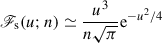 and, consequently,
 (19)
(19)
In summary, the magnetic field is exponentially suppressed for long distances relative to the diffusion length, while it retains its dipole form for short distances.
Although in the ideal case the resistivity ηSp(z) is independent of plasma density and is therefore assumed a constant, we may account for slight spatial variations by viewing the resistivity factor η0 in Eq. (5) as a spatial average over distance d, i.e.,  . These inhomogeneity effects can be accounted for by modifying the screening length of Eq. (11) via the replacement,
 (20)
(20)
and treating ηSp, 0(r) as an input function for the line-of-sight resistivity profile.
Following Garg et al. (2025), we estimated the magnetic field strength in voids from the collective effect of numerous galaxies, each modeled as dipoles. We can safely assume that the size of the galaxies is much smaller than the size of the void. Consequently, we may approximate the magnetic field of a single galaxy as
 (21)
(21)
where we use the void size of rv ∼ 20 Mpc and B0 ∼ 10−6 G (Unger & Farrar 2024). In general, one expects lr, 0 ≪ rv (see Eq. (11) for the Spitzer resistivity with reasonable plasma parameters) and thus an exponentially small Bgal.(rv). Approximating the number of galaxies around the void by Ng ≃ 4πrv2/dig2, where dig ∼ 1 Mpc is the typical distance between galaxies, the total magnetic field in the middle of the spherical void becomes
 (22)
(22)
To obtain Bvoid ∼ 𝒪(10−16) G, one requires a critical wave number kr,0 ≈ 0.3 Mpc−1, or equivalently, a diffusion length of order  Mpc, which is far from realistic for intergalactic plasmas.
Finally, we note that in general, no relationship is expected between the Fourier component at a specific wave number k0 = 2π/r0 and the corresponding magnetic field strength at r0. Thus, the exponentially small field in Eq. (21) is not in any contradiction with the quadratically small field in Eq. (14). Regardless, we can safely say that both give magnetic fields that are multiple orders of magnitude too weak to explain the observed lower bounds of Eq. (1).
3. Conclusions
In this paper, we showed that dipole-like galactic magnetic fields cannot account for the observational lower bounds on the magnetic field strength in voids. Such fields cannot propagate to cosmic distances because of intergalactic plasma. In fact, for reasonable values of plasma resistivity, the resulting field strength falls short of the observed lower bound by many orders of magnitude. For the Fourier spectrum of the magnetic field (Bk), we find a (k/kr, 0)2 suppression at small k modes. In real space, the field diffusion is exponentially strong, effectively eliminating the field on scales r ≫ lr, 0. We conclude that a diffusion length of lr, 0 ∼ few Mpc would be necessary to sustain the simple galactic field explanation. However, such values are astrophysically implausible. Finally, we emphasize that our calculation is a simplified argument showing that galactic fields alone cannot explain the observed void fields. Other mechanisms discussed in the introduction (e.g., instabilities and outflows) may play an important role and further complicate the picture.
Acknowledgments
We acknowledge support by the Deutsche Forschungsgemeinschaft (DFG, German Research Foundation) under Germany’s Excellence Strategy – EXC 2121 “Quantum Universe” – 390833306. We thank Kandaswamy Subramanian, Ruth Durrer, Jennifer Schober, Deepen Garg, and Suman Dey for discussions regarding this topic.
References
- Acciari, V. A., Agudo, I., Aniello, T., et al. 2023, A&A, 670, A145 [NASA ADS] [CrossRef] [EDP Sciences] [Google Scholar]
- Ackermann, M., Ajello, M., Baldini, L., et al. 2018, ApJS, 237, 32 [NASA ADS] [CrossRef] [Google Scholar]
- Aharonian, F., Aschersleben, J., Backes, M., et al. 2023, ApJ, 950, L16 [NASA ADS] [CrossRef] [Google Scholar]
- Alawashra, M., Vovk, I., & Pohl, M. 2025a, ApJ, 978, 95 [Google Scholar]
- Alawashra, M., Yang, Y., Hirata, C. M., Long, H., & Pohl, M. 2025b, ApJ, 989, 37 [Google Scholar]
- Alves Batista, R., & Saveliev, A. 2020, ApJ, 902, L11 [NASA ADS] [CrossRef] [Google Scholar]
- Aramburo-Garcia, A., Bondarenko, K., Boyarsky, A., et al. 2023, MNRAS, 519, 4030 [CrossRef] [Google Scholar]
- Beck, R. 2015, A&A Rev., 24, 4 [Google Scholar]
- Blunier, J., Neronov, A., & Semikoz, D. 2025, A&A submitted, [arXiv:2506.22285] [Google Scholar]
- Broderick, A. E., Chang, P., & Pfrommer, C. 2012, ApJ, 752, 22 [NASA ADS] [CrossRef] [Google Scholar]
- Choudhuri, A. R. 1998, The Physics of Fluids and Plasmas: An Introduction for Astrophysicists (Cambridge University Press) [Google Scholar]
- Dolag, K., Kachelriess, M., Ostapchenko, S., & Tomas, R. 2011, ApJ, 727, L4 [NASA ADS] [CrossRef] [Google Scholar]
- Durrer, R., & Neronov, A. 2013, A&A Rev., 21, 62 [Google Scholar]
- Elyiv, A., Neronov, A., & Semikoz, D. V. 2009, Phys. Rev. D, 80, 023010 [NASA ADS] [CrossRef] [Google Scholar]
- Essey, W., Ando, S., & Kusenko, A. 2011, Astropart. Phys., 35, 135 [NASA ADS] [CrossRef] [Google Scholar]
- Finke, J. D., Reyes, L. C., Georganopoulos, M., et al. 2015, ApJ, 814, 20 [NASA ADS] [CrossRef] [Google Scholar]
- Furlanetto, S., & Loeb, A. 2001, ApJ, 556, 619 [NASA ADS] [CrossRef] [Google Scholar]
- Garcia, A. A., Bondarenko, K., Boyarsky, A., et al. 2021, MNRAS, 505, 5038 [NASA ADS] [CrossRef] [Google Scholar]
- Garg, D., Durrer, R., & Schober, J. 2025, arXiv e-prints [arXiv:2505.14774] [Google Scholar]
- Ghosh, O., Brandenburg, A., Caprini, C., Neronov, A., & Vazza, F. 2026, Phys. Rev. D, 113, 023523 [Google Scholar]
- Jedamzik, K., & Sigl, G. 2011, Phys. Rev. D, 83, 103005 [Google Scholar]
- Minoda, T., Ichiki, K., & Tashiro, H. 2021, JCAP, 03, 093 [Google Scholar]
- Neronov, A., & Vovk, I. 2010, Science, 328, 73 [NASA ADS] [CrossRef] [Google Scholar]
- Neronov, A., Semikoz, D., & Kalashev, O. 2023, Phys. Rev. D, 108, 103008 [NASA ADS] [CrossRef] [Google Scholar]
- Plaga, R. 1995, Nature, 374, 430 [NASA ADS] [CrossRef] [Google Scholar]
- Shukurov, A., & Subramanian, K. 2021, Astrophysical Magnetic Fields: From Galaxies to the Early Universe, Cambridge Astrophysics (Cambridge University Press) [Google Scholar]
- Subramanian, K. 2016, Rept. Prog. Phys., 79, 076901 [Google Scholar]
- Taylor, A. M., Vovk, I., & Neronov, A. 2011, A&A, 529, A144 [NASA ADS] [CrossRef] [EDP Sciences] [Google Scholar]
- Tjemsland, J., Meyer, M., & Vazza, F. 2024, ApJ, 963, 135 [NASA ADS] [CrossRef] [Google Scholar]
- Unger, M., & Farrar, G. R. 2024, ApJ, 970, 95 [NASA ADS] [CrossRef] [Google Scholar]
- Vachaspati, T. 2021, Rept. Prog. Phys., 84, 074901 [Google Scholar]
- Vovk, I., Korochkin, A., Neronov, A., & Semikoz, D. 2024, A&A, 683, A25 [NASA ADS] [CrossRef] [EDP Sciences] [Google Scholar]
- Webar, M. S., Abed, Y., & Horns, D. 2025, arXiv e-prints [arXiv:2509.11996] [Google Scholar]
Current usage metrics show cumulative count of Article Views (full-text article views including HTML views, PDF and ePub downloads, according to the available data) and Abstracts Views on Vision4Press platform.
Data correspond to usage on the plateform after 2015. The current usage metrics is available 48-96 hours after online publication and is updated daily on week days.
Initial download of the metrics may take a while.