


Fig. 9
Download original image
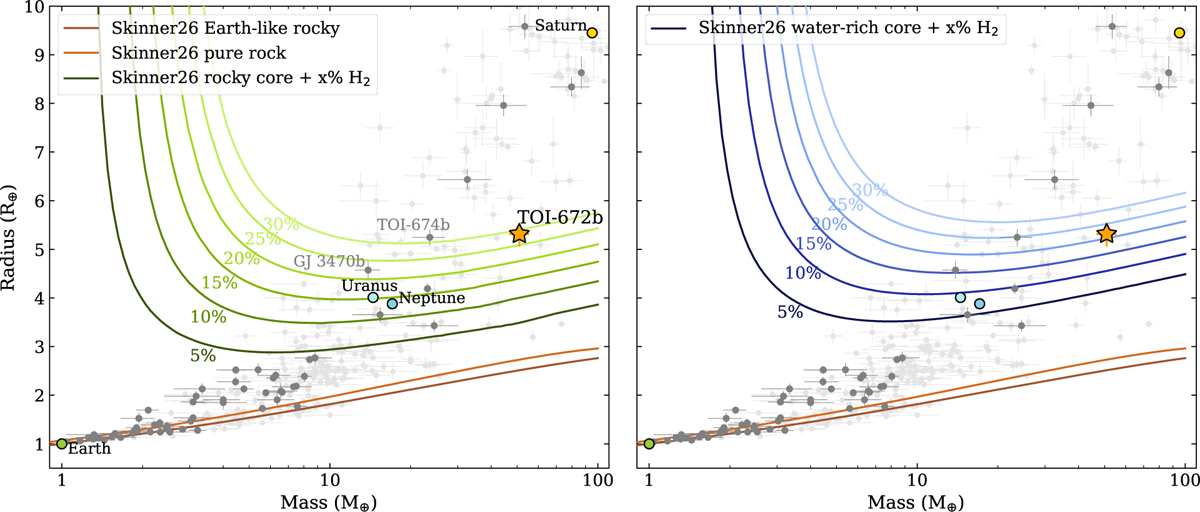
Mass-radius diagrams showing TOI-672 b (yellow star) against the well-characterised planet population (light grey dots) from the PlanetS catalogue, available at https://dace.unige.ch/exoplanets. It contains planets with precisions on planet mass and radius of <25 and 8%, respectively (Otegi et al. 2020; Parc et al. 2024). Planets around M dwarf hosts (i.e. Teff < 3900 K and M*, R* < 0.6 M⊙, R⊙) are highlighted as dark grey dots. Solar System planets are shown for comparison (outlined circles, labelled). Both panels show mass-radius relations from Skinner et al. (2026) for Earth-like rocky (32.5% core + 67.5% mantle) compositions (dark brown) and pure rock (100% mantle) compositions (light brown). Both panels also show model mass-radius relations from Skinner et al. (2026) (solid lines), as described in Section 5.2 for an equilibrium temperature of 700 K, with annotated percentages reporting the hydrogen mass fraction of each curve. The mass-radius relations in the left panel correspond to an Earth-like core composition (i.e. 32.5% iron + 67.5% mantle), while the right panel assumes a 50% water plus 50% Earth-like core composition.
Current usage metrics show cumulative count of Article Views (full-text article views including HTML views, PDF and ePub downloads, according to the available data) and Abstracts Views on Vision4Press platform.
Data correspond to usage on the plateform after 2015. The current usage metrics is available 48-96 hours after online publication and is updated daily on week days.
Initial download of the metrics may take a while.