


Fig. 5
Download original image
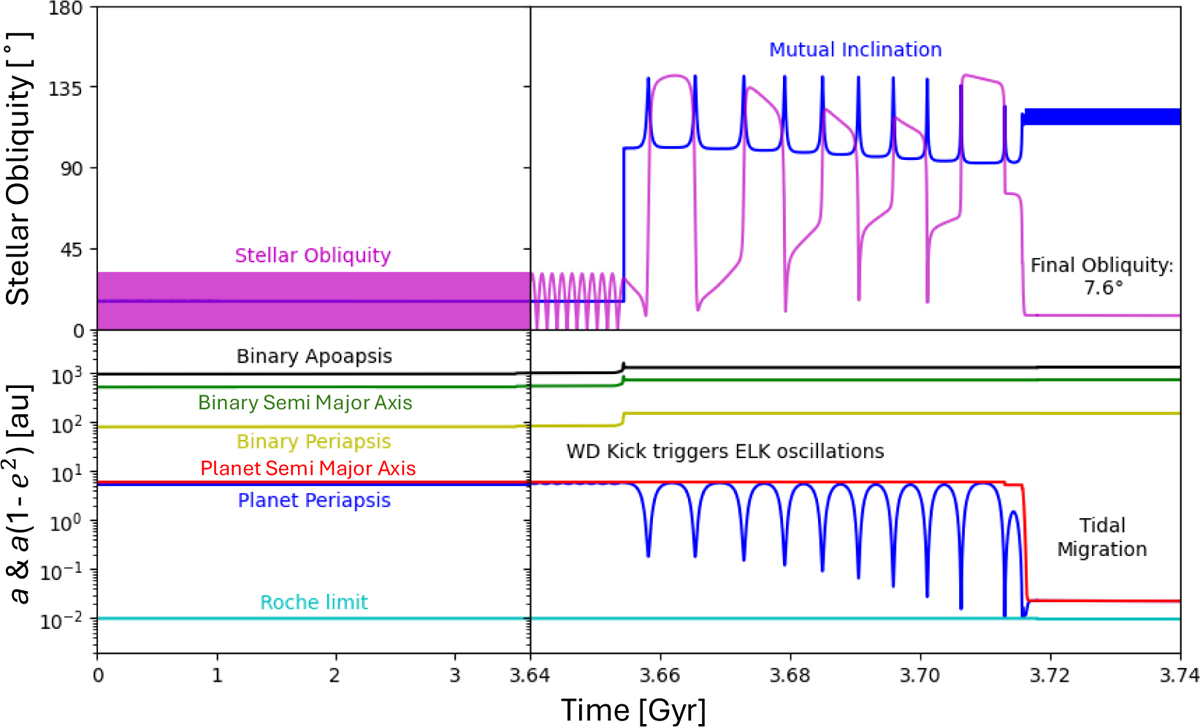
Example evolution of a well-aligned gas giant in a binary system consistent with the TOI-1259 system. In this system, ELK oscillations are initially absent due to the low mutual inclination between the planetary and binary orbits (upper panels, blue line). The stellar obliquity (upper panels, magenta line) initially oscillates due to precession of the planetary orbit’s line of nodes around the total system angular momentum. However, the WD kick changes the orbital parameters of the system and triggers strong ELK oscillations (lower right panel), causing high eccentricities for the planetary orbit and short periapsis distances (lower panels, blue line) and eventually leading to shrinking of the planet’s semimajor axis (lower panels, red line) via tidal migration. In this simulation, the planet’s final obliquity is 7.6°, and the final mutual inclination between the planetary and binary orbits is high (and oscillatory, as the planetary orbit normal precesses around the star’s spin axis due to tidal coupling). The WD companion has a wide final orbit with an apoapsis distance (lower panels, black line) of about 1300 au, consistent with the projected separation of the TOI-1259 binary.
Current usage metrics show cumulative count of Article Views (full-text article views including HTML views, PDF and ePub downloads, according to the available data) and Abstracts Views on Vision4Press platform.
Data correspond to usage on the plateform after 2015. The current usage metrics is available 48-96 hours after online publication and is updated daily on week days.
Initial download of the metrics may take a while.