


2020 Highlights
A global model of particle acceleration at pulsar wind termination shocks
Vol. 642
2. Astrophysical processes
A global model of particle acceleration at pulsar wind termination shocks
Pulsar wind nebulae are among the brightest Galactic nonthermal sources at high energies, up through TeV, testifying to the efficient acceleration of charged particles in the vicinity of the central neutron star. Determining how to reach the required energies has been a challenging problem for decades. This study uses a schematic but physically plausible representation of the latitude-dependent pulsar wind and magnetic field into which leptons (electron-positron) are injected. The time dependent flow forms a shock, whose structure rapidly becomes macroscopically turbulent. The simulation uses a fully relativistic particle-in-cell (PIC) code, Zeltron, to follow the diffusive particle energization through this tangle of filamented structures at the termination shock of the wind with its surrounding interstellar medium (ISM). The formation of the shock over time is a result of the simulation and it is not pre-imposed, hence the complex structure development can be followed. This is perhaps the most intriguing result of the modeling, that is to say the synchrotron emission in different energy ranges is diagnostic for the site of origin: The highest energy emission comes from the turbulent regions imbedded within shock cavities and it is boosted and beamed by the local bulk motions at the shock.
A gravitational lensing detection of filamentary structures connecting luminous red galaxies (Xia et al.)
Vol. 633
Sect. 3. Cosmology
A gravitational lensing detection of filamentary structures connecting luminous red galaxies
In this cosmic web, large under-dense regions (voids) are enclosed by anisotropically collapsed surface structures (sheets) and line structures (filaments) which intersect at the most overdense isotropic regions (clusters). Simulations predict that as much as 40% of the mass in the Universe should be located in filaments, however, its detection poses a great challenge. Filaments have been detected by Xray emission and, recently, by the SZ signal. In this paper, the authors investigate the use of weak gravitational lensing to detect their presence combining three large public weak lensing surveys: KIDS+VIKING, RCSLenS, and the CFHTLenS to improve upon previous methodologies with the help of N-body simulations. As a result, they find a 3.4 σ detection of filamentary structure connecting luminous red galaxies separated by 3 − 5 h−1 Mpc, while they do not detect significant signals for larger separations, which is contrary to previous claims. The average density at the centre of these filamentary structures is found to be 15 ± 4 times the critical density.
A physical model for the magnetosphere of Uranus at solstice time (Pantellini)
Vol. 643
10. Planets and planetary systems
A physical model for the magnetosphere of Uranus at solstice time
The magnetosphere of Uranus is subject to strong seasonal variations. The variability is a consequence of the planet's rotation axis being nearly parallel to its orbital plane, a situation unique in the Solar System. A short rotation period of 17.24h and a large angle between the rotation axis and magnetic dipole axis induces a twist of the planetary magnetic field lines, which are forced to expand downstream of the planet under the action of the supersonic solar wind. Numerical simulations suggest the scale of the twist to be of the order of several hundred times the Uranian radius. Specifically, for the solstice case, simulations show that the planetary field lines expanding downstream of the planet become organized into two distinct interlaced helically structured bundles. This paper presents a detailed physical description of this tail structure for a Uranus-like magnetosphere at solstice, when the solar wind and the rotation axis are quasi-aligned. In a symmetrized version of the original problem, the paper describes the time evolution of a field line from its emergence through the planet's surface to its final position. It shows, for example, that in the planet frame, the asymptotic position is a unique one-dimensional static double helix, independently of the field line's emergence point. It also shows that each strand of a field line approaches its asymptotic position along a spiraling path, similarly to the path followed by a fluid parcel in a tornado.
A stringent upper limit of the PH3 abundance at the cloud top of Venus
Vol. 643
1. Letters to the Editor
A stringent upper limit of the PH3 abundance at the cloud top of Venus
A recent candidate detection of the phosphine molecule (PH3) with JCMT and ALMA in the upper atmosphere of Venus has incited a great deal of public interest. Phosphine is not expected to survive long in the highly oxidizing atmosphere of Venus, and its tentative detection has therefore been speculated to reflect biological processes in the Venusian atmosphere. Encrenaz et al. use observations of a 10 micrometer transition of phosphine to set an upper limit on its abundance at and slightly above the top of the Venus clouds. That limit is, at the 3 sigma confidence level, a factor of four lower than the PH3 abundance derived from the tentative millimeter-wave detection. The millimeter-wave transition of PH3 probes higher levels of the Venus atmosphere than the 10 micrometer transition, leaving the two results formally compatible; however, the tight upper limit obtained by Encrenaz et al. sets very strong constraints on phosphine production in Venus.A stripped helium star in the potential black hole binary LB-1 (A. Irrgang et al.)
Vol. 633
In section 1. Letters to the Editor
A stripped helium star in the potential black hole binary LB-1
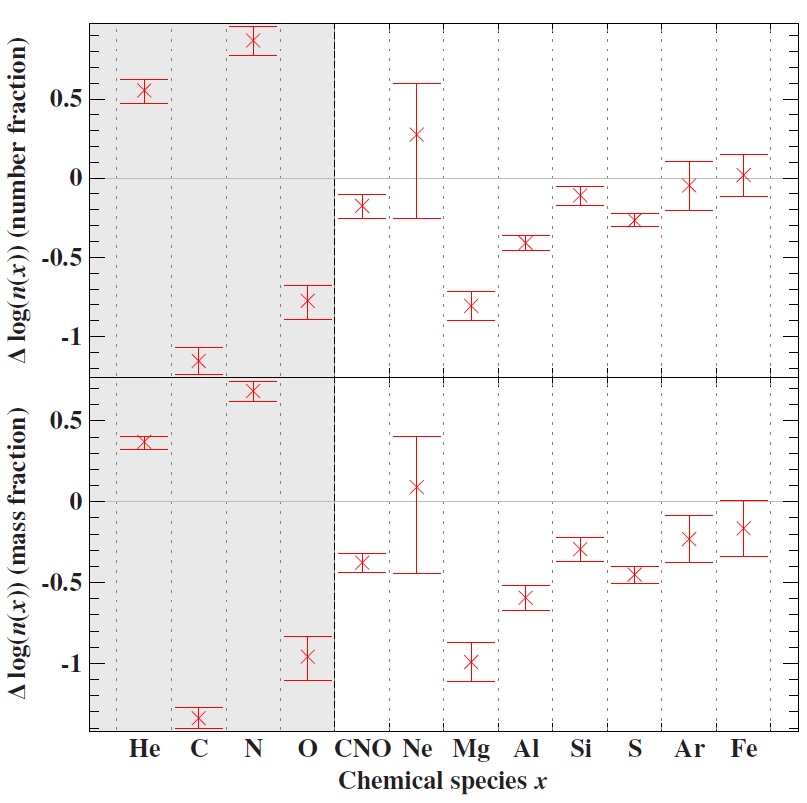
Very recently, the single-lined spectroscopic binary system LB-1 at a distance of 2.3kpc (inferred from the Gaia DR2 parallax) was claimed to contain a black hole of about 70 solar masses. This result is surprising, and would be completely at odds with current stellar evolution models as these do not predict such massive black holes in an environment that is as metal-rich as the Galactic solar neighborhood. In this Letter, the authors present a quantitative spectroscopic analysis of the visible component in LB-1 which reveals that this object is not an ordinary main sequence B-type star as previously assumed. Instead, the derived abundance pattern shows heavy imprints of hydrogen burning via the CNO bi-cycle, indicating that it is actually a stripped helium star. This result overturns the previous interpretation: the revised nature of the visible component significantly lowers the mass estimate to for the unseen companion, allowing values as low as 2-3 Msun; this is no longer in contradiction with stellar evolution models. The exact nature of the companion remains ambiguous for the time-being: it could be an ordinary black hole, a (massive) neutron star, or even a relatively unevolved main sequence star.
A thin shell of ionized gas as the explanation for infrared excess among classical Cepheids (V. Hocdé et al.)
Vol. 633
6. Interstellar and circumstellar matter
A thin shell of ionized gas as the explanation for infrared excess among classical Cepheids
Cepheids have played a crucial role in the distance scale and determination of the present value of the Hubble constant H_0. This distance ladder is, however, mainly based on the period-luminosity relation and uncertainties around this relation are one of the largest contributors to the error of H_0. The IR excess of classical Cepheids is poorly understood but it is likely to affect the PL relation in a systematic way. The authors built a phase-independent spectral energy distribution (SED) of a sample of Cepheids from visible to mid-IR wavelengths, compared the SED to atmospheric models, and derived the IR excess features. Furthermore, they showed that the excess cannot be explained by a hot or cold dust model of the circumstellar environment. A free-free emission from a thin shell of ionized gas around Cepheids can reproduce the observed IR excess. Further investigation is needed to understand the impact of the presence of an ionized gas shell on the PL relation
An in-depth reanalysis of the alleged type Ia supernova progenitor Henize 2-428 (Reindl et al.)
Vol. 638
7. Stellar structure and evolution
An in-depth reanalysis of the alleged type Ia supernova progenitor Henize 2-428
The planetary nebula Hen 2-428 was reported in 2015 to have a double degenerate core with an orbital period of 4.2 hours and, more excitingly, a combined mass of 1.76Msun, which is above the Chandrasekhar mass limit. The period and the mass imply that the system should merge in 700 million years and trigger in a type Ia supernova event. Reindl et al. most recently carried out an in-depth reanalysis of the alleged type Ia progenitor. They show that blends of He II λ 5412 Angstrom with DIBs resulted in an overestimation of the previously reported mass. The new total mass of the double degenerates is 1.08 Msun, a measurement that no longer exceeds the Chandrasekhar mass limit.
Broad-line type Ic SN 2020bvc. Signatures of an off-axis gamma-ray burst afterglow (Izzo et al.)
Vol. 639
1. Letters
Broad-line type Ic SN 2020bvc. Signatures of an off-axis gamma-ray burst afterglow
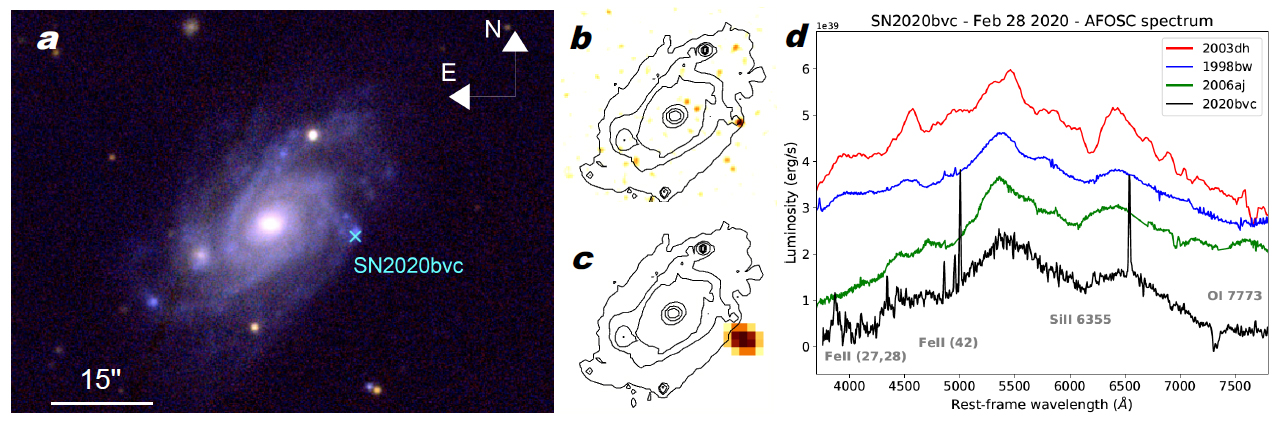
Gamma-ray bursts (GRBs) are the brightest explosions in the Universe. There are two types of GRBs, and the long-duration ones are the outcome of the death of massive stars. A narrow, collimated jet pointing toward the Earth marks the GRB. At the same time, the star explodes giving rise to a supernova. GRBs that explode in the local Universe are almost always associated with broad-line, type Ic supernovae (i.e., those that were stripped more during the evolutionary path which brought them to explode). The supernova emission is isotropic and the GRB emission is collimated: We do expect that most of the type Ic supernovae lack a GRB, being that the Earth was missed by the jet. However, if we are just outside the GRB narrow jet, it is possible to observe an "orphan" GRB, that is to say a relativistic explosion without a high-energy signature. In this letter, Izzo et al. provide strong evidence for an off-axis GRB or choked jet (i.e., a jet which fails to break out from the star). This evidence comes from delayed X-ray emission - GRBs have a decaying X-ray afterglow and supernovae rarely have X-ray emission - and from the very high expansion velocity which is 20% of the speed of light, which were revealed from an early optical spectrum that was taken 1.5 d after the explosion. The off-axis viewing angle is ~25 degrees. The GRB barely missed the Earth and the authors were able to detect the X-ray emission thanks to its closeness of just 120 Mpc.
Common-envelope evolution with an asymptotic giant branch star (Sand et al.)
Vol. 643
7. Stellar structure and evolution
Common-envelope evolution with an asymptotic giant branch star
Common envelope evolution is an unresolved problem in binary evolution and a key for the formation of double compact objects. Hydrodynamic simulations show that the orbital energy released during spiral-in is not able to eject the complete envelope. The recombination energy of hydrogen and helium has long been proposed to play a crucial role during the ejection process. The authors carried out three-dimensional hydrodynamic simulations to study the common envelope evolution of a 1Msol early-AGB star with companions of different masses. They clearly demonstrate how recombination energy works to eject the complete envelope.
Deep Horizon: A machine learning network that recovers accreting black hole parameters (van der Gucht et al.)
Vol. 636
15. Numerical methods and codes
Deep Horizon: A machine learning network that recovers accreting black hole parameters
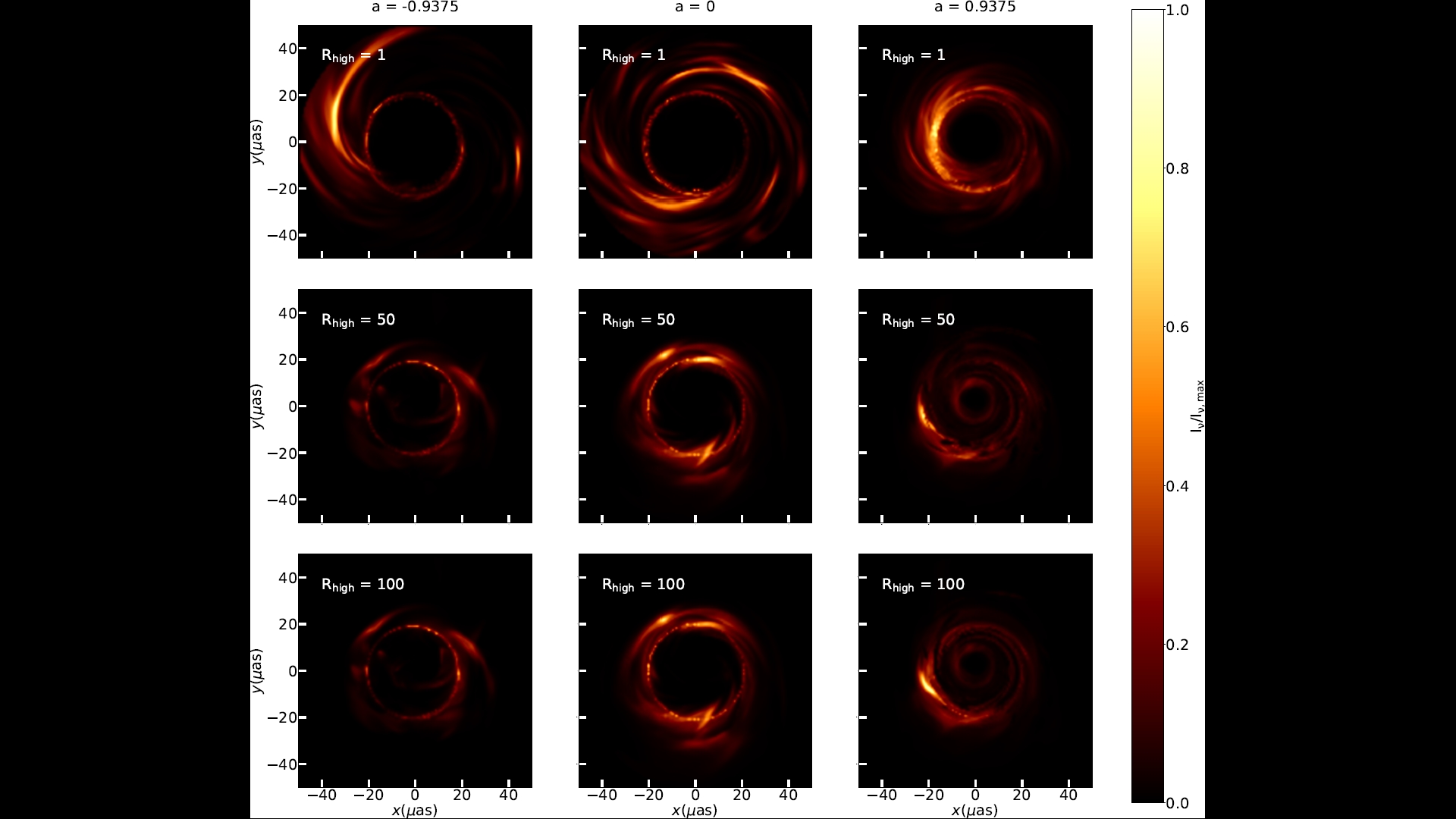
In April 2019, the Event Horizon Telescope released the first ever image of the shadow of a black hole at the center of the M87 elliptical galaxy, dominating the Virgo cluster. These observations were made possible by eight ground-based radio telescopes spread all over the world. In this paper, van der Gucht et al. present a combination of two neural network algorithms that are able to recover the physical parameters of the accreting black hole based on the observed shadow. To train these networks, they used a set of general relativistic simulations of accretion disks around massive black holes, testing a grid of parameters. They discover that with the current resolution, only the mass of the black hole and the mass accretion rate can be safely recovered. To derive further parameters, such as the black hole spin, we would need to go beyond the Earth-based set of radio telescopes and include a space-based radio mission.
Detection of the Geminga pulsar with MAGIC hints at a power-law tail emission beyond 15 GeV
Vol. 643
1. Letters to the Editor
Detection of the Geminga pulsar with MAGIC hints at a power-law tail emission beyond 15 GeV
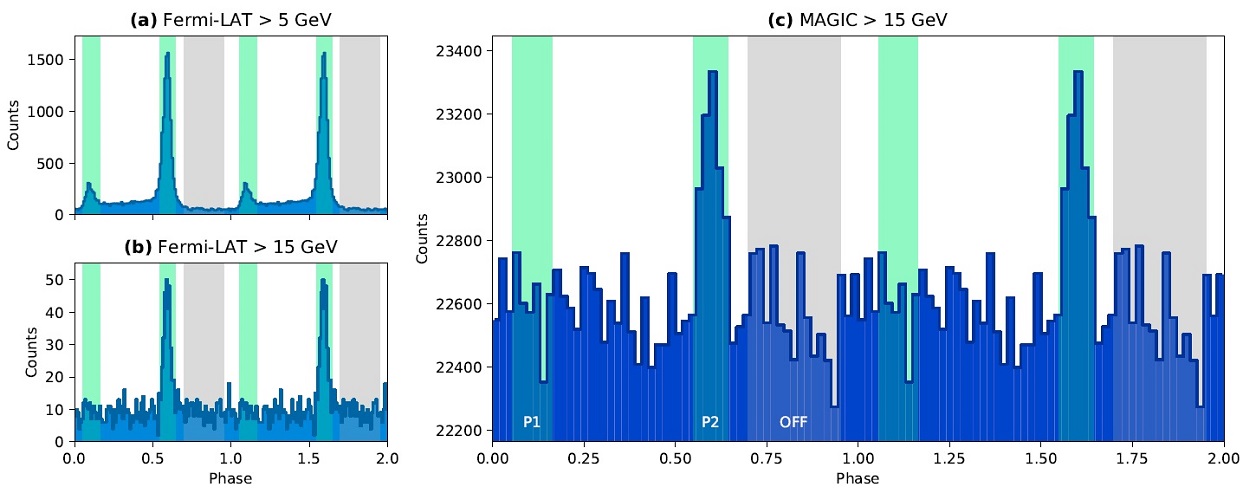
Geminga is the archetypal gamma-ray pulsar with no radio emission. Geminga has been observed up to 30 GeV by the Large Area Telescope (LAT) onboard the Fermi satellite. Previous attempts to detect Geminga by ground-based Cherenkov telescopes were unsuccessful. New observations carried out with the MAGIC telescope have succeeded in revealing a pulsed signal from Geminga up to 75 GeV. Modeling of the spectrum indicates that we are observing Geminga nearly perpendicularly to its rotation axis.
Dust and gas in the central region of NGC 1316 (Fornax A). Its origin and nature (T. Richtler)
Vol. 643
4. Extragalactic astronomy
Dust and gas in the central region of NGC 1316 (Fornax A). Its origin and nature
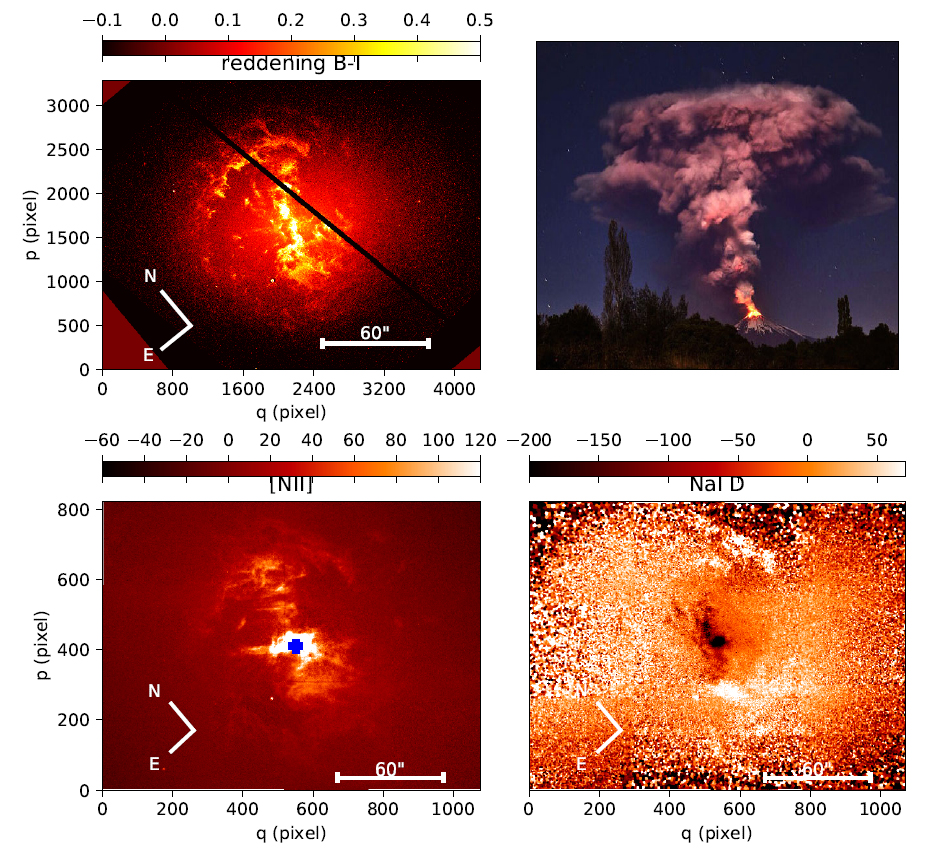
The central galaxy of the Fornax cluster, NGC 1316, is an early-type galaxy that hosts the radio source FornaxA. NGC 1316 reveals a perturbed dust structure within a 5kpc radius as well as gas that is probably accreted from a merger. Using archival HST/ACS color data and MUSE maps of the ionized gas, the authors studied the central stellar population as well as neutral (NaI D-lines) and ionized ([NII]) velocity fields. The excitation of the ionized gas is thought to come from the post-AGB stars of the old- and intermediate-age stellar population. In the dust-free regions, the interstellar NaI D lines appear in emission, which is indicative of a galactic wind. In the very center, a bipolar velocity field of the ionized gas is observed, which is interpreted as an outflow. There is also an almost edge-on gas and/or dust disk along the major axis of NGC 1316. The dust in NGC 1316 appears to have different origins. There exists an outflow that is curved along the line-of-sight. Nuclear outflows may be important dust-producing machines in galaxies. The dusty gaseous disk looks to be a predecessor for a central dust lane.
Effect of wind-driven accretion on planetary migration (Kimmig et al.)
Vol. 633
10. Planets and planetary systems
Effect of wind-driven accretion on planetary migration
 The authors compare the efficiency of the wind-driven accretion process with respect to the viscous accretion process in protoplanetary disks. They show that for the co-orbital region, this wind-driven process always injects mass from the outer edge of the co-orbital region and removes mass from the inner edge, while the viscous process does not. As a consequence, wind-driven accretion may strongly alter our formation scenarios.
Evidence for a rapid decrease of Pluto’s atmospheric pressure revealed by a stellar occultation in 2019 (Arimatsu et al.)
Vol. 638
1. Letters
Evidence for a rapid decrease of Pluto’s atmospheric pressure revealed by a stellar occultation in 2019
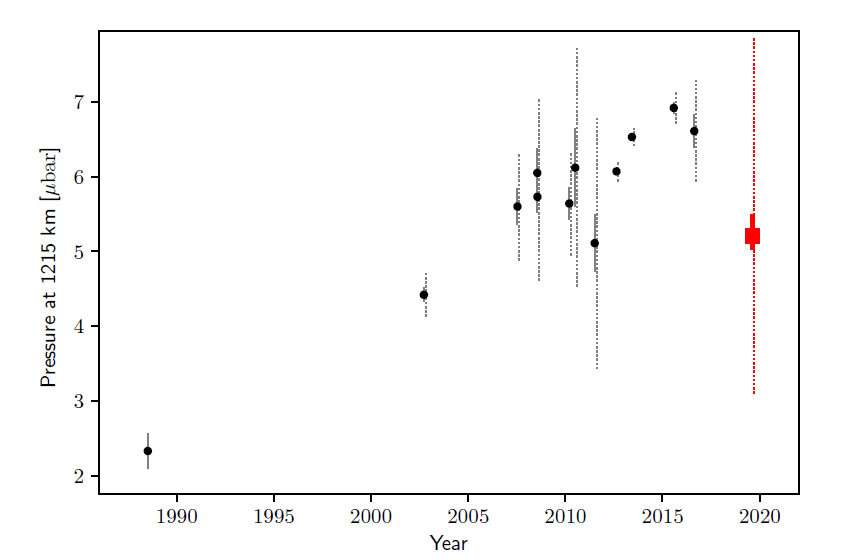
Pluto's atmosphere originates from sublimation-condensation equilibria of surface volatiles, primarily N2. Pluto's strongly elliptical orbit and high obliquity lead to marked seasonal variability of the local insolation. Regular monitoring of stellar occultations over the last 30 years has revealed that although Pluto has been receding from the Sun since 1989, its atmospheric pressure has increased by a factor of ~3 from 1988-2016. Based on climate models, this is best understood to be due to the evolution of insolation over Sputnik Planitia, the largest reservoir of N2 ice on Pluto, and models have predicted that the pressure should progressively decline after 2015, which is a consequence of the subsolar point moving to higher northern latitudes. Using a single-chord stellar occultation observed from Hawaii, Arimatsu et al. determine that Pluto's atmospheric pressure in 2019 was approximately 21% lower than it was in 2016. Although significant at 2.4 sigma only, this result! suggests that Pluto's long-expected atmospheric decline has started, and at a pace faster than anticipated by models, possibly pointing to additional regions of nitrogen ice deposition. Continuing the monitoring of Pluto's atmosphere is needed to confirm the trend and improve our understanding of Pluto's climate and its atmospheric sublimation-condensation cycles.
Explaining the low luminosity of Uranus: a self-consistent thermal and structural evolution (A. Vazan et al.)
Vol. 633
10. Planets and planetary systems
Explaining the low luminosity of Uranus: a self-consistent thermal and structural evolution
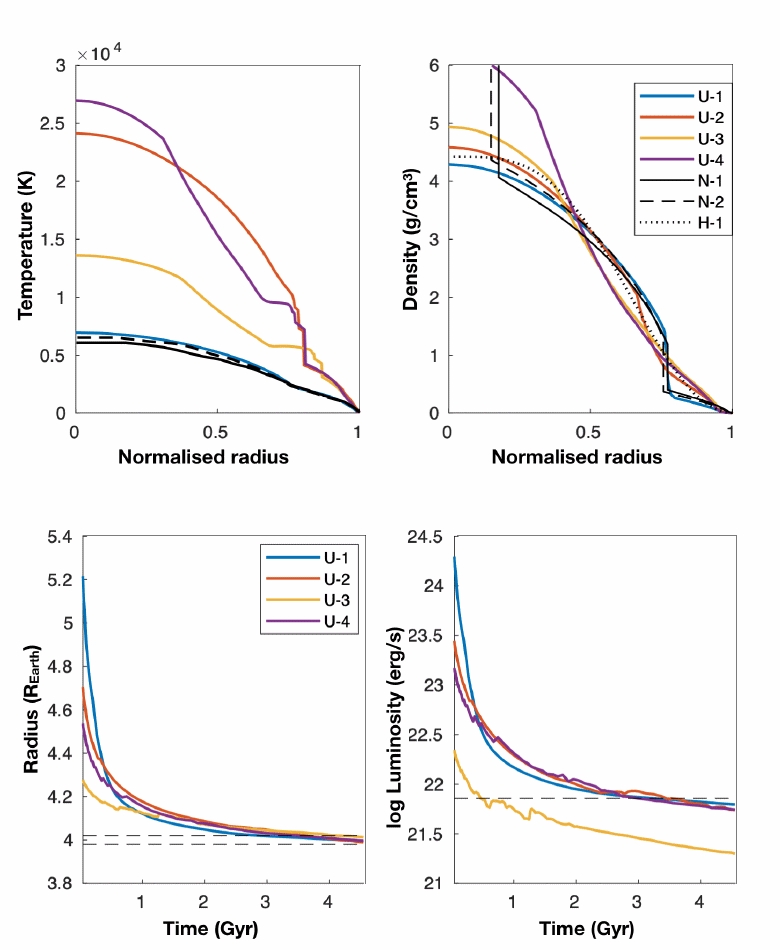
Unlike Jupiter, Saturn, and Neptune, which emit 1.7-2.6 times more energy than they receive from the Sun, Uranus has very low-to-zero intrinsic flux. This long-recognised feature has not been given any satisfactory explanation thus far. The low luminosity of Uranus indicates that its interior is non-adiabatic; either its internal energy has been lost or it remains captured in this interior. The former scenario is unsatisfying as it seems hard to understand why Uranus' interior would already be cold while the other outer planets remain in a cooling phase. Vazan and Helled explore the second possibility and, specifically, that a compositional gradient acts as a thermal boundary, isolating the inner hot region from the outer atmosphere, suppressing convection, and slowing down the cooling. They show that different types of composition gradients are stable over the planet's evolution time and can explain Uranus' observed radius, moment of inertia, and luminosity — without the need for artificial thermal boundaries. They also find that the initial energy content of Uranus was at most 20% of its accretion energy nd that convective mixing is limited in Uranus' outermost region. In contrast to Jupiter and Saturn, the atmosphere of Uranus today may not be very different from that of its primordial state.
Fermi Large Area Telescope observations of the fast-dimming Crab Nebula in 60–600 MeV (Yeung et al.)
Vol. 638
2. Astrophysical processes
Fermi Large Area Telescope observations of the fast-dimming Crab Nebula in 60–600 MeV
The supernova that exploded in 1054 gave rise to the following well-known nebula since the manufacturing of large telescopes: the Crab Nebula, which is the first object in the Messier’s list of nebulae. The Crab Nebula is also one of the brightest objects in the X-ray sky; it consists of a pulsar at its center and a powered wind nebula. The Crab is a very stable object in X-rays and it has been used by astronomers to calibrate instruments since the dawn of X-ray astronomy. At very high energies (60-600 MeV), the Crab is known to produce bright gamma-ray flares at a rate of ~1 per year. In this paper, Yeung and Horns report the discovery of fast dimming in the 60-600 MeV flux from the Crab, observed by the Fermi Large Area Telescope. Typically, the Crab weakens by a factor of ~5 in a timescale of a few days and remains faint for several weeks. This fast variability lends support to models which ascribe to the inner knot of the Crab Nebula (a spot at ~0.3 arcsec from the pulsar itself and visible in Hubble Space telescope images) from which very high energy emission is observed from the Crab, arising as synchrotron emission.
First detection of 13CH in the interstellar medium (Jacob et al.)
Vol. 640
6. Interstellar and circumstellar matter
First detection of 13CH in the interstellar medium
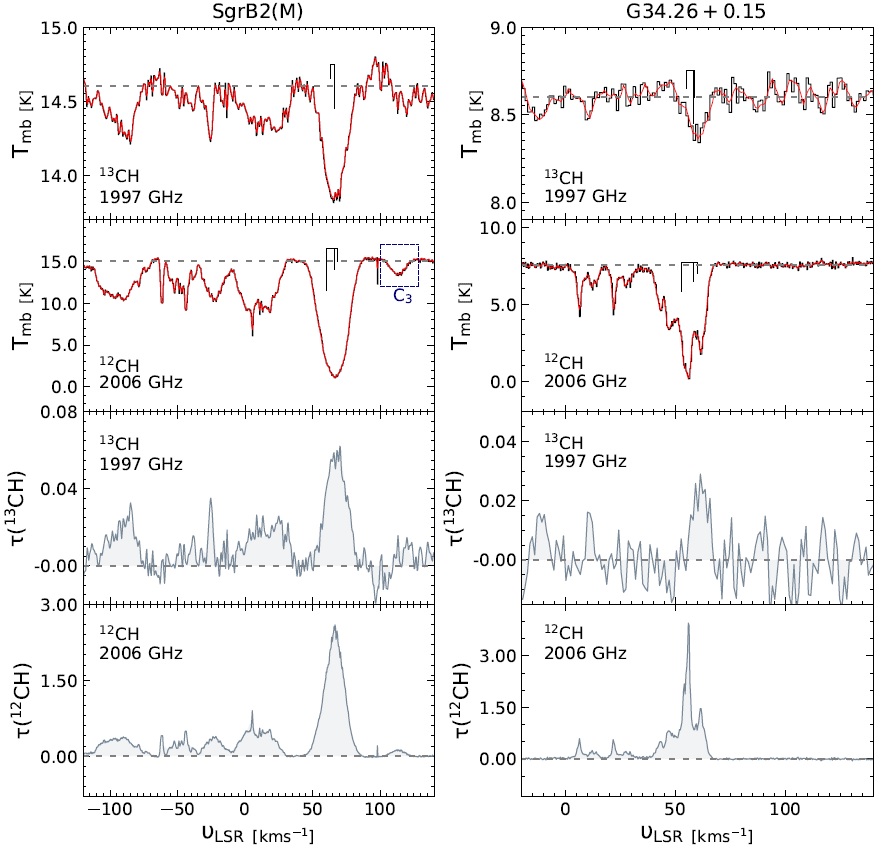 The CH radical has long been recognized as a reliable proxy of molecular hydrogen in diffuse and translucent clouds. Its rare isotopolog $^{13}$CH, however, had been alluded to as a detection in the interstellar medium. In this paper, Jacob et.al present the detection of $^{13}$CH in absorption toward Sgr B2(M) and other galactic star-forming regions using the upGREAT receiver on board SOFIA. Combining these new data with previous observations of the main CH isotopolog toward the same sight lines, the authors have determined an improved estimate for the 12C^13 ratio as a function of the galactocentric distance.
First direct observation of a torsional Alfvén oscillation at coronal heights (P. Kohutova et al.)
Vol. 633
Sect. 1. Letters
First direct observation of a torsional Alfvén oscillation at coronal heights
The magnetized solar atmosphere can support a variety of waves. Torsional, or Alfvén waves, are promising candidates for transporting energy across different layers of the solar atmosphere and have been theoretically predicted for decades. Previous detections of Alfvén waves have, however, so far relied mostly on indirect signatures. Using data from the space-based IRIS observatory, the authors analyzed imaging and spectral observation of a surge of cool solar plasma which is triggered by a magnetic reconnection between open and closed magnetic field lines happening in the solar corona. The IRIS spectral data shows an oscillation in the line-of-sight velocity with a 180° phase difference at opposite edges of the surge flux tube. This signature of torsional oscillation is further complimented with an alternating tilt observable in the Si IV and Mg II k spectra across the flux tube and the trajectories traced by the individual threads of the surge material. Together these provide the first direct observational evidence that magnetic reconnection leads to the generation of large-scale torsional Alfvén waves in the solar corona.
Formation of moon systems around giant planets (Ronnet & Johansen)
Vol. 633
Sect. 10. Planets and planetary systems
Formation of moon systems around giant planets Capture and ablation of planetesimals as foundation for a pebble accretion scenario
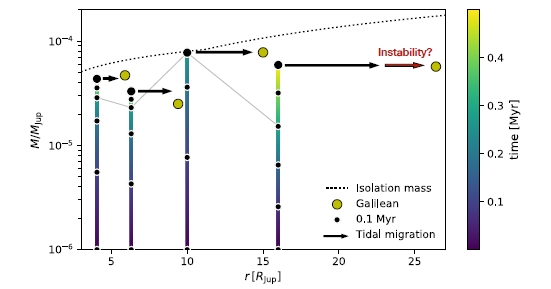
The formation of massive moons around giant planets, such as Jupiter and Saturn, is believed to take place in gaseous circum-planetary disks (CPDs), in a manner analogous to the formation of planets around stars. As a matter of fact, the jovian moons share many similarities with compact super-Earth and terrestrial-mass planet systems around solar-type stars and M-dwarfs. Yet, it remains unclear how the solid material needed to build the moons is brought to the CPDs of giant planets, as well as how the moons subsequently form and evolve out of this material. In this study, the authors show that planetesimals initially orbiting in the vicinity of a giant planet can be gravitationally captured when they interact with the gaseous CPD and experience, in most cases, sufficient frictional heating to be efficiently ablated, thereby feeding the planet’s disk with small dust grains. The authors demonstrate that the moons then mainly grow by accreting the pebbles that coagulate from the dust released via the ablation of planetesimals, and they rapidly migrate inward due to their tidal interaction with the gaseous CPD, resulting in their pile-up in resonant chains at the inner edge of the disk. Dynamical instabilities in these resonant chains could be at the origin of the different architectures of Jupiter’s and Saturn’s moon systems. This scenario is a direct analogy of the one proposed for the formation of super-Earths.
From universal profiles to universal scaling laws in X-ray galaxy clusters
Vol. 644
3. Cosmology
From universal profiles to universal scaling laws in X-ray galaxy clusters
The properties of galaxy clusters are shaped mainly by gravity and astrophysical dissipative processes and show remarkable universal behavior once they are rescaled by halo mass and redshift. In this work, the authors show that a universal pressure profile of the intracluster medium (ICM) combined with a halo–mass concentration–redshift relation and the hydrostatic equilibrium equations allow for the reconstruction of the radial profiles of the thermodynamical quantities. When they are integrated over a characteristic scale (such as the commonly used R500 radius), as was done in the observations, they produce the most important physical quantities for characterizing clusters, that is to say, the total mass, gas mass, temperature, and so on. These quantities in turn satisfy universal scaling laws. Using a large sample of clusters from the Planck observations, which have homogeneous X-ray data, the authors calibrate the predicted scaling laws. Their model not only reproduces the observed scaling laws well, but it also provides a way to interpret possible deviations from this self-similar behavior of galaxy clusters. For example, this comparison allows for the quantification of the effect of gas clumping on the studied sample.