


2020 Highlights
The origin of tail-like structures around protoplanetary disks (Vorobyov et al.)
Vol. 635
6. Interstellar and circumstellar matter
The origin of tail-like structures around protoplanetary disks

The origin of the enigmatic tail-like structures recently detected around the disks of several young stars was studied using numerical hydrodynamics simulations. Two possible formation mechanisms were considered: ejections of gaseous clumps from dynamically unstable protostellar disks and close encounters between quiescent protoplanetary disks and intruder stars. The authors demonstrate that ejected clumps produce a unique type of tail that is characterized by a bow-shock shape. Such tails originate from the supersonic motion of clumps ejected through the dense envelope that often surrounds young protostellar disks. On the other hand, close encounters between an intruder star and a protoplanetary disk produce three types of such tail-like structures. The authors define these as pre-collisional, post-collisional, and spiral tails. These tails can be distinguished from one another by particular features of the gas and dust flow in and around them. The estimated mass of gas and dust in the tail can amount to tens of Jovian and Earth masses, respectively, which is higher than what was inferred for similar structures in SU Aurigae and FU Orionis. The authors argue that tail-like structures around protostellar and protoplanetary disks can be used to infer interesting phenomena, such as clump ejection or close encounters. In particular, the bow-shock morphology of the tails could point to clump ejections as a possible formation mechanism.
The path to instability in compact multi-planetary systems
Vol. 641
10. Planets and planetary systems
The path to instability in compact multi-planetary systems

Three or more compact planetary systems can become unstable on timescales of up to billions of years. Predicting their stability is challenging and numerically expensive due to the chaotic dynamics, and, until now, there has been no theoretical understanding of the nature of the mechanism driving the instability. Based on numerical simulations, it had been postulated that the system's survival time follows an exponential trend in the planet orbital separation measured in units of Hill radii. Contrary to a constant diffusion process, planetary systems seem to remain dynamically quiescent for most of their lifetimes prior to a very short unstable phase. In this work, Petit and colleagues study a two-phase mechanism in which the slow chaotic diffusion due to the overlap of three-body resonances dominates the instability timescale prior to a rapid scattering phase triggered by the crossing of a two-planet mean motion resonance. They obtain an analytical estimate of the survival time that is consistent with numerical simulations over four orders of magnitude for the planet-to-star mass ratio, and six to eight orders of magnitude for the instability time. They also confirm that measuring the orbital spacing in terms of Hill radii is not suitable and that the correct spacing unit scales have a flatter dependency in the planet mass. Their model reproduces the observation that the survival time increases beyond a certain spacing since the three-planet resonances do not overlap.
The solar gravitational redshift from HARPS-LFC Moon spectra. A test of the general theory of relativity (Gonzalez Hernandez et al.)
Vol. 643
13. Astronomical instrumentation
The solar gravitational redshift from HARPS-LFC Moon spectra. A test of the general theory of relativity

The general theory of relativity predicts that the wavelengths of solar spectrum lines should be shifted redwards compared to laboratory wavelengths by about 633 m/s in velocity scale. However, the competing blueshift due to granulation phenomena produced by convection makes an accurate observational test of this prediction extremely challenging. This paper presents the most accurate measurement of the solar gravitational redshift to date. The authors employed the laser frequency comb calibration system attached to the HARPS spectrograph on the ESO 3.6 m telescope at La Silla and observations of the sunlight reflected off the moon. State-of-the-art 3D hydrodynamical models of the solar atmosphere were then employed to analyze the spectral lines and measure an accurate gravitational redshift value, which is in full agreement with the theoretical prediction.
The spatially resolved broad line region of IRAS 09149-6206 (GRAVITY Collaboration)
Vol. 635
4. Extragalactic astronomy
The spatially resolved broad line region of IRAS 09149-6206

The GRAVITY collaboration reports on near-infrared interferometric spectra of the Br-gamma line, resolving the broad line region (BLR) of a nearby active galaxy nucleus (AGN). They are able to measure the size of the BLR (radius 0.075pc) and estimate the mass of the black hole (10^8 M_sun). These results are compatible with average values that have been measured in nearby AGNs through reverberation mapping as well as with the standard M_BH-sigma relation. A surprising result is the 0.14 pc offset between the BLR and the centroid of the hot dust distribution, which is traced by the 2.3 micron continuum. The hot dust is thought to be distributed in a ring, with a measured radius of 0.35 pc, since the high temperature inside the ring sublimates the dust. The offset falls well inside the ring and is thought to be due to the brightness asymmetry of the ring. A clear velocity gradient, almost perpendicular to the offset, is interpreted as the Keplerian rotation of the BLR.
THOR data release 2 (Y. Wang et al.)
Vol. 634
6. Interstellar and circumstellar matter
The HI/OH/recombination line survey of the inner Milky Way (THOR): data release 2 and H I overview
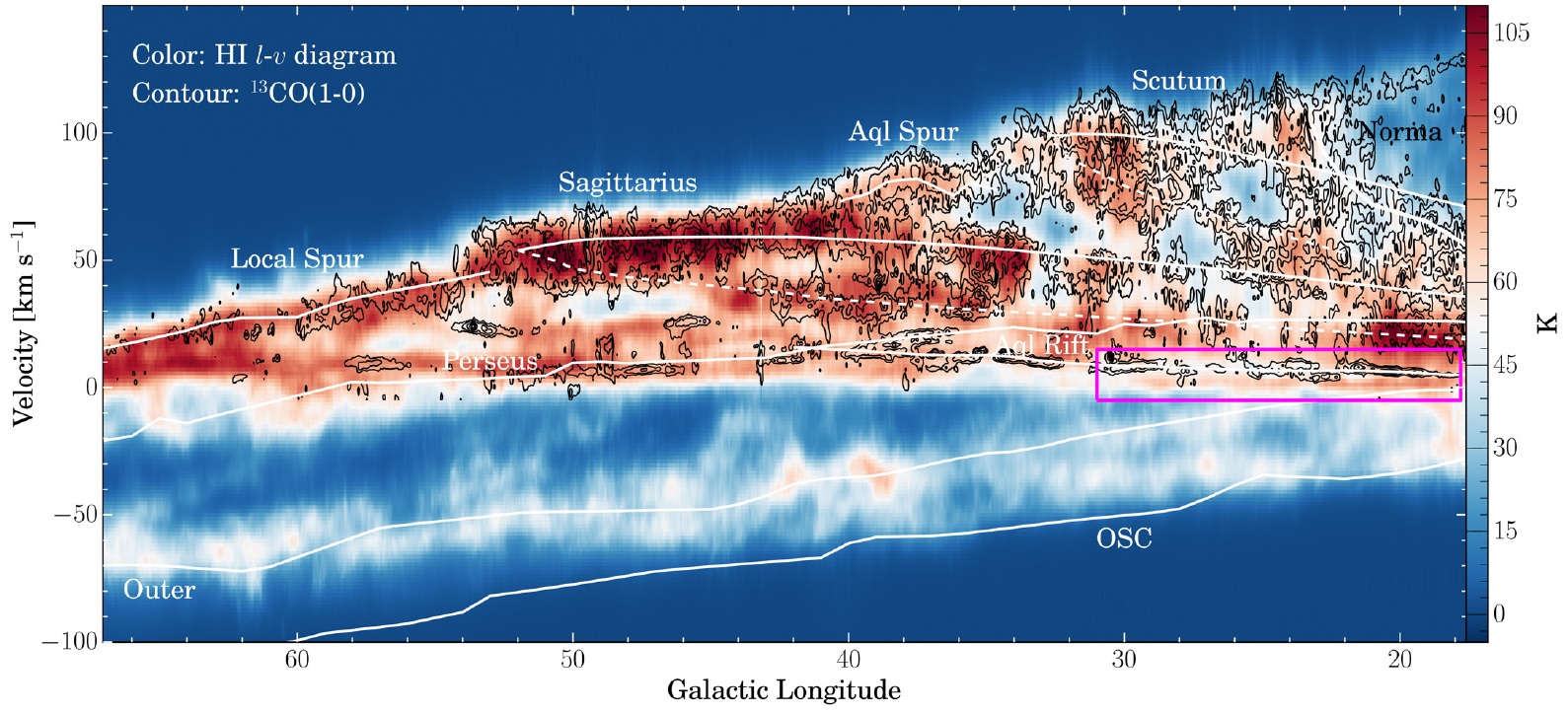 The Data Release 2 of The HI/OH/recombination line survey of the Milky Way (THOR) provides the most detailed view so far of the first Galactic quadrant at a 21 cm wavelength. The authors have combined observations from the Karl G. Jansky Very Large Array (VLA) and Green Bank Telescope (GBT) to recover the large-scale structure of the HI emission and achieve an angular resolution of 40". Among their results, the authors derive an opacity-correction factor that implies a total atomic gas mass of 9.4–10.5x10^9 M_sun when applied to the entire Milky Way.
Tracing the anemic stellar halo of M101 (In Sung Jang et al.)
Vol. 637
4. Extragalactic astronomy
Tracing the anemic stellar halo of M101
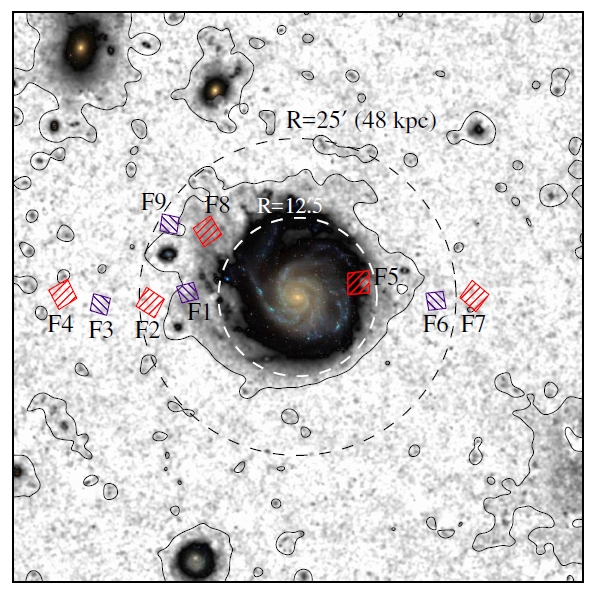
Cosmological models of galaxy formation show that disk galaxies are embedded in extended stellar halos. However, previous studies of some disk galaxies have failed to detect this stellar component. This was the case of the prototypical disk galaxy M101, for which it has been suggested that it lacked this stellar halo component. In using optical imaging with the Hubble Space Telescope (HST), it is now possible to resolve M101 stars and map their halo out to 70 kpc from the center. The new color-magnitude diagrams reach down to two magnitudes fainter than the tip of the red giant branch (RBG). This allowed HST to trace the M101 halo component down to very faint surface brightness (μg ≈ 34 mag arcsec−1). The stellar population is found to be similar to that of metal-poor globular clusters in the Milky Way based on the mean color of the RGB stars. The HST star counts also allowed the authors to measure the total halo mass of M101, which is small in comparison to! Well studied galaxies, such as the Milky Way or M31. Indeed, the comparison with the other six galaxies from the same survey shows that M101 has an anemic stellar halo.
Tracing the total molecular gas in galaxies: [CII] and the CO-dark gas (Madden et al.)
Vol. 643
4. Extragalactic astronomy
Tracing the total molecular gas in galaxies: [CII] and the CO-dark gas
The CO molecule is the tracer of choice for inferring the amount of star-forming molecular hydrogen gas in our Galaxy and other galaxies with similar metallicities. In low-metallicity systems like dwarf galaxies, however, CO can fail to trace the full reservoir of H2 due to the presence of large quantities of molecular gas where CO has been photodissociated by penetrating far ultra-violet radiation. To account for this CO-dark gas, Suzanne Madden and collaborators have systematically studied the use of CII. Using grids of Cloudy models that span a variety of physical conditions and metallicities, these authors provide recipes for deriving total H2 mass estimates from CII observations. Using these models, they find that 70% to 100% of the total H2 mass in dwarf galaxies is not traced by CO(1-0) but is well traced by the λ 158 μm line of CII. When this CO-dark gas is accounted for, the dwarf galaxies are found to follow the same Schmidt-Kennicutt relation identified in more metal-rich disk galaxies.
Understanding and improving the timing of PSR J0737-3039B (Noutsos et al.)
Vol. 643
7. Stellar structure and evolution
Understanding and improving the timing of PSR J0737-3039B
The double pulsar (PSR J07373039A/B) is the only known system consisting of two radio pulsars in a 2.5hr orbit. Given its unique characteristics, and thanks to its incredible inclination of 89 degrees, it is our best laboratory for general relativity studies. Past studies have concentrated on pulsar A, a recycled millisecond pulsar spinning at 23 ms. Pulsar B is a normal pulsar spinning at 2.8 s. Being less powerful by a factor of ~3500, pulsar B is heavily embedded in the relativistic wind of pulsar A. In this paper, Noutsos and collaborators study pulsar B in detail, notably its emission during the time interval 2004-2008 when the pulsar was detectable before moving away from the line of sight due to geodetic precession. They have developed a model for the pulsar emission beam and its interaction with pulsar A's wind, and they make predictions for 2024 when pulsar B should become visible again. This will allow for more precise testing of the geodetic precession.
Unexpected late-time temperature increase observed in the two neutron star crust-cooling sources XTE J1701-462 and EXO 0748-676 (Parikh et al.)
Vol. 638
1. Letters
Unexpected late-time temperature increase observed in the two neutron star crust-cooling sources XTE J1701-462 and EXO 0748-676
During an X-ray outburst, a transient neutron star accretes matter which then heats the crust. After the outburst has ended, the neutron star cools, providing invaluable insights into the properties of the crust. Without further sources of heat, the compact object is expected to continue to cool. This simple physical picture is challenged by the observations presented in this Letter, in which a late time rise in temperature has been observed in two transient systems years after the outburst ended. As the authors have stated, this rise in temperature is unexplained. Further studies should lead to a deeper understanding of the dense matter physics.