

You can’t see me: Super-Eddington growth hindering X-ray detection in high-z broad-line active galactic nuclei
- Details
- Published on 18 June 2026
Vol. 710
4. Extragalactic astronomy
You can’t see me: Super-Eddington growth hindering X-ray detection in high-z broad-line active galactic nuclei
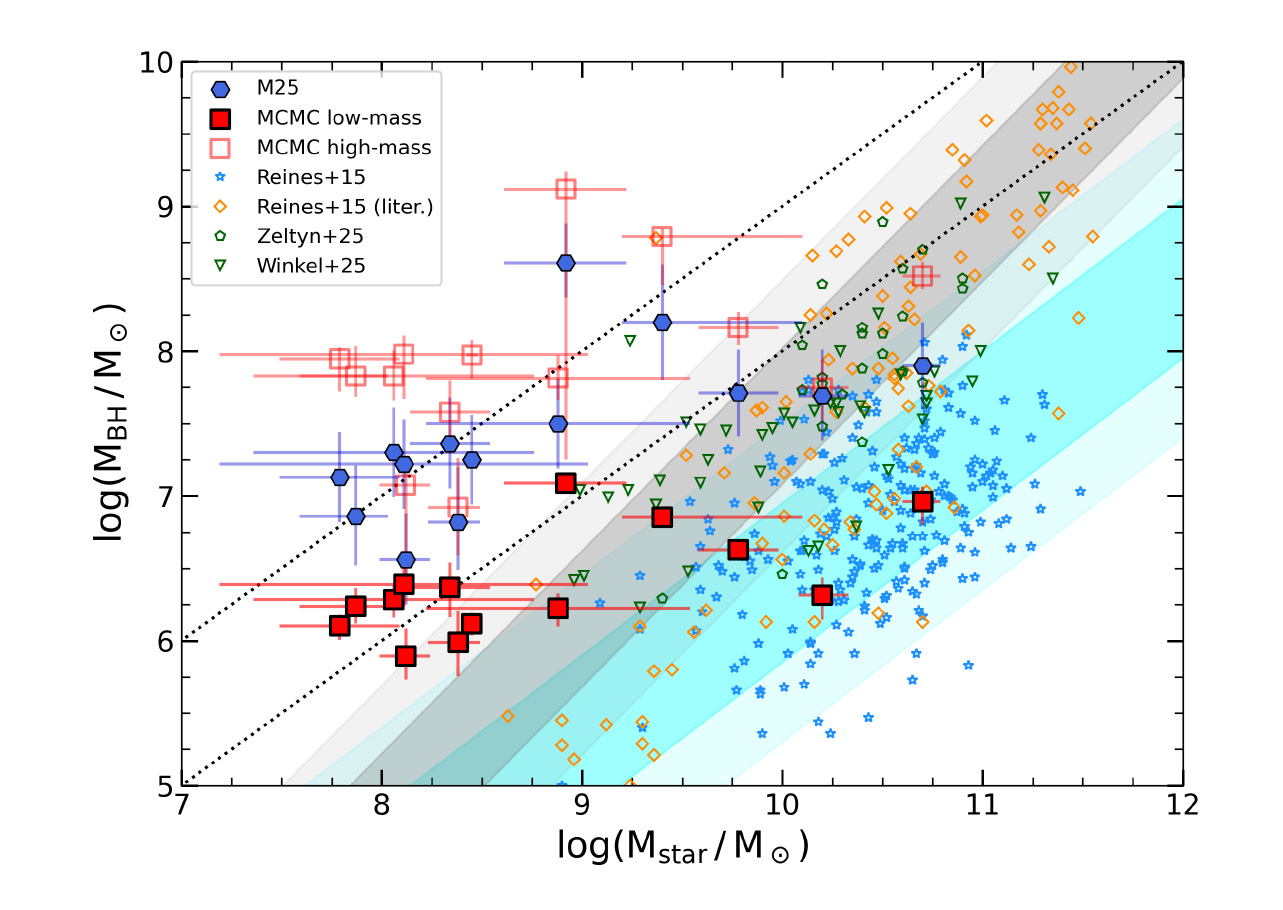
Massive black holes (MBHs) play an important role in the evolution of galaxies, as active galactic nucleus (AGN) activity impacts the formation of their stellar mass component. Consequently, understanding MBH growth is essential to extragalactic astrophysics. High redshift data from JWST and ALMA have recently sparked interest in MBHs, as several detected systems exhibit masses that are challenging to reconcile with the young age of the early Universe. While a well-defined correlation exists between stellar mass and central black hole mass in lower redshift galaxies, high-redshift AGNs frequently display unusually high (BH-to-stellar) mass ratios. Furthermore, the weak or absent X-ray emission in these systems challenges standard, lower-redshift AGN growth models. This paper revisits the data with alternative models of MBH evolution, finding that lower mass MBHs accreting at super-Eddington ratios would better reconcile the well-established trends between black hole mass and stellar mass. In this scenario, weak X-ray emission is explained by a confined, over-cooled corona within a narrow super-Eddington funnel. These findings suggest that the growth mode of many AGNs at high redshift is markedly different from their lower redshift counterparts.
The figure illustrates that the low BH mass solution (filled red squares) brings these galaxies into closer alignment with the low-redshift scaling relation, whereas traditional interpretations (filled circles) render them as outliers. Moreover, the secondary solution of the models (open red squares) predicts even higher masses, placing them further from the expected relation.