


Fig. 6
Download original image
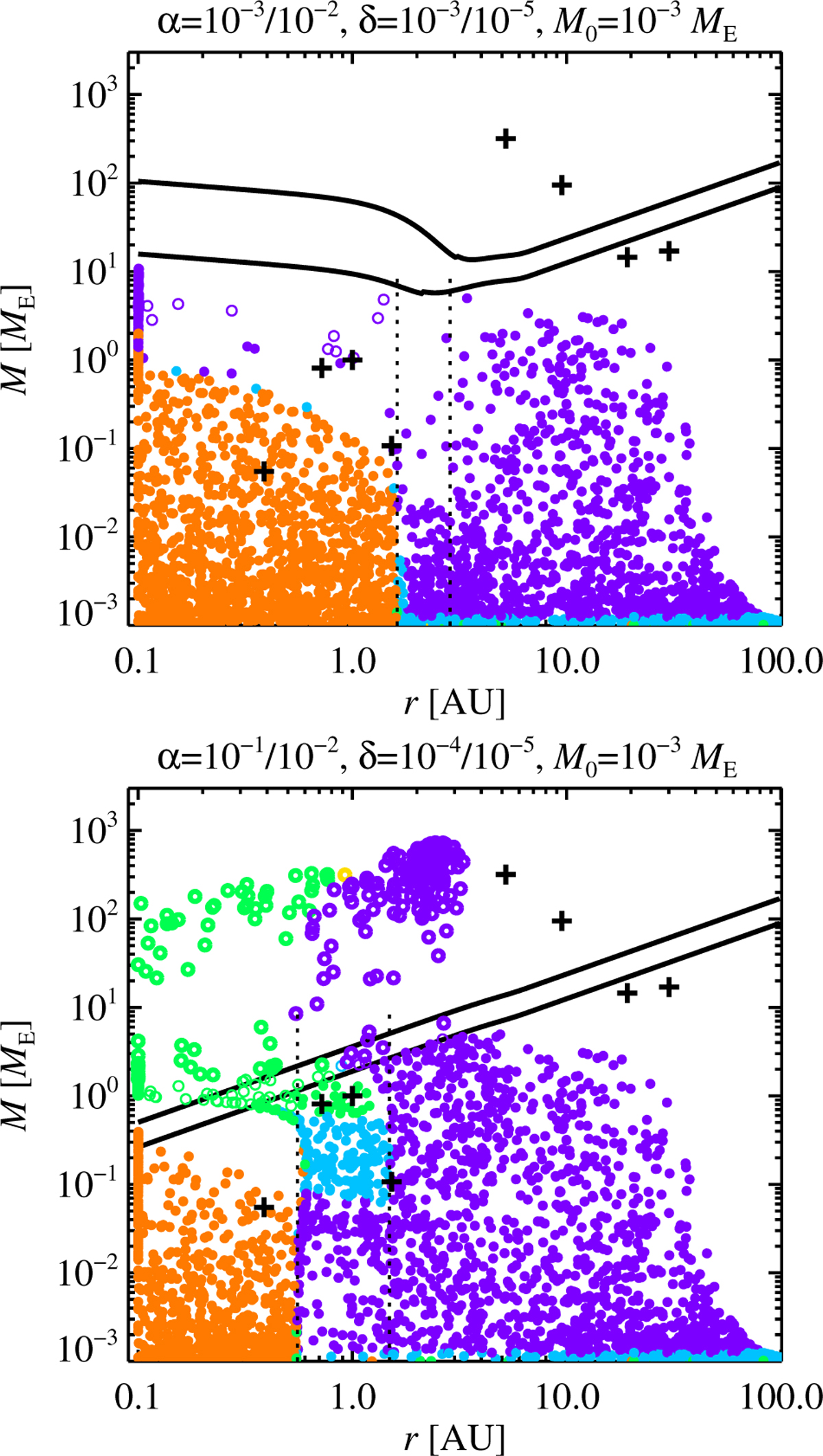
Comparison of two models with angular momentum transport coefficient α = 10−2 outside of 5 AU and a lower value (α = 10−3; top) or a higher value (α = 10−1; bottom) inside of 5 AU. We fix the initial planetesimal mass to M0 = 10−3 ME and the starting times between 0.5 and 5 Myr, to probe the effect of early collisional evolution. In the low-α case, we use δ = α = 10−3 to additionally probe the effect of viscous heating, which pushes the ice line outwards to 1.5–3 AU. Pebble accretion is strongly suppressed by the high temperatures in the inner disc and all planets ending up in this region have migrated from more distant orbits beyond the water ice line. In the case of higher α, migration is strongly reduced due to lower gas column densities in the inner disc, which suppresses the migration of super-Earths and sub-Neptunes to the disc edge. Lower-mass rocky planets form more or less in situ with this reduced migration.
Current usage metrics show cumulative count of Article Views (full-text article views including HTML views, PDF and ePub downloads, according to the available data) and Abstracts Views on Vision4Press platform.
Data correspond to usage on the plateform after 2015. The current usage metrics is available 48-96 hours after online publication and is updated daily on week days.
Initial download of the metrics may take a while.