

Planetary formation tracks on the Hertzsprung--Russell diagram. Visualising the processes of giant planet growth
- Details
- Published on 10 July 2026
Vol. 711
10. Planets, planetary systems, and small bodies
Planetary formation tracks on the Hertzsprung--Russell diagram. Visualising the processes of giant planet growth
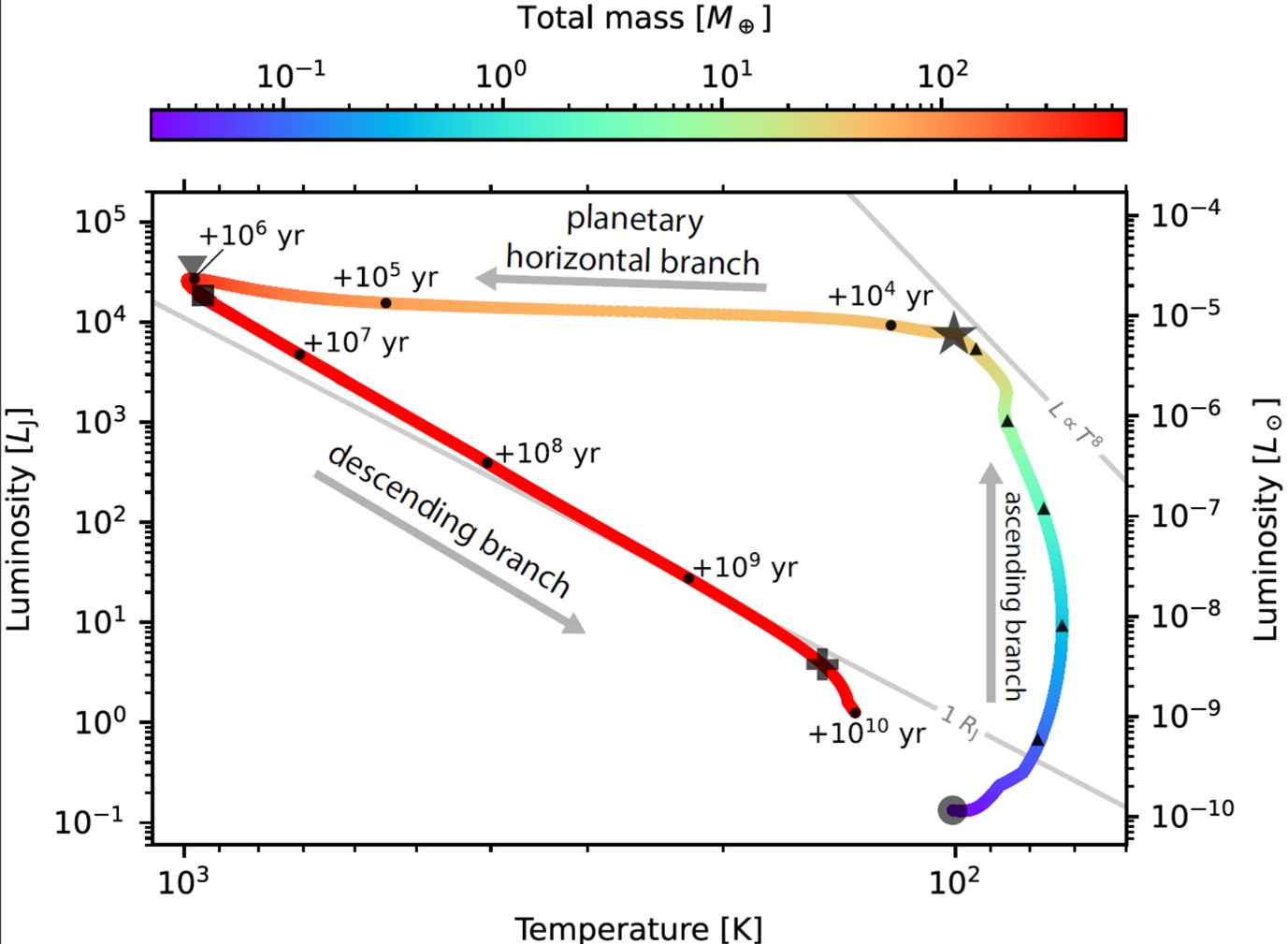
For over a century, the Hertzsprung–Russell (HR) diagram, a representation of the (observational or theoretical) luminosity-temperature relation in stars, has been a cornerstone in understanding stellar evolution, from the formation of stars to their final stages. Motivated by the emerging observational constraints on young forming or recently formed planets, and exploiting the global Bern planet formation and evolution model, Gottstein et al. here extend the HR diagram framework to visualize planet formation and evolution, investigating how gas and solid accretion, cooling and contraction, and orbital migration altogether shape evolutionary tracks under different formation scenarios. The planetary HR diagram shows three branches, each associated with a distinct formation and/or evolution phase. In the “ascending branch,” during which the planet is still deeply embedded in the protoplanetary disk, it gains almost all its new mass and luminosity from solid accretion; this phase is heavily influenced by the accretion mode (planetesimal vs. pebble) and planet migration. In the second phase, the “planetary horizontal branch,” gas accretion becomes disk-limited; the planet detaches from the disk, subsequently contracts, and its surface temperature increases dramatically. Finally, in the “descending branch,” the planet further contracts and cools at constant mass and with only small changes in radius, leading to diagonal tracks with L proportional to T^4. While comparisons with directly imaged planets in this third phase indicate broad agreement with predictions, observationally populating the first two, short-lived branches is more challenging. Further theoretical work is needed to refine the model in the early phases of the evolution (e.g., by including the effect of accretion-shock emission and circumplanetary-disk reprocessing) and enhance its predictive power. Still, this work represents a novel and promising framework for interpreting planetary formation and evolution.