

Three factors that are irrelevant in the optical and X-ray domains play a role in the description of the longer radio wavelengths and the early radio AG. In this section we discuss the first one of them.
Electrons that enter a CB with an injection Lorentz factor  are rapidly Fermi accelerated to a distribution that we have argued
to be roughly that of Eq. (9). On a longer time scale, they
lose energy by synchrotron radiation, and their
energy distribution evolves as in Eq. (11).
Electrons with a large
are rapidly Fermi accelerated to a distribution that we have argued
to be roughly that of Eq. (9). On a longer time scale, they
lose energy by synchrotron radiation, and their
energy distribution evolves as in Eq. (11).
Electrons with a large
![$\gamma\sim {\cal{O}}\,[\gamma(t)]$](/articles/aa/full/2003/13/aa2654/img123.gif) emit
synchrotron radiation, with no significant time-delay,
at the observer's optical and X-ray wavelengths.
But the emission of radio is delayed by the time it takes the electrons
to ``descend'' to an energy at which their characteristic emission
is in the observer's radio band. At the start of the afterglow, when
equilibrium conditions have not yet been reached, this implies a
dearth of radio emission relative to the higher-frequency bands.
This introduces a ``cumulation factor''
emit
synchrotron radiation, with no significant time-delay,
at the observer's optical and X-ray wavelengths.
But the emission of radio is delayed by the time it takes the electrons
to ``descend'' to an energy at which their characteristic emission
is in the observer's radio band. At the start of the afterglow, when
equilibrium conditions have not yet been reached, this implies a
dearth of radio emission relative to the higher-frequency bands.
This introduces a ``cumulation factor''
 in Eq. (6).
Consider a fixed observed radio frequency
 .
It corresponds to a time changing frequency
.
It corresponds to a time changing frequency
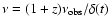 in the CB system.
The CB electrons preferentially emitting at this frequency (over an
unconstrained range of pitch angles) are those
whose Lorentz factor
in the CB system.
The CB electrons preferentially emitting at this frequency (over an
unconstrained range of pitch angles) are those
whose Lorentz factor
 satisfies the relation
 ,
in analogy to Eq. (3). To
estimate
,
in analogy to Eq. (3). To
estimate![[*]](/icons/foot_motif.gif) the time
the time
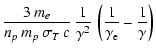
 it takes an electron to decelerate from
 to
to
 ,
substitute the magnetic
energy density of Eq. (1) into the electron energy loss of Eq. (10)
and integrate, to obtain
,
substitute the magnetic
energy density of Eq. (1) into the electron energy loss of Eq. (10)
and integrate, to obtain
 is given by Eq. (37) of Appendix A,
which we may rewrite as:
is given by Eq. (37) of Appendix A,
which we may rewrite as:
![\begin{displaymath}{1\over \gamma^2} = {1\over \gamma_0^2}\left[1+{t\over t_0}\right]
\end{displaymath}](/articles/aa/full/2003/13/aa2654/img134.gif)
 ,
so that the proper CB times
,
so that the proper CB times
 and t0 are of
 year,
corresponding to observer's times - foreshortened
by a factor
year,
corresponding to observer's times - foreshortened
by a factor
 - of
day.
For optical and radio observations
- of
day.
For optical and radio observations
 there is no significant delay in their emission. Moreover, the
electron accumulation rate (
there is no significant delay in their emission. Moreover, the
electron accumulation rate (
 in the
CB system) is orders of magnitude larger than the characteristic
synchrotron cooling time
in the
CB system) is orders of magnitude larger than the characteristic
synchrotron cooling time
 of Eq. (10), even for
 .
Thus, the optical and X-ray AG emission
starts as soon as the CB is transparent to its enclosed radiation: for
each CB, a few observer's seconds after the corresponding -ray
pulse (DDD 2001). The radio signal, on the other hand, must await
a time
for the
cumulated electrons to cool down.
.
Thus, the optical and X-ray AG emission
starts as soon as the CB is transparent to its enclosed radiation: for
each CB, a few observer's seconds after the corresponding -ray
pulse (DDD 2001). The radio signal, on the other hand, must await
a time
for the
cumulated electrons to cool down.
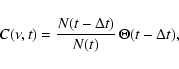
The simple way to parametrize the frequency-dependent
``cumulation effect'' is to use the expression for the total number
of electrons N(t) incorporated by the CB up to time t
(Eq. (40) of Appendix A) and to posit:
 ,
and the sharp start at
,
and the sharp start at
 is an artifact of our simplifications.
For optical and X-ray frequencies,
is an artifact of our simplifications.
For optical and X-ray frequencies,
 and
and
 .
In practice we find that, except for GRB 980425 whose viewing angle
is exceptionally large, one may also use within the radio band an
approximation to Eq. (17):
.
In practice we find that, except for GRB 980425 whose viewing angle
is exceptionally large, one may also use within the radio band an
approximation to Eq. (17):
Copyright ESO 2003

![$\displaystyle [8.27\times 10^7\,{\rm s}]\left[{{10^{-3}\,{\rm cm}^{-3}}\over{n_...
...10^6\over \gamma^2}\,
\left({1\over \gamma_{\rm e}}-{1\over \gamma}\right)\cdot$](/articles/aa/full/2003/13/aa2654/img133.gif)
![\begin{displaymath}t_0\equiv [5.14\times 10^7\, {\rm s}]
\left[{x_\infty\over 1\;{\rm Mpc}}\right]
\left[{10^3\over \gamma_0}\right]^2.
\end{displaymath}](/articles/aa/full/2003/13/aa2654/img135.gif)
![\begin{displaymath}C(\nu,t)\sim C(t)=\left[1-{\gamma(t)\over\gamma_0}\right]^{1/2},
\end{displaymath}](/articles/aa/full/2003/13/aa2654/img149.gif)