In this paper we reported the preliminary evidence for an association of galaxy clusters with unidentified, high
galactic latitude (|b|>20  )
gamma-ray sources in the Third EGRET catalog. Our selection criteria
eventually allowed us to identify 9 EGRET sources most probably associated to 12 galaxy clusters (see the sources
marked with an asterisk in Table 1) which have the following characteristics:
i) the clusters are found within the
)
gamma-ray sources in the Third EGRET catalog. Our selection criteria
eventually allowed us to identify 9 EGRET sources most probably associated to 12 galaxy clusters (see the sources
marked with an asterisk in Table 1) which have the following characteristics:
i) the clusters are found within the  confidence level position error contours of the relative EGRET source
map for which there is no other known counterpart;
ii) the selected EGRET sources have flux
confidence level position error contours of the relative EGRET source
map for which there is no other known counterpart;
ii) the selected EGRET sources have flux
 and flux
variability
and flux
variability 
 over their viewing periods;
iii) the gamma-ray spectral index of the EGRET source are found in the range
over their viewing periods;
iii) the gamma-ray spectral index of the EGRET source are found in the range  2 - 3;
iv) the 12 galaxy clusters which are most probably associated with the previous 9 unidentified
EGRET sources have bright radio sources (identified radio galaxies,
radio halo/relic, NVSS bright radio source) in the cluster environment;
v) the nine EGRET sources selected according to the previous criteria show a
correlation
2 - 3;
iv) the 12 galaxy clusters which are most probably associated with the previous 9 unidentified
EGRET sources have bright radio sources (identified radio galaxies,
radio halo/relic, NVSS bright radio source) in the cluster environment;
v) the nine EGRET sources selected according to the previous criteria show a
correlation
 between their gamma-ray flux,
 ,
and the radio flux at 1.4 GHz, S1.4, of the brightest radio source in the associated clusters;
vi) the same EGRET sources and the same clusters show also a correlation,
,
and the radio flux at 1.4 GHz, S1.4, of the brightest radio source in the associated clusters;
vi) the same EGRET sources and the same clusters show also a correlation,
 between the gamma-ray luminosity at E > 100 MeV,
 ,
of the EGRET
source and the X-ray luminosity,
,
of the EGRET
source and the X-ray luminosity,  ,
of the associated clusters.
,
of the associated clusters.
From our analysis of the sample listed in Table 1, we expected a priori a spatial
correlation between unidentified EGRET sources and galaxy clusters at the 
 confidence level (see
Sect. 2). We noticed, however, that this should be considered as a lower limit to the true statistical confidence
level of the correlation since the effect of the non-uniform EGRET sky coverage has to be taken into account and
it would tend to increase the statistical significance level of the EGRET-cluster spatial correlation (see Sect. 2
for a discussion). The detailed analysis (see Sect. 3) of each specific EGRET source yielded a most probable
spatial association between 9 EGRET sources and 12 Abell clusters selected from the original list
of 18 EGRET sources associated with 24 clusters given in Table 1: such a spatial
correlation is found at
confidence level (see
Sect. 2). We noticed, however, that this should be considered as a lower limit to the true statistical confidence
level of the correlation since the effect of the non-uniform EGRET sky coverage has to be taken into account and
it would tend to increase the statistical significance level of the EGRET-cluster spatial correlation (see Sect. 2
for a discussion). The detailed analysis (see Sect. 3) of each specific EGRET source yielded a most probable
spatial association between 9 EGRET sources and 12 Abell clusters selected from the original list
of 18 EGRET sources associated with 24 clusters given in Table 1: such a spatial
correlation is found at  confidence level and might decrease to
 eliminating the still questionable case of the spatial association between Abell 1688 and 3EGJ1310-0517
(see Fig. 4).
Note, again, that this is a lower limit to the true statistical confidence level of the correlation because of the
effect of the non-uniform EGRET sky coverage.
eliminating the still questionable case of the spatial association between Abell 1688 and 3EGJ1310-0517
(see Fig. 4).
Note, again, that this is a lower limit to the true statistical confidence level of the correlation because of the
effect of the non-uniform EGRET sky coverage.
The gamma-ray-radio correlation found for the nine most probable EGRET-cluster associations,
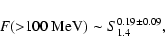 |
(5) |
 confidence level (we
considered here only the statistical uncertainties).
The gamma-ray - X-ray correlation shown by the same EGRET-cluster associations,
confidence level (we
considered here only the statistical uncertainties).
The gamma-ray - X-ray correlation shown by the same EGRET-cluster associations,
 |
(6) |
 confidence level (again, we
considered only the statistical uncertainties).
confidence level (again, we
considered only the statistical uncertainties).
We estimated the diffuse gamma-ray fluxes predicted in the available models under reasonable assumption for the energy density of relativistic particles in the ICM (see Sects. 4 and 5 above) for the galaxy clusters listed in Table 1 and we found that the total diffuse fluxes are usually a factor 2-4 below the fluxes actually detected for the associated EGRET sources. So, to recover the gamma-ray flux of the EGRET sources we have to consider that, at least, a comparable fraction of the cluster gamma-ray flux is contributed also by the (active) radio galaxies living within the cluster. We found, consistently with such a picture, that all of the clusters which are counterparts of the unidentified EGRET sources host several bright radio galaxies in their environment. Such radio galaxies can be, or have recently passed through a phase of substantial gamma-ray emission, according to the leading unified scheme scenarios for radio galaxy evolution (see, e.g., Urry & Padovani 1995). Thus, the EGRET data require that the gamma-ray flux associated to the relative galaxy clusters are likely due to a superposition of diffuse and concentrated gamma-ray emission.
The low flux variability of the associated EGRET sources does not indicate a strong contamination from very bright
[
 ]
AGN-like gamma-ray sources with strong flux variability. This is
clearly shown by the comparison of the flux changes for the EGRET sources more probably associated with clusters
(see Fig. 1) with the flux changes of the EGRET sources spatially correlated with clusters and whose gamma-ray
emission is dominated by bright AGNs (see Fig. 2).
]
AGN-like gamma-ray sources with strong flux variability. This is
clearly shown by the comparison of the flux changes for the EGRET sources more probably associated with clusters
(see Fig. 1) with the flux changes of the EGRET sources spatially correlated with clusters and whose gamma-ray
emission is dominated by bright AGNs (see Fig. 2).
![\begin{figure}
\par\includegraphics[width=7.8cm,clip]{gamma_coma_predictions.ps}\end{figure}](/articles/aa/full/2002/46/aah3369/img251.gif) |
Figure 11:
Theoretical predictions for the gamma-ray flux
 expected for a Coma-like cluster are shown as a function of the gamma-ray energy and are compared with the
sensitivity of the next generation space-borne and ground-based gamma-ray experiments: non-thermal electron
bremsstrahlung (Sreekumar et al. 1996; Colafrancesco 2001b) for two choices of the intracluster magnetic field (
expected for a Coma-like cluster are shown as a function of the gamma-ray energy and are compared with the
sensitivity of the next generation space-borne and ground-based gamma-ray experiments: non-thermal electron
bremsstrahlung (Sreekumar et al. 1996; Colafrancesco 2001b) for two choices of the intracluster magnetic field (
 G: short-dashed curve and G: short-dashed curve and  G: long-dashed curve); decay of neutral pions produced in pp
collisions (Colafrancesco & Blasi 1998) (blue curve and the associated theoretical uncertainties given in the
cyan region); decay of neutral pions produced in the annihilation of dark matter neutralinos (Colafrancesco &
Mele 2001) (black solid curve and the associated theoretical uncertainties given in the yellow region). Due to the
very different spatial resolution of the various experiments reported, we show here the case of their sensitivity
for point-like sources. G: long-dashed curve); decay of neutral pions produced in pp
collisions (Colafrancesco & Blasi 1998) (blue curve and the associated theoretical uncertainties given in the
cyan region); decay of neutral pions produced in the annihilation of dark matter neutralinos (Colafrancesco &
Mele 2001) (black solid curve and the associated theoretical uncertainties given in the yellow region). Due to the
very different spatial resolution of the various experiments reported, we show here the case of their sensitivity
for point-like sources. |
The spectral indices of the most probable EGRET-cluster associations are found to be in the range 2 -
3.5, values which are consistent with the expectations from model of the diffusion of relativistic particles in
the ICM, and seem to be quite larger than the very flat spectral indices (
 )
shown by the EGRET
sources associated with pulsars. Theoretical models for cluster gamma-ray emission predict in fact slopes in the
range
)
shown by the EGRET
sources associated with pulsars. Theoretical models for cluster gamma-ray emission predict in fact slopes in the
range
 (see, e.g., Fig. 11, see also Blasi 2000), going from annihilation of dark matter
neutralinos to non-thermal electron bremsstrahlung. Active galaxies with a substantial gamma-ray emission at the
flux level shown by the EGRET-cluster associations also have spectral slopes
(see, e.g., Fig. 11, see also Blasi 2000), going from annihilation of dark matter
neutralinos to non-thermal electron bremsstrahlung. Active galaxies with a substantial gamma-ray emission at the
flux level shown by the EGRET-cluster associations also have spectral slopes
 ,
as shown in
Fig. 3 (see also Hartman et al. 1999). Thus, the superposition of gamma-ray emission of both diffuse origin and
coming from the active galaxies shall certainly show overall spectral indices which are consistent with those of
the nine EGRET sources selected in our analysis.
,
as shown in
Fig. 3 (see also Hartman et al. 1999). Thus, the superposition of gamma-ray emission of both diffuse origin and
coming from the active galaxies shall certainly show overall spectral indices which are consistent with those of
the nine EGRET sources selected in our analysis.
In conclusion, we found that there are several converging evidence (even though still preliminary) of an
association between unidentified EGRET sources at high galactic latitude (|b|>20 )
and galaxy clusters
which show an enhanced radio activity in their ICM as triggered by radio (or active) galaxies or by non-thermal
phenomena giving rise also to radio halos and relics (see, e.g., Colafrancesco 2001a,b). These evidence are found
at several levels, from the geometrical spatial association with a minimal statistical confidence level of
 (see Sect. 2), to the gamma-ray flux and luminosity correlations with the radio and X-ray data of the
associated clusters with a statistical confidence level of
(see Sect. 2), to the gamma-ray flux and luminosity correlations with the radio and X-ray data of the
associated clusters with a statistical confidence level of  and
,
respectively
(see Sects. 4 and 5).
and
,
respectively
(see Sects. 4 and 5).
Even though the cluster sample we derived here is far from being an a priori flux limited sample, the correlation we found with unidentified EGRET gamma-ray sources can be considered as the first evidence of the expected distribution of the gamma-ray luminosity of "active'' galaxy clusters.
There have been recently other attempts to investigate the possible association of galaxy clusters with EGRET
gamma-ray sources. In fact, Totani & Kitayama (2000, hereafter TK) proposed that only galaxy clusters which are
just dynamically forming might be bright sources of gamma-rays due to Inverse Compton Scattering (ICS) of CMB
photons by high-energy electrons accelerated at the shock waves induced by gravity during the early formation of
large scale structures. Their model would predict, for instance, a gamma-ray flux of
 for a Coma-like cluster undergoing a merger event (roughly a factor 16 higher than the
actual upper limit,
for a Coma-like cluster undergoing a merger event (roughly a factor 16 higher than the
actual upper limit,
 found for Coma in the EGRET database (see,
e.g., Sreekumar et al. 1996)). As a consequence, TK predicted that a few tens of clusters (20 to 50 with a
limiting flux
found for Coma in the EGRET database (see,
e.g., Sreekumar et al. 1996)). As a consequence, TK predicted that a few tens of clusters (20 to 50 with a
limiting flux
 )
should have already been detected by EGRET (see their Fig. 1). The absence of
any correlation between the ROSAT Bright Cluster Sample (Ebeling et al. 1998) or the ACO (Abell et al. 1989)
cluster catalog and the EGRET source catalog should depend, according to TK, on the large extension of these
"just forming clusters'' which would cause a huge dimming of their X-ray surface brightness as well as of their
surface number density of galaxies in the optical with respect to the population of virialized, relaxed
clusters.
)
should have already been detected by EGRET (see their Fig. 1). The absence of
any correlation between the ROSAT Bright Cluster Sample (Ebeling et al. 1998) or the ACO (Abell et al. 1989)
cluster catalog and the EGRET source catalog should depend, according to TK, on the large extension of these
"just forming clusters'' which would cause a huge dimming of their X-ray surface brightness as well as of their
surface number density of galaxies in the optical with respect to the population of virialized, relaxed
clusters.
However, more recently and after the submission of our paper, the same authors (Kawasaki & Totani 2002, hereafter KT) found instead a
strong correlation between merging clusters and steady unidentified EGRET sources at high galactic
latitude (|b| > 45 ). They used the same data sets (Third EGRET catalog and ACO cluster catalog) and found that 9 close
pair/groups (CPG) of Abell clusters have a significative statistical level of spatial association with 7 steady
unidentified EGRET sources.
Interestingly, 6 out of these 7 EGRET sources are coincident with the EGRET-cluster associations found in our
analysis (see Table 1) while the last case (the clusters Abell 1564 and Abell 1581 associated with 3EGJ1235+0233) is not
found in our analysis because these clusters are found outside the
confidence level position error
contours of the relative EGRET source (see Sect. 2).
These last authors, nonetheless, suggested that the gamma-ray emission comes only from just forming/merging clusters
with large, violent shocks, but not from usual ones in dynamically quiet regime where the violent shock has subsided.
They further concluded that their finding "implies that the bulk of the steady unidentified EGRET sources in the
high latitude originate from forming clusters'' and "indirectly give support to the gamma-ray cluster
hypothesis'' delineated in TK.
Let us briefly comment on this point. We notice here that since the gamma-ray clusters considered in TK and KT are
physically the same "forming/merging clusters'' (their gamma-ray fluxes are evaluated according to the same ICS
model) and since TK predicted that a few tens of these clusters should have already been detected by EGRET, there
seem to be a missing gamma-ray cluster problem in their approach because KT do not find the remaining
(13-43) bright gamma-ray clusters, as predicted by TK. A possible solution to this problem could be that the
large majority of the forming clusters are not "just forming'' as suggested by TK but have experienced a strong
merging event more than a few Gyrs ago, so that the gamma-ray emission from the once accelerated primary electrons
has faded away due to their rapid energy losses (
 yr; see, e.g., Blasi 2000
and TK). The only gamma-ray clusters still remaining should be those which experienced a strong merger event in
the last 108 yr.
yr; see, e.g., Blasi 2000
and TK). The only gamma-ray clusters still remaining should be those which experienced a strong merger event in
the last 108 yr.
But there are also other concerns as regards the energetics of the just forming/merging galaxy clusters. The
gamma-ray luminosity of the EGRET sources selected by KT are found in the range
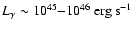 (see Fig. 10: note that most of the EGRET sources selected by KT are the same we select
in this paper) and should be emitted from primary electrons on a time scale
(see Fig. 10: note that most of the EGRET sources selected by KT are the same we select
in this paper) and should be emitted from primary electrons on a time scale
 yr.
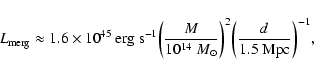
This gamma-ray power should be compared with the total power,
yr.
This gamma-ray power should be compared with the total power,
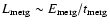 ,
provided by the merging between two sub-cluster units with masses M1 and M2, respectively. Here the total
energy of the merger is
,
provided by the merging between two sub-cluster units with masses M1 and M2, respectively. Here the total
energy of the merger is
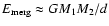 where d is the typical sub-cluster separation at
which most of the energy is released on the time scale for the merging,
where d is the typical sub-cluster separation at
which most of the energy is released on the time scale for the merging,
 yr, of the
order of the crossing time for the considered cluster. Simulations show that equal-mass mergers are more effective
in releasing energy from its gravitational form to heating of the ICM and to particle acceleration at the ICM
shocks. Thus, the total power provided by the merger can be written as
yr, of the
order of the crossing time for the considered cluster. Simulations show that equal-mass mergers are more effective
in releasing energy from its gravitational form to heating of the ICM and to particle acceleration at the ICM
shocks. Thus, the total power provided by the merger can be written as
 of the total
 is transformed in particles which are shock-accelerated up to energies
  GeV while the bulk
of the total merging energy goes mainly into heating of the cluster ICM (see, e.g., Blasi 2000). Thus, the
gamma-ray luminosity emitted by primary electrons accelerated at the merging shocks can be written, in general, as
GeV while the bulk
of the total merging energy goes mainly into heating of the cluster ICM (see, e.g., Blasi 2000). Thus, the
gamma-ray luminosity emitted by primary electrons accelerated at the merging shocks can be written, in general, as
 .
The values of
of the EGRET sources selected by KT
require, on average, an efficiency
.
The values of
of the EGRET sources selected by KT
require, on average, an efficiency
 -10 in the CGP clusters. This result seems to be strongly
in contrast with the available models for gamma-ray emission from a population of primary electrons for which
-10-1 is expected (Blasi 2000; Colafrancesco & Blasi 1998; Sarazin 2002).
-10 in the CGP clusters. This result seems to be strongly
in contrast with the available models for gamma-ray emission from a population of primary electrons for which
-10-1 is expected (Blasi 2000; Colafrancesco & Blasi 1998; Sarazin 2002).
Such a problem could be partially reduced if a substantial fraction of the gamma-ray emission from clusters is
provided by
 decay produced by pp
interactions in the cluster ICM, where high-energy protons are accelerated at the same merging shocks but do not
appreciably loose their energy over an age comparable with H0-1 (see, e.g., Colafrancesco & Blasi 1998).
If a ratio p/e
decay produced by pp
interactions in the cluster ICM, where high-energy protons are accelerated at the same merging shocks but do not
appreciably loose their energy over an age comparable with H0-1 (see, e.g., Colafrancesco & Blasi 1998).
If a ratio p/e
 -100 is assumed, then a large part of the cluster gamma-ray emission
could be dominated by
-100 is assumed, then a large part of the cluster gamma-ray emission
could be dominated by  decay and secondary electron emission by bremsstrahlung and ICS. This fact would
weaken the constraint
-10 for the values
of the EGRET sources produced by the
primary electrons in the approach of KT but would also provide a gamma-ray emission which is stationary with time
along the cluster lifetime (Blasi 2000). As a consequence, a large fraction of the 20-50 gamma-ray, merging
clusters predicted by TK should have been already detected by EGRET, which does not seem to be the case.
decay and secondary electron emission by bremsstrahlung and ICS. This fact would
weaken the constraint
-10 for the values
of the EGRET sources produced by the
primary electrons in the approach of KT but would also provide a gamma-ray emission which is stationary with time
along the cluster lifetime (Blasi 2000). As a consequence, a large fraction of the 20-50 gamma-ray, merging
clusters predicted by TK should have been already detected by EGRET, which does not seem to be the case.
On another side, if the gamma-ray luminosity of the EGRET source,
 is provided by primary electrons accelerated at the merging shock, then a much larger energy amount,
 ,
where
,
where
 erg
(we assume here
erg
(we assume here
 yr and
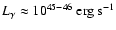 ,
see Fig. 10)
should go mainly into heating of the ICM. Note also that this estimate is a lower limit to the energy available
for heating of the ICM since only electrons which produce emission at E> 100 MeV are considered. We
notice that the energy budget
,
see Fig. 10)
should go mainly into heating of the ICM. Note also that this estimate is a lower limit to the energy available
for heating of the ICM since only electrons which produce emission at E> 100 MeV are considered. We
notice that the energy budget
 erg (we
assume
erg (we
assume
 )
is larger than the kinetic energy of the IC gas, which is of the order of
)
is larger than the kinetic energy of the IC gas, which is of the order of
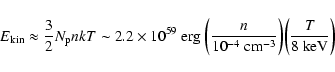 |
(8) |
 where
where
 is the gas mass of the cluster and
  is the proton mass). As a consequence,
one should expect that the just forming/merging clusters suggested by KT and TK have quite high temperatures if
most of the merging energy is transformed into heating of the ICM, as indicated by numerical simulation (see,
e.g., Sarazin 2002 for a review). Specifically, for
is the proton mass). As a consequence,
one should expect that the just forming/merging clusters suggested by KT and TK have quite high temperatures if
most of the merging energy is transformed into heating of the ICM, as indicated by numerical simulation (see,
e.g., Sarazin 2002 for a review). Specifically, for
 ,
an ICM density which is
appropriate to non-virialized clusters, one should expect to have
,
an ICM density which is
appropriate to non-virialized clusters, one should expect to have
 keV, values which are by far
higher than the temperatures actually observed in relaxed clusters of similar mass and also higher than those of
the forming/merging clusters found in numerical simulations of structure formation (see, e.g., Roettiger et al.
1999; Ricker & Sarazin 2001; Schindler 2002). This result indicates again that the hypothesis that the EGRET
source luminosity is provided by just forming/merging clusters is somewhat extreme.
keV, values which are by far
higher than the temperatures actually observed in relaxed clusters of similar mass and also higher than those of
the forming/merging clusters found in numerical simulations of structure formation (see, e.g., Roettiger et al.
1999; Ricker & Sarazin 2001; Schindler 2002). This result indicates again that the hypothesis that the EGRET
source luminosity is provided by just forming/merging clusters is somewhat extreme.
Finally, we notice here, following Blasi & Colafrancesco (1999) and Blasi (2000), that values
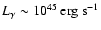 provided by primary electrons would imply a quite high diffuse radio emission
in the case of usual IC magnetic field values
provided by primary electrons would imply a quite high diffuse radio emission
in the case of usual IC magnetic field values
 ,
which would have been easily detected in these merging clusters,
unless very low and unreasonable (see, e.g., Carilli & Taylor 2002) values,
,
which would have been easily detected in these merging clusters,
unless very low and unreasonable (see, e.g., Carilli & Taylor 2002) values,
 ,
are considered.
Moreover, also strong EUV and hard X-ray excesses would be present in many of the merging clusters selected by KT,
which does not seem the case (see, e.g., Bowyer 2000; Lieu et al. 1999; Colafrancesco 2001a).
,
are considered.
Moreover, also strong EUV and hard X-ray excesses would be present in many of the merging clusters selected by KT,
which does not seem the case (see, e.g., Bowyer 2000; Lieu et al. 1999; Colafrancesco 2001a).
So, in conclusion, the suggestion that just forming/merging clusters are the counterparts of the unidentified EGRET sources at high galactic latitude seems to face several theoretical problems.
On the observational side, we noticed that none of the clusters selected by KT (and found in our analysis
presented in Sect. 3 above) show evidence of strong merging. In fact, strong ICM shocks are expected in merging
clusters and their features can be observed in the cluster X-ray images (see, e.g., Sarazin 2002). Shocks are
irreversible changes to the IC gas in clusters and hence increase the entropy
 in the gas.
Thus, one can use X-ray observations to determine the temperature T and the density n of the IC gas and hence
to measure the specific entropy in the gas just before and after the apparent merger shocks seen in the X-ray
images. Since merger shocks produce compression, heating, pressure increase and entropy increase, the
corresponding increase in all of these quantities (and in particular the entropy) can be used to check that
discontinuities are really shocks and not "cold fronts'' or other contact discontinuities (see, e.g., Sarazin
2002 for a discussion). Markevitch et al. (1999) applied such kind of test to the ASCA temperature maps and ROSAT
images of several clusters. There are clear cases, like the Cyg-A cluster, in which a change in entropy is
observed at the shock front thus confirming the presence of a merger shock. On the other hand, cold fronts with no
entropy change at the discontinuity region have been observed in a number of other clusters including Abell 3667
(Vikhlinin et al. 2001), RXJ1720.1+2638 (Mazzotta et al. 2001) and possibly also Abell 754 and Abell 2163.
in the gas.
Thus, one can use X-ray observations to determine the temperature T and the density n of the IC gas and hence
to measure the specific entropy in the gas just before and after the apparent merger shocks seen in the X-ray
images. Since merger shocks produce compression, heating, pressure increase and entropy increase, the
corresponding increase in all of these quantities (and in particular the entropy) can be used to check that
discontinuities are really shocks and not "cold fronts'' or other contact discontinuities (see, e.g., Sarazin
2002 for a discussion). Markevitch et al. (1999) applied such kind of test to the ASCA temperature maps and ROSAT
images of several clusters. There are clear cases, like the Cyg-A cluster, in which a change in entropy is
observed at the shock front thus confirming the presence of a merger shock. On the other hand, cold fronts with no
entropy change at the discontinuity region have been observed in a number of other clusters including Abell 3667
(Vikhlinin et al. 2001), RXJ1720.1+2638 (Mazzotta et al. 2001) and possibly also Abell 754 and Abell 2163.
The cluster Abell 85 which is considered by KT as a candidate for being a strong merging system triggering the gamma-ray
emission of the EGRET source 3EGJ0038-0949 is clearly associated, instead, with a cold front (a signature of a possible early stage of
merging, see Sarazin 2002 and references therein), and not with an ongoing violent merging process.
The two clusters Abell 219S and Abell 2963 associated with 3EGJ0158-3602 have very poor information available (see Sect. 3.4) especially at X-ray wavelenghts,
and there is no evidence of merging ongoing in these clusters.
Also the clusters Abell 1555 and Abell 1558 associated with 3EGJ1234-1318 have poor information in X-rays (see Sect. 3.7) and there is no
evidence of merging ongoing in these clusters.
The clusters Abell 1564 and Abell 1581 fall beyond the
position error contours of the EGRET source 3EGJ1235+0233,
they have poor information in X-rays and there is no
evidence of merging ongoing in these clusters.
The cluster Abell 1688 associated with 3EGJ1310-0517 has no relevant information in X-rays (see Sect. 3.9)
and there is no evidence of merging ongoing in this clusters.
The cluster Abell 1758 associated with 3EGJ1337+5029 is a distant, bright X-ray cluster (see Sect. 3.17)
which has a temperature and metallicity structure similar to that of nearby clusters with similar richness
(Rizza et al. 1998). This cluster has two main clumps with irregular, unrelaxed morphology (Rizza et al. 1998).
However, the presence of either an ongoing merging or a system consisting of two orbiting cold clumps is demanded to
more detailed X-ray studies with Chandra and/or XMM.
The cluster Abell 1781 associated with 3EGJ1347+2932 is a bright X-ray cluster with a high radio activity in its
galaxy population (see Sect.3.15). However, there is no evidence of merging ongoing in this clusters.
To summarize, the available observations do not confirm the presence of ongoing, strong merging in the cluster sample
suggested by KT as the possible counterpart of some unidentified EGRET sources.
Moreover, KT also suggested that the brightest unidentified EGRET source 3EG1835+5918 is the gamma-ray counterpart
of a galaxy cluster which is still uncatalogued and should be one of the "just forming'' gamma-ray clusters
proposed by these authors. This X-ray cluster is well outside the error ellipse of the EGRET source and "there is
no reason to suspect that they are related'', according to the analysis performed by Mirabal et al. (2000): also,
there is no evidence of an AGN belonging to this cluster. Other reasons that do not indicate any relation between
the cluster and the EGRET source are the high gamma-ray flux,
 ,
which is much higher than the typical flux of the EGRET-cluster associations (see Fig. 3), and
the very flat spectral index,
,
which is much higher than the typical flux of the EGRET-cluster associations (see Fig. 3), and
the very flat spectral index,
 ,
which is much flatter than those of the EGRET-cluster
associations (see Fig. 3). Such high gamma-ray flux and flat spectral index are more typical of an AGN or pulsar
(see Fig. 3) being the possible counterpart of this bright EGRET source. These conclusions has been reached also
through an independent analysis of this source by Mirabal & Halpern (2001) and Reimer et al. (2001).
,
which is much flatter than those of the EGRET-cluster
associations (see Fig. 3). Such high gamma-ray flux and flat spectral index are more typical of an AGN or pulsar
(see Fig. 3) being the possible counterpart of this bright EGRET source. These conclusions has been reached also
through an independent analysis of this source by Mirabal & Halpern (2001) and Reimer et al. (2001).
We conclude, on the basis of the available observational and theoretical evidence, that cluster formation/merging cannot be responsible for most of the gamma-ray emission observed in the clusters associated with the EGRET sources listed in Table 1. As discussed in our paper, the energy release at gamma-ray energies E> 100 MeV of the EGRET-cluster associations is probably due to a superposition of diffuse (associated with the active ICM of the cluster) and concentrated (associated with the active galaxies living within the cluster) gamma-ray emission.
While at the moment we have the first, preliminary evidence for the first gamma-rays coming from galaxy clusters, their detailed study will have a full bloom with the next generation space-borne (AGILE, GLAST, MEGA) and ground-based (VERITAS, ARGO, MAGIC) gamma-ray instruments. The next generation gamma-ray telescopes, and especially the GLAST mission, will have the spatial and spectral capabilities to confirm the preliminary result here presented and to disentangle between the diffuse and concentrated nature of the cluster gamma-ray emission.
Gamma-ray observations of galaxy clusters in the range
0.01 - 104 GeV (see Fig. 11 for a prediction in
the case of a Coma-like cluster) can probe directly the existence of
different populations of relativistic particles (e.g., electrons, protons, dark matter particles) in the
intracluster medium through their distinctive gamma-ray spectral features and will open a new window on the
astrophysical studies of large scale structures in the universe.
Moreover, the detection of mid-energy (
10 -
100 MeV) and high-energy (>100 MeV) gamma-rays from galaxy clusters will definitely disentangle
the leading mechanisms for the origin of the variety of puzzling non-thermal phenomena (radio halos/relics, EUV
and hard X-ray excesses) which are already observed in many galaxy clusters.
Acknowledgements
The author (S.C.) thanks the Referee for several useful suggestions which contributed to improve both the clarity and the presentation of the paper. Part of the data analysis has been performed at the ASI Science Data Center with the collaboration of P. Giommi. S.C. thanks also G. Ghisellini, M. Salvati, D. Fargion, P. Sreekumar and H. Andernach for useful discussions.
Copyright ESO 2002