

In this section we analyze in details the more probable associations of galaxy
clusters with the unidentified EGRET sources which are listed in Table 1: all of
these galaxy clusters are found within the  confidence level position
error contours of the associated EGRET source. As for the flux of each source,
we report only the first entry given in the Third EGRET catalogue (Hartman et al. 1999) providing also the viewing period (VP) of the source detection and the
significance level,
(TS)1/2, of the detection. The reader may refer to
Hartman et al. (1999) for the full list of information about the EGRET source
under consideration.
confidence level position
error contours of the associated EGRET source. As for the flux of each source,
we report only the first entry given in the Third EGRET catalogue (Hartman et al. 1999) providing also the viewing period (VP) of the source detection and the
significance level,
(TS)1/2, of the detection. The reader may refer to
Hartman et al. (1999) for the full list of information about the EGRET source
under consideration.
This EGRET source has been detected with a
(TS)1/2 = 4.4 in the VP = P1234.
It has a flux
 with a power-law spectral index
 .
Its flux does not change significantly over all the VPs with the exception of
the VP = 10.0 in which a flux increase by a factor
.
Its flux does not change significantly over all the VPs with the exception of
the VP = 10.0 in which a flux increase by a factor  2 has been recorded;
however, this flux is consistent with the flux detected in the other periods at
the
2 has been recorded;
however, this flux is consistent with the flux detected in the other periods at
the  confidence level, so that it can be considered a stationary
gamma-ray source (see Fig. 1). There is no identified gamma-ray source
counterpart for this EGRET source and, thus, it is a good candidate for the
galaxy cluster association. Two Abell clusters fall within the
confidence level position error contours of this source: Abell 1014S and Abell 1024S. The
EGRET source map is very broad with an effective radius of the
confidence level position error circle of
confidence level, so that it can be considered a stationary
gamma-ray source (see Fig. 1). There is no identified gamma-ray source
counterpart for this EGRET source and, thus, it is a good candidate for the
galaxy cluster association. Two Abell clusters fall within the
confidence level position error contours of this source: Abell 1014S and Abell 1024S. The
EGRET source map is very broad with an effective radius of the
confidence level position error circle of

 .
The
elongation of the EGRET source probability map is aligned with the position of
the two clusters, suggesting a possible contribution to the gamma-ray emission
from both clusters (see Fig. 4).
.
The
elongation of the EGRET source probability map is aligned with the position of
the two clusters, suggesting a possible contribution to the gamma-ray emission
from both clusters (see Fig. 4).
There is no definite X-ray information on these two galaxy clusters available in
the literature. However, we found that both these clusters have some radio
information. Given the low declination of the sources, they are not covered by
the NVSS. So, we looked for radio sources associated with the cluster in the
SUMMS survey (Bock et al. 1999).
We found that Abell 1014S at z=0.048 (Abell et al. 1989)
has several bright SUMSS radio sources located within its Abell radius,
 arcmin. A
preliminary analysis of the RASS field also yielded a flux
arcmin. A
preliminary analysis of the RASS field also yielded a flux
 .
.
The cluster Abell 1024S has an estimated redshift of z=0.1053 (taken from a 2002 version of Andernach & Tago 1998 compilation of Abell clusters redshifts, H. Andernach 2002, priv. comm.) and we found two bright SUMSS radio sources within its Abell radius.
A preliminary analysis of all these radio sources yields a total flux evaluated
at 1.4 GHZ of
 mJy.
A more refined analysis of the radio and X-ray sources in the field of this
EGRET source will be presented in a future paper Colafrancesco & Andernach (2002, in
preparation).
mJy.
A more refined analysis of the radio and X-ray sources in the field of this
EGRET source will be presented in a future paper Colafrancesco & Andernach (2002, in
preparation).
Based on the previous evidence, we consider now that this is a probable association between galaxy clusters and an EGRET gamma-ray source.
This EGRET source has been detected with a
(TS)1/2 = 4.9 in the VP = P1234. It has a flux
 with a power-law spectral index
 .
Its flux does not change significantly over all the VPs with the exception of the VP = 38.0 in which a flux
increase by a factor 2 has been recorded; however, this flux is consistent with the flux detected in the
other periods at less than the
confidence level (see Fig. 1). The quite low upper limit of <
.
Its flux does not change significantly over all the VPs with the exception of the VP = 38.0 in which a flux
increase by a factor 2 has been recorded; however, this flux is consistent with the flux detected in the
other periods at less than the
confidence level (see Fig. 1). The quite low upper limit of <
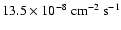 found in the VP = 402.+ has
 and thus is not statistically
significant.
The Abell cluster Abell 3631 falls at the border of the
confidence level position error contours of the EGRET source. The position
error map of this EGRET source is quite broad with
and thus is not statistically
significant.
The Abell cluster Abell 3631 falls at the border of the
confidence level position error contours of the EGRET source. The position
error map of this EGRET source is quite broad with
 and it is elongated in the south-west north-east direction. There is no other
known gamma-ray source counterpart for this EGRET source. However, there is poor
information available on the cluster Abell 3631. In particular, there is no NVSS
radio source found in the field of this cluster and no X-ray information. There
is one bright radio source in the field of 3EGJ1825-7926 found in the SUMSS
survey, but it is 20 arcmin away from the optical center of Abell 3631.
and it is elongated in the south-west north-east direction. There is no other
known gamma-ray source counterpart for this EGRET source. However, there is poor
information available on the cluster Abell 3631. In particular, there is no NVSS
radio source found in the field of this cluster and no X-ray information. There
is one bright radio source in the field of 3EGJ1825-7926 found in the SUMSS
survey, but it is 20 arcmin away from the optical center of Abell 3631.
Due to the previous evidence, there is no strong hint indicating the possible association of this cluster with the EGRET source 3EG J1825-7926 and so we consider this case as likely due to projection effects.
This EGRET source has been detected with a
 in the VP = P2. It has a flux
 but the power-law spectral index remains
unconstrained. Its flux does not change over all the VPs in which it has been detected and it is a stationary
gamma-ray source (see Fig. 1).
The quite low upper limits <
but the power-law spectral index remains
unconstrained. Its flux does not change over all the VPs in which it has been detected and it is a stationary
gamma-ray source (see Fig. 1).
The quite low upper limits <
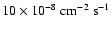 found in other independent VPs
have all
(TS)1/2 = 0 and can not be considered as statistically significant. The other reported upper limits
on this source are consistent with the detection fluxes.
found in other independent VPs
have all
(TS)1/2 = 0 and can not be considered as statistically significant. The other reported upper limits
on this source are consistent with the detection fluxes.
The Abell cluster Abell 3164 falls within the
confidence level position
error contours of the EGRET source.
Also, there is no other identified gamma-ray source counterpart for this EGRET source.
The EGRET source map is relatively broad with
 and has a comet-like tail in the east
direction.
and has a comet-like tail in the east
direction.
Abell 3164 is an irregular cluster with a redshift of z = 0.057 (Struble et al.
1999) for which there is poor information available. Ebeling et al. (1996)
estimated its X-ray luminosity to be
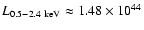 erg s-1 and its temperature as
 keV from the ROSAT
data. There are no evidence for NVSS radio sources found in correlation with
this cluster, given the low cluster declination. A few SUMSS radio sources are
found at more than 20 arcmin from the cluster center.
keV from the ROSAT
data. There are no evidence for NVSS radio sources found in correlation with
this cluster, given the low cluster declination. A few SUMSS radio sources are
found at more than 20 arcmin from the cluster center.
Based on the previous evidence, we do not find any strong hint for the probable association of this cluster with the EGRET source 3EG J0348-5708 and we consider also this case as likely due to projection effects.
This EGRET source has been detected with a
 in the VP = P1234.
It has a flux
in the VP = P1234.
It has a flux
 with a power-law spectral index
 .
Its flux does not change over all the VPs and it is a stationary gamma-ray
source (see Fig. 1).
Two Abell clusters fall within the
confidence level position error
contours of this source: Abell 219S and Abell 2963. Other galaxy clusters are found in the
vicinities of the EGRET source (see Fig. 5). The EGRET source map is quite broad
with
.
Its flux does not change over all the VPs and it is a stationary gamma-ray
source (see Fig. 1).
Two Abell clusters fall within the
confidence level position error
contours of this source: Abell 219S and Abell 2963. Other galaxy clusters are found in the
vicinities of the EGRET source (see Fig. 5). The EGRET source map is quite broad
with
 and the elongation of the EGRET probability map
is aligned with the position of the two clusters, suggesting a possible
contribution to the gamma-ray emission from both clusters. There is no other
known gamma-ray source counterpart for this EGRET source.
and the elongation of the EGRET probability map
is aligned with the position of the two clusters, suggesting a possible
contribution to the gamma-ray emission from both clusters. There is no other
known gamma-ray source counterpart for this EGRET source.
There is little optical and X-ray information on both the clusters Abell 219S and
Abell 2963. There are nonetheless three NVSS radio sources associated with the
cluster Abell 2963: they have radio flux at 1.4 GHz of
 and
and
 mJy, respectively.
In view of these evidence, we consider that this is a candidate for a probable association between galaxy clusters and an EGRET gamma-ray source.
This EGRET source has been detected with a
 in the VP = P1234.
It has a flux
in the VP = P1234.
It has a flux
 with a power-law spectral index
 .
Its flux changes
significantly over several VPs and in the VP = 419.5 it increase by a factor
.
Its flux changes
significantly over several VPs and in the VP = 419.5 it increase by a factor
 4 with respect to the VP = P1234. Due to such strong flux variations in
comparison with other cases shown in Fig. 1, it is hard to consider it as a
stationary gamma-ray source.
4 with respect to the VP = P1234. Due to such strong flux variations in
comparison with other cases shown in Fig. 1, it is hard to consider it as a
stationary gamma-ray source.
Two clusters (Abell 577S and Abell 575S) fall close to the
confidence level error
contour for the position of this EGRET source. Another cluster (Abell 573S) falls
within 1
radius from the center of the EGRET source. However, the shape
of the EGRET map of this source is quite compact and round with
 .
.
The two clusters Abell 577S and Abell 575S have very few morphological and physical information
(see Table 1).
Nonetheless, the cluster Abell 577S is associated with three NVSS radio sources with
flux
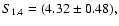
 and
and
 mJy,
respectively. Also Abell 575S is correlated with other three NVSS radio sources with
flux
mJy,
respectively. Also Abell 575S is correlated with other three NVSS radio sources with
flux
 and
and
 mJy,
respectively. Note that also the cluster Abell 573S is associated with 7 NVSS radio
sources.
mJy,
respectively. Note that also the cluster Abell 573S is associated with 7 NVSS radio
sources.
Due to the previous evidence, and in particular the flux variation over the various VPs, we consider this association as suspect and probably due to projection effects.
This EGRET source has been detected with a
 in the VP = P1. It
has a flux
in the VP = P1. It
has a flux
 with a
power-law spectral index
with a
power-law spectral index
 .
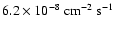
Even though the flux variations
over the different VPs and the upper limit of <
.
Even though the flux variations
over the different VPs and the upper limit of <
 with
found in the VP = 209.0 are not statistically significant, the
behaviour of this EGRET source is quite different from the other sources here
selected as possible association with galaxy clusters, which are expected to be
quite stationary over different VPs. Due to such flux variations in comparison
with other cases shown in Fig. 1, we do not consider it as a stationary gamma-ray
source.
with
found in the VP = 209.0 are not statistically significant, the
behaviour of this EGRET source is quite different from the other sources here
selected as possible association with galaxy clusters, which are expected to be
quite stationary over different VPs. Due to such flux variations in comparison
with other cases shown in Fig. 1, we do not consider it as a stationary gamma-ray
source.
Nonetheless, this EGRET source is quite broad and irregular with a quite large
value of
 .
The cluster Abell 886S falls within the
confidence level position error contour of the source. There is no other
gamma-ray source counterpart in the field of 3EG J2034-3110.
.
The cluster Abell 886S falls within the
confidence level position error contour of the source. There is no other
gamma-ray source counterpart in the field of 3EG J2034-3110.
The cluster Abell 886S has no detailed information available, it is not associated with any NVSS radio sources and there are no other hints for the presence of galaxy activity in its environment.
Due to the previous evidence, and in particular the flux variation over the various VPs, we consider also this association as suspect and probably due to projection effects.
This EGRET source has been detected with a
 in the VP = P1234.
It has a flux
in the VP = P1234.
It has a flux
 with a quite low power-law spectral index
 .
The flux
variations over the different VPs are not statistically significant, and for
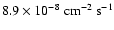
this reason it can be considered as a stationary gamma-ray source. The upper
limit of <
.
The flux
variations over the different VPs are not statistically significant, and for
this reason it can be considered as a stationary gamma-ray source. The upper
limit of <
 has
and its very poor
statistical significance does not affect strongly the previous conclusion.
has
and its very poor
statistical significance does not affect strongly the previous conclusion.
Two galaxy clusters (Abell 1558 and Abell 1555) fall within the
confidence level
position error contour of the EGRET source. This EGRET source is quite regular
with
 even though source confusion may affect its flux
and/or its position (see Hartman et al. 1999). No other known gamma-ray source
counterpart has been found in the field of this EGRET source.
even though source confusion may affect its flux
and/or its position (see Hartman et al. 1999). No other known gamma-ray source
counterpart has been found in the field of this EGRET source.
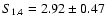
Abell 1558 has an estimated redshift of z=0.116 (Andernach 2002, priv. comm.) and
it is associated with two NVSS radio sources with flux
 and
and
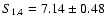
 mJy, respectively. Also the cluster Abell 1555 at z =0.127 is
associated with two NVSS radio sources with flux
mJy, respectively. Also the cluster Abell 1555 at z =0.127 is
associated with two NVSS radio sources with flux
 and
and
 mJy, respectively. No other information is available on these
clusters at both optical and X-ray frequencies.
mJy, respectively. No other information is available on these
clusters at both optical and X-ray frequencies.
Due to the previous evidence, we find that the association of this EGRET source with the two Abell clusters here mentioned is still questionable.
This EGRET source has been detected with a
in the VP = P1234.
It has a flux
 with a power-law spectral index
 .
The flux variations over
the different VPs are at less than the
level and so are not strongly
statistically significant.
Also the low upper limit of <
.
The flux variations over
the different VPs are at less than the
level and so are not strongly
statistically significant.
Also the low upper limit of <
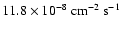 obtained in the VP = 327.0
has
(TS)1/2 = 0 and it is not statistically significant.
However, the behaviour of the flux changes in the different viewing periods over which
this EGRET source has been detected is somewhat different from a purely
stationary source as shown in Fig. 1. This EGRET source is elongated in the
east-west direction and has a value
obtained in the VP = 327.0
has
(TS)1/2 = 0 and it is not statistically significant.
However, the behaviour of the flux changes in the different viewing periods over which
this EGRET source has been detected is somewhat different from a purely
stationary source as shown in Fig. 1. This EGRET source is elongated in the
east-west direction and has a value
 .
.
The optical and X-ray center of the cluster Abell 85 is found slightly beyond the
confidence level position error contour of the EGRET source (see Fig. 4).
However, due to its large extension (30 arcmin radius) a large part of
this nearby (z=0.056) cluster falls within the
confidence level
position error contour of the EGRET source and hence can be considered to be
spatially correlated with it. No other known gamma-ray source counterpart is
found in the field of this EGRET source.
Abell 85 is a bright X-ray cluster with a luminosity
 and a temperature
of
and a temperature
of
 keV (Wu et al. 1999) and shows a strong activity in its
ICM.
keV (Wu et al. 1999) and shows a strong activity in its
ICM.
In fact, there are several bright radio galaxies within the cluster Abell 85
and also several bright NVSS radio sources correlated with the cluster as well
as in the field of the relative EGRET source. Abell 85 has been observed with the VLA
in the B and C configurations and a flux
S1.4 = 55 mJy has been reported
by Owen & Ledlow (1997). Abell 85 contains also a diffuse, relic radio source (see,
e.g., Slee et al. 2001) found off-center with respect to the X-ray center of the
cluster (see Fig. 6). Giovannini & Feretti (2000) estimated that the diffuse
radio halo flux at 1.4 GHz is
S1.4 = 46 mJy, consistently with the result
of Owen & Ledlow (1997), with a power
 W Hz-1.
There is also evidence of a hard X-ray emission excess which is spatially
correlated with the radio relic source and is due probably to Inverse Compton
Scattering (ICS) of the CMB photons with the relativistic electrons of the radio
relic (Bagchi et al. 1998; Lima-Neto et al. 2001). Such a non-thermal X-ray
emission is spatially correlated with the Very Steep Spectrum radio source MRC 0038-096 (see Bagchi et al. 1998), without any detected optical
counterpart, which is 7 arcmin south-west of the X-ray center of the
cluster.
The positive detection of both synchrotron radio and ICS X-ray emission from a
common ensemble of relativistic electrons leads to an estimate of the average
magnetic field,
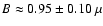 G, on the cluster scale. Further,
the radiative flux and the estimated value of B imply the presence of
relativistic electrons (with radiative lifetime 109 yr) with Lorentz
factor
G, on the cluster scale. Further,
the radiative flux and the estimated value of B imply the presence of
relativistic electrons (with radiative lifetime 109 yr) with Lorentz
factor
 (Bagchi et al. 1998). Electrons with these
energies can easily emit gamma-rays at
(Bagchi et al. 1998). Electrons with these
energies can easily emit gamma-rays at
 by
bremsstrahlung in addition to the ICS emission tail which is present in the
gamma-ray region probed by EGRET.
by
bremsstrahlung in addition to the ICS emission tail which is present in the
gamma-ray region probed by EGRET.
Even though the cluster Abell 85 is offset with respect to the center of the EGRET source map, there are good reasons to believe that it may contribute substantially to the gamma-ray flux of the EGRET source 3EG J0038-0949 in addition to the possible gamma-ray flux possibly produced by the active radio-galaxies which are living in the cluster environment.
This EGRET source has been detected with a
 in the VP = P1234.
It has a flux
in the VP = P1234.
It has a flux
 with a power-law spectral index
 .
The flux variations over
the different VPs are at less than the
level and are not
statistically significative (see Fig. 1). Also the lowest upper limit <
.
The flux variations over
the different VPs are at less than the
level and are not
statistically significative (see Fig. 1). Also the lowest upper limit <
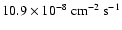 ,
obtained for this source in the VP = Virgo4 with
,
obtained for this source in the VP = Virgo4 with
 has a very poor statistical significance. The EGRET source is
elongated in the south-north direction and has a value
.
has a very poor statistical significance. The EGRET source is
elongated in the south-north direction and has a value
.
The center of the cluster Abell 1688 is found within the
confidence level
position error contour of the source, even though quite off-center with respect
to the EGRET map center (see Fig. 4). There is, however, no other known gamma-ray
source counterpart in the field of this EGRET source.
Abell 1688 is one of the most distant clusters listed in Table 1 and has little
information available at both optical and X-ray wavelengths.
Kowalski et al. (1984) gave an estimate of its redshift
 and of its X-ray
luminosity,
and of its X-ray
luminosity,
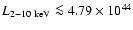 erg s-1 as
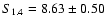
obtained from the HEAO-A1 all-sky survey. There are, nonetheless, 4 NVSS radio
sources correlated with the position of Abell 1688 and they have flux
erg s-1 as
obtained from the HEAO-A1 all-sky survey. There are, nonetheless, 4 NVSS radio
sources correlated with the position of Abell 1688 and they have flux
 ;
;
 ;
;
 ;
;
 mJy, respectively.
Due to these evidence, this could be considered as a probable - but still questionable - association between galaxy clusters and EGRET gamma-ray source.
This EGRET source has been detected with a
in the VP = 317.0.
It has a flux
 with a power-law spectral index which is unconstrained. There are no flux
variations over the two VPs in which the source has been detected (see Fig. 1).
The low upper limit <
with a power-law spectral index which is unconstrained. There are no flux
variations over the two VPs in which the source has been detected (see Fig. 1).
The low upper limit <
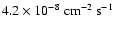 derived in the VP = 21.0 has
and is not statistically significant.
The EGRET source map is quite extended and round with a high value of
derived in the VP = 21.0 has
and is not statistically significant.
The EGRET source map is quite extended and round with a high value of
 .
.
The cluster Abell 388 falls within the
confidence level position error
contour of the source (see Fig. 4) and other Abell clusters are found in the
field of this EGRET source. No other possible counterpart of the gamma-ray
source is found in the field of this EGRET source.
Abell 388 has a redshift of z =0.134 and an estimated X-ray
luminosity of
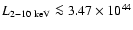 erg s-1, as reported in the HEAO-A1 all-sky
survey (Kowalski et al. 1984). No other relevant X-ray information is available for this cluster. There are 8
NVSS radio sources correlated with this cluster with flux
erg s-1, as reported in the HEAO-A1 all-sky
survey (Kowalski et al. 1984). No other relevant X-ray information is available for this cluster. There are 8
NVSS radio sources correlated with this cluster with flux
 and
and
 mJy,
respectively.
mJy,
respectively.
Due to these evidence, this could be considered as a probable - but not yet definite - association between galaxy clusters and EGRET gamma-ray source.
This EGRET source has been detected with a
 in the VP = P1234.
It has a flux
in the VP = P1234.
It has a flux
 with a power-law spectral index
 .
There are no
statistically significative flux variations over the different VPs in which the
source has been detected (see Fig. 1) and the statistically significant upper
limits are consistent with this conclusion.
The EGRET source error area is quite extended with a high value of
.
There are no
statistically significative flux variations over the different VPs in which the
source has been detected (see Fig. 1) and the statistically significant upper
limits are consistent with this conclusion.
The EGRET source error area is quite extended with a high value of
 .
.
The cluster Abell 497 falls within the
confidence level position error
contour of the source. No other gamma-ray source counterpart is found in the
field of this EGRET source (see Fig. 5).
Abell 497 has an
estimated redshift of
 and an estimated X-ray luminosity of
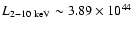 erg s-1 (Ulmer et al. 1980).
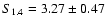
There is a NVSS radio source correlated with the cluster within its Abell radius with a flux
erg s-1 (Ulmer et al. 1980).
There is a NVSS radio source correlated with the cluster within its Abell radius with a flux
 mJy.
mJy.
Due to these evidence, this could be considered as a probable - but not yet definite - association between galaxy clusters and EGRET gamma-ray source.
This EGRET source has been detected with a
 in the VP = 21.0. It
has a flux
in the VP = 21.0. It
has a flux
 with
a quite low power-law spectral index
with
a quite low power-law spectral index
 .
There are no
other definite detection of this EGRET source over other viewing periods (see
Fig. 1).
The upper limit of
.
There are no
other definite detection of this EGRET source over other viewing periods (see
Fig. 1).
The upper limit of
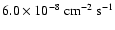 obtained in the VP = 317.0 is not
statistically significant since it has
.
The EGRET source is
quite extended with a high value of
obtained in the VP = 317.0 is not
statistically significant since it has
.
The EGRET source is
quite extended with a high value of
 and is elongated
in the south-north direction.
and is elongated
in the south-north direction.
The cluster Abell 331 falls near the center of the EGRET source (see Fig. 5) and
there is no other gamma-ray source counterpart in the field of 3EG J0215+1123.
There is another Abell cluster (Abell 330) which is found at 1.1
south
of Abell 331. The cluster Abell 331 has an estimated redshift of z = 0.186 and an X-ray
luminosity of
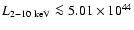 erg s-1 as
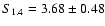
estimated in the HEAO-A1 all-sky survey (Kowalski et al. 1984). There are four
NVSS radio sources which are correlated with this cluster within its Abell radius and their flux is
erg s-1 as
estimated in the HEAO-A1 all-sky survey (Kowalski et al. 1984). There are four
NVSS radio sources which are correlated with this cluster within its Abell radius and their flux is
 ;
;
 ;
;
 ;
;
 mJy,
respectively.
mJy,
respectively.
Due to these evidence, this could be considered as a probable - but still questionable - association between galaxy clusters and EGRET gamma-ray source.
This EGRET source has been detected with a
in the VP = P1234.
It has a flux
 with a power-law spectral index
 .
The flux variations
over the different VPs are at less than the
level, but the behaviour
of this source is quite different from the stationary ones in Fig. 1.
The EGRET source is quite extended with a value
.
The flux variations
over the different VPs are at less than the
level, but the behaviour
of this source is quite different from the stationary ones in Fig. 1.
The EGRET source is quite extended with a value
 and is
elongated in the south-north direction.
and is
elongated in the south-north direction.
The cluster Abell 2486 falls within the
confidence level position error
contour of the source. No other gamma-ray source counterpart is found in the
field of this EGRET source.
Abell 2486 has an estimated redshift of z = 0.143 and an X-ray luminosity of
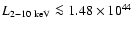 erg s-1 as estimated in the
HEAO-A1 all-sky survey (Kowalski et al. 1984). There are two NVSS radio sources
which are correlated with this cluster within its Abell radius and their flux is
erg s-1 as estimated in the
HEAO-A1 all-sky survey (Kowalski et al. 1984). There are two NVSS radio sources
which are correlated with this cluster within its Abell radius and their flux is
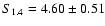 and
and
 mJy, respectively.
Due to these evidence, and in particular to the flux variations over the various VPs, this case should not be considered as a possible association between galaxy clusters and an EGRET gamma-ray source.
This EGRET source has been detected with a
 in the VP = Virgo2.
It has a flux
in the VP = Virgo2.
It has a flux
 with a power-law spectral index
 .
Even though the flux
of this source may be affected by confusion, there are quite strong flux
variations over the three different VPs in which this source has been detected
(see Fig. 1). The EGRET source is quite extended with a value
.
Even though the flux
of this source may be affected by confusion, there are quite strong flux
variations over the three different VPs in which this source has been detected
(see Fig. 1). The EGRET source is quite extended with a value
 and is elongated in the south-north direction.
The cluster Abell 1494 falls within the
confidence level position error
contour of the source. No other gamma-ray source counterpart is found in the
field of this EGRET source.
Abell 1494 has an estimated redshift of z=0.159 and an X-ray luminosity of
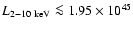 erg s-1 as estimated in the
HEAO-A1 all-sky survey (Kowalski et al. 1984). There are five NVSS radio sources
which are correlated with this cluster and their flux is
erg s-1 as estimated in the
HEAO-A1 all-sky survey (Kowalski et al. 1984). There are five NVSS radio sources
which are correlated with this cluster and their flux is
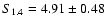 ;
;
 ;
;
 ;
;
 ;
;
 mJy,
respectively.
mJy,
respectively.
Due to these evidence, and in particular to the flux variations over the various VPs, this case should not be considered as a possible association between galaxy clusters and EGRET gamma-ray source.
This EGRET source has been detected with a
in the VP = P1234.
It has a flux
 with a power-law spectral index
 .
There are no strong
flux variations over the different VPs in which this source has been detected
(see Fig. 1), even though the flux of this source may be affected by confusion.
However, we noticed that there is only one independent detection of this source
in the VP = 4.0 which does not allow to draw any definite conclusion on its
possible variability.
The EGRET source is quite extended with a value of
.
There are no strong
flux variations over the different VPs in which this source has been detected
(see Fig. 1), even though the flux of this source may be affected by confusion.
However, we noticed that there is only one independent detection of this source
in the VP = 4.0 which does not allow to draw any definite conclusion on its
possible variability.
The EGRET source is quite extended with a value of
 and is irregular.
The cluster Abell 1781 falls within the
confidence level position error
contour of the source. No other gamma-ray source counterpart is found in the
field of this EGRET source.
Abell 1781 has a redshift of
z = 0.0618 and an X-ray
luminosity of
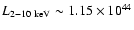 erg s-1 as
estimated in the HEAO-A1 all-sky survey (Kowalski et al. 1984). There is one
radio galaxy (FIRST J134159.7+294653) at a redshift of
z = 0.0457 which
is apparently in the foreground of the cluster. There is evidence for 36 NVSS
radio sources correlated with Abell 1781 within its Abell radius.
erg s-1 as
estimated in the HEAO-A1 all-sky survey (Kowalski et al. 1984). There is one
radio galaxy (FIRST J134159.7+294653) at a redshift of
z = 0.0457 which
is apparently in the foreground of the cluster. There is evidence for 36 NVSS
radio sources correlated with Abell 1781 within its Abell radius.
Due to these evidence, and in particular to the uncertainties in the flux variations over the various VPs, this case should not be considered as a possible association between galaxy clusters and EGRET gamma-ray source.
This EGRET source has been detected with a
in the VP = P1. It
has a flux
 with a
power-law spectral index
with a
power-law spectral index
 .
There are no strong flux
variations over the different VPs in which this source has been detected (see
Fig. 1) and the lowest upper limit of <
.
There are no strong flux
variations over the different VPs in which this source has been detected (see
Fig. 1) and the lowest upper limit of <
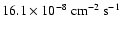 found in the
VP = 201.+ is not statistically significant because it has
.
The
EGRET source is quite regular with a value
and with
an emission tail in the north-west side of the field.
found in the
VP = 201.+ is not statistically significant because it has
.
The
EGRET source is quite regular with a value
and with
an emission tail in the north-west side of the field.
Two rich clusters (Abell 1914 and Abell 1902) fall within the
confidence level
position error contour of the source (see Fig. 4). No other gamma-ray source
counterpart is found in the field of this EGRET source.
Abell 1902 has a redshift of z = 0.16 and is associated with the X-ray source
RXJ1421.6+3717 (Boehringer et al. 2000) with an X-ray flux
 and
a luminosity
and
a luminosity
 .
Its X-ray luminosity has been also estimated to be
.
Its X-ray luminosity has been also estimated to be
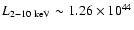 erg s-1 in the HEAO-A1 all-sky survey
(Kowalski et al. 1984). There is one radio source (FIRST J142140.4+371731)
associated to the cluster galaxy MAPS-NGP
0-272-0323568 found at a
redshift of z = 0.16. There is also a NVSS radio source with flux
erg s-1 in the HEAO-A1 all-sky survey
(Kowalski et al. 1984). There is one radio source (FIRST J142140.4+371731)
associated to the cluster galaxy MAPS-NGP
0-272-0323568 found at a
redshift of z = 0.16. There is also a NVSS radio source with flux
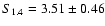 mJy which is associated with the cluster.
Abell 1914 has a redshift of
z = 0.1712 and
is associated to the X-ray source RXJ1426.0+3749 with an X-ray flux
 .
Its X-ray luminosity has been estimated to be
.
Its X-ray luminosity has been estimated to be
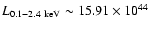 erg s-1 (Boehringer et al. 2000). Three NVSS
radio sources are correlated with Abell 1914 and they have flux
erg s-1 (Boehringer et al. 2000). Three NVSS
radio sources are correlated with Abell 1914 and they have flux
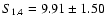 ,
,
 ,
,
 mJy, respectively. The cluster Abell 1914 also
hosts the Very Steep Spectrum radio galaxy 1474+380 (4C 38.39) (Komissarov
& Gubanov 1994). This cluster has also a bright radio halo (see Fig. 7) detected
in the VLA with a flux of
S1.4 = 50 mJy and a power
mJy, respectively. The cluster Abell 1914 also
hosts the Very Steep Spectrum radio galaxy 1474+380 (4C 38.39) (Komissarov
& Gubanov 1994). This cluster has also a bright radio halo (see Fig. 7) detected
in the VLA with a flux of
S1.4 = 50 mJy and a power
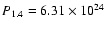 W Hz-1 (Giovannini & Feretti 2000).
Due to the previous evidence we consider this case as a probable candidate for the correlation of galaxy clusters and EGRET unidentified gamma-ray sources.
This EGRET source has been detected with a
in the VP = P1234.
It has a flux
 with a power-law spectral index
 .
There are no strong
flux variations over the different VPs in which this source has been detected
(see Fig. 1). The EGRET source is quite regular with a value
.
There are no strong
flux variations over the different VPs in which this source has been detected
(see Fig. 1). The EGRET source is quite regular with a value
 .
.
The rich cluster Abell 1758 falls within the
confidence level position error
contour of the source, very close to the center of the EGRET source map (see
Fig. 5). No other gamma-ray source counterpart is found in the field of this
EGRET source.
Abell 1758 is the most distant cluster listed in Table 1. It has a redshift of z =
0.279 and is associated with the X-ray source RXJ1332.7+5032 with an X-ray flux
 and a luminosity
 (Boehringer et al. 2000). The ROSAT-PSPC observation
yielded a temperature
(Boehringer et al. 2000). The ROSAT-PSPC observation
yielded a temperature
 keV which is found to be much lower than
the ASCA (SIS+GIS) temperature of
keV which is found to be much lower than
the ASCA (SIS+GIS) temperature of
 keV (Rizza et al. 1995). An
X-ray luminosity of
keV (Rizza et al. 1995). An
X-ray luminosity of
 erg s-1 has been estimated independently by Wu et al. (1999).
There are four NVSS radio sources correlated with this cluster with a flux
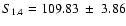 ,
,
 ,
,
 ,
,
 mJy,
respectively. Abell 1758 also hosts the narrow tailed radio galaxy 87GB 133050.3+504752 (Feretti et al. 1992). This cluster also shows a diffuse
radio emission (see Fig. 8) which could be possibly identified with an extended
radio halo (Giovannini & Feretti 2000).
mJy,
respectively. Abell 1758 also hosts the narrow tailed radio galaxy 87GB 133050.3+504752 (Feretti et al. 1992). This cluster also shows a diffuse
radio emission (see Fig. 8) which could be possibly identified with an extended
radio halo (Giovannini & Feretti 2000).
Due to the previous evidence we consider this case as a probable candidate for the correlation of galaxy clusters and EGRET unidentified gamma-ray sources.
This EGRET source has been detected with a
 in the VP = P1234.
It has a flux
in the VP = P1234.
It has a flux
 with a power-law spectral index
 .
There are no strong
flux variations over the different VPs in which this source has been detected
(see Fig. 1). However, the only two independent detections of this source do not
allow to draw any definite conclusion on its variability.
The EGRET source is quite regular with a value
.
There are no strong
flux variations over the different VPs in which this source has been detected
(see Fig. 1). However, the only two independent detections of this source do not
allow to draw any definite conclusion on its variability.
The EGRET source is quite regular with a value
 .
The cluster Abell 774S falls within the
confidence level position error contour of the source. No other
gamma-ray source is found in the field of this EGRET source.
.
The cluster Abell 774S falls within the
confidence level position error contour of the source. No other
gamma-ray source is found in the field of this EGRET source.
Abell 774S is a poor cluster with very limited information at other wavelengths.
There are 9 NVSS radio sources correlated with this cluster within its Abell radius. There are also 2 PMN sources within the Abell radius of Abell 774S with flux
 mJy and
  mJy, respectively. The latter one coincides with NVSS J144952.4-395732 with
S1.4=55 mJy, an inverted-spectrum radio source.
mJy, respectively. The latter one coincides with NVSS J144952.4-395732 with
S1.4=55 mJy, an inverted-spectrum radio source.
We thus believe that this case of spatial correlation is likely due to projection effects.
Copyright ESO 2002
![\begin{figure}
\par\includegraphics[width=7cm,clip]{a85_bw_last.ps}\hspace*{5mm}...
...]
\includegraphics[width=7cm,clip]{a1688_bw_last.ps}\hspace*{7.5cm}
\end{figure}](/articles/aa/full/2002/46/aah3369/img66.gif)
![\begin{figure}
\par\includegraphics[width=8.4cm,clip]{a331_bw.ps}\includegraphic...
...cm,clip]{a2963_bw.ps}\includegraphics[width=8.4cm,clip]{a1758_bw.ps}\end{figure}](/articles/aa/full/2002/46/aah3369/img112.gif)
![\begin{figure}
\par\includegraphics[width=14.5cm,clip]{a85fig6.ps}\end{figure}](/articles/aa/full/2002/46/aah3369/img123.gif)
![\begin{figure}
\par\includegraphics[width=14.5cm,clip]{a1914fig7.ps}\end{figure}](/articles/aa/full/2002/46/aah3369/img191.gif)
![\begin{figure}
\par\includegraphics[width=18cm,clip]{a1758fig8.ps}\end{figure}](/articles/aa/full/2002/46/aah3369/img204.gif)