

Motivated by the previous arguments, we analyzed the available data for the
gamma-ray sources in the Third EGRET catalog (Hartman et al. 1999) and we looked
for a correlation between the position of unidentified gamma-ray sources with
|b|>20  and the positions of galaxy clusters in the Abell catalogue
(Abell et al. 1989). We further looked for the X-ray information about the
selected clusters in the ROSAT all sky survey and pointed observations and in
the BeppoSAX cluster catalogue. We also looked for radio sources associated with
galaxy clusters in the NVSS radio survey, in the VLA and SUMSS surveys as well
as in the available literature.
and the positions of galaxy clusters in the Abell catalogue
(Abell et al. 1989). We further looked for the X-ray information about the
selected clusters in the ROSAT all sky survey and pointed observations and in
the BeppoSAX cluster catalogue. We also looked for radio sources associated with
galaxy clusters in the NVSS radio survey, in the VLA and SUMSS surveys as well
as in the available literature.
We first studied such a spatial correlation
within a fixed radius (1 )
from the center of each EGRET source and
subsequently we refined our analysis considering the actual  confidence
level position error contours of each EGRET source found in the previous step.
confidence
level position error contours of each EGRET source found in the previous step.
We found that 50 EGRET sources at high galactic latitude, |b|>20 ,
are
spatially correlated - within 1 degree from the center of the EGRET source -
with the position of 70 galaxy clusters in the Abell catalogue (Abell et al.
1989). We choose a correlation radius of 1
because this is the angular
distance at which EGRET cannot distinguish two separate point-like sources
(Hartman et al. 1999). We performed a Monte Carlo simulation to check if such a
spatial association can be understood as a simple random projection effect.
Specifically, we built 103 random distributions of galaxy clusters extracted
from the Abell catalogue and taking into account their clustering properties and we cross-correlated their positions with the EGRET
source positions within 1
radius.
We find that, on average, 33 EGRET sources can be randomly associated with
simulated cluster positions. Based on a Kolmogorov-Smirnov test, the probability
that all of the remaining 17 EGRET unidentified sources are still randomly
associated with galaxy clusters is 
 .
This indicates that the
confidence level of the spatial association is about
.
This indicates that the
confidence level of the spatial association is about
 (assuming a
Gaussian statistics which is justified for
(assuming a
Gaussian statistics which is justified for  20 spatial associations).
For a more detailed analysis, we correlated the positions of the Abell clusters
with the exact position error contours given for each EGRET source found in the
Third EGRET catalogue. In this procedure we consider also the spatial extent
of the galaxy clusters. We find that the coordinates of the optical centers of
52 Abell clusters fall within the contour containing the
confidence
level error region for the positions of 39 EGRET sources. In this analysis we
consider a positive correlation also for those clusters whose optical centers
are close to the border of the
confidence level error contours of the
EGRET sources and whose spatial extent is found within the
confidence
level EGRET position error contour.
We then simulated, as before, 103 random distributions of galaxy clusters
extracted from the Abell catalogue preserving their clustering properties and we cross-correlated their positions with
the EGRET source positions within their
confidence level contours,
finding that, on average, 26 EGRET sources can be randomly associated with
simulated cluster positions. Based on a Kolmogorov-Smirnov test, the probability
that all of the remaining 13 EGRET unidentified sources are still randomly
associated with galaxy clusters is  (or, in other words, the
significance of the probable correlation between galaxy clusters and EGRET
sources is at more than
(or, in other words, the
significance of the probable correlation between galaxy clusters and EGRET
sources is at more than
 confidence level).
Since a substantial fraction of the sky observed by EGRET has a low sensitivity
(where it would be difficult to observe any faint source), the previous estimate
of the significance level of the correlation can be safely considered as a lower
limit of the true one. In fact,
the cluster - EGRET source correlation we
found here is suffering from a lack of other possible EGRET-cluster associations
coming from those gamma-ray sources which are not detected in the low-exposure
region of the EGRET sky. Assuming that the number of additional EGRET sources
detectable with a uniform sky coverage,
 (where
 is the area of the gamma-ray sky with low-exposure),
is correlated with galaxy clusters in the same ratio of our previous estimates,
and assuming that the fraction of random correlation is again similar to what
previously estimated (i.e.
is the area of the gamma-ray sky with low-exposure),
is correlated with galaxy clusters in the same ratio of our previous estimates,
and assuming that the fraction of random correlation is again similar to what
previously estimated (i.e.  2/3 of the correlations are random and
 are probable), the statistical confidence level of the correlation found
after correcting for the non-uniform exposure of EGRET increases with increasing
value of
are probable), the statistical confidence level of the correlation found
after correcting for the non-uniform exposure of EGRET increases with increasing
value of  and scales like
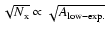 ,
for high values of .
So, in conclusion, we believe that
the previous estimate of the statistical significance of the cluster-EGRET
source correlation given above can be reliably considered as a lower limit to
the actual significance level of the spatial correlation between galaxy clusters
and unidentified EGRET sources.
,
for high values of .
So, in conclusion, we believe that
the previous estimate of the statistical significance of the cluster-EGRET
source correlation given above can be reliably considered as a lower limit to
the actual significance level of the spatial correlation between galaxy clusters
and unidentified EGRET sources.
To select out of the full list previously found the more probable associations of galaxy clusters with the unidentified EGRET sources, we superposed the optical cluster positions and their X-ray images onto the maps containing the probability distribution for the spatial position of the 50 EGRET sources found in our spatial correlation analysis.
We found that 18 of the original 50 EGRET sources associated with galaxy
clusters have also an AGN (with confirmed identification) whose position falls
within the
confidence level position error contours of the gamma-ray
source. We also found that a Gamma Ray Burst is found in association with the
EGRET source 3EG J2255-5012 and the clusters Abell 1073S and Abell 1074S. Also a SN remnant
is found in the field of the source 3EG J1235+0233 associated to the cluster
Abell 1564. We then excluded these 20 EGRET sources and the associated 30 clusters
from the list of probable physical associations.
We also excluded 12 EGRET sources with a possible, but not confirmed, AGN contamination
in the Third EGRET catalog (see Hartman et al. 1999).
Note that also this procedure is very conservative since there are 4 cases out
of the 12 listed in which the possible AGN source is found beyond the
confidence level position error contours of the associated EGRET sources, while
the galaxy clusters spatially associated with the EGRET sources fall within
their
confidence level position error contours.
Finally, we conclude that, in our conservative analysis, 24 galaxy clusters are
associated to 18 unidentified EGRET sources with |b|>20
for which there
is no firmly established counterpart at other wavelengths, neither extragalactic
(AGN or "active'' galaxy) or galactic (Supernova remnant, pulsar, neutron
star). All of these galaxy clusters have their optical and X-ray centers falling
within the
confidence level position error contours of the EGRET
sources. We show in Table 1 the list of the 18 EGRET sources and the 24 clusters
which are spatially correlated within the
confidence level position
error contours of each EGRET source. This is the initial sample of likely
associations between galaxy clusters and EGRET gamma-ray sources on which we
performed a more detailed analysis, as discussed in the following.
| EGRET source | RA | Dec | Cluster | RA | Dec | z | R |
 |
Notes |
| * 3EG J2219-7941 | 22 20 00.0 | -79 41 24.00 | Abell 1014S | 22 24 10 | -80 10 4 | 0.048 | 0 | - | SUMSS |
| Abell 1024S | 22 27 32 | -78 45 4 | 0.105a | 0 | - | SUMSS | |||
| 3EG J1825-7926 | 18 25 02.4 | -79 26 24.00 | Abell 3631 | 18 34 08 | -78 47 4 | 0.085a | 0 | - | SUMSS |
| 3EG J0348-5708 | 03 48 28.8 | -57 08 24.00 | Abell 3164 | 03 45 49 | -57 02 4 | 0.057 | 0 | 4.5 |
SUMSS |
| * 3EG J0159-3603 | 01 59 21.6 | -36 03 36.00 | Abell 2963 | 02 00 45 | -35 59 3 | 0.113a | 0 | - | NVSS |
| Abell 219S | 02 02 03 | -35 48 3 | 0.128a | 1 | 15 |
- | |||
| 3EG J0616-3310 | 06 16 36.0 | -33 10 12.00 | Abell 577S | 06 15 18 | -34 07 0 | 0.102a | 2 | 7 |
NVSS |
| Abell 575S | 06 13 25 | -33 40 5 | 0.098a | 0 | - | NVSS | |||
| Abell 573S | 06 12 02 | -32 57 4 | 0.078a | 0 | - | NVSS | |||
| 3EG J2034-3110 | 20 34 55.2 | -31 10 48.00 | Abell 886S | 20 37 11 | -31 38 3 | 0.095a | 0 | - | - |
| 3EG J1234-1318 | 12 34 02.4 | -13 18 36.00 | Abell 1558 | 12 33 59 | -13 34 3 | 0.116a | 0 | 14 |
NVSS |
| Abell 1555 | 12 31 59 | -13 23 3 | 0.127a | 1 | 14 |
NVSS | |||
| * 3EG J0038-0949 | 00 38 57.6 | -09 49 12.00 | Abell 85 | 00 41 37 | -09 20 3 | 0.056 | 1 | 30 |
RH, RG, NVSS |
| * 3EG J1310-0517 | 13 10 24.0 | -05 18 00.00 | Abell 1688 | 13 11 29 | -04 40 5 | 0.190k | 0 | - | NVSS |
| * 3EG J0253-0345 | 02 53 57.6 | -03 45 36.00 | Abell 388 | 02 51 36 | -03 45 4 | 0.134 | 2 | 10 |
NVSS |
| * 3EG J0439+1105 | 04 39 14.4 | 11 05 24.00 | Abell 497 | 04 36 51 | 10 38 0 | 0.140k | 0 | 17.5 |
NVSS |
| * 3EG J0215+1123 | 02 16 00.0 | 11 22 48.00 | Abell 331 | 02 15 35 | 11 21 5 | 0.186k | 1 | 9 |
NVSS |
| 3EG J2248+1745 | 22 48 57.6 | 17 46 12.00 | Abell 2486 | 22 48 45 | 17 09 5 | 0.143k | 0 | 18 |
NVSS |
| 3EG J1212+2304 | 12 12 36.0 | 23 04 48.00 | Abell 1494 | 12 13 14 | 23 56 1 | 0.159k | 1 | 15 |
NVSS |
| 3EG J1347+2932 | 13 47 12.0 | 29 32 24.00 | Abell 1781 | 13 44 28 | 29 50 5 | 0.062 | 0 | 16 |
RG, NVSS |
| * 3EG J1424+3734 | 14 24 52.8 | 37 34 48.00 | Abell 1902 | 14 21 46 | 37 17 2 | 0.160 | 2 | 15 |
RG, NVSS |
| Abell 1914 | 14 26 02 | 37 49 3 | 0.171 | 2 | 13 |
RH, RG, NVSS | |||
| * 3EG J1337+5029 | 13 37 31.2 | 50 28 48.00 | Abell 1758 | 13 32 32 | 50 30 3 | 0.279 | 3 | 11 |
RH, RG, NVSS |
| 3EG J1447-3936 | 14 14748.0 | -39 36 36.0 | Abell 774S | 14 49 23 | -40 20 6 | 0.062a | 0 | - | - |
 arcmin, of the cluster; RH: radio
halo or relic belonging to the cluster. The specific ID names of the identified
radio galaxies and NVSS radio sources associated to the clusters are given in
Sect. 3 of the text.
arcmin, of the cluster; RH: radio
halo or relic belonging to the cluster. The specific ID names of the identified
radio galaxies and NVSS radio sources associated to the clusters are given in
Sect. 3 of the text.
According to our selection procedure, the significance level of such a spatial
association is 
 which corresponds to a probability
 for the null hypothesis that the two source populations are randomly
associated. However, the point is still to determine how many of these spatial
associations are due to random projection effects and which are the most
probable physical associations. A rough estimate of the probability to have
still random associations in the sample here selected (see Table 1) and to be
not contaminated by either extra-galactic (AGN, GRB) or galactic (SNR, pulsars, ...) gamma-ray sources, yields that about 2/3 of the 18 selected EGRET sources
are still random associations. This rough estimate would yield 6 most probable
cluster-EGRET source associations with a confidence level of
for the null hypothesis that the two source populations are randomly
associated. However, the point is still to determine how many of these spatial
associations are due to random projection effects and which are the most
probable physical associations. A rough estimate of the probability to have
still random associations in the sample here selected (see Table 1) and to be
not contaminated by either extra-galactic (AGN, GRB) or galactic (SNR, pulsars, ...) gamma-ray sources, yields that about 2/3 of the 18 selected EGRET sources
are still random associations. This rough estimate would yield 6 most probable
cluster-EGRET source associations with a confidence level of
 .
Note, however, that this is again a lower limit to the true statistical
confidence of the correlation since the effect of the non-uniform EGRET sky
coverage has to be taken into account and would tend to increase the statistical
significance level of the most probable association. If we correct for the
number of correlations expected in the fraction of the EGRET sky (
.
Note, however, that this is again a lower limit to the true statistical
confidence of the correlation since the effect of the non-uniform EGRET sky
coverage has to be taken into account and would tend to increase the statistical
significance level of the most probable association. If we correct for the
number of correlations expected in the fraction of the EGRET sky ( of the full sky) which has a flux limit below
 cm-2 s-1, we obtain that the expected confidence level of the
most probable associations increases from
to
cm-2 s-1, we obtain that the expected confidence level of the
most probable associations increases from
to
 .
.
In addition to the spatial information contained in the Third EGRET catalog and in the Abell cluster survey, we can use more physical criteria to determine the number of spurious correlations in our selected sample of Table 1. Specifically, we first analyze the flux level, the flux variability and the spectral indices of the 18 EGRET sources in Table 1 compared to the same quantities of other gamma-ray sources more definitely identified in the Third EGRET catalogue (mainly AGN and Pulsars). Then we run Monte Carlo simulations of flux level and variability for the probable EGRET-cluster associations to determine the fraction of random correlations expected in our selected sample.
![\begin{figure}
\par\includegraphics[width=6.96cm,clip]{3EG_flux_cls_1.ps}\hspace...
...}\hspace*{3mm}\includegraphics[width=3.48cm,clip]{3EG_flux_cls_3.ps}\end{figure}](/articles/aa/full/2002/46/aah3369/img45.gif) |
Figure 1: We show the gamma-ray flux of the EGRET sources in Table 1 as detected in the different viewing periods (VP) of the source detection. Data are from Hartman et al. (1999). The flux detected in the different VPs are reported here in the sequential order given in the Third EGRET catalog, being the correct observing time sequence irrelevant for our purposes. The fluxes of the EGRET sources are in units of 10-8 cm-2 s-1. |
Figure 1 shows the flux variation in the viewing periods (hereafter VP) over which
the EGRET sources reported in Table 1 have been detected. We notice that the
flux variability for the probable cluster-EGRET source associations listed in
Table 1 is, on average,  and only in a few cases (3EG J1825-7926,
3EG J1212+2304, 3EG J0616-3310, 3EG J2248+1745) it can be considered
in some specific VP (see Fig. 1). The correspondingly associated clusters
(see Table 1) are poorly studied, do not have X-ray information and do not have
any identified bright radio galaxy or radio halo/relic emission. Hence, we also
consider these cases as suspiciously due to projection effects. Beyond the
positive detections with high statistical significance
and only in a few cases (3EG J1825-7926,
3EG J1212+2304, 3EG J0616-3310, 3EG J2248+1745) it can be considered
in some specific VP (see Fig. 1). The correspondingly associated clusters
(see Table 1) are poorly studied, do not have X-ray information and do not have
any identified bright radio galaxy or radio halo/relic emission. Hence, we also
consider these cases as suspiciously due to projection effects. Beyond the
positive detections with high statistical significance
 (see Hartman et al. 1999 for a definition of the quantity
(TS)1/2) of
the EGRET sources reported in Fig. 1, the Third EGRET catalog provides also upper
limits on their fluxes in other independent VPs. Such upper limits have
(see Hartman et al. 1999 for a definition of the quantity
(TS)1/2) of
the EGRET sources reported in Fig. 1, the Third EGRET catalog provides also upper
limits on their fluxes in other independent VPs. Such upper limits have
 (i.e., a low statistical significance) and we verified that
most of them are consistent with the positive detections of the EGRET sources we
show in Fig. 1. In some cases, however, (see, e.g., 3EGJ0348-5708, 3EGJ1234-1318,
3EGJ0253-0345, 3EGJ0215+1123) there are upper limits which are well below the
flux level found in other independent VP detections of the sources. Nonetheless,
we noticed that these "quite low'' upper limits all have a very low statistical
confidence level,
(i.e., a low statistical significance) and we verified that
most of them are consistent with the positive detections of the EGRET sources we
show in Fig. 1. In some cases, however, (see, e.g., 3EGJ0348-5708, 3EGJ1234-1318,
3EGJ0253-0345, 3EGJ0215+1123) there are upper limits which are well below the
flux level found in other independent VP detections of the sources. Nonetheless,
we noticed that these "quite low'' upper limits all have a very low statistical
confidence level,
 ,
and are hence extremely unreliable. Thus,
due to their quite low statistical significance, the upper limits of the EGRET
sources listed in Table 1 and shown in Fig. 1 do not strongly affect our
conclusions on their overall flux variability. A few other sources with
independent flux upper limits below the definite detections (see, e.g.,
3EGJ0616-3310, 3EGJ2034-3110, 3EGJ1212+2304) show also a level of flux
variability which does not justify to consider them as stationary sources.
For the sake of completeness, we will discuss in Sect. 3 below the detailed
analysis of each specific EGRET source listed in Table 1.
,
and are hence extremely unreliable. Thus,
due to their quite low statistical significance, the upper limits of the EGRET
sources listed in Table 1 and shown in Fig. 1 do not strongly affect our
conclusions on their overall flux variability. A few other sources with
independent flux upper limits below the definite detections (see, e.g.,
3EGJ0616-3310, 3EGJ2034-3110, 3EGJ1212+2304) show also a level of flux
variability which does not justify to consider them as stationary sources.
For the sake of completeness, we will discuss in Sect. 3 below the detailed
analysis of each specific EGRET source listed in Table 1.
For comparison, we show in Fig. 2 the flux variation of the EGRET sources which are correlated with galaxy clusters and moreover contain also a confirmed AGN in the field. In these last cases, the flux of the EGRET sources not only show stronger and statistically significative variations, but also have a much higher value of their average gamma-ray flux.
![\begin{figure}
\par\includegraphics[width=6.96cm,clip]{3EG_flux_agn_1.ps}\hspace...
...}\hspace*{3mm}\includegraphics[width=3.48cm,clip]{3EG_flux_agn_3.ps}\end{figure}](/articles/aa/full/2002/46/aah3369/img50.gif) |
Figure 2: The variation of the gamma-ray flux of the EGRET sources which are correlated with galaxy clusters and which have also an identified AGN in the field. Data are from Hartman et al. (1999). As in Fig. 1, the flux detected in the different VPs are reported in the sequential order given in the Third EGRET catalog, being the correct observing time sequence irrelevant for our purposes. The fluxes of the EGRET sources are in units of 10-8 cm-2 s-1. |
In Fig. 3 we compare the spectral index,  ,
of the EGRET sources which are
probably associated with galaxy clusters with those of the EGRET sources which
are spatially correlated with galaxy clusters and moreover contain an AGN in the
field. The EGRET sources correlated with clusters are not found to be brighter
than
,
of the EGRET sources which are
probably associated with galaxy clusters with those of the EGRET sources which
are spatially correlated with galaxy clusters and moreover contain an AGN in the
field. The EGRET sources correlated with clusters are not found to be brighter
than
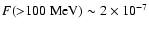 counts cm-2 s-1 and show
spectral indices in a large range
counts cm-2 s-1 and show
spectral indices in a large range
 .
With a remarkable difference,
the EGRET sources identified with known AGNs span over a much higher gamma-ray
flux range and have a much smaller range of spectral index values (
.
With a remarkable difference,
the EGRET sources identified with known AGNs span over a much higher gamma-ray
flux range and have a much smaller range of spectral index values (
 -2.5) especially at very bright flux levels
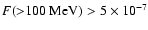 counts cm-2 s-1. Pulsars also show very flat spectral indices
 and very high gamma-ray flux which cannot be compared with
those of the EGRET sources associated with clusters.
and very high gamma-ray flux which cannot be compared with
those of the EGRET sources associated with clusters.
The gamma-ray spectral indices for the probable associations listed in Table 1
have values which are consistent with those expected from the viable mechanisms
for gamma-ray emission in clusters. Theoretical models for cluster gamma-ray
emission predict in fact slopes in the range
 ,
going from
annihilation of dark matter neutralinos (Colafrancesco & Mele 2001) to
non-thermal electron bremsstrahlung (Colafrancesco 2001a,b; Blasi 2000). Only
the sources 3EG J2034-3110 (associated to Abell 886S) and 3EG J1424+3734 (associated
to Abell 1902 and Abell 1914) have spectral indices 3, even though with large
uncertainties. However, while the first source, 3EG J2034-3110, shows also some
level of flux variability (see Fig. 1) and could then be contaminated by AGN-like
sources, the gamma-ray source 3EG J1424+3734 has a very low flux variability
(
,
going from
annihilation of dark matter neutralinos (Colafrancesco & Mele 2001) to
non-thermal electron bremsstrahlung (Colafrancesco 2001a,b; Blasi 2000). Only
the sources 3EG J2034-3110 (associated to Abell 886S) and 3EG J1424+3734 (associated
to Abell 1902 and Abell 1914) have spectral indices 3, even though with large
uncertainties. However, while the first source, 3EG J2034-3110, shows also some
level of flux variability (see Fig. 1) and could then be contaminated by AGN-like
sources, the gamma-ray source 3EG J1424+3734 has a very low flux variability
( )
and is likely to be a probable association whose gamma-ray
emission could be dominated by non-thermal electron bremsstrahlung, which shows
typically a steep spectrum consistent with that of the parent cosmic-ray
electrons (see, e.g., Longair 1993).
)
and is likely to be a probable association whose gamma-ray
emission could be dominated by non-thermal electron bremsstrahlung, which shows
typically a steep spectrum consistent with that of the parent cosmic-ray
electrons (see, e.g., Longair 1993).
![\begin{figure}
\par\includegraphics[width=8.5cm,clip]{gindex.ps}\end{figure}](/articles/aa/full/2002/46/aah3369/img58.gif) |
Figure 3:
The gamma-ray spectral index
is plotted against the gamma-ray flux
 of the EGRET sources found to be spatially correlated with galaxy clusters. In the top panel we compare the
spectral indices for the EGRET sources which are more probably associated with clusters (filled circles) with the
EGRET sources again correlated with clusters and in which an identified AGN is also found (open circles). In the
lower panel the data from the EGRET sources contaminated by possible AGNs (gray triangles), GRB (open, light-gray
triangle), SNR (open black triangle) and Pulsars (stars) are added to the previous data sets. Data are from
Hartman et al. (1999).
of the EGRET sources found to be spatially correlated with galaxy clusters. In the top panel we compare the
spectral indices for the EGRET sources which are more probably associated with clusters (filled circles) with the
EGRET sources again correlated with clusters and in which an identified AGN is also found (open circles). In the
lower panel the data from the EGRET sources contaminated by possible AGNs (gray triangles), GRB (open, light-gray
triangle), SNR (open black triangle) and Pulsars (stars) are added to the previous data sets. Data are from
Hartman et al. (1999). |
We finally run Monte Carlo simulations of the flux variability level of the 18 EGRET sources of Table 1. For a uniform random distribution of their fractional
flux change,
 ,
we expect 4 EGRET sources with
,
we expect 4 EGRET sources with
 ,
while the remaining 14 EGRET sources possibly associated with galaxy
clusters should have
,
while the remaining 14 EGRET sources possibly associated with galaxy
clusters should have
 .
The actual data reported
in Fig. 1 show that there are about 11 EGRET sources with
.
The actual data reported
in Fig. 1 show that there are about 11 EGRET sources with
 and only 7 sources with
.
This indicates that
the low flux variability shown by the EGRET sources found in association with
clusters cannot be recovered by a simple random distribution at more than the
and only 7 sources with
.
This indicates that
the low flux variability shown by the EGRET sources found in association with
clusters cannot be recovered by a simple random distribution at more than the  confidence level.
Based on these results we expect that about 10 EGRET sources out of the 18 listed in Table 1 are probable EGRET-cluster associations having
,
 cm-2 s-1 and
 .
However, only a detailed analysis of the spatial and
spectral features of each EGRET source as well as a detailed analysis of their
cluster counterparts can reveal the nature of the more probable physical
association. We will present in the next section the detailed analysis of each
one of the specific EGRET sources listed in Table 1 and of their possible
astrophysical counterparts.
.
However, only a detailed analysis of the spatial and
spectral features of each EGRET source as well as a detailed analysis of their
cluster counterparts can reveal the nature of the more probable physical
association. We will present in the next section the detailed analysis of each
one of the specific EGRET sources listed in Table 1 and of their possible
astrophysical counterparts.
Copyright ESO 2002