

The major part of the gamma-ray sources detected with the EGRET instrument
(Kanbach et al. 1988) on board the CGRO satellite have not yet been identified
with secure counterparts at other wavelenghts because of the poor spatial
resolution of the EGRET instrument. In fact, 170 gamma-ray sources out of the
271 found in the Third EGRET catalogue are not yet identified with firmly
established counterpart (Hartman et al. 1999). Most of the unidentified
gamma-ray sources are found at low galactic latitudes, 
 ,
and are likely to belong to our Galaxy (Gehrels et al. 2000). Fifty of these
sources are found at high galactic latitudes,
,
and are likely to belong to our Galaxy (Gehrels et al. 2000). Fifty of these
sources are found at high galactic latitudes,  ,
and there
are several hints that they are of extra-galactic nature (Grenier 2001). Among
the identified extra-galactic gamma-ray sources observed with EGRET, most are AGNs (Hartman et al. 1999) but there is no firm evidence that the
remaining unidentified EGRET sources can be associated with another population
of active galaxies. In fact, most of the unidentified EGRET sources have a
rather low flux variability while AGNs usually show a strong flux variability in
the gamma-rays (Urry & Padovani 1995; Ulrich et al. 1997).
,
and there
are several hints that they are of extra-galactic nature (Grenier 2001). Among
the identified extra-galactic gamma-ray sources observed with EGRET, most are AGNs (Hartman et al. 1999) but there is no firm evidence that the
remaining unidentified EGRET sources can be associated with another population
of active galaxies. In fact, most of the unidentified EGRET sources have a
rather low flux variability while AGNs usually show a strong flux variability in
the gamma-rays (Urry & Padovani 1995; Ulrich et al. 1997).
Galaxy clusters are bright sources of X-rays produced through bremsstrahlung emission from a hot (with temperature
 K), optically thin (number density
 cm-3), highly
ionized intracluster (hereafter IC) gas (mainly consisting of a population of thermal electrons and protons) in
nearly hydrostatic equilibrium with the overall gravitational potential of the structure (see, e.g., Sarazin 1988
for a review). Many galaxy clusters also show the presence of non-thermal emission phenomena like extended radio
halos (see, e.g., Giovannini & Feretti 2000), likely produced by synchrotron emission of relativistic electrons
either accelerated in the intracluster medium (hereafter ICM) by merging shocks or produced in the decay of dark
matter annihilation products (see, e.g., Colafrancesco 2001a; Colafrancesco & Mele 2001). Many clusters also host
bright radio (or active) galaxies living in their environment. These active galaxies can inject relativistic
particles into the ICM through the interaction of radio jets with the surrounding medium (Blandford 2002).
The presence of relativistic
particles in the ICM has been also suggested to explain the emission excesses observed in some clusters in the EUV
(Lieu et al. 1999; Bowyer 2000) and in the hard X-rays (Fusco-Femiano et al. 1999-2000; Rephaeli et al. 1999;
Kaastra et al. 1999; Henriksen 2000). However, there is no evidence in the EGRET database for a detection of
gamma-ray emission in the direction of a few selected clusters like Coma (Sreekumar et al. 1996) and Virgo.
cm-3), highly
ionized intracluster (hereafter IC) gas (mainly consisting of a population of thermal electrons and protons) in
nearly hydrostatic equilibrium with the overall gravitational potential of the structure (see, e.g., Sarazin 1988
for a review). Many galaxy clusters also show the presence of non-thermal emission phenomena like extended radio
halos (see, e.g., Giovannini & Feretti 2000), likely produced by synchrotron emission of relativistic electrons
either accelerated in the intracluster medium (hereafter ICM) by merging shocks or produced in the decay of dark
matter annihilation products (see, e.g., Colafrancesco 2001a; Colafrancesco & Mele 2001). Many clusters also host
bright radio (or active) galaxies living in their environment. These active galaxies can inject relativistic
particles into the ICM through the interaction of radio jets with the surrounding medium (Blandford 2002).
The presence of relativistic
particles in the ICM has been also suggested to explain the emission excesses observed in some clusters in the EUV
(Lieu et al. 1999; Bowyer 2000) and in the hard X-rays (Fusco-Femiano et al. 1999-2000; Rephaeli et al. 1999;
Kaastra et al. 1999; Henriksen 2000). However, there is no evidence in the EGRET database for a detection of
gamma-ray emission in the direction of a few selected clusters like Coma (Sreekumar et al. 1996) and Virgo.
There are, nonetheless, several
theoretical motivations to expect that galaxy clusters can indeed be extended sources of gamma-rays emitted in the
decay of neutral pions, produced either in the interaction of cosmic ray protons with the ICM protons (
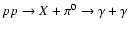 ;
see Colafrancesco & Blasi 1998; Völk & Atoyan 1999) or in the annihilation of dark
matter particles (
;
see Colafrancesco & Blasi 1998; Völk & Atoyan 1999) or in the annihilation of dark
matter particles (
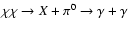 ;
see Colafrancesco & Mele 2001). The secondary
electrons produced in the previous mechanisms (see, e.g., Blasi & Colafrancesco 1999; Colafrancesco & Mele 2001)
can also produce additional gamma-ray emission through both bremsstrahlung and Inverse Compton Scattering (ICS)
against the Cosmic Microwave Background (CMB) photons. Also primary cosmic ray electrons can produce a diffuse
flux of gamma-rays due to non-thermal bremsstrahlung (see Sreekumar et al. 1996; Colafrancesco 2001b) and ICS of
the CMB photons. On top of such diffuse emission, the gamma-ray emission emerging from individual "normal''
galaxies (Berezinsky et al. 1990; Dar & deRujula 2000) living in the cluster is also expected, as well as from
"active'' galaxies (Urry & Padovani 1995) which belong to the cluster.
;
see Colafrancesco & Mele 2001). The secondary
electrons produced in the previous mechanisms (see, e.g., Blasi & Colafrancesco 1999; Colafrancesco & Mele 2001)
can also produce additional gamma-ray emission through both bremsstrahlung and Inverse Compton Scattering (ICS)
against the Cosmic Microwave Background (CMB) photons. Also primary cosmic ray electrons can produce a diffuse
flux of gamma-rays due to non-thermal bremsstrahlung (see Sreekumar et al. 1996; Colafrancesco 2001b) and ICS of
the CMB photons. On top of such diffuse emission, the gamma-ray emission emerging from individual "normal''
galaxies (Berezinsky et al. 1990; Dar & deRujula 2000) living in the cluster is also expected, as well as from
"active'' galaxies (Urry & Padovani 1995) which belong to the cluster.
In this paper, we report the results of a detailed spatial and spectral analysis of the unidentified EGRET sources
at high galactic latitude and the findings of preliminary evidence for a correlation between galaxy clusters and
unidentified EGRET sources at |b| > 20 .
The plan of the paper is the following. In Sect. 2 we discuss the
evidence for the spatial correlation between EGRET sources at high galactic latitude and galaxy clusters in the
Abell catalog (Abell et al. 1989). We also discuss the analysis of the gamma-ray flux and spectra of the EGRET
sources probably associated with galaxy clusters in comparison with those associated with other EGRET sources. In
Sect. 3 we analyze in details each one of the 18 EGRET sources which have possible associations with galaxy clusters. We finally derive a sample of 9 EGRET sources which are most
probably associated with 12 galaxy clusters. In Sect. 4 we discuss the correlation we found between the gamma-ray
flux of the EGRET source and the radio flux of the cluster radio sources for the 9 most probable EGRET-cluster
associations and in Sect. 5 we discuss the evidence for a similar correlation between the gamma-ray luminosity and
the X-ray luminosity of the same most probable EGRET-cluster associations. We present in Sect. 6 our conclusions
and a discussion of the future expectations for the detection of gamma-ray emission from galaxy clusters in the
light of the next generation space and ground-based gamma-ray experiments. We use
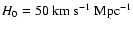 and a flat (
 )
cosmology throughout the paper unless otherwise specified.
)
cosmology throughout the paper unless otherwise specified.
Copyright ESO 2002