

Many of the clusters listed in Table 1 (namely, 17 out of 24 clusters) have also NVSS and SUMSS radio sources within their Abell radius, five clusters have identified bright radio galaxies in their environment and three clusters (Abell 1758, Abell 1914 and Abell 85) have also a radio halo or radio relic inhabiting their ICM (see Figs. 6-8). Since the EGRET sources have been selected to be of high galactic latitude, the NVSS radio sources are very likely non-identified (active) radio galaxies, as also indicated by the NVSS-NRAO images of many of the radio sources found in our analysis of the specific EGRET sources counterparts as discussed in Sect. 3 above.
The 9 EGRET sources in Table 1 which are marked with an asterisk are those more likely associated to galaxy clusters according to our analysis of the specific sources presented in Sect. 3 above. These galaxy clusters are quite peculiar since all of them have bright NVSS radio sources in their environment and six of them have also bright radio galaxies living in their environment. Three of the clusters which are more probably associated with these EGRET sources show also the presence of extended radio halos or relics. Hence, such galaxy clusters which have strong radio emission (either diffuse or associated with member galaxies) show the direct presence of a population of relativistic electrons which are injected in their ICM.
Radio galaxies, which are mainly found in the central regions of the clusters, may inject into the cluster ICM
large quantities of energy transported by their relativistic jets.
This energy is probably changed from an electromagnetic form to a pair plasma, to an ion plasma and (at least
partially along the way) into energetic photons (see, e.g., Blandford 2002). Such high-energy particles and
photons may produce  GeV gamma-ray emission which can be observed by EGRET.
The active galaxy radio power correlates with the gamma-ray power (Padovani et al. 1993) indicating that
radio louder galaxies emit more gamma-ray power which, in turn, seems to be associated with relativistic beaming
of the jets (see, e.g., Urry & Padovani 1995).
Also the particles injected into the ICM by the radio-galaxy jets may diffuse in the magnetized ICM (Colafrancesco
& Blasi 1998) and interact with the ICM particles (mainly electrons and protons)
to produce diffuse radio emission (Blasi & Colafrancesco 1999), heating of the ICM itself (Yamada & Fujita 2001;
Kaiser & Alexander 1999; Inoue & Sasaki 2001; Nath & Roychowdhury 2002) and secondarily produced gamma-ray
emission (Colafrancesco & Blasi 1998; Blasi 2000).
GeV gamma-ray emission which can be observed by EGRET.
The active galaxy radio power correlates with the gamma-ray power (Padovani et al. 1993) indicating that
radio louder galaxies emit more gamma-ray power which, in turn, seems to be associated with relativistic beaming
of the jets (see, e.g., Urry & Padovani 1995).
Also the particles injected into the ICM by the radio-galaxy jets may diffuse in the magnetized ICM (Colafrancesco
& Blasi 1998) and interact with the ICM particles (mainly electrons and protons)
to produce diffuse radio emission (Blasi & Colafrancesco 1999), heating of the ICM itself (Yamada & Fujita 2001;
Kaiser & Alexander 1999; Inoue & Sasaki 2001; Nath & Roychowdhury 2002) and secondarily produced gamma-ray
emission (Colafrancesco & Blasi 1998; Blasi 2000).
In addition, particles in the ICM could be efficiently accelerated at the accretion shocks located at the cluster
periphery as well as at the ICM shocks produced by subcluster mergings (see, e.g.,
Miniati et al. 2000) and/or by fast galaxy motions.
The subsequent interaction of the accelerated particles with the surrounding hot, magnetized
ICM can again produce diffuse radio halo/relic emission (see, e.g., Blasi & Colafrancesco 1999; Sarazin 2002) and diffuse
gamma-ray emission at
 (Colafrancesco & Blasi 1998).
On top of these acceleration mechanisms, it has been recently shown that dark matter particle (neutralinos)
annihilation - a mechanism which is especially efficient in the central regions of the clusters - may produce
both diffuse radio halo emission and diffuse gamma-ray emission visible at
(Colafrancesco &
Mele 2001).
(Colafrancesco & Blasi 1998).
On top of these acceleration mechanisms, it has been recently shown that dark matter particle (neutralinos)
annihilation - a mechanism which is especially efficient in the central regions of the clusters - may produce
both diffuse radio halo emission and diffuse gamma-ray emission visible at
(Colafrancesco &
Mele 2001).
The presence of such relativistic particles into the ICM strongly suggests, in conclusion, that themselves and/or their parent population (e.g., relativistic protons, dark matter particles) can be responsible for a substantial gamma-ray flux at the EGRET energies (E > 100 MeV) as well as non-thermal radio emission through different mechanisms. Thus, we propose that there should be a close connection between radio emission (either diffuse or associated with individual active galaxies) and gamma-ray emission in galaxy clusters.
Based on the previous arguments, we should expect a positive correlation between the flux of the radio sources
associated with the galaxy cluster and the gamma-ray flux of the relative EGRET source. In fact, we found a
positive correlation between the radio flux at 1.4 GHz, S1.4, of the brightest radio source in the cluster
and the EGRET source flux,
 ,
which is reported in the Third EGRET Catalog (Hartman et al.
1999). Specifically, we find a correlation
,
which is reported in the Third EGRET Catalog (Hartman et al.
1999). Specifically, we find a correlation
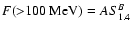 with
A= 6.053+2.637-1.836 and
with
A= 6.053+2.637-1.836 and
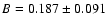 (
( errors) using gamma-ray fluxes selected in the different observing periods of
the EGRET source (see Fig. 9). The best fit has a
errors) using gamma-ray fluxes selected in the different observing periods of
the EGRET source (see Fig. 9). The best fit has a
 which gives a probability P=0.064 for the null
hypothesis of a random distribution for the radio and gamma-ray flux of the nine sources in our analysis. This
gives a statistical confidence level of
which gives a probability P=0.064 for the null
hypothesis of a random distribution for the radio and gamma-ray flux of the nine sources in our analysis. This
gives a statistical confidence level of 
 .
We show in Fig. 9 the best fit curve and the
and
.
We show in Fig. 9 the best fit curve and the
and  confidence level regions for the fit.
A similar result obtains considering the
total radio flux from the clusters (most of the clusters here considered have more than one radio source in their
environment) associated with the previous EGRET sources. The reason for such similar result is that in many cases
the cluster radio flux at 1.4 GHz is dominated by the brightest radio source in the cluster.
confidence level regions for the fit.
A similar result obtains considering the
total radio flux from the clusters (most of the clusters here considered have more than one radio source in their
environment) associated with the previous EGRET sources. The reason for such similar result is that in many cases
the cluster radio flux at 1.4 GHz is dominated by the brightest radio source in the cluster.
![\begin{figure}
\par\includegraphics[width=7.2cm,clip]{gamma_radio_corr_ott.ps}\end{figure}](/articles/aa/full/2002/46/aah3369/img217.gif) |
Figure 9:
The correlation between the gamma-ray flux,
,
and the radio flux at
1.4 GHz, S1.4, shown by the EGRET source - cluster associations listed with an asterisk in Table 1.
The best fit curve
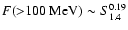 is shown (solid) together with the
(green/dark gray) and
(yellow/pale gray) confidence level regions of the fit.
is shown (solid) together with the
(green/dark gray) and
(yellow/pale gray) confidence level regions of the fit. |
Even though the large uncertainties in the EGRET source fluxes do not allow to draw any strong conclusion for the universality of such correlation, the present results indicate that there is a connection between the activity of the cluster ICM, and of its active galaxy content, and the overall gamma-ray behaviour of these large-scale structures, an indication that can be definitely confirmed by the next generation gamma-ray telescopes. The detailed follow-up of the galaxy populations of the clusters most probably associated to the 9 EGRET sources here selected is an important aspect in this research field but it is far beyond the aims of the present work and will be tackled in a forthcoming paper.
Copyright ESO 2002