

To further strengthen our argument presented in the previous sections, we looked for other intrinsic correlations
among galaxy clusters and unidentified EGRET sources. Specifically, we correlated the cluster X-ray luminosity,
 ,
with the luminosity of the associated EGRET source under the assumption that it is physically
associated to the cluster and, hence, has the same redshift. We derived the gamma-ray luminosity,
,
with the luminosity of the associated EGRET source under the assumption that it is physically
associated to the cluster and, hence, has the same redshift. We derived the gamma-ray luminosity,
 ,
of
each EGRET source from the gamma-ray fluxes at E > 100 MeV given in the Third EGRET catalog (Hartman et al. 1999) using the cluster optical redshift given in Table 1.
We consider the same EGRET-cluster associations (with the exception of the
source 3EGJ0159-3603 associated with the clusters Abell 219S and Abell 2963 because no
reliable redshift is available for these clusters) which show the
,
of
each EGRET source from the gamma-ray fluxes at E > 100 MeV given in the Third EGRET catalog (Hartman et al. 1999) using the cluster optical redshift given in Table 1.
We consider the same EGRET-cluster associations (with the exception of the
source 3EGJ0159-3603 associated with the clusters Abell 219S and Abell 2963 because no
reliable redshift is available for these clusters) which show the
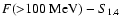 correlation analyzed in the previous Sect. 4.
The
correlation analyzed in the previous Sect. 4.
The
 correlation shown by the data (see Fig. 10) is fitted by
 with best fit values
 and
and
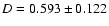 (
( errors). A similar result, however,
is also found for viewing periods P1234 which do not show, in general, the best S/N ratios for the detected EGRET
sources: in this last case we found
errors). A similar result, however,
is also found for viewing periods P1234 which do not show, in general, the best S/N ratios for the detected EGRET
sources: in this last case we found
 and
and
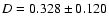 (
errors). In any case,
the
relation shown by the data is significant at more than the
(
errors). In any case,
the
relation shown by the data is significant at more than the
 confidence level.
Such a
correlation indicates a connection between the physical status of the cluster ICM,
and of its galaxy content, and the overall gamma-ray emissivity of the cluster: such a connection is indeed
expected in the viable model for the gamma-ray emission of galaxy clusters. In fact, both the diffuse emission
arising from the interaction of relativistic particles with the cluster ICM and the one arising from a
superposition of the gamma-ray emission associated with individual galaxies within the cluster predict a relation
 with
with
 .
Specifically, the cluster gamma-ray luminosity
produced by non-thermal electron bremsstrahlung (see, e.g., Longair 1993),
.
Specifically, the cluster gamma-ray luminosity
produced by non-thermal electron bremsstrahlung (see, e.g., Longair 1993),
 |
(1) |
 in pp collisions
(Colafrancesco & Blasi 1998),
in pp collisions
(Colafrancesco & Blasi 1998),
 |
(2) |
in dark matter annihilation (Colafrancesco & Mele 2001),
 |
(3) |
 |
(4) |
 ,
and relativistic protons,
,
and relativistic protons,
 ,
are decoupled from the
ICM density while the dark matter density is proportional to the ICM density. Note that a scaling similar to that
in Eq. (3) applies also to the gamma-ray emission arising from the superposition of the cluster galaxies. Using the
previous scalings and the observed X-ray luminosity - temperature relation,
,
are decoupled from the
ICM density while the dark matter density is proportional to the ICM density. Note that a scaling similar to that
in Eq. (3) applies also to the gamma-ray emission arising from the superposition of the cluster galaxies. Using the
previous scalings and the observed X-ray luminosity - temperature relation,
 with
with
 (see, e.g., Arnaud & Evrard 1999; Wu et al. 1999),
a correlation
(see, e.g., Arnaud & Evrard 1999; Wu et al. 1999),
a correlation
 ,
with
,
with
 is predicted by the previous models, in agreement
with our results shown in Fig. 10.
is predicted by the previous models, in agreement
with our results shown in Fig. 10.
![\begin{figure}
\par\includegraphics[width=6.8cm,clip]{lg_lx_radio_true_ott.ps}\end{figure}](/articles/aa/full/2002/46/aah3369/img240.gif) |
Figure 10:
The
correlation shown by the clusters listed with an asterisk in
Table 1. The best fit curve (solid line) is shown together with the
(green/dark-gray area) and  (yellow/pale-gray area) confidence level region for the fitting parameters. The X-ray luminosity, in units
of 1044 erg s-1, is given in the 2-10 keV energy range and the gamma-ray luminosity, at E> 100
MeV, of the associated EGRET source is given in units of 1046 erg s-1.
(yellow/pale-gray area) confidence level region for the fitting parameters. The X-ray luminosity, in units
of 1044 erg s-1, is given in the 2-10 keV energy range and the gamma-ray luminosity, at E> 100
MeV, of the associated EGRET source is given in units of 1046 erg s-1. |
Copyright ESO 2002