

We analysed H and  images of the Arches cluster center
obtained in the course of the Gemini science demonstration
at the Gemini North 8 m telescope located on Mauna Kea, Hawai'i,
at an altitude of 4200 m above sea level.
images of the Arches cluster center
obtained in the course of the Gemini science demonstration
at the Gemini North 8 m telescope located on Mauna Kea, Hawai'i,
at an altitude of 4200 m above sea level.
Gemini is an alt-azimuth-mounted telescope with a monolithic primary mirror and small secondary mirror optimised for IR observations. The telescope is always used in Cassegrain configuration with instruments occupying either the upward looking Cassegrain port or one of three sideward facing ports. The University of Hawai'i adaptive optics (AO) system Hokupa'a is a 35 element curvature sensing AO system (Graves et al. 2000), which typically delivers Strehl ratios between 5% and 25% in the K-band.
Hokupa'a is operated with the near-infrared camera QUIRC
(Hodapp et al. 1996), equipped with
a
 pixel HgCdTe array. The plate scale is
19.98 milliarcsec per pixel, yielding a field of view (FOV) of 20.2
pixel HgCdTe array. The plate scale is
19.98 milliarcsec per pixel, yielding a field of view (FOV) of 20.2
 .
The images are shown in Fig. 1, along with the HST/NICMOS images
used for calibration.
.
The images are shown in Fig. 1, along with the HST/NICMOS images
used for calibration.
![\begin{figure}
\par\includegraphics[bb=25 510 284 757,width=18cm,clip]{racha.ps}
\end{figure}](/articles/aa/full/2002/41/aah3531/img220.gif) |
Figure 1:
Upper panels: Gemini/Hokupa'a H (left) and
(right) images,
20
 20
(0.8 pc
0.8 pc)
with a spatial resolution of less than 0.2
.
North is up and East is to the right.
Lower panels: HST/NICMOS F160W and F205W images from Figer et al. (1999), geometrically
transformed to the Gemini FOV.
20
(0.8 pc
0.8 pc)
with a spatial resolution of less than 0.2
.
North is up and East is to the right.
Lower panels: HST/NICMOS F160W and F205W images from Figer et al. (1999), geometrically
transformed to the Gemini FOV. |
The observations were carried out between July 3 and 30, 2000.
12 individual 60 s exposures, dithered in a 4 position pattern
with an offset of 16 pixels (0.32
)
between subsequent frames,
were coadded to an H-band image
with a total integration time of 720 s. In ,
the
set of 34 dithered 30 s exposures obtained under the best observing conditions
was coadded to yield a total exposure time of 1020 s.
The full width at half maximum (FWHM) of the point spread function (PSF)
was 9.5 pixels (0.19
)
in H and 6.8 pixels (0.135
)
in .
The observations were carried out at an airmass of 1.5,
the lowest airmass at which the Galactic Center can be observed from Hawai'i.
The H-band data were oversampled, and  binning was
applied to improve the effective signal-to-noise ratio per resolution element,
allowing a more precise PSF fit.
A combination of long and short exposures has been used to
increase the dynamic range.
For the short exposures, 3 frames with 1 s exposure time have been coadded
in H, and 16 such frames in .
See Table 1 for the observational details.
In the long exposures, the limiting magnitudes were about 21 mag in H and
20 mag in .
Note that the completeness limit in the crowded regions
was significantly lower. The procedure used for completeness correction
will be described in detail in Sect. 2.1.6.
binning was
applied to improve the effective signal-to-noise ratio per resolution element,
allowing a more precise PSF fit.
A combination of long and short exposures has been used to
increase the dynamic range.
For the short exposures, 3 frames with 1 s exposure time have been coadded
in H, and 16 such frames in .
See Table 1 for the observational details.
In the long exposures, the limiting magnitudes were about 21 mag in H and
20 mag in .
Note that the completeness limit in the crowded regions
was significantly lower. The procedure used for completeness correction
will be described in detail in Sect. 2.1.6.
The data reduction was carried out by the Gemini data reduction team, F. Rigaut,
T. Davidge, R. Blum, and A. Cotera. The procedure as outlined in the
science demonstration report![[*]](/icons/foot_motif.gif) was as follows: sky images, obtained after the short observation period
when the Galactic Center was in culmination, were averaged using median clipping
for star rejection, and then subtracted from the individual images.
The frames were then flatfielded and corrected for bad pixels and cosmic ray
hits. After inspecting the individual frames with respect to signal-to-noise ratio
and resolution, and background adjustment, the images with sufficient quality were
combined using sigma clipped averaging. The final images were scaled to counts per
second. For the analysis presented in this paper, this set
of images reduced by the Gemini reduction team has been used.
was as follows: sky images, obtained after the short observation period
when the Galactic Center was in culmination, were averaged using median clipping
for star rejection, and then subtracted from the individual images.
The frames were then flatfielded and corrected for bad pixels and cosmic ray
hits. After inspecting the individual frames with respect to signal-to-noise ratio
and resolution, and background adjustment, the images with sufficient quality were
combined using sigma clipped averaging. The final images were scaled to counts per
second. For the analysis presented in this paper, this set
of images reduced by the Gemini reduction team has been used.
The photometry was performed using the IRAF
(Tody 1993) DAOPHOT implementation
(Stetson 1987).
Due to the wavelength dependence of the adaptive optics correction and
anisoplanatism
over the field, the H and
data
have been treated differently for PSF fitting. While in H the PSF radius
increases significantly with distance from the guide star,
with a radially varying FWHM in the range of 0.18
to 0.23
(see the science demonstration data description),
the
PSF was nearly constant over the field
(0.125
to 0.135
). This behaviour is expected from an AO system,
as the isoplanatic angle
 varies as
 ,
yielding a 1.4 times larger
in
than in H,
resulting in a more uniform PSF in
across the field of view.
,
yielding a 1.4 times larger
in
than in H,
resulting in a more uniform PSF in
across the field of view.
As obscuration due to extinction decreases with increasing wavelength,
many more stars are detected in
than in H.
For comparison, the number of objects found with
 mag and
uncertainty
mag and
uncertainty
 mag was 1017 (1020 s effective exposure time),
while for H < 20 mag and
mag was 1017 (1020 s effective exposure time),
while for H < 20 mag and
 mag
we detected only 391 objects (720 s effective exposure time),
where in both cases visual inspection led to the conclusion
that objects with photometric uncertainties below 0.2 mag were real detections.
On the other hand, the increased stellar number density in
leads to
increased crowding effects,
such that we decided to use a non-variable PSF for the -band data
after thorough investigation of the results of a quadratically, linearly or
non-varying PSF. It turns out that, due to a lack of isolated stars for
the determination of the PSF variation across the field, the mean uncertainty is
lower and the number of outliers with unacceptably large uncertainties reduced
when a non-variable PSF is used.
Thus, the 5 most isolated stars on the
image, which were
well spread out over the field, were used to derive the median averaged PSF
of the long exposure.
In the case of the short exposure, where due to the very short integration
time faint stars are indistinguishable from the background,
leaving more "uncrowded'' stars to derive the shape
of the PSF, 7 isolated stars could be used.
In ,
the best fitting function was an elliptical
Moffat-function with
mag
we detected only 391 objects (720 s effective exposure time),
where in both cases visual inspection led to the conclusion
that objects with photometric uncertainties below 0.2 mag were real detections.
On the other hand, the increased stellar number density in
leads to
increased crowding effects,
such that we decided to use a non-variable PSF for the -band data
after thorough investigation of the results of a quadratically, linearly or
non-varying PSF. It turns out that, due to a lack of isolated stars for
the determination of the PSF variation across the field, the mean uncertainty is
lower and the number of outliers with unacceptably large uncertainties reduced
when a non-variable PSF is used.
Thus, the 5 most isolated stars on the
image, which were
well spread out over the field, were used to derive the median averaged PSF
of the long exposure.
In the case of the short exposure, where due to the very short integration
time faint stars are indistinguishable from the background,
leaving more "uncrowded'' stars to derive the shape
of the PSF, 7 isolated stars could be used.
In ,
the best fitting function was an elliptical
Moffat-function with
 .
.
| Date | Filter | single exp. |
 |
exp. total | det. limit |
 |
resolution | diffraction limit |
| Gemini | ||||||||
| 05/07/2000 | H | 1 s | 3 | 3 s | 18.5 mag | 7.74 | 0.17
|
0.05
|
| 05/07/2000 | H | 60 s | 12 | 720 s | 21 mag | 0.19 | 0.20
|
0.05
|
| 30/07/2000 | |
1 s | 16 | 16 s | 17.5 mag | 3.73 | 0.12
|
0.07
|
| 09/07/2000 | |
30 s | 34 | 1020 s | 20 mag | 0.22 | 0.13
|
0.07
|
| HST | ||||||||
| 14/09/1997 | F160W | 256 s | 21 mag | 0.04 | 0.18
|
0.17
|
||
| 14/09/1997 | F205W | 256 s | 20 mag | 0.15 | 0.22
|
0.21
|
||
Due to the lower detection rate on the H-band image crowding is less severe,
while the PSF exhibits more pronounced spatial variations than in .
We thus used the quadratically variable option of the DAOPHOT psf and
allstar tasks for our H-band images, with 27 stars to determine a
median averaged PSF function and residuals.
The best fitting function was a Lorentz function
on the binned H-band image.
In both filters, the average FWHM of the data has been used as the PSF
fitting radius, i.e., the kernel
of the best-fitting PSF function, to derive PSF magnitudes of the stars.
The short exposures have been used
to obtain photometry of the brightest stars, which are saturated in the
long exposures. The photometry of the long and short exposures
agreed well after atmospheric extinction correction in the form of a constant
offset had been applied.
The saturation limit was 13.0 mag in H and 13.3 mag in .
At fainter magnitudes, the photometry of both images
was indiscernible within the uncertainties for the
bright stars, and the better quality long exposure values were used.
Furthermore, a comparison of the bright star photometries was used to
estimate photometric uncertainties (see Sect. 2.1.6 and Table 2).
![\begin{figure}
\par\includegraphics[width=17cm,clip=]{aah3531f2.eps}\end{figure}](/articles/aa/full/2002/41/aah3531/img50.gif) |
Figure 2:
Formal DAOPHOT photometric uncertainties. Top panel: Gemini/Hokupa'a H and
photometry transformed to HST/NICMOS F160W and F205W filter magnitudes,
m160 and m205.
Bottom panel: HST/NICMOS m160, m205 photometry of the same
 field (shown in Fig. 1).
 |
To transform instrumental into apparent magnitudes, we used the HST/NICMOS photometry of Figer et al. (1999) as local standards. The advantage of this procedure lies in the possibility to correct for remaining PSF deviations over the field, e.g., due to a change in the Strehl ratio with distance from the guide star or due to the increased background from bright star halos in the cluster center. Indeed, as will be discussed below, the spatial distribution of photometric residuals shows a mixture of these effects.
We were able to use approximately 380 stars to derive colour equations.
The residuals obtained for these stars after calibration allow a detailed
analysis and correction of field variations.
The colour equations to transform Gemini instrumental H and magnitudes to magnitudes in the HST/NICMOS filter system were determined
using the IRAF PHOTCAL package, yielding:


 and
and
 are the Gemini instrumental
magnitudes, and m160 and m205 correspond to magnitudes obtained with
the NICMOS broadband filters F160W and F205W, respectively.
After the transformation had been applied, it turned out that the residual
magnitudes in the two independent fitting parameters
are the Gemini instrumental
magnitudes, and m160 and m205 correspond to magnitudes obtained with
the NICMOS broadband filters F160W and F205W, respectively.
After the transformation had been applied, it turned out that the residual
magnitudes in the two independent fitting parameters
 and
still varied systematically over the field.
As can be seen in Fig. 3, the variation is not a simple radial
variation increasing with distance from the guide star (GS), but a mixture
of displacement from the GS position (shown in the contour map in Fig.
3 as a cross), and the position with respect to the cluster center
or bright stars in the field.
Fortunately, the variation was well behaved in the Y-direction, and
could be fitted by a fourth order polynomial. Close inspection showed
that two areas on the QUIRC array showed a remaining photometric offset compared
to the HST photometry. In the region
400 < X < 700 pixels and Y < 250 pixels,
the magnitude was underestimated by 0.1 mag. For X > 850 pixels
and Y > 850 pixels, i.e., the upper right corner, the
magnitude was
overestimated by 0.25 mag (however, note that there are only 7 stars
in this region). For a discussion of these effects, see Sect. 2.1.4.
We corrected for these offsets before deriving the Y-correction, which then
showed remarkable homogeneity over the entire field.
This smooth correction function is probably due to discrepancies in the
dome flat field illumination versus sky exposures.
The correction
was then applied to transformed
and
magnitudes,
denoted
and
still varied systematically over the field.
As can be seen in Fig. 3, the variation is not a simple radial
variation increasing with distance from the guide star (GS), but a mixture
of displacement from the GS position (shown in the contour map in Fig.
3 as a cross), and the position with respect to the cluster center
or bright stars in the field.
Fortunately, the variation was well behaved in the Y-direction, and
could be fitted by a fourth order polynomial. Close inspection showed
that two areas on the QUIRC array showed a remaining photometric offset compared
to the HST photometry. In the region
400 < X < 700 pixels and Y < 250 pixels,
the magnitude was underestimated by 0.1 mag. For X > 850 pixels
and Y > 850 pixels, i.e., the upper right corner, the
magnitude was
overestimated by 0.25 mag (however, note that there are only 7 stars
in this region). For a discussion of these effects, see Sect. 2.1.4.
We corrected for these offsets before deriving the Y-correction, which then
showed remarkable homogeneity over the entire field.
This smooth correction function is probably due to discrepancies in the
dome flat field illumination versus sky exposures.
The correction
was then applied to transformed
and
magnitudes,
denoted
 and
and
 from now on.
The
from now on.
The
 magnitude was calculated from the corrected
and
values.
magnitude was calculated from the corrected
and
values.
An additional advantage of this procedure is the independence on uncertainties in
colour transformations at large reddening and non-main sequence colours,
as opposed to colour transformations derived from typical main sequence
standard stars.
Using the HST photometry as local standards, we are naturally in equal
colour and temperature regimes,
allowing the direct comparison of the Gemini and HST photometry.
For most parts of the paper, we remain in the HST/NICMOS system.
We use the colour equations obtained in Brandner et al. (2001,
hereafter BGB) to transform typical main sequence colours
and theoretical isochrone magnitudes into the HST/NICMOS system where
indicated. This allows us to transform mainly unreddened main-sequence stars,
for which the BGB colour transformations have been established.
The only exceptions are the two-colour diagram (Sect. 3.4)
and the derivation of the extinction variation from colour gradients
(Sect. 3.1), where the extinction law is needed to
determine the reddening path.
We will use the notation "m160'' and "m205'' as in FKM for magnitudes in the
HST/NICMOS filters,
and "
'' and "
'' for the Gemini/Hokupa'a
data calibrated to the NICMOS photometric system.
HST magnitudes transformed to the ground-based 2MASS system will be denoted by
 or simply
 .
.
![\begin{figure}
\par\mbox{\includegraphics[width=8cm,angle=0,clip=]{H3531F3a.ps}\...
...hspace{0.7cm}
\includegraphics[width=8.2cm,clip=]{aah3531f3d.eps} }
\end{figure}](/articles/aa/full/2002/41/aah3531/img61.gif) |
Figure 3:
Map of residuals of NICMOS vs. Gemini photometry (orientation as in
Fig. 1).
Left panels:
 ,
right panels: ,
right panels:
 .
Stars have been binned into areas of .
Stars have been binned into areas of
 pixels, and the value displayed
shows the average of all stars in each bin. Statistical fluctuations are large
due to the varying number of stars in each pixel intervall, but the overall
trends are clearly visible. The position of the guide star is marked by a cross,
the cluster center as determined from the HST/NICMOS F205W image as an asterisk,
and stars denote stars resolved in the Gemini images with magnitudes brighter than
pixels, and the value displayed
shows the average of all stars in each bin. Statistical fluctuations are large
due to the varying number of stars in each pixel intervall, but the overall
trends are clearly visible. The position of the guide star is marked by a cross,
the cluster center as determined from the HST/NICMOS F205W image as an asterisk,
and stars denote stars resolved in the Gemini images with magnitudes brighter than
 mag. The strong correlation between the position of bright
stars and positive residuals reveals the tendency of PSF fitting photometry
applied to AO data to overestimate the flux of bright sources, and underestimate
the flux of faint sources in their vicinity (see text for discussion).
mag. The strong correlation between the position of bright
stars and positive residuals reveals the tendency of PSF fitting photometry
applied to AO data to overestimate the flux of bright sources, and underestimate
the flux of faint sources in their vicinity (see text for discussion). |
The behaviour of the residual of the HST/NICMOS vs. Gemini magnitudes,
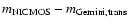 ,
can be analysed in more detail when studying
the residual map and the smoothed contour plot. In Fig. 3,
positive (negative) residuals correspond to overestimated (underestimated) flux.
From the map we denote a general tendency to overestimate the flux.
The contour maps show that positive residuals are correlated
with the position of bright stars on the
image, both in the crowded
cluster center as well as in the area to the lower left, where a band of bright stars
is located (see Fig. 1). This is the area where the
magnitudes
were found to be underestimated in Sect. 2.1.3, and thus the flux overestimated.
This suggests that the increased background
due to the uncompensated seeing halos of bright stars (cf. Sect. 2.1.5),
inherent to AO observations, causes an overestimation of the flux of bright
(
,
can be analysed in more detail when studying
the residual map and the smoothed contour plot. In Fig. 3,
positive (negative) residuals correspond to overestimated (underestimated) flux.
From the map we denote a general tendency to overestimate the flux.
The contour maps show that positive residuals are correlated
with the position of bright stars on the
image, both in the crowded
cluster center as well as in the area to the lower left, where a band of bright stars
is located (see Fig. 1). This is the area where the
magnitudes
were found to be underestimated in Sect. 2.1.3, and thus the flux overestimated.
This suggests that the increased background
due to the uncompensated seeing halos of bright stars (cf. Sect. 2.1.5),
inherent to AO observations, causes an overestimation of the flux of bright
(
 mag) sources.
On the other hand, points with negative residuals are mainly correlated with fainter
stars (
mag) sources.
On the other hand, points with negative residuals are mainly correlated with fainter
stars ( mag), suggesting that this enhanced background
leads to an oversubtraction of the individually calculated
background of nearby fainter stars. The result is an underestimate of the
flux of companion stars in the vicinity of bright stars.
The correlation of positive residuals with the position of bright stars
seems to be less pronounced in the H-band image
(Fig. 3). In H, the distance from the guide star is supposed to
be more important due to the smaller size of the isoplanatic angle
at shorter wavelengths and consequently more pronounced anisoplanatism.
Indeed, the smoothed residual contour plot shows a symmetry in the residuals
around the guide star, with close-to-zero residuals in the immediate vicinity
of the guide star, where the best adaptive optics correction can be achieved.
With increasing distance from the guide star,
the residuals increase not only towards the bright
cluster, but also to the west (left in Fig. 1) of the field,
indicating that remaining distortion
effects from the AO correction are mixed with the problem of the proximity to
bright stars as seen in .
mag), suggesting that this enhanced background
leads to an oversubtraction of the individually calculated
background of nearby fainter stars. The result is an underestimate of the
flux of companion stars in the vicinity of bright stars.
The correlation of positive residuals with the position of bright stars
seems to be less pronounced in the H-band image
(Fig. 3). In H, the distance from the guide star is supposed to
be more important due to the smaller size of the isoplanatic angle
at shorter wavelengths and consequently more pronounced anisoplanatism.
Indeed, the smoothed residual contour plot shows a symmetry in the residuals
around the guide star, with close-to-zero residuals in the immediate vicinity
of the guide star, where the best adaptive optics correction can be achieved.
With increasing distance from the guide star,
the residuals increase not only towards the bright
cluster, but also to the west (left in Fig. 1) of the field,
indicating that remaining distortion
effects from the AO correction are mixed with the problem of the proximity to
bright stars as seen in .
The Strehl ratio (SR) is defined to be the ratio of the observed peak-to-total flux
ratio
to the peak-to-total flux ratio of a perfect diffraction limited optical system.
This definition allows to compare the quality and photometric resolution of
different optical systems using a single characteristic quantity.
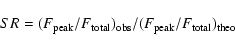
 is the maximum flux value of the PSF, and
 is
the total flux, including the uncompensated halos induced by the natural seeing.
The labels obs and theo refer
to the observed and the theoretically expected flux, respectively.
Diffraction limited theoretical PSFs have been calculated using the
imgen task of the ESO data analysis package eclipse (Devillard
1997).
The Strehl ratio in the Gemini H-band 720 s exposure is found to be 2.5% compared
to 95% in the HST F160W image, and 7% in
(1020 s)
compared to
is
the total flux, including the uncompensated halos induced by the natural seeing.
The labels obs and theo refer
to the observed and the theoretically expected flux, respectively.
Diffraction limited theoretical PSFs have been calculated using the
imgen task of the ESO data analysis package eclipse (Devillard
1997).
The Strehl ratio in the Gemini H-band 720 s exposure is found to be 2.5% compared
to 95% in the HST F160W image, and 7% in
(1020 s)
compared to  90% in F205W. The low SRs measured in the Gemini science
demonstration data indicate that more than 90% of the light of a star
is distributed into the resolution pattern of the AO PSF and the halo around
each star induced by the natural seeing. It has turned out that these
halos cause a significant limitation to the resolution and depth of the observations
in a crowded field, as faint stars can be lost to the enhanced background in the
vicinity of bright objects. When comparing the HST and Gemini luminosity functions
(Sect. 4), this effect causes the main difference between both data sets.
90% in F205W. The low SRs measured in the Gemini science
demonstration data indicate that more than 90% of the light of a star
is distributed into the resolution pattern of the AO PSF and the halo around
each star induced by the natural seeing. It has turned out that these
halos cause a significant limitation to the resolution and depth of the observations
in a crowded field, as faint stars can be lost to the enhanced background in the
vicinity of bright objects. When comparing the HST and Gemini luminosity functions
(Sect. 4), this effect causes the main difference between both data sets.
In the case of very low Strehl ratios, the SR does not directly indicate the
fraction of the flux concentrated in the FWHM area of the PSF. A much larger
fraction of the source flux can be used for PSF fitting in this case,
although the spatial resolution is limited by the large FWHM as compared to
diffraction limited observations (cf. Table 1).
The ratio of the flux in the FWHM kernel of the compensated stellar image
to the total flux,
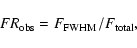
 only in H, although
many stars on the H-band image were still too influenced by
neighbours to study the aperture curve of growth in detail.
We were able to create well-behaved curves of growth for 7 stars.
As in the PSF fitting routine, we have used the FWHM of the PSF as kernel radius
and as the reference flux for the flux ratio determination.
These ratios range from 0.47 to 0.58, with an average of
only in H, although
many stars on the H-band image were still too influenced by
neighbours to study the aperture curve of growth in detail.
We were able to create well-behaved curves of growth for 7 stars.
As in the PSF fitting routine, we have used the FWHM of the PSF as kernel radius
and as the reference flux for the flux ratio determination.
These ratios range from 0.47 to 0.58, with an average of
 ,
i.e., 50% of the integrated point source flux are used for PSF fitting.
In addition, the variation of the flux ratio
over the field
serves as an indicator of the Strehl ratio variation.
If the AO correction mechanism is the dominant factor determining the
concentration of the flux into the FWHM kernel, the Strehl ratio and
thus
should decrease with distance form the guide star,
as the seeing correction worsens.
No correlation of the flux ratio with distance from the guide star is found.
Though these are small number statistics, this supports the suggestion
that the sensitivity variations over the field are not predominantly due
to increasing distance from the guide star (Sect. 2.1.4).
,
i.e., 50% of the integrated point source flux are used for PSF fitting.
In addition, the variation of the flux ratio
over the field
serves as an indicator of the Strehl ratio variation.
If the AO correction mechanism is the dominant factor determining the
concentration of the flux into the FWHM kernel, the Strehl ratio and
thus
should decrease with distance form the guide star,
as the seeing correction worsens.
No correlation of the flux ratio with distance from the guide star is found.
Though these are small number statistics, this supports the suggestion
that the sensitivity variations over the field are not predominantly due
to increasing distance from the guide star (Sect. 2.1.4).
For the incompleteness correction, artificial frames were
created with randomly positioned artificial stars. Magnitudes were
also assigned automatically in a random way. Due to the very crowded
field, only 40 stars were added to each artificial frame in order
to avoid significant changes in the stellar density. A total of 100 frames
was created for both the H and
deep exposures, leading
to a total of 4000 artificial stars used in the statistics.
In addition to the individual incompleteness in each band, the loss of
sources due to scatter of the main sequence generated by the more
uncertain photometry
in the dense parts of the cluster was estimated. For this purpose the
artificial
stars were assigned a formal instrumental "colour''
of
 mag (corresponding to 1.745 mag after photometric
transformation),
derived from the average observed instrumental colour of the main sequence,
and via this transformed into instrumental H magnitudes.
Artificial stars were inserted at the same positions in the H and frames.
In this way the procedure also accounts for
stars lost due to the matching of H and
data.
The artificial stars were calibrated
using the colour equations shown in Sect. 2.1.3 , thus allowing us
to estimate
the loss of stars in the mass function derivation due to the applied main sequence
colour selection (see Sect. 5).
This resulted in significantly larger corrections as compared
to the individual filter recoverage without matching and colour selection.
As an example, the results for the mass function calculation performed
on the artificial stars are displayed in Fig. 4.
mag (corresponding to 1.745 mag after photometric
transformation),
derived from the average observed instrumental colour of the main sequence,
and via this transformed into instrumental H magnitudes.
Artificial stars were inserted at the same positions in the H and frames.
In this way the procedure also accounts for
stars lost due to the matching of H and
data.
The artificial stars were calibrated
using the colour equations shown in Sect. 2.1.3 , thus allowing us
to estimate
the loss of stars in the mass function derivation due to the applied main sequence
colour selection (see Sect. 5).
This resulted in significantly larger corrections as compared
to the individual filter recoverage without matching and colour selection.
As an example, the results for the mass function calculation performed
on the artificial stars are displayed in Fig. 4.
As the recovery rate depends strongly on the stellar density and thus radial distance from the cluster center, the incompleteness correction will be determined in dependence of the radial bin analysed when radial variations in the MF are studied (Sect. 5.3).
In addition to luminosity and mass function corrections, the artificial star tests
were used to estimate the real photometric uncertainties by comparing
inserted to recovered magnitudes of the artificial stars.
The median difference between the original and the recovered
magnitude of the artificial stars,
 ,
has
been used as an estimate of the real photometric uncertainty. To obtain the
median uncertainty, the intervalls
,
has
been used as an estimate of the real photometric uncertainty. To obtain the
median uncertainty, the intervalls
 and
and
 have been treated individually, and the mean of the absolute
value of both median values,
weighted with the number of objects in each intervall, is quoted in Table 2.
The overall flux deviation, including positive and negative deviations,
is close to zero for stars brighter than 20 mag (<
have been treated individually, and the mean of the absolute
value of both median values,
weighted with the number of objects in each intervall, is quoted in Table 2.
The overall flux deviation, including positive and negative deviations,
is close to zero for stars brighter than 20 mag (< ), and for fainter stars
becomes -0.17 and -0.13 in H and ,
respectively, showing a
tendency to underestimate the flux of faint stars. This tendency is more serious
in the cluster center, where comparably large uncertainties are already observed for
magnitudes fainter than 18 mag in both pathbands.
), and for fainter stars
becomes -0.17 and -0.13 in H and ,
respectively, showing a
tendency to underestimate the flux of faint stars. This tendency is more serious
in the cluster center, where comparably large uncertainties are already observed for
magnitudes fainter than 18 mag in both pathbands.
In a second test,
photometry of the bright stars in the short exposures was compared to the
magnitudes of the deep exposures, yielding
 using the same procedure as for artificial stars.
Note, however, that the quality of the short
exposures is much worse than the one of the long exposures due to the high
background noise. Therefore, the artificial star experiments, for which only
the deep exposures have been used, yield a more realistic estimate of the
photometric uncertainties. The results of both tests are summarised in Table
2.
using the same procedure as for artificial stars.
Note, however, that the quality of the short
exposures is much worse than the one of the long exposures due to the high
background noise. Therefore, the artificial star experiments, for which only
the deep exposures have been used, yield a more realistic estimate of the
photometric uncertainties. The results of both tests are summarised in Table
2.
The resulting uncertainty is roughly a factor of 2 to 3 larger than
the theoretical magnitude uncertainty
 determined
from detector characteristics by DAOPHOT. The photometry in the cluster
center shows a larger uncertainty than the photometry in the outskirts.
As expected in a crowding-limited field, this also implies a reduced
detection probability of faint sources in the center of the cluster.
determined
from detector characteristics by DAOPHOT. The photometry in the cluster
center shows a larger uncertainty than the photometry in the outskirts.
As expected in a crowding-limited field, this also implies a reduced
detection probability of faint sources in the center of the cluster.
| Band | mag |
 |
 |
|
|
|
|
|
|
|
| all | R < 10
|
R > 10
|
||||||||
| H | 12-14 | 0.007 | 0.059 | 0.004 | 0.012 | 0.052 | 0.005 | 0.004 | - | 0.002 |
| 14-16 | 0.015 | 0.061 | 0.008 | 0.025 | 0.065 | 0.010 | 0.011 | 0.035 | 0.004 | |
| 16-18 | 0.044 | 0.128 | 0.015 | 0.077 | 0.120 | 0.017 | 0.038 | 0.134 | 0.009 | |
| 18-20 | 0.119 | - | 0.036 | 0.167 | - | 0.039 | 0.098 | - | 0.030 | |
| >20 | 0.264 | - | 0.142 | 0.514 | - | 0.142 | 0.265 | - | 0.144 | |
|
10-12 | 0.004 | - | 0.005 | 0.004 | - | 0.005 | 0.003 | - | 0.006 |
| 12-14 | 0.008 | 0.042 | 0.005 | 0.011 | 0.048 | 0.005 | 0.007 | 0.028 | 0.005 | |
| 14-16 | 0.027 | 0.072 | 0.007 | 0.041 | 0.086 | 0.007 | 0.020 | 0.042 | 0.006 | |
| 16-18 | 0.071 | 0.121 | 0.016 | 0.125 | 0.166 | 0.017 | 0.057 | 0.088 | 0.016 | |
| 18-20 | 0.206 | - | 0.060 | 0.280 | - | 0.073 | 0.189 | - | 0.056 | |
| >20 | 0.411 | - | 0.274 | 0.520 | - | - | 0.360 | - | 0.274 | |
HST/NICMOS observations have been obtained in the three broad-band filters F110W, F160W and F205W, roughly equivalent to J, H and K. The basic parameters are included in Table 1. For a detailed description of the HST data and their reduction see Figer et al. (1999).
Copyright ESO 2002
![\begin{figure}
\par\includegraphics[width=8.8cm,clip=]{aah3531f4.eps}\end{figure}](/articles/aa/full/2002/41/aah3531/img72.gif)