

The Galactic Center (GC) is the most extreme star forming environment within the Milky Way. High stellar and gas densities, turbulent motion, tidal torques exerted by the steep gravitational potential, magnetic fields and an intense radiation field determine the physical environment of star formation in the GC region. Although disruptive forces exerted by the gravitational and radiation fields counteract the agglomeration of material, the high gas and dust densities cause star formation in the GC environment to be most efficient. In particular, the formation of high mass stars and massive clusters is more successful than in any other region of the Milky Way.
A detailed study of star
formation processes and the stellar content of the GC region has until recently
been limited to the brightest and most massive stars due to the large amount of
extinction (
 mag) along the line of sight.
Additional constraints are imposed due to the spatial resolution at the GC
distance of
mag) along the line of sight.
Additional constraints are imposed due to the spatial resolution at the GC
distance of  8 kpc (
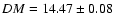 mag, e.g., McNamara et al.
2000),
much farther than nearby star forming regions such as the Orion or
mag, e.g., McNamara et al.
2000),
much farther than nearby star forming regions such as the Orion or  Ophiuchi
star forming complexes, which have been studied in greater detail to date.
Only with the advent of deep, high resolution near-infrared instruments, the
analysis of stellar populations in young star clusters near the GC has become feasible.
Ophiuchi
star forming complexes, which have been studied in greater detail to date.
Only with the advent of deep, high resolution near-infrared instruments, the
analysis of stellar populations in young star clusters near the GC has become feasible.
During the past few years, it has become evident that three out of four young starburst clusters known in the Milky Way are located in the GC region - namely, the Arches and Quintuplet clusters, as well as the Galactic Center Cluster itself. With a cluster age of only a few Myr for Arches and Quintuplet, the question arises how many clusters do actually form in the densest environment of the Milky Way. The 2MASS database yielded new insights into the estimated number of star clusters hidden in the dense stellar background. Dutra & Bica (2000, 2001) report the detection of new cluster candidates of various ages located in the innermost 200 pc of the Galaxy found in 2MASS. Numerical simulations by Portegies Zwart et al. (2001) suggest that clusters with properties similar to the massive Arches and Quintuplet may have formed in the past in the innermost 200 pc, but were then dispersed and are now indistinguishable from the dense stellar background. As dynamical evolution timescales are short due to the strong tidal field in the GC region (Kim et al. 1999), young star clusters are disrupted quickly after formation, contributing to the Galactic bulge population. Thus, only the youngest clusters remain intact for the study of star formation in this extraordinary environment.
The Arches cluster, at a projected distance of only 25 pc from the GC
(assuming a heliocentric distance of 8 kpc to the GC),
is one of the most massive young clusters known in the Milky Way.
With an estimated mass of about
 and a central density
of
and a central density
of
 ,
Arches is the densest young star
cluster (YC) known (Figer et al. 1999).
From physical properties of Wolf-Rayet stars, the age of the cluster is estimated
to be between 2 and 4.5 Myr (Blum et al. 2001).
The stellar content of Arches has been
studied by Figer et al. (1999) using HST/NICMOS data.
They derived a shallow initial
mass function in the range
,
Arches is the densest young star
cluster (YC) known (Figer et al. 1999).
From physical properties of Wolf-Rayet stars, the age of the cluster is estimated
to be between 2 and 4.5 Myr (Blum et al. 2001).
The stellar content of Arches has been
studied by Figer et al. (1999) using HST/NICMOS data.
They derived a shallow initial
mass function in the range
 with a slope of
 ,
but with significant flattening observed in the innermost
part of the cluster (
,
but with significant flattening observed in the innermost
part of the cluster (
 ).
).
Most young star clusters and associations in the Milky Way display a mass
function close to a Salpeter (1955) power law with a slope of
 .
Several such star forming regions have been studied by Massey et al.
(1995a), yielding slopes in the range
.
Several such star forming regions have been studied by Massey et al.
(1995a), yielding slopes in the range
 with an average of
 ,
which leads these authors to conclude
that within the statistical limits no deviation from a Salpeter slope is observed.
,
which leads these authors to conclude
that within the statistical limits no deviation from a Salpeter slope is observed.
A flat mass function as observed in Arches implies an overpopulation of
the high-mass end as compared to "normal'' clusters.
The special physical conditions in the GC region have been suggested
to enhance the formation of massive stars, thereby resulting in a flattened
mass function (Morris 1993).
The formation of high-mass stars in itself poses serious problems for
the standard core collapse and subsequent accretion model, as radiation pressure
from the growing star is capable of reversing the gas infall as soon as
the mass is in excess of
 (Yorke & Krügel 1977).
Assuming disk accretion instead of spherical infall, the limiting mass may be
increased to
(Yorke & Krügel 1977).
Assuming disk accretion instead of spherical infall, the limiting mass may be
increased to
 (Behrend & Maeder 2001),
still far below the mass
observed in O-type stars.
Various scenarios are suggested to circumvent this problem.
Simulations with enhanced accretion rates and collision probabilities
in dense cluster centers (Bonnell et al. 1998),
as well as growing accretion rates depending on the mass of
the accreting protostar (Behrend & Maeder 2001), allow stars of up to
(Behrend & Maeder 2001),
still far below the mass
observed in O-type stars.
Various scenarios are suggested to circumvent this problem.
Simulations with enhanced accretion rates and collision probabilities
in dense cluster centers (Bonnell et al. 1998),
as well as growing accretion rates depending on the mass of
the accreting protostar (Behrend & Maeder 2001), allow stars of up to
 to form in the densest regions of a rich star cluster.
In case of the GC environment,
a higher gas density may lead to a higher accretion rate and/or to a
longer accretion process in the protostellar phase.
As long as the gravitational potential is strongly influenced by
the amount of gas associated with the cluster, gas infall causes
a decrease in cluster radius and subsequent increase in the collision rate,
reinforcing the formation of high-mass stars.
Physical processes such as gravitational
collapse or cloud collisions scale with the square root of the local density,
to form in the densest regions of a rich star cluster.
In case of the GC environment,
a higher gas density may lead to a higher accretion rate and/or to a
longer accretion process in the protostellar phase.
As long as the gravitational potential is strongly influenced by
the amount of gas associated with the cluster, gas infall causes
a decrease in cluster radius and subsequent increase in the collision rate,
reinforcing the formation of high-mass stars.
Physical processes such as gravitational
collapse or cloud collisions scale with the square root of the local density,
 (Elmegreen 1999, 2001),
causing an enhanced star formation rate
(SFR) in high density environments. Elmegreen (2001) shows that the total
mass as well as the maximum stellar mass in a cluster strongly depends on the
SFR and local density. This is confirmed by observations of high-mass stars
found predominantly in the largest star forming clouds (Larson 1982).
(Elmegreen 1999, 2001),
causing an enhanced star formation rate
(SFR) in high density environments. Elmegreen (2001) shows that the total
mass as well as the maximum stellar mass in a cluster strongly depends on the
SFR and local density. This is confirmed by observations of high-mass stars
found predominantly in the largest star forming clouds (Larson 1982).
Both the growing accretion and the collision scenario predict the high-mass stars to form in the densest central region of a cluster, leading to primordial mass segregation, which may be evidenced in a flat mass function in the dense cluster center. As an additional physical constraint, both scenarios require the lower-mass stars to form first, and the highest-mass stars last in the cluster evolution process. As the strong UV-radiation field originating from hydrogen ignition in high-mass stars expells the remaining gas from the cluster center, the accretion process should be halted immediately after high-mass star formation.
The short dynamical timescales of compact clusters are, however, influencing the spatial distribution of stellar masses as well. On the one hand, high-mass stars are dragged into the cluster center due to the gravitational potential of the young cluster. On the other hand, low-mass stars may easily be flung out of the cluster due to interaction processes, especially given star densities as high as in the Arches cluster. The result of these processes would also be a flat mass function in the cluster center, steepening as one progresses outwards due to dynamical mass segregation. Dynamical segregation is predicted to occur within one relaxation time (Bonnell & Davies 1998), which for compact clusters is only one to a few Myr, and should thus be well observable in Arches in the form of a spatially varying mass function.
In addition to the internal segregation process, the external GC tidal field exerts shear forces tearing apart the cluster entity. N-body simulations by Kim et al. (2000) yield tidal disruption timescales as short as 10 to 20 Myr in the GC tidal field. We expect to find a mixture of all these effects in the Arches cluster.
We have analysed adaptive optics (AO) data obtained under excellent seeing conditions with the Gemini North 8 m telescope in combination with the University of Hawai'i (UH) AO system Hokupa'a. We are investigating the presence of radial variations in the mass distribution within the Arches cluster. We compare our ground-based results in detail to the HST/NICMOS data presented in Figer et al. (1999, hereafter FKM), discussing possible achievements and limitations of ground-based, high-resolution adaptive optics versus space-based deep NIR photometry.
In Sect. 2, we will introduce the data and describe the reduction and calibration processes. In this context, a thorough investigation of the quality of ground-based adaptive optics photometry as compared to space-based diffraction limited observations will be presented. The photometric results derived from colour-magnitude diagrams and extinction maps will be discussed in Sect. 3. A comparison of Gemini and HST luminosity functions will be given in Sect. 4. The mass functions will be derived in Sect. 5, and their spatial variation will be discussed with respect to cluster formation scenarios. We will estimate the relevant timescales for cluster evolution for the Arches cluster in Sect. 6, and discuss the implication on the dynamical evolution of Arches. We will summarise our results in Sect. 7.
Copyright ESO 2002