

The mass function (MF) may be defined as the number of stars observed in a certain
mass bin. The mass function in stellar populations is most frequently
fitted by a power law, whose slope depends on the mass range analysed
(e.g., Kroupa 2001).
In the logarithmic representation, the mass function is defined as
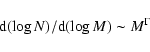
 is the slope of the
mass function. The exact shape of the mass function and, in particular,
its slope, has been subject of intense discussion (see, e.g., Massey 1995a,
1995b; Scalo 1986; and Scalo 1998 for a review).
Massey et al. (1995a, 1995b) report slopes
between -0.7 and -1.7 with a weighted mean of
is the slope of the
mass function. The exact shape of the mass function and, in particular,
its slope, has been subject of intense discussion (see, e.g., Massey 1995a,
1995b; Scalo 1986; and Scalo 1998 for a review).
Massey et al. (1995a, 1995b) report slopes
between -0.7 and -1.7 with a weighted mean of
 for
for
 in several starforming regions in the Milky Way, and
 with a mean of
 for
for
 in the LMC.
From these studies in young clusters and associations, the mass function
has been suspected to be rather universal, following a Salpeter (1955) power law
with a slope of
in the LMC.
From these studies in young clusters and associations, the mass function
has been suspected to be rather universal, following a Salpeter (1955) power law
with a slope of
 for stars with masses
 (Kroupa 2001).
For the two starburst clusters studied in the Milky Way, Arches (FKM) and NGC 3603
(Eisenhauer et al. 1998), a flat slope of
(Kroupa 2001).
For the two starburst clusters studied in the Milky Way, Arches (FKM) and NGC 3603
(Eisenhauer et al. 1998), a flat slope of  -0.7 is observed
for masses
-0.7 is observed
for masses
 in Arches, and
 in NGC 3603.
These values have to be kept in mind as a comparison for the results presented
in the following sections. The mass regime which will be discussed here
spans a mass range of
in NGC 3603.
These values have to be kept in mind as a comparison for the results presented
in the following sections. The mass regime which will be discussed here
spans a mass range of
 for Arches cluster stars.
The present-day mass function (Fig. 13) of the Arches cluster
has been derived from the colour-magnitude diagram
by transforming stellar luminosities into masses via a 2 Myr isochrone
from the Geneva basic set of stellar evolution models
(Lejeune & Schaerer 2001)
using the method described in Grebel & Chu (2000).
Enhanced mass loss models were also used, but did not alter the resultant
mass function. Stellar evolution (mass loss, giant evolution)
is not important on timescales of the Arches age of 2 Myr
for stars with initial masses of
 (
(
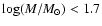 ,
i.e. stellar evolution affects the two upper mass bins of the MF at most).
No attempt has been made to reconstruct the initial mass function (IMF)
from the present-day MF for
,
i.e. stellar evolution affects the two upper mass bins of the MF at most).
No attempt has been made to reconstruct the initial mass function (IMF)
from the present-day MF for
 .
A distance modulus of 14.5 mag and an extinction of
AV = 24.1 mag
have been applied.
.
A distance modulus of 14.5 mag and an extinction of
AV = 24.1 mag
have been applied.
The slopes of all mass functions discussed have been derived by performing a
weighted least-squares fit to the number of stars per mass bin.
The size of the mass bins was chosen to be
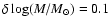 as the best
compromise between mass function resolution and statistical relevance.
This bin size is significantly larger than the photometric uncertainty in
the considered mass and thus magnitude ranges. Only mass bins
with a completeness factor of
as the best
compromise between mass function resolution and statistical relevance.
This bin size is significantly larger than the photometric uncertainty in
the considered mass and thus magnitude ranges. Only mass bins
with a completeness factor of  75% have been included in the fit.
Note that we have not attempted to subtract the field star contribution. As can be seen in Fig. 1, the Gemini field is mostly restricted to the densest cluster region. When comparing to an arbitrary part of the GC field, we do not expect to observe the same distribution of stars as in the Arches field, as the faint, reddened background sources are negligible due to the high density of bright sources in the cluster area.
In addition, the stellar density in the GC is strongly variable, imposing additional uncertainties on the field contribution. Neither the Gemini nor the HST field covers enough area to estimate the field star population in the immediate vicinity of the cluster. A main sequence colour cut ( 1.15 < H-K < 1.90 mag) has been applied to the colour-corrected CMDs to select Arches members, excluding blue foreground and red background sources.
To allow for a direct comparison with the results obtained in FKM,
we have used isochrones calculated for a metallicity of Z = 0.04 for all
MF derivations. The derived MFs are displayed in Fig. 13.
The overall mass function derived from the Gemini data displays the same
slope as derived from NICMOS within the uncertainties, namely
 and
and
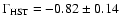 fitted for
 (Fig. 13),
which may be extrapolated down to
(Fig. 13),
which may be extrapolated down to
 when taking into account the incompleteness
correction. The present-day upper mass of
when taking into account the incompleteness
correction. The present-day upper mass of
 corresponds to an initial
mass of about
corresponds to an initial
mass of about
 according to the Geneva models.
FKM derive an overall slope of
according to the Geneva models.
FKM derive an overall slope of
 in the inital mass range
 ,
in good agreement with our results.
The remaining difference in the maximum mass is due to the different extinction
and the extinction corrections applied, which represent the largest
uncertainties in the mass function derivation.
As in particular the correction of the K magnitude for the varying extinction
is uncertain due to the unknown extinction law of the NICMOS filters, we have
also derived the mass function for uncorrected K magnitudes, with only the
colour correction applied, which is independent of the extinction law assumed.
In this case, the MF appears flatter with a slope of
,
in good agreement with our results.
The remaining difference in the maximum mass is due to the different extinction
and the extinction corrections applied, which represent the largest
uncertainties in the mass function derivation.
As in particular the correction of the K magnitude for the varying extinction
is uncertain due to the unknown extinction law of the NICMOS filters, we have
also derived the mass function for uncorrected K magnitudes, with only the
colour correction applied, which is independent of the extinction law assumed.
In this case, the MF appears flatter with a slope of
 (Fig. 13, lower panel).
The discrepancy in the derived slopes clearly shows that the effects of
differential extinction are not negligible, especially when deriving mass
functions for very young regions, where the reddening varies significantly.
(Fig. 13, lower panel).
The discrepancy in the derived slopes clearly shows that the effects of
differential extinction are not negligible, especially when deriving mass
functions for very young regions, where the reddening varies significantly.
Furthermore, we have checked the effect of the binning on the MF by shifting
the starting point of each bin by one tenth of the bin-width,
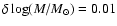 .
The resultant slopes range from
.
The resultant slopes range from
 and
and
 .
The average slopes for Gemini and
HST,
.
The average slopes for Gemini and
HST,
 and
and
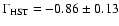 ,
respectively, agree well within the errors.
The slightly flatter slope observed in the Gemini data may reflect the more severe
incompleteness due to crowding.
Although all slopes are consistent within the errors,
the range in slopes derived by scanning the bin-step shows that
statistical effects due to the binning may not be entirely neglected in the MF derivation.
,
respectively, agree well within the errors.
The slightly flatter slope observed in the Gemini data may reflect the more severe
incompleteness due to crowding.
Although all slopes are consistent within the errors,
the range in slopes derived by scanning the bin-step shows that
statistical effects due to the binning may not be entirely neglected in the MF derivation.
The metallicity within the immediate Galactic Center region has been a matter
of discussion during the past decade. Several authors report supersolar
metallicities derived from CO index strength and TiO bands in bulge stars
(Frogel & Whitford 1987; Rich 1988; Terndrup et al.
1990, 1991).
Carr et al. (2000) measure [Fe/H]
 dex for the 7 Myr old
supergiant IRS 7, and Ramirez et al. (2000) derive an average of
[Fe/H]
dex for the 7 Myr old
supergiant IRS 7, and Ramirez et al. (2000) derive an average of
[Fe/H]
 dex for 10 young to intermediate age supergiants, both
very close to the solar value.
dex for 10 young to intermediate age supergiants, both
very close to the solar value.
Using a 2 Myr isochrone with solar metallicity Z=0.02,
the average slope of all bin steps is
 and
and
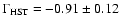 .
The mass function is thus not significantly altered when using solar
instead of enhanced GC metallicity. We note, however, that a lower metallicity
(i.e., in this case solar) steepens the MF slightly, thus working into the same
direction as the incompleteness correction.
.
The mass function is thus not significantly altered when using solar
instead of enhanced GC metallicity. We note, however, that a lower metallicity
(i.e., in this case solar) steepens the MF slightly, thus working into the same
direction as the incompleteness correction.
FKM report a flat portion of the
MF in the range
 ,
which is not seen in the Gemini
MF. This plateau can, however, be recovered, when we create a MF from
K-band magnitudes uncorrected for differential extinction,
and use a lowest mass of
,
which is not seen in the Gemini
MF. This plateau can, however, be recovered, when we create a MF from
K-band magnitudes uncorrected for differential extinction,
and use a lowest mass of
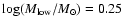 .
For
.
For
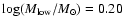 the plateau is seen neither with
nor without extinction correction.
This, again, shows the dependence of the shape of the MF on the extinction corrections
applied, as well as on the chosen binning.
the plateau is seen neither with
nor without extinction correction.
This, again, shows the dependence of the shape of the MF on the extinction corrections
applied, as well as on the chosen binning.
From the considerations above,
we conclude that the overall mass function of the Arches cluster has
a slope of
 to -0.9 in the range
.
Although the uncertainty of missing lower mass stars in the
immediate cluster center remains, the incompleteness correction strongly supports
the derived shape of the MF. If the flat slope would be solely due to a low recovery
rate of low-mass stars in the cluster center, this should be visible in a much
steeper rise of the incompleteness corrected MF in contrast to the observed MF.
We thus conclude that the slope of the MF observed in Arches is flatter than the
Salpeter slope of
,
assumed to be a standard mass distribution in
young star clusters. Such a flat mass function is a strong indication of the
efficient production of high-mass stars in the Arches cluster and the GC environment.
to -0.9 in the range
.
Although the uncertainty of missing lower mass stars in the
immediate cluster center remains, the incompleteness correction strongly supports
the derived shape of the MF. If the flat slope would be solely due to a low recovery
rate of low-mass stars in the cluster center, this should be visible in a much
steeper rise of the incompleteness corrected MF in contrast to the observed MF.
We thus conclude that the slope of the MF observed in Arches is flatter than the
Salpeter slope of
,
assumed to be a standard mass distribution in
young star clusters. Such a flat mass function is a strong indication of the
efficient production of high-mass stars in the Arches cluster and the GC environment.
Blum et al. (2001) estimate a cluster age of 2-4.5 Myr for Arches
assuming that the observed high-mass stars are of type WN7.
If we compare the Geneva basic grid of isochrones with fundamental
parameters obtained for WN7 stars (Crowther et al. 1995), a reasonable
upper age limit for this set of isochrones is 3.5 Myr.
Crowther compares the parameters derived for WN stars with evolutionary
models at solar metallicity from Schaller et al. (1992) and with the
mass-luminosity relation for O supergiants from Howarth & Prinja (1989),
yielding a mass range of
 ,
but with high uncertainties
at the low-mass end. The more reliable mass estimates for the colour
and magnitude range observed for WN stars in Arches are restricted to
,
but with high uncertainties
at the low-mass end. The more reliable mass estimates for the colour
and magnitude range observed for WN stars in Arches are restricted to
 .
From spectroscopic binaries, the masses
of two WN7 stars are determined to be 30
.
From spectroscopic binaries, the masses
of two WN7 stars are determined to be 30  and >48 (Smith & Maeder 1989).
The theoretical lower limit to form Wolf-Rayet
stars is
and >48 (Smith & Maeder 1989).
The theoretical lower limit to form Wolf-Rayet
stars is
 for the Geneva models
(Schaerer et al. 1993).
for the Geneva models
(Schaerer et al. 1993).
In the Geneva basic grid of models with Z = 0.04,
the 3.5 Myr isochrone is limited by a turnoff mass of
 .
We have thus calculated mass functions for isochrones with ages 2.5, 3.2, and
3.5 Myr in addition to the 2 Myr case discussed above.
Though the derived slopes scatter widely, irrespective of the isochrone
used, the slope of the MF tends to be even flatter for any of the older
population models.
We thus conclude that, regardless of the choice of model and
parameters, the Arches mass function displays a flat slope.
.
We have thus calculated mass functions for isochrones with ages 2.5, 3.2, and
3.5 Myr in addition to the 2 Myr case discussed above.
Though the derived slopes scatter widely, irrespective of the isochrone
used, the slope of the MF tends to be even flatter for any of the older
population models.
We thus conclude that, regardless of the choice of model and
parameters, the Arches mass function displays a flat slope.
The radial variation (Fig. 14) of the mass function is
particularly interesting with respect to YC evolution.
We have analysed the stellar population in Arches within
three different radial bins,
 ,
,
 and
and
 .
The resulting mass functions for the Gemini and HST datasets,
along with the radius dependent incompleteness correction for the Gemini MFs,
are displayed in Fig. 14.
.
The resulting mass functions for the Gemini and HST datasets,
along with the radius dependent incompleteness correction for the Gemini MFs,
are displayed in Fig. 14.
We confirm the flat mass function observed by FKM
in the innermost regions of the cluster, which steepens
rapidly beyond the innermost few arcseconds.
Most of the bright, massive stars are
found in the dense cluster center, where the mass function slope is very flat.
FKM derive a slope of
 from the HST data in this region,
which is consistent with Fig. 14. It is obvious from the lowest panel
in Fig. 14 that we are crowding limited in the innermost region.
We have thus not tried to fit a slope for
from the HST data in this region,
which is consistent with Fig. 14. It is obvious from the lowest panel
in Fig. 14 that we are crowding limited in the innermost region.
We have thus not tried to fit a slope for
 .
.
In the next bin,
,
the mass function obtained from
the weighted least-squares fit has already steepened to a slope of
 .
Again, the MF in this radial bin remains significantly flatter (
.
Again, the MF in this radial bin remains significantly flatter (
 )
when no AK-correction is applied.
Beyond 10
)
when no AK-correction is applied.
Beyond 10
 (0.4 pc, upper panel), a power law can only be defined in the range
 (
(
 ), where a slope of
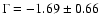 is found, consistent with a Salpeter (
)
law.
The large error obviously reflects the small
number of mass bins used in the fit. Nevertheless, Fig. 14 clearly
reveals the steepening of the MF very soon beyond the cluster center.
is found, consistent with a Salpeter (
)
law.
The large error obviously reflects the small
number of mass bins used in the fit. Nevertheless, Fig. 14 clearly
reveals the steepening of the MF very soon beyond the cluster center.
For a more quantitative confirmation of the mass segregation present in the Arches cluster, we created cumulative functions for the mass distributions in the three radial bins (Fig. 15). We have applied a Kolmogorov-Smirnov test to quantify the observed differences of these functions. When the central, intermediate, and outer radial bin are compared pairwise, we obtain in each case a confidence level of more than 99% that the mass distributions do not originate from the same distribution.
Thus, the inner regions of the cluster are indeed skewed towards higher masses either by sinking of the high mass stars towards the cluster center due to dynamical processes or by primordial mass segregation, or both. The same effect is observed in the similarly young cluster NGC 3603 (Grebel et al. 2002, in prep.).
We find several (5)
high mass stars in the cluster vicinity. These stars fall onto the Arches main
sequence after applying the reddening correction (Sect. 3.1).
When the entire HST field is separated into two equalsize areas,
the first area being a circle of radius 16
around
the cluster center, and the second the surrounding field,
no additional comparably high-mass stars are found with Arches main sequence colours
except for the two bright stars found at the edges of the Gemini field.
In the dynamical models of
Bonnell & Davies (1998) there is a low, but non-zero probability that
a massive star originating outside the cluster's half-mass radius might
remain in the cluster vicinity. High-mass stars formed near the center
show, however, a tendency to migrate closer to the cluster center.
The disruptive GC potential might enhance the ejection process of low-mass stars,
but according to equipartition, it is unlikely that the most massive stars gain
energy due to dynamical interaction with lower mass objects.
We have to bear in mind, however, that interactions between massive stars in the
dense cluster core could cause the ejection of high-mass stars.
N-body simulations performed
by Portegies Zwart et al. (1999) show that the inclusion
of dynamical mass segregation in cluster evolution models enhances the
collision rate by about
a factor of 10 as compared to theoretical cross section considerations.
For a cluster with 12 000 stars initially distributed according to a Scalo
(1986)
mass function, a relaxation time of 10 Myr, and a central density and half-mass radius
comparable to the values found in Arches, about 15 merging collisions occur
within the first 10 Myr (
 )
of the simulated cluster. Shortly after
the start of the simulations, frequent binary and multiple systems form from
dynamical interactions leading to the ejection of several contributing massive
stars. The flat MF in the Arches center as compared to a Scalo MF,
containing a larger fraction of massive stars to interact, may even
increase the collision rate.
)
of the simulated cluster. Shortly after
the start of the simulations, frequent binary and multiple systems form from
dynamical interactions leading to the ejection of several contributing massive
stars. The flat MF in the Arches center as compared to a Scalo MF,
containing a larger fraction of massive stars to interact, may even
increase the collision rate.
Though it is likely that the high-mass stars seen in the immediate vicinity of the Arches cluster have formed from the same molecular cloud at the same time as the cluster, a final conclusion on the possible ejection of these stars from the cluster core due to dynamical processes can only be drawn when velocities for these cluster member candidates are available.
![\begin{figure}
\par\includegraphics[width=8.8cm,clip=]{aah3531f13a.eps}\vspace*{4mm}
\par\includegraphics[width=8.8cm,clip=]{aah3531f13b.eps}\end{figure}](/articles/aa/full/2002/41/aah3531/img179.gif) |
Figure 13:
Arches mass function derived from the Gemini/Hokupa'a colour-magnitude
diagram shown in Fig. 9. A 2 Myr main sequence
isochrone from the Geneva set of models (Lejeune & Schaerer 2001)
was used to transform magnitudes into stellar masses.
The mass function has been derived for bins of
with a lowest mass bin
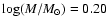 .
Upper panel: with AK correction.
Lower panel: without AK correction. .
Upper panel: with AK correction.
Lower panel: without AK correction. |
Copyright ESO 2002
![\begin{figure}
\par\includegraphics[width=8.8cm,clip=]{aah3531f14.eps}\end{figure}](/articles/aa/full/2002/41/aah3531/img180.gif)