

During the process of calibration we realised that a strong colour gradient is
present in the Arches field.
In Fig. 5, the
 colour is plotted against radial
distance from the cluster center.
As the extinction law has not yet been derived
for HST filters, we have used the colour transformations in BGB
to transform NICMOS into 2MASS magnitudes. Though the 2MASS filters
deviate slightly from the standard Johnson JHK filters used to determine the
extinction law (Rieke & Lebofsky 1985), we will be able to estimate
the approximate amount of change in visual extinction across the field.
The extinction parameters from Rieke & Lebofsky (1985) are given by
colour is plotted against radial
distance from the cluster center.
As the extinction law has not yet been derived
for HST filters, we have used the colour transformations in BGB
to transform NICMOS into 2MASS magnitudes. Though the 2MASS filters
deviate slightly from the standard Johnson JHK filters used to determine the
extinction law (Rieke & Lebofsky 1985), we will be able to estimate
the approximate amount of change in visual extinction across the field.
The extinction parameters from Rieke & Lebofsky (1985) are given by

 is the extinction in the given filter.
For a change in extinction of
is the extinction in the given filter.
For a change in extinction of
 this leads to
 |
|||
 |
|||
 |
 photometry.
The resulting
is given in each plot in Fig. 6,
together with the fitting uncertainty from the rms scatter in the colour.
photometry.
The resulting
is given in each plot in Fig. 6,
together with the fitting uncertainty from the rms scatter in the colour.
From the linear fits in Fig. 6 we see that
AV increases by about one order of magnitude
over the entire field when moving outwards from
the cluster center. The effect is
most pronounced in the HST
 vs. radius diagram (Fig. 6, bottom),
where the longest colour baseline is used. We derive a change in visual extinction
of
vs. radius diagram (Fig. 6, bottom),
where the longest colour baseline is used. We derive a change in visual extinction
of
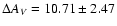 mag over the Gemini field
(1000 pixels
mag over the Gemini field
(1000 pixels  0.8 pc).
Notably, if only the innermost 5
0.8 pc).
Notably, if only the innermost 5
 (250 pixels, 0.2 pc)
are fitted, no variation in AV is observed.
When fitting the core separately, we get
(250 pixels, 0.2 pc)
are fitted, no variation in AV is observed.
When fitting the core separately, we get
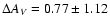 mag for
 (250 pixels)
versus
(250 pixels)
versus
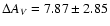 mag for
 (
250 < R < 1000 pixels). The latter value corresponds to
(
250 < R < 1000 pixels). The latter value corresponds to
 ,
consistent
with the trend over the entire field.
The small radial trend and low extinction value in the cluster center
indicates the local depletion of dust. This could be either due to
winds from massive stars or due to photo-evaporation of dust grains
caused by the intense UV-radiation field.
,
consistent
with the trend over the entire field.
The small radial trend and low extinction value in the cluster center
indicates the local depletion of dust. This could be either due to
winds from massive stars or due to photo-evaporation of dust grains
caused by the intense UV-radiation field.
A change in AV of 
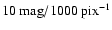 is also
consistent with the result found in J-H,
is also
consistent with the result found in J-H,
 ,
while a larger value of
,
while a larger value of
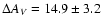 mag is derived
from the
mag is derived
from the
 plot. Due to the uncertainties we conclude that the
extinction varies by
plot. Due to the uncertainties we conclude that the
extinction varies by
 mag across the
Arches field of 20
or 0.8 pc, most likely
closer to the lower value. This is in any case a tremendous change
in the dust column density along the line of sight, with strong implications
on limiting magnitudes and the potential detection of faint objects.
mag across the
Arches field of 20
or 0.8 pc, most likely
closer to the lower value. This is in any case a tremendous change
in the dust column density along the line of sight, with strong implications
on limiting magnitudes and the potential detection of faint objects.
We have used a linear fit to the colour variation with radius for
 to correct for the strong change in reddening observed in the outer cluster field.
The values for cluster center stars (
)
have been left unchanged,
due to the large scatter and the very small trend found. Thus, these adjusted colours
are scaled to the cluster center, where AV is lowest.
From the Rieke & Lebofsky (1985) extinction law, the change in
K-band magnitude with radius corresponding to the change in colour
can be derived as
to correct for the strong change in reddening observed in the outer cluster field.
The values for cluster center stars (
)
have been left unchanged,
due to the large scatter and the very small trend found. Thus, these adjusted colours
are scaled to the cluster center, where AV is lowest.
From the Rieke & Lebofsky (1985) extinction law, the change in
K-band magnitude with radius corresponding to the change in colour
can be derived as
 .
We have used this relation to adjust the K-band magnitudes accordingly.
The "dereddened'' colour-magnitude diagrams will be shown in direct comparison with
the observed CMDs in Sect. 3.3 (cf. Fig. 9).
.
We have used this relation to adjust the K-band magnitudes accordingly.
The "dereddened'' colour-magnitude diagrams will be shown in direct comparison with
the observed CMDs in Sect. 3.3 (cf. Fig. 9).
![\begin{figure}
\par\includegraphics[width=8.8cm,clip=]{aah3531f6.eps}\end{figure}](/articles/aa/full/2002/41/aah3531/img100.gif) |
Figure 6:
Colour trends over the Arches field as observed in the HST/NICMOS data set within the area covered by the Gemini observations.
The radial distance from the cluster center is given in pixels on the Gemini
scale. For the calculation of
,
the Rieke & Lebofsky (1985) reddening law has
been assumed. |
Since the original HST/NICMOS field has twice the area of the Gemini central Arches field, we have also calculated the extinction map for the entire NICMOS field following the same procedure. The corresponding map is shown in Fig. 8.
The extinction measured with this procedure in the K-band lies in the range
1.9 < AK < 4.1 mag, with an average value of 3.1 mag,
corresponding to
16 < AV < 37 mag,
 mag.
Cotera et al. (2000) derive a near-infrared extinction of
2.8 < AK < 4.2 mag,
with an average value of
mag.
Cotera et al. (2000) derive a near-infrared extinction of
2.8 < AK < 4.2 mag,
with an average value of
 mag for 15 lines of sight towards
several Galactic Center regions, corresponding to an average visual extinction of
mag for 15 lines of sight towards
several Galactic Center regions, corresponding to an average visual extinction of
 mag (transformed using Rieke & Lebofsky 1985).
They obtain the highest extinction
towards a field close to the Arches cluster,
AV = 37.5 mag.
This is very close to our highest extinction value.
The average value determined from individual dereddening here is the same
as the average extinction obtained by Figer et al. (1999),
mag (transformed using Rieke & Lebofsky 1985).
They obtain the highest extinction
towards a field close to the Arches cluster,
AV = 37.5 mag.
This is very close to our highest extinction value.
The average value determined from individual dereddening here is the same
as the average extinction obtained by Figer et al. (1999),
 mag.
Note that the typical random scatter
mag.
Note that the typical random scatter
 from foreground dust density
fluctuations found in GC fields is linearly related to the average extinction
within a field. The relation determined by Frogel et al. (1999) from giant
branch stars in 22 pointings towards fields within 4
from foreground dust density
fluctuations found in GC fields is linearly related to the average extinction
within a field. The relation determined by Frogel et al. (1999) from giant
branch stars in 22 pointings towards fields within 4 from the GC is given by
 .
This yields an
expected natural scatter from GC clouds of only
.
This yields an
expected natural scatter from GC clouds of only
 mag for
 mag, much below the difference in
reddening observed in the Arches field. Thus, the change in extinction cannot be
explained by the natural fluctuations of the dust distribution in the GC region.
mag, much below the difference in
reddening observed in the Arches field. Thus, the change in extinction cannot be
explained by the natural fluctuations of the dust distribution in the GC region.
Comparison of the cluster center main sequence population
with the main sequence colour of a theoretical 2 Myr isochrone
from the Geneva set of models (Lejeune & Schaerer 2001), later-on used for
the derivation of the mass function, yields an average extinction of
 mag
in the cluster center.
This extinction value has been used to transform isochrone magnitudes
and colours into the cluster magnitude system. It has been suggested that the
brightest and most massive stars in Arches are Wolf-Rayet stars of type WN7
(Cotera et al. 1996; Blum et al. 2001).
Fundamental parameters of Wolf-Rayet stars are compiled in Crowther et al.
(1995).
For stars of subtype WN7 they find typical colours of
mag
in the cluster center.
This extinction value has been used to transform isochrone magnitudes
and colours into the cluster magnitude system. It has been suggested that the
brightest and most massive stars in Arches are Wolf-Rayet stars of type WN7
(Cotera et al. 1996; Blum et al. 2001).
Fundamental parameters of Wolf-Rayet stars are compiled in Crowther et al.
(1995).
For stars of subtype WN7 they find typical colours of
 mag,
leading to an extinction of
mag,
leading to an extinction of
 mag with an observed
H - K colour of 1.77 mag for the WN7 stars, which were
identified by comparison with the Blum et al. (2001) narrow band photometry.
This value is in very good agreement with the AV determined from the
main sequence colour in the cluster center.
mag with an observed
H - K colour of 1.77 mag for the WN7 stars, which were
identified by comparison with the Blum et al. (2001) narrow band photometry.
This value is in very good agreement with the AV determined from the
main sequence colour in the cluster center.
![\begin{figure}
\par\mbox{\includegraphics[width=8cm,clip=]{H3531F7a.ps}\hspace{1cm}
\includegraphics[width=7cm,clip=]{H3531F7b.ps} }
\end{figure}](/articles/aa/full/2002/41/aah3531/img113.gif) |
Figure 7: AK extinction map, binned in the same manner as the residual map in Fig. 3 (North is up, East is to the right). White spots are positions without stars for evaluation. The individual extinction has been calculated by shifting the stars in the K vs. H - K colour-magnitude diagram to a 2 Myr isochrone offset bluewards of the main sequence. Transformation to AK = 0 mag has been performed afterwards, to avoid large errors in the shifting procedure. This results in a minimum AK of 1.86 mag, and a maximum of 4.08 mag, assuming a Rieke & Lebofsky (1985) extinction law. |
![\begin{figure}
\par\mbox{\includegraphics[width=8cm,clip=]{H3531F8a.ps}\hspace{1cm}
\includegraphics[width=7cm,clip=]{H3531F8b.ps} }
\end{figure}](/articles/aa/full/2002/41/aah3531/img114.gif) |
Figure 8:
AK extinction map derived from HST m205 photometry. See Fig. 7
for details. The coordinate transformed HST/NICMOS F205W image is also shown
for comparison. Note the different scales (HST/NICMOS:
 ,
Gemini/Hokupa'a: ,
Gemini/Hokupa'a:
 ). ). |
The resulting colour-magnitude diagrams for Gemini and HST are presented in
Fig. 9 (upper panel). Two important differences are seen when inspecting the CMDs.
First, the scatter in the main sequence is significantly larger in the ground-based
photometry. While the HST/NICMOS CMD reveals a
narrow main sequence in the cluster center (circles in Fig. 9), the same
stars display a much larger colour range in the Gemini CMD.
The poor Strehl ratio in the Gemini/Hokupa'a data as compared to
the HST/NICMOS data (see Sect. 2.1.5)
causes a high, non-uniform additional background due to uncompensated
seeing halos around bright stars, which decreases photometric accuracy.
In the dense regions of the cluster center, where crowding problems are most
severe, the photometry is most affected. The number of faint,
unresolved companion stars that merge into the high stellar background underneath
the bright cluster population is very high. As discussed in Sect. 2.1.4,
the halos of the bright stars hinder the detection of faint objects
despite the principally high spatial resolution seen in individual PSF kernels.
Operating at the diffraction limit,
NICMOS is not restricted by these effects, yielding a better effective resolution
especially in the dense regions. A tighter main sequence and less
scatter is the consequence.
In Fig. 9, the innermost 5
of the Arches
cluster are marked by open circles.
It is clearly seen that most massive (bright) stars are located
in the cluster center.
A second effect observed is the much larger number of faint objects seen in the HST data (cf. Fig. 2). As the limiting magnitude and the measured spatial resolution of the images are similar in both datasets, this, too, has to be a consequence of the low Strehl ratio in the AO data.
![\begin{figure}
\par\includegraphics[width=8.8cm,clip=]{aah3531f9.eps}\end{figure}](/articles/aa/full/2002/41/aah3531/img115.gif) |
Figure 9: Colour-magnitude diagrams. Left: Gemini/Hokupa'a, right: HST/NICMOS. Lower panel: CMDs corrected for radial reddening gradient (Sect. 3.1). |
The lower panel of Fig. 9 shows the "dereddened'' CMDs, corrected
for the radial colour gradient found and the corresponding change
in extinction,
 (Sect. 3.1). The colours of
stars beyond
have been adjusted to the colour of the cluster
center.
Comparison with the original CMDs shows that
most of the bright, seemingly reddened stars fall onto the same main sequence
after correcting for the colour trend.
These stars are located at larger distances from the cluster
center and thus suffer from more reddening by residual dust.
As will be discussed in the context of the mass function (Sect. 5),
these stars might have formed close to the cluster at a similar time
as the cluster population. At the faint end of the CMD,
there are, however, a large number of objects that remain unusually red after
the correction has been applied.
These objects may either be pre-main sequence stars or faint background sources.
Unfortunately, we are not able to disentangle these two possible contributions,
and will thus exclude objects significantly reddened relative to the main
sequence when deriving the mass function.
(Sect. 3.1). The colours of
stars beyond
have been adjusted to the colour of the cluster
center.
Comparison with the original CMDs shows that
most of the bright, seemingly reddened stars fall onto the same main sequence
after correcting for the colour trend.
These stars are located at larger distances from the cluster
center and thus suffer from more reddening by residual dust.
As will be discussed in the context of the mass function (Sect. 5),
these stars might have formed close to the cluster at a similar time
as the cluster population. At the faint end of the CMD,
there are, however, a large number of objects that remain unusually red after
the correction has been applied.
These objects may either be pre-main sequence stars or faint background sources.
Unfortunately, we are not able to disentangle these two possible contributions,
and will thus exclude objects significantly reddened relative to the main
sequence when deriving the mass function.
For comparison with the reddening path and a main sequence in standard
colours, the NICMOS filters have been transformed into the 2MASS
system.
In Fig. 10, we show the transformed HST/NICMOS colour-colour diagram
for the stars bright enough to be observed in all three filters.
The AV values are from the Rieke & Lebofsky (1985) extinction
law for standard JHK photometry.
Though we are aware of the uncertainties inherent to the transformation
of severely reddened stars, the proximity of the reddening path to
the data points supports the validity of the equations derived by BGB.
Changing the transformation parameters slightly results in a large angle between the
data points and the reddening path.
A wide spread population of stars is clearly seen along the reddening path, as expected from the colour trend discussed in Sect. 3.1 (no correction for the varying extinction has been applied in this diagram). Again, the stars with the lowest reddening within the cluster population are the bright stars in the Arches cluster center. Moving along the reddening line towards higher values of AV mainly means moving radially outwards from the cluster center. As in the CMD, a correction for the observed colour gradient causes the bulk of the stars to fall onto the main sequence with a reddening of AV = 24 mag, corresponding to the cluster center.
Copyright ESO 2002
![\begin{figure}
\par\includegraphics[width=8.8cm,clip=]{aah3531f5.eps}\end{figure}](/articles/aa/full/2002/41/aah3531/img99.gif)
![\begin{figure}
\par\includegraphics[width=8.8cm,clip=]{aah3531f10.eps}\end{figure}](/articles/aa/full/2002/41/aah3531/img117.gif)