

We propose a scenario for large variation of
 for each
BCD along with intermittent SFH. The
time variability of SFH on a short (<1 Gyr) timescale has been
suggested observationally by Searle & Sargent (1972) and
theoretically by Gerola et al. (1980). Nonlinear
processes in the ISM may also cause an intermittent star formation
(Ikeuchi 1988; Kamaya & Takeuchi 1997 and
references therein).
Thus, it is pertinent to consider the intermittent SFH of BCDs.
for each
BCD along with intermittent SFH. The
time variability of SFH on a short (<1 Gyr) timescale has been
suggested observationally by Searle & Sargent (1972) and
theoretically by Gerola et al. (1980). Nonlinear
processes in the ISM may also cause an intermittent star formation
(Ikeuchi 1988; Kamaya & Takeuchi 1997 and
references therein).
Thus, it is pertinent to consider the intermittent SFH of BCDs.
As shown in the following, an intermittent star formation
history leads to the time variation of
,
because
 depends on time. We consider an intermittent SFH: a
starburst whose SFR is
depends on time. We consider an intermittent SFH: a
starburst whose SFR is
 and an inter-starburst
epoch whose SFR is
and an inter-starburst
epoch whose SFR is
 .
We assume that
.
We assume that
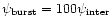 ,
for example. Such a
two-orders-of magnitude variation in SFR is proposed theoretically
by Gerola et al. (1980) and Kamaya & Takeuchi (1997).
While the starburst is going on, we expect that
almost all the SNe are Type II (
,
for example. Such a
two-orders-of magnitude variation in SFR is proposed theoretically
by Gerola et al. (1980) and Kamaya & Takeuchi (1997).
While the starburst is going on, we expect that
almost all the SNe are Type II (
 ,
where
,
where
 is a typical SN rate in the bursting epoch).
However, in the inter-burst epoch, Type Ia SNe can be dominated
(
is a typical SN rate in the bursting epoch).
However, in the inter-burst epoch, Type Ia SNe can be dominated
(
 ,
where
,
where
 is a typical
SN rate in the inter-burst). According to
the model by Bradamante et al. (1998), a given
stellar population releases energy in the form of Type II and Ia
SNe with a ratio of 5:1 (Bradamante et al. 1998;
see their Fig. 9. This value is essentially determined
by the initial mass function (IMF), and they assumed the Salpeter
IMF with a
stellar mass range from 0.1 to 100
is a typical
SN rate in the inter-burst). According to
the model by Bradamante et al. (1998), a given
stellar population releases energy in the form of Type II and Ia
SNe with a ratio of 5:1 (Bradamante et al. 1998;
see their Fig. 9. This value is essentially determined
by the initial mass function (IMF), and they assumed the Salpeter
IMF with a
stellar mass range from 0.1 to 100  )
)![[*]](/icons/foot_motif.gif) . Since they assumed the
same energy between Type Ia and II SNe, this means that
the number ratio between Type Ia and II SNe is 5:1.
Therefore, we expect that
. Since they assumed the
same energy between Type Ia and II SNe, this means that
the number ratio between Type Ia and II SNe is 5:1.
Therefore, we expect that
 .
The intermittent
star formation finally predicts that
.
The intermittent
star formation finally predicts that
 .
This means that an intermittent SFH can
cause a 20-times variation in
.
This means that an intermittent SFH can
cause a 20-times variation in
 during a single star formation cycle.
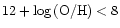
Furthermore, Fig. 1 shows that the value of
has little effect on the relation between dust-to-gas ratio and
metallicity for
 .
Therefore, until the
metallicity level becomes
.
Therefore, until the
metallicity level becomes
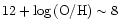 ,
the relation
between dust-to-gas ratio and metallicity evolves in the same way
whatever the value of
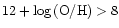
might be. On the contrary, the
relation is largely affected by
if
,
the relation
between dust-to-gas ratio and metallicity evolves in the same way
whatever the value of
might be. On the contrary, the
relation is largely affected by
if
 .
Then, we study the response of the relation between
dust-to-gas ratio and metallicity to the
change of
at
,
as we are
interested in the intermittent SFH.
.
Then, we study the response of the relation between
dust-to-gas ratio and metallicity to the
change of
at
,
as we are
interested in the intermittent SFH.
First, we shall estimate a typical metallicity increment during a single
star formation epoch of the intermittent SFH. The metallicity
increase during an episode of star formation,  ,
can be
estimated by
,
can be
estimated by
 ,
where M* is the
mass of stars formed in the episode, and y is a chemical yield.
If the IMF is similar
to that of the Galaxy,
,
where M* is the
mass of stars formed in the episode, and y is a chemical yield.
If the IMF is similar
to that of the Galaxy,
 (i.e.,
 for
for
 ). We estimate M* by multiplying
observed SFR with a duration of an episode of a star formation
activity. Assuming that the SFR is
0.1
). We estimate M* by multiplying
observed SFR with a duration of an episode of a star formation
activity. Assuming that the SFR is
0.1
 and that the duration is 107 yr
(Legrand et al. 2001), we obtain
and that the duration is 107 yr
(Legrand et al. 2001), we obtain
 .
With typical gas mass
.
With typical gas mass
 ,
we obtain
,
we obtain
 .
This corresponds, for example, to the metallicity increase
from
.
This corresponds, for example, to the metallicity increase
from
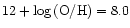 to 8.2. The model by Bradamante et al. (1998) also indicates that one
episode of star formation can result in such a metallicity increment.
to 8.2. The model by Bradamante et al. (1998) also indicates that one
episode of star formation can result in such a metallicity increment.
As shown above, the effect of intermittence can be examined by
changing
.
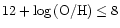
In order to examine the effect of time
variation of
,
thus, we calculate the relation between dust-to-gas ratio and
metallicity in the following two cases:
 for
for
 and
and
 for
for
and
for
for
and
 for
for
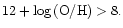
 increases from 8.0 to 8.2, the line rapidly
converges to the two dotted lines, which represent the result for
constant
(1 and 25, respectively). This rapid
convergence supports the idea that the dust-to-gas ratio varies
widely in response to the time-evolution of
in an episode of
star formation at the metallicity level of
.
Thus, it is possible to determine the variance of
the dust-to-gas ratio among BCDs from the time variation of
.
increases from 8.0 to 8.2, the line rapidly
converges to the two dotted lines, which represent the result for
constant
(1 and 25, respectively). This rapid
convergence supports the idea that the dust-to-gas ratio varies
widely in response to the time-evolution of
in an episode of
star formation at the metallicity level of
.
Thus, it is possible to determine the variance of
the dust-to-gas ratio among BCDs from the time variation of
.
![\begin{figure}
\par\includegraphics[width=8.8cm,clip]{MS1728f2.eps}\end{figure}](/articles/aa/full/2002/23/aa1728/img94.gif) |
Figure 2:
Relation between dust-to-gas ratio and
metallicity. The three dotted lines
show the model
results same as Fig. 1. The squares
are the data points same as Fig. 1.
The two solid lines represents the result of
the calculations which change
(from 5 to 1 and from 5 to 25 for upper and lower lines,
respectively). |
If the age of BCDs varies, the present turn-off mass of stars is
changed. As a result, the returned fraction of gas ( ), the
metal yield (
), the
metal yield (
 ), and the dust supply from stars
(
), and the dust supply from stars
(
 )
are effectively different among BCDs. The
effect of varying
and
on the relation between dust-to-gas ratio
and metallicity has been examined by H99. However, the resulting relation
is less sensitive to the two parameters than to
.
The
dependence of
on the turn-off mass can be important
since it largely affects the dust amount in low-metallicity systems
(LF98; Hirashita 1999a).
)
are effectively different among BCDs. The
effect of varying
and
on the relation between dust-to-gas ratio
and metallicity has been examined by H99. However, the resulting relation
is less sensitive to the two parameters than to
.
The
dependence of
on the turn-off mass can be important
since it largely affects the dust amount in low-metallicity systems
(LF98; Hirashita 1999a).
Thus, if the BCD sample proves to have a large age variation, we
should reconsider the variation in dust-to-gas ratio with a
time-dependent formulation. Indeed, we cannot reject the possibility
that some BCDs
are much younger than the cosmic age. A metal-poor BCD SBS 0335-052
may be younger than
 yr (Vanzi et al. 2000). Recently, Hirashita et al.
(2002) have succeeded in explaining the dust amount of SBS
0335-052 with a time-dependent formulation applicable to young
galaxies.
yr (Vanzi et al. 2000). Recently, Hirashita et al.
(2002) have succeeded in explaining the dust amount of SBS
0335-052 with a time-dependent formulation applicable to young
galaxies.
The time variation of
 also leads to the time dependence
of
also leads to the time dependence
of
 (Eq. (6)),
although
was assumed as unity (Sect. 4.1).
If the various
for the BCD sample is interpreted to
reflect the
time evolution of
in each BCD, we can suggest that the
gas mass in a star-forming region should change temporally because of
the mass exchange between the star-forming region and the envelope.
Such a
mass exchange during episodic star formation activity in BCDs is indeed
suggested by e.g., Saito et al. (2000). The
temporal change of
is also possible
if the ISM in the star-forming region is consumed for star
formation and locked in stellar remnants like white dwarfs, neutron
stars, and black holes.
(Eq. (6)),
although
was assumed as unity (Sect. 4.1).
If the various
for the BCD sample is interpreted to
reflect the
time evolution of
in each BCD, we can suggest that the
gas mass in a star-forming region should change temporally because of
the mass exchange between the star-forming region and the envelope.
Such a
mass exchange during episodic star formation activity in BCDs is indeed
suggested by e.g., Saito et al. (2000). The
temporal change of
is also possible
if the ISM in the star-forming region is consumed for star
formation and locked in stellar remnants like white dwarfs, neutron
stars, and black holes.
In order to constrain
,
we need to observe H I emission
or FIR emission with angular resolution fine enough. The present
typical angular resolution of 1' corresponds to 2.9 kpc in physical
size if a galaxy lies at a typical distance of 10 Mpc.
Future large space FIR telescopes such as
Herschel (e.g.,
Pilbratt 2000) or SPICA (e.g.,
Nakagawa et al. 2000) will resolve the star-forming
regions of the BCDs. For example, the Japanese future infrared
satellite SPICA will have a diameter larger than 3.5 m. If the
diffraction limit is achieved, the angular resolution becomes 6''at the
wavelength of 100  m. This corresponds to 290 pc at the distance
of 10 Mpc, and is comparable to or smaller than the half-light
radius of a typical BCD (Marlowe et al. 1999).
m. This corresponds to 290 pc at the distance
of 10 Mpc, and is comparable to or smaller than the half-light
radius of a typical BCD (Marlowe et al. 1999).
Copyright ESO 2002