

We compare the model calculation in Eq. (3) with the observed values of dust-to-gas ratio and metallicity of BCDs. We adopt the data in Table 2 of LF98 and Table 1 of Sage et al. (1992). The latter sample has been adopted by Tajiri & Kamaya (2002). We select BCDs whose 21-cm H I emission and FIR dust emission are both detected. The data are summarised in Table 1.
| Object | D | S60 | S100 |
 |
 |
 |
 |
| (Mpc) | (Jy) | (Jy) | ![$[M_\odot]$](/articles/aa/full/2002/23/aa1728/img47.gif) |
|
|||
| II Zw 40 | 9.1 | 6.6 | 5.8 | 8.30 | 4.55 | 8.15 | S92 |
| Haro 2 | 20.3 | 4.8 | 5.5 | 8.68 | 5.39 | 8.4 | S92 |
| Haro 3 | 13.7 | 5.2 | 6.7 | 8.76 | 5.21 | 8.3 | S92 |
| UM 439 | 12.6 | 0.39 | 1.2 | 8.23 | 4.96 | 7.98 | S92 |
| UM 462 | 11.9 | 0.99 | 1.1 | 8.15 | 4.21 | 7.89 | S92 |
| UM 465 | 13.2 | 0.99 | 1.3 | 7.71 | 4.48 | 8.9 | S92 |
| UM 533 | 10.4 | 0.51 | 0.54 | 7.76 | 3.75 | 8.10 | S92 |
| UM 448 | 6.00 | 4.14 | 4.32 | 7.54 | 4.16 | 8.08 | LF98 |
| IC 3258 | 21.2 | 0.490 | 0.970 | 8.55 | 5.03 | 8.44 | LF98 |
| Mrk 7 | 42.3 | 0.480 | 0.970 | 9.56 | 5.64 | 8.54 | LF98 |
| Mrk 33 | 21.6 | 4.68 | 5.30 | 8.77 | 5.41 | 8.40 | LF98 |
| Mrk 35 | 14.5 | 4.95 | 6.74 | 8.73 | 5.29 | 8.30 | LF98 |
| Mrk 450 | 12.1 | 0.480 | 0.820 | 7.77 | 4.37 | 8.21 | LF98 |
| NGC 4670 | 12.1 | 2.63 | 4.47 | 8.52 | 5.10 | 8.30 | LF98 |
| NGC 4861 | 12.9 | 1.97 | 2.26 | 9.13 | 4.60 | 8.08 | LF98 |
| II Zw 70 | 17.6 | 0.710 | 1.24 | 8.56 | 4.89 | 8.11 | LF98 |

The observational dust-to-gas ratio in a star-forming region should
be
 |
(8) |
 and
and
 are dust mass determined
from the IRAS observation and the total H I gas determined from the
21-cm observations.
traces H I gas in both the
star-forming region and the envelope of a galaxy. On the other hand,
traces the amount of dust in the star-forming
region, because the IRAS is sensitive to high-temperature (
are dust mass determined
from the IRAS observation and the total H I gas determined from the
21-cm observations.
traces H I gas in both the
star-forming region and the envelope of a galaxy. On the other hand,
traces the amount of dust in the star-forming
region, because the IRAS is sensitive to high-temperature ( 25 K) dust. In the following two paragraphs, we describe the two
quantities further.
25 K) dust. In the following two paragraphs, we describe the two
quantities further.
LF98 divided the observed H I mass by a factor of 2 to obtain the
gas mass in only the star-forming region. In other words, LF98
assumed that
 is 0.5. However,
is hardly constrained
observationally. In this paper we assume
is 0.5. However,
is hardly constrained
observationally. In this paper we assume
 for the observational sample to
obtain the first result. As we discuss in
Sect. 5, the variation of
also contributes to the variation of
for the observational sample to
obtain the first result. As we discuss in
Sect. 5, the variation of
also contributes to the variation of
 .
Therefore,
affects our analysis in the following two ways:
.
Therefore,
affects our analysis in the following two ways:
.
affects the value
of
,
thus changing the dust-to-gas ratio.
on
is well
determined from Eq. (6).
The observational dust mass,
 ,
is derived from the
luminosity densities
at wavelengths of 60
,
is derived from the
luminosity densities
at wavelengths of 60  m and 100 m observed by IRAS using
Eq. (4) of LF98. The IRAS bands are insensitive to the cold (
m and 100 m observed by IRAS using
Eq. (4) of LF98. The IRAS bands are insensitive to the cold ( 20 K) dust that lies out of star-forming regions. Moreover, since
the dust in a star-forming region suffers destruction by SN
shocks, we should take into account an efficient destruction in the
star-forming region. Therefore, in order to discuss the IRAS sample
and the selective dust destruction in star-forming regions, we need to
define
as the dust destruction efficiency
(Sect. 3) in star-forming regions as we have done
in Eq. (6).
20 K) dust that lies out of star-forming regions. Moreover, since
the dust in a star-forming region suffers destruction by SN
shocks, we should take into account an efficient destruction in the
star-forming region. Therefore, in order to discuss the IRAS sample
and the selective dust destruction in star-forming regions, we need to
define
as the dust destruction efficiency
(Sect. 3) in star-forming regions as we have done
in Eq. (6).
Finally, we hypothesise that the fraction of oxygen contained in
dust grains is
constant for all the sample BCDs. Following H99, we assume the Galactic
composition of the grains:
In Fig. 1, we show analytical results calculated
according to Eqs. (3) and (9) with
 for various values of
as solid line
(
for various values of
as solid line
(
 ), dotted line (
 ;
the case of
LF98) and dashed line (
;
the case of
LF98) and dashed line (
 ), respectively. The black
and gray squares indicate the observational samples in Sage et al. (1992) and LF98, respectively. The number ratio of oxygen
atoms to the hydrogen atoms is denoted as (O/H). We convert the mass
fraction of oxygen,
), respectively. The black
and gray squares indicate the observational samples in Sage et al. (1992) and LF98, respectively. The number ratio of oxygen
atoms to the hydrogen atoms is denoted as (O/H). We convert the mass
fraction of oxygen,  ,
to (O/H) for the model prediction,
assuming
,
to (O/H) for the model prediction,
assuming
 .
In this figure,
.
In this figure,
 is assumed to concentrate on the variation in
.
LF98 have shown a large variety of
is assumed to concentrate on the variation in
.
LF98 have shown a large variety of
 to explain the large scatter of the relation between
  and
in their Fig. 7. Since Hirashita
(1999a) has shown that
and
in their Fig. 7. Since Hirashita
(1999a) has shown that
 reproduces the observed trend between dust-to-gas ratio and
metallicity, it is worth considering the effect of
by setting
.
reproduces the observed trend between dust-to-gas ratio and
metallicity, it is worth considering the effect of
by setting
.
![\begin{figure}
\par\includegraphics[width=8.8cm,clip]{MS1728f1.eps}\end{figure}](/articles/aa/full/2002/23/aa1728/img65.gif) |
Figure 1:
Relation between dust-to-gas ratio and
metallicity. The solid, dotted, and dashed lines show the model
results with the dust destruction efficiencies (Eq. (2))
,
5, and 25, respectively. The black and gray
squares show the data for the blue compact dwarf galaxies in
Sage et al. (1992) and in
Lisenfeld & Ferrara (1998),
respectively. |
From Fig. 1, we see that the variance in
dust-to-gas ratio is reproduced by an order-of-magnitude variation in
(1-25 here). We note that LF98's value (
)
is within this range. Even if outflow does not efficiently
occur in BCDs, we can explain the variance of the dust-to-gas ratio
of BCDs with the various "destruction efficiency'' of dust,
,
although we can never reject the importance of
outflow in the
framework of this paper. The important point is that we have
demonstrated that dust destruction by SNe can play an important role
in producing the variance of .
The result also indicates that the difference in dust-to-gas ratio
among the three lines becomes clear at an oxygen abundance,
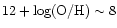 .
Thus, we conclude
.
Thus, we conclude
 ,
reaches about 8
(
,
reaches about 8
( 10% of the solar metallicity), and
.
10% of the solar metallicity), and
.
Copyright ESO 2002
