

In order to consider the dust formation and destruction, we analyse the dust-to-gas ratio along with the chemical evolution model by H99. The model is based on Eales & Edmunds (1996), LF98 and Dwek (1998). In our model, we do not need to model any SFH. This has an advantage in considering the dust-to-gas ratio of BCDs since the SFH of a dwarf galaxy is generally complex (e.g., Grebel 2001) and is difficult to model. We focus especially on dust destruction, because LF98 have not fully considered it. As we see later, our model is a powerful tool to know the metallicity level where dust destruction becomes effective enough to suppress the dust-to-gas ratio.
In order to investigate dust content in a galaxy, H99 has
established a set of model equations describing dust formation and
destruction processes. In H99, a galaxy is treated as one zone to
focus on the quantities averaged over the whole galaxy. The galaxy
is assumed to be a closed system; that is, mass inflow and outflow
are not considered. If the metallicity of the infalling material is
zero or much lower than that of the ISM in the
galaxy, the relation between dust-to-gas ratio and metallicity, with
which we will be concerned in this paper, is not altered by infall
(Edmunds 2001; Hirashita 2001). This is
because the infall dilutes
both metallicity and dust-to-gas ratio at almost the same rate. Our
model does not include the effect of outflow, and this is different
to LF98, in which outflow is essential to explain the observed
variance of the dust-to-gas ratio in BCDs. Since Tajiri & Kamaya
(2002) and Legrand et al. (2001) have suggested that
outflow is not efficient for BCDs, it is worth examining a case of no
outflow. Indeed, we present another clear possibility to explain the
large scatter of  among BCDs later.
The model equations in H99 (see the paper for details; see also
LF98) describe the evolution of total gas mass ( ), the
total mass of metals (both in gas and dust phases) labeled as i(Mi;
), the
total mass of metals (both in gas and dust phases) labeled as i(Mi;  ,
C, Fe, etc.), and the mass of metal i in a dust
phase (
,
C, Fe, etc.), and the mass of metal i in a dust
phase (
 ). We neglect dust growth in clouds, since
Hirashita (1999a) has shown that this process in
low-metallicity systems such as dwarf galaxies is much less efficient
than the formation of dust around stars. Then, we adopt an
instantaneous recycling approximation as in LF98 and H99 according to
the formalism in Tinsley (1980): stars less massive than
mt (present turn-off mass set to be 1
). We neglect dust growth in clouds, since
Hirashita (1999a) has shown that this process in
low-metallicity systems such as dwarf galaxies is much less efficient
than the formation of dust around stars. Then, we adopt an
instantaneous recycling approximation as in LF98 and H99 according to
the formalism in Tinsley (1980): stars less massive than
mt (present turn-off mass set to be 1  )
live forever and
the others die instantaneously.
)
live forever and
the others die instantaneously.
Dust-to-gas ratio and metallicity of galaxies are observationally
known to correlate with each other (e.g., Issa et al. 1990). This relation has recently been used as a test for
chemical evolution models including dust formation and destruction
(LF98; H99; Hirashita 1999a; Edmunds 2001).
The model by H99 reduces the following differential equation:
 is the mass fraction of an element i locked up
in dust (i.e.,
is the mass fraction of an element i locked up
in dust (i.e.,
 ); Xiis the mass fraction of an element i(i.e.,
 );
);
 quantifies what fraction of an element iejected from stars condenses into dust grains;
 is "dust destruction efficiency'', which we explain
later;
is "dust destruction efficiency'', which we explain
later;  is the
fraction of stellar mass subsequently returned to the
interstellar space, and
is the
fraction of stellar mass subsequently returned to the
interstellar space, and
 is the mass fraction of an
element i newly produced and ejected by stars
is the mass fraction of an
element i newly produced and ejected by stars![[*]](/icons/foot_motif.gif) . The definition of
is as follows:
. The definition of
is as follows:
 is the timescale of dust destruction by SN
shocks (Eq. (5)), and
is the timescale of dust destruction by SN
shocks (Eq. (5)), and  is the star
formation rate (SFR). Hereafter,
is called
"dust destruction
efficiency'', because it is inversely proportional to the timescale
of dust destruction (
). This is the most important
parameter in this paper.
is the star
formation rate (SFR). Hereafter,
is called
"dust destruction
efficiency'', because it is inversely proportional to the timescale
of dust destruction (
). This is the most important
parameter in this paper.
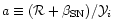
When all the quantities except Xi and
are constant
in time, the
analytical solution obtained by LF98 is applicable. With our
notations, it is rewritten as
 ,
,
 ,
and
,
and
 .
.
Here, we select oxygen as a traced element (i.e., )
according
to LF98, because
(i) most of the oxygen is produced by massive stars (Type II SNe and
their progenitors), (ii) oxygen is one of the main constituents of
dust grains, and (iii) the common tracer for the metal abundance in
BCDs is an oxygen emission line. The first item (i) means that an
instantaneous recycling approximation may be reasonable for the
investigation of oxygen abundances, since the generation of oxygen is
a massive-star-weighted phenomenon. In other words, results are
insensitive to the value of mt. Following H99, we adopt
 ,
which
are consistent with the relation between dust-to-gas ratio and
metallicity of nearby galaxies including our BCD sample.
,
which
are consistent with the relation between dust-to-gas ratio and
metallicity of nearby galaxies including our BCD sample.
Copyright ESO 2002


