In this paper, we discuss the variance of dust-to-gas ratio of a BCD
sample in terms of the variation of
 defined in
Eq. (2). We estimate
based on McKee
(1989) and LF98, while we also address their differences.
defined in
Eq. (2). We estimate
based on McKee
(1989) and LF98, while we also address their differences.
We assume that gas is divided into two components: gas in the
star-forming region and that in the H I envelope. Such an envelope
is generally observed around a star-forming region of a BCD (e.g.,
van Zee et al. 1998). We denote the gas mass fraction in
the star-forming region as
 and that in the H I envelope
as
and that in the H I envelope
as
 (i.e.,
 ). We distinguish the
two regions for the comparison with the IRAS sample
(Sect. 4.1). IRAS FIR bands are sensitive to dust
hotter than about 25 K. Such "warm'' dust exists in star-forming
regions, not in
H I envelopes. Calzetti et al. (1995) have also shown
by using the IRAS sample of actively star-forming galaxies that 70%
of the FIR flux comes from such a warm component of dust. Thus, dust
mass derived from the IRAS observation of a BCD is considered to
trace the dust in the star-forming region. This suggests that it is
useful for us to consider dust contained in star-forming regions as
long as we are interested in the comparison of our result with the
IRAS observations.
). We distinguish the
two regions for the comparison with the IRAS sample
(Sect. 4.1). IRAS FIR bands are sensitive to dust
hotter than about 25 K. Such "warm'' dust exists in star-forming
regions, not in
H I envelopes. Calzetti et al. (1995) have also shown
by using the IRAS sample of actively star-forming galaxies that 70%
of the FIR flux comes from such a warm component of dust. Thus, dust
mass derived from the IRAS observation of a BCD is considered to
trace the dust in the star-forming region. This suggests that it is
useful for us to consider dust contained in star-forming regions as
long as we are interested in the comparison of our result with the
IRAS observations.
Thus, we estimate
 and
in star-forming
regions. Gas mass accelerated to a velocity of
and
in star-forming
regions. Gas mass accelerated to a velocity of  by a SN,
 ,
is estimated as
,
is estimated as
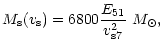 |
(4) |
 is
in units of 107 cm s-1 (McKee
1989). In swept ISM, dust is not fully destroyed. Thus, the fraction
of destroyed dust,
is
in units of 107 cm s-1 (McKee
1989). In swept ISM, dust is not fully destroyed. Thus, the fraction
of destroyed dust,  (
( 0.1; McKee 1989),
should be multiplied. Since we are interested in mass swept by
multiple SNe in a star-forming region, SN rate must be considered,
which is denoted as
0.1; McKee 1989),
should be multiplied. Since we are interested in mass swept by
multiple SNe in a star-forming region, SN rate must be considered,
which is denoted as  .
Then,
is expressed as
with the threshold velocity for dust
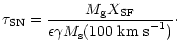
destruction (100 km s-1; McKee 1989). Comparing Eqs. (2) and (5), we obtain
.
Type II SNe occur "soon'' after a star formation, because the progenitors of
Type II SNe have lifetimes much shorter than the age of the universe. On
the other hand, Type Ia SNe, whose progenitors are low-mass stars, occur
about 1 Gyr after a star formation. Thus,
and
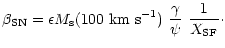
should be sensitive to the SFH. We express
as
.
Then,
is expressed as
with the threshold velocity for dust
destruction (100 km s-1; McKee 1989). Comparing Eqs. (2) and (5), we obtain
.
Type II SNe occur "soon'' after a star formation, because the progenitors of
Type II SNe have lifetimes much shorter than the age of the universe. On
the other hand, Type Ia SNe, whose progenitors are low-mass stars, occur
about 1 Gyr after a star formation. Thus,
and
should be sensitive to the SFH. We express
as
 |
(7) |
 and
and
 are the rate of Type Ia and Type II SNe,
respectively. We note that LF98 estimated
to be 5.
But, for example, the fraction between
and
changes
according to SFH of BCDs.
In the next section, we examine the relation between dust-to-gas
ratio and metallicity for various
,
whose probable
range is constrained.
are the rate of Type Ia and Type II SNe,
respectively. We note that LF98 estimated
to be 5.
But, for example, the fraction between
and
changes
according to SFH of BCDs.
In the next section, we examine the relation between dust-to-gas
ratio and metallicity for various
,
whose probable
range is constrained.
Copyright ESO 2002