Many astrophysical analyses, such as that of the cosmic diffuse
gamma-ray background (CDG), of the galactic 1.8 MeV line emission
from 26Al, or of  -ray line emission from supernovae, can be
optimized by detailed modelling of the instrumental line
background. Below, the (similar) procedures used to determine the
background event rates due to individual isotopes employed by
Weidenspointner et al. (2001); Oberlack
(1997) and Plüschke et al. (2000) in investigations of the CDG
-ray line emission from supernovae, can be
optimized by detailed modelling of the instrumental line
background. Below, the (similar) procedures used to determine the
background event rates due to individual isotopes employed by
Weidenspointner et al. (2001); Oberlack
(1997) and Plüschke et al. (2000) in investigations of the CDG![[*]](/icons/foot_motif.gif) and of the 26Al emission,
respectively, are described.
and of the 26Al emission,
respectively, are described.
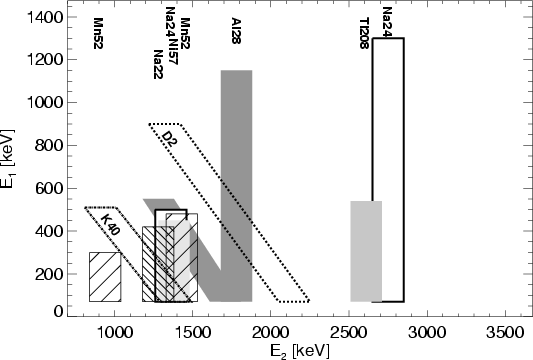 |
Figure B.1: A schematic representation of the simulated E1-E2 distributions of the eight isotopes identified in the instrumental line background for CDG event selections. The "vertical'' and "diagonal'' bands represent multiple photon and single photon events, respectively (compare to the detailed individual diagrams in Sect. 4) |
Accounting for the event rates due to the instrumental line
background, in particular its long-lived components, is important for
measuring the CDG at MeV energies (e.g. Kappadath et al. 2000; Weidenspointner et al. 2001). As explained above, the background
contributions of long-lived isotopes have to be subtracted before
prompt and short-lived backgrounds can be eliminated by veto rate
extrapolation. The event rates due to the eight identified background
isotopes producing the major instrumental lines are determined, as a
function of veto rate, in an iterative procedure by fitting a set of
three E2 spectra and one
 spectrum for
each veto rate interval.
spectrum for
each veto rate interval.
The rationale of the iterative fitting procedure is illustrated in
Figs. B.1 and
B.2. The
E1-E2 distributions of the eight isotopes as
obtained from Monte Carlo simulations are schematically depicted for
CDG event selections in
Fig. B.1. In general, there
is considerable overlap in the
E1-E2distributions of individual isotopes (in particular around 1.3 MeV in
E2), which precludes an independent determination of the
isotopes' background contributions.
Therefore, an iterative procedure was introduced, which starts at the
highest energies in E1 and E2, where
ambiguities are minimal, and then proceeds down to the increasingly
complex structures at lower E1 and E2energies. The
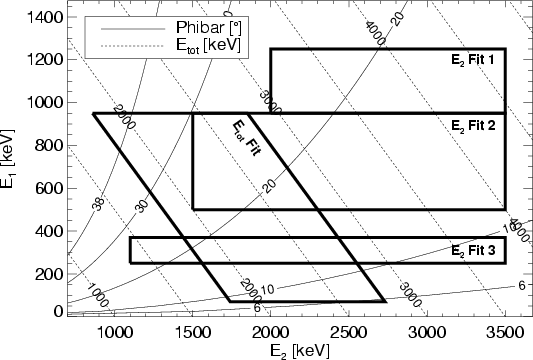
E1-E2 ranges of the three
E2 spectra and the
spectrum, chosen such
as to enhance or suppress individual lines or spectral features, are
indicated in Fig. B.2. The
E1-E2 ranges covered by the second and third
E2 fit and by the
fit overlap, hence the
results of these fits are not statistically independent. The overlap
is caused by the
fit, which was introduced to
properly separate the background events from 2D and
28Al. Inclusion or omission of the
fit therefore
is a trade-off between systematic and statistical uncertainty. By
iteratively fitting the second and third E2 spectrum and
the
spectrum, both the systematic and the statistical
uncertainty in the 2D and 28Al event rates are minimized
(other isotopes are hardly affected by the overlap, see below). In
additon, the iterative approach ensures the self-consistency of the
determined isotope background contributions.
Also included in Fig. B.2 are
lines of constant
 and
.
Comparison of
Figs. B.1 and
B.2 provides a first
indication of the many options for fitting individual lines, which can
be enhanced or suppressed through the choice of the fit regions, and
in addition through selections on
and/or
.
In
particular, event selections may be used to suppress unidentified,
long-lived spectral features, which cannot be eliminated by veto rate
extrapolation (see Kappadath et al. 2000;
Weidenspointner et al. 2001).
and
.
Comparison of
Figs. B.1 and
B.2 provides a first
indication of the many options for fitting individual lines, which can
be enhanced or suppressed through the choice of the fit regions, and
in addition through selections on
and/or
.
In
particular, event selections may be used to suppress unidentified,
long-lived spectral features, which cannot be eliminated by veto rate
extrapolation (see Kappadath et al. 2000;
Weidenspointner et al. 2001).
The
E1-E2 ranges of the three E2spectra and the
spectrum indicated in
Fig. B.2 were chosen for the
iterative fitting procedure for the following reasons.
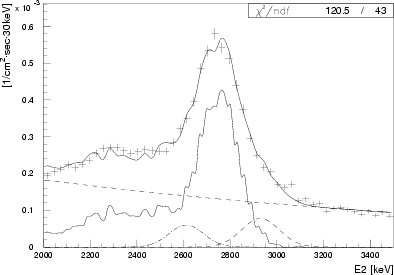
The first E2 spectrum, covering the
E1-E2region of 950-1250 keV in E1 and 2000-3500 keV in E2(see Figs. B.1 and
B.2), allows us to determine the
event rate from 24Na. The signal from this isotope is optimized
by selecting E1 energies around the Compton edge of the 1.37 MeV
photon interacting in D1 and around the photopeak of the 2.75 MeV
photon interacting in D2 (see Fig. 5).
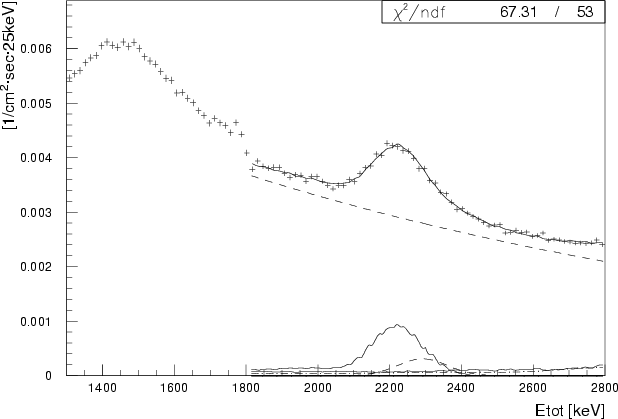
The 2D event rate is determined from fitting the
spectrum (
1810-2800 keV, E1 70-950 keV,
and E2 730-2800 keV, see
Figs. B.1 and
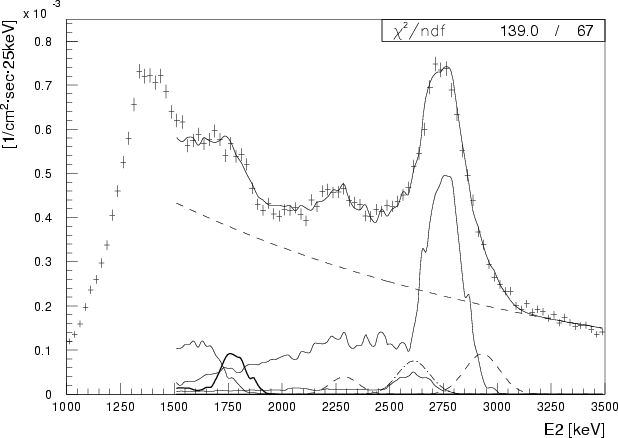
B.2). The second
E2 spectrum (E1 500-950 keV, E21500-3500 keV, see Figs. B.1
and B.2) is used to determine
the event rate from 28Al. Finally, the third E2spectrum is intended for determining the background contributions from
the  -decays of 22Na, 52Mn, and 57Ni, with the
270-350 keV range in E1 being optimized for the Compton
edge of 511 keV photons, and the E2 range covering the
energies 1100-3500 keV (see
Figs. B.1 and
B.2).
To optimize the signal of the instrumental lines, which originate in
the D1 detector material, a ToF range of 2.5-7.5 ns was
selected for the spectra (compare Fig. 3).
-decays of 22Na, 52Mn, and 57Ni, with the
270-350 keV range in E1 being optimized for the Compton
edge of 511 keV photons, and the E2 range covering the
energies 1100-3500 keV (see
Figs. B.1 and
B.2).
To optimize the signal of the instrumental lines, which originate in
the D1 detector material, a ToF range of 2.5-7.5 ns was
selected for the spectra (compare Fig. 3).
The three E2 spectra and the
spectrum are
analyzed in an iterative procedure consisting of eight fits, listed
below. The contributions from the primordial radio-nuclides 40K
and 208Tl are not determined from the fits, but calculated from
their known (40K, see Sect. 4.3) or estimated (208Tl,
see Sect. 4.7) activities based on Monte Carlo
simulations. Similarly, once the background contribution of an isotope
has been determined from any spectrum, the isotope's contribution to
any other spectrum can be predicted based on Monte Carlo simulations.
The eight identified isotopes can account for the major instrumental
lines, however, some weak lines or spectral features remain
unidentified at this time. In the fits, some of these unidentified
lines were described by Gaussians to minimize systematic errors in the
determination of the event rates of the identified components. The
unidentified components are genuinely different from those identified
since their variation with cosmic-ray intensity, as well as their
dependence on event parameter selections, are different (see Kappadath
et al. 2000; Weidenspointner et al. 2001).
The identified isotopes are represented by templates obtained from
Monte Carlo simulation. These templates have not been smoothed
as smoothing inevitably increases the systematic uncertainty due to
distortions of the template shape. The small "spikes'' in the
templates in Figs. B.3-B.6 are
an artifact of the plotting software.
The eight fit steps are:
Fit: The 2D event rate is estimated;
the contributions from 24Na and 208Tl are fixed. All other
isotopes are neglected;
-decays of 22Na, 52Mn, and 57Ni are
estimated; the contributions from 2D, 24Na, 28Al,
40K, and 208Tl are fixed;
Fit: The 2D event rate is
determined; the contributions from all other isotopes (22Na,
24Na, 28Al, 40K, 52Mn, 57Ni, and 208Tl)
are fixed (see Fig. B.4);
-decays of 22Na, 52Mn, and 57Ni are
determined; all other isotopes are fixed (see
Fig. B.6);
Fit: The 2D event rate is
re-determined as in Fit 5.
-decays of 22Na, 52Mn, and 57Ni are
derived from the results of Fit 7. As pointed out before, the
contributions from the primordial radio-nuclides 40K and
208Tl need not be determined from the line fits, but can be
computed based on the known or estimated activities.
The analysis of the galactic 1.8 MeV line emission from 26Al
is, similar to that of the CDG, affected by the instrumental line
background and its temporal variation. The galactic 1.8 MeV line
emission is determined in the energy band 1.7-1.9 MeV, using
adjacent energy bands for constructing a model for the
background in this so-called line interval (comprehensive
descriptions of this approach can be found in, e.g., Knödlseder
1997 & Oberlack 1997). In
particular, the scatter angle
 distribution of the
1.7-1.9 MeV background model is derived from an
interpolation of the
distributions in narrow adjacent
energy intervals (1.6-1.7 MeV and 1.9-2.0 MeV). Due to the
long-term variation of the instrumental line background (see e.g. Fig. 8), the ratio of the number of counts in
the line interval and in the adjacent energy intervals is decreasing
with time (see Fig. B.7), mostly due to the
build-up of 22Na, a major component in the 1.6-1.7 MeV band
in
(Oberlack 1997). To eliminate the
time dependent contamination of the background reference from adjacent
energies, the number of counts due to each component of the
instrumental line background has to be determined for each individual
observation period, employing a procedure outlined below. After
subtraction of the instrumental line background, the ratio of counts
in the line interval and the adjacent energy intervals to a good
approximation is constant in time (see
Fig. B.7), and data from individual observation
periods can be summed to analyze the galactic 1.8 MeV line emission.
distribution of the
1.7-1.9 MeV background model is derived from an
interpolation of the
distributions in narrow adjacent
energy intervals (1.6-1.7 MeV and 1.9-2.0 MeV). Due to the
long-term variation of the instrumental line background (see e.g. Fig. 8), the ratio of the number of counts in
the line interval and in the adjacent energy intervals is decreasing
with time (see Fig. B.7), mostly due to the
build-up of 22Na, a major component in the 1.6-1.7 MeV band
in
(Oberlack 1997). To eliminate the
time dependent contamination of the background reference from adjacent
energies, the number of counts due to each component of the
instrumental line background has to be determined for each individual
observation period, employing a procedure outlined below. After
subtraction of the instrumental line background, the ratio of counts
in the line interval and the adjacent energy intervals to a good
approximation is constant in time (see
Fig. B.7), and data from individual observation
periods can be summed to analyze the galactic 1.8 MeV line emission.
The procedure used in the 26Al analysis to determine the
background contributions of the eight identified background isotopes
is a modified version of the CDG procedure described in
Appendix B.1. The modifications are motivated by
differences in the event selections applied in the two analyses,
particularly differences in the elimination of atmospheric background
(see Appendix A.1 and
A.2). One of the consequences is that in
the 26Al imaging analysis events with larger
values are accepted than in the CDG analysis. For some isotopes,
notably 24Na, this results in significant changes of the
E1-E2 distribution as compared to that for CDG
event selections. Consequently, the optimal fit regions in
E1-E2 space are somewhat different. Also, in
contrast to the CDG analysis, in the 26Al analysis the
distribution of the accepted events is different for
each observation period due to the orbit dependent rejection of
atmospheric background. The simulated energy distributions for each
background isotope therefore have to be corrected for the specific
distribution of each individual observation period
(Oberlack 1997).
The correction for selections to reject atmospheric background has
been calculated assuming a homogeneous illumination of the D1
detector. Since there is a certain edge enhancement in the
illumination of the D1 modules for background produced in the D1
structure, slight differences in these corrections result in small
distortions of the templates, and thus add to the observed scatter in
the determined isotope event rates (see
Fig. 8).
As each observation period is independently analyzed for its
instrumental line background contamination, the background modelling
in the 26Al analysis yields as a welcome by-product the
long-term variation of the event rates due to the eight identified
background isotopes depicted in Fig. 8.
The four steps of the iterative line fitting procedure in the
26Al analysis are similar to those in the CDG analysis, hence we
content ourselves with describing only the differences. In the first
step, two
E1-E2 regions are fitted
simultaneously to obtain the 24Na event rate (Oberlack
1997): the
E1-E2 region
depicted in Fig. B.2, and an
additional
E1-E2 region extending from 2000 to
2700 keV in E1 and from 1100 to 2000 keV in
E2. Analogous to the first
E1-E2region, the additional
E1-E2 region optimizes
the 24Na signal from simultaneous interactions of the 1.37 MeV
and 2.75 MeV photons in D2 and D1, respectively, which are no longer
suppressed due to the larger accepted
values for
imaging selections. The
E1-E2 region for the
second step extends down to 700 keV in E1, and is used for
determining the 28Al rate and for obtaining start parameters to
determine the event rates of the remaining isotopes, particularly
22Na, in Fit 3. However, unlike in the CDG analysis, the
contributions of the primordial isotopes 40K and 208Tl are
not fixed in the 26Al analysis, but determined in Fit 3 and 1,
respectively. As far as determining the contributions of each
individual isotope is concerned, the procedure ends here, since it has
been demonstrated in the CDG analysis that one fit cycle is sufficient
to obtain self-consistent isotope rates. This advanced background
treatment provided the basis for the latest COMPTEL 26Al all-sky
maps (e.g. Oberlack 1997; Plüschke et al. 2000).
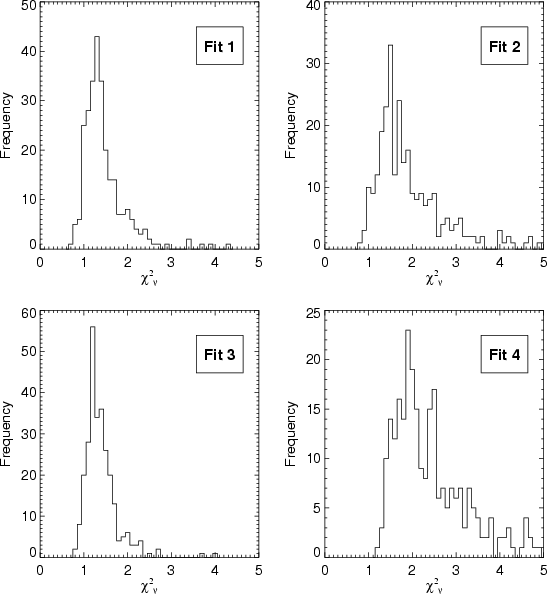 |
Figure B.9:
The distribution of the
 values for each of
the four fit steps in determining the instrumental line contamination
in the 26Al analysis (Plüschke et al. 2000)
values for each of
the four fit steps in determining the instrumental line contamination
in the 26Al analysis (Plüschke et al. 2000) |
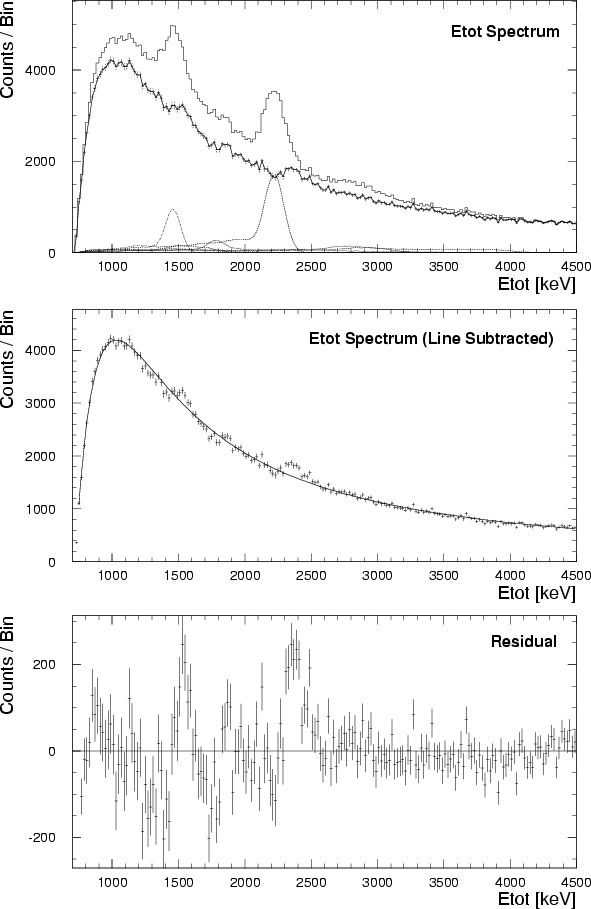
To investigate the extent to which the identified isotopes can account
for spectral features in
,
an additional fit is
performed (see Fig. B.8). In this
fit (
E1 > 70 keV,
E2 > 650 keV), the
contributions from the eight background isotopes are fixed at the
values obtained from the three previous E2 fits; only the
continuum background, modelled by a power law with an exponential
turn-over at low energies, is varied. As can be seen, the major
spectral features are accounted for by the eight identified isotopes,
however, some minor features remain unidentified at this time.
The distribution of the
values for each of the four fit
steps, as obtained in the analysis of Plüschke et al. (2000), is shown in Fig. B.9. The
quality of Fits 1 and 3, in which the event rates of most of the
background isotopes are determined, is acceptable. The
distribtion for the
fit, however, indicates that further
improvement of the instrumental line background modelling is still
possible.
Copyright ESO 2001
 1.6 MeV, fixed), 28Al (the
1.78 MeV line), 24Na (the strong line at 2.75 MeV, fixed) and
208Tl (the weaker line at 2.61 MeV, fixed), the three
unidentified features (dashed, dashed-dotted, and dashed lines), and the
exponential continuum are indicated
1.6 MeV, fixed), 28Al (the
1.78 MeV line), 24Na (the strong line at 2.75 MeV, fixed) and
208Tl (the weaker line at 2.61 MeV, fixed), the three
unidentified features (dashed, dashed-dotted, and dashed lines), and the
exponential continuum are indicated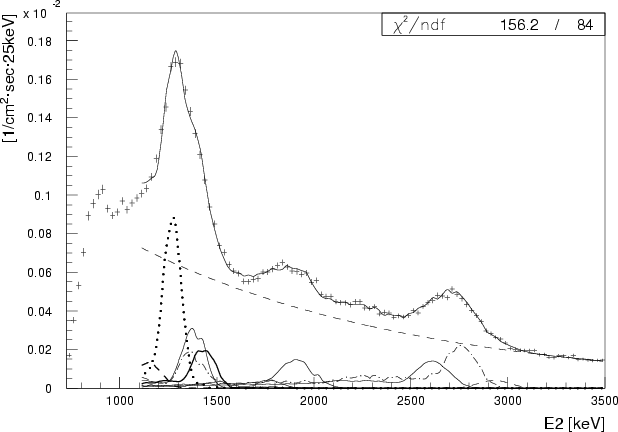
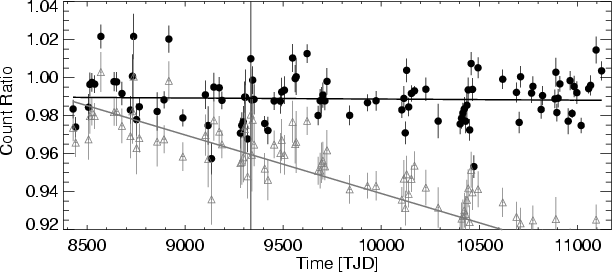
 .
The ratios, and a linear model of their time variation,
are shown before (grey) and after (black) subtraction of the
instrumental line background
.
The ratios, and a linear model of their time variation,
are shown before (grey) and after (black) subtraction of the
instrumental line background