The particle and photon environment of COMPTEL produces coincident
interactions in the D1 and D2 detectors that pass all the logic and
electronic criteria for a valid event.
In the following, an overview is given of different types of
instrumental background events in terms of their interaction process
and location, as illustrated in Fig. 2. This
classification of background events (van Dijk 1996)
provides a simple and versatile framework for discussing the COMPTEL
instrumental background.
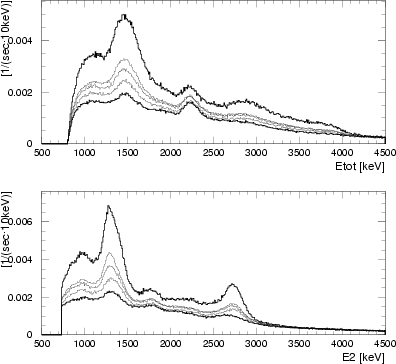
ToF is of prime importance in identifying and rejecting instrumental
background events. A schematic representation of the ToF distribution
of valid events is depicted in Fig. 3.
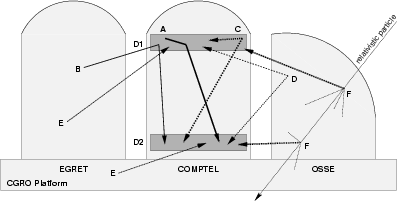 |
Figure 2: An illustration of the main channels for the triggering of valid events due to instrumental background (adopted from van Dijk 1996). For simplicity, BATSE was omitted in this schematic view of CGRO. The various event types are explained in the text |
 Event types A and B: events caused by the
double scattering of a single photon. Any photon created in CGRO may
produce this type of background event, which, if the scattering is
from D1 to D2, is identical to a proper celestial event. It follows
that the ToF distribution of forward scattered single photon events is
identical to that of celestial photons and peaks around 5 ns in the
ToF forward peak. Depending on where they originate, forward
scattered single photon events may be rejected. In particular, many of
the photons that originate from below the D1 detector (such as type
B events) can be eliminated by a selection on the scatter angle
Event types A and B: events caused by the
double scattering of a single photon. Any photon created in CGRO may
produce this type of background event, which, if the scattering is
from D1 to D2, is identical to a proper celestial event. It follows
that the ToF distribution of forward scattered single photon events is
identical to that of celestial photons and peaks around 5 ns in the
ToF forward peak. Depending on where they originate, forward
scattered single photon events may be rejected. In particular, many of
the photons that originate from below the D1 detector (such as type
B events) can be eliminated by a selection on the scatter angle
 (see e.g. the event selections in
Appendix A). The remaining instrumental background
from forward scattered single photons is therefore mostly due to
photons originating in, around and above the D1 detector (such as type
A events); type B events are negligible. Line emissions
appear in energy space, particularly in
(see e.g. the event selections in
Appendix A). The remaining instrumental background
from forward scattered single photons is therefore mostly due to
photons originating in, around and above the D1 detector (such as type
A events); type B events are negligible. Line emissions
appear in energy space, particularly in
 and
E1-E2 space (see below).
and
E1-E2 space (see below).
Single photons may also scatter in D2 before interacting in D1. These
backward scattered single photon events, however, are identifiable by
their ToF distribution, which is confined in the backward peak at ToF
values of about - 5 ns. Finally, high-energy neutrons can undergo a
double scattering process analogously to photons, however, many of
these neutron events can be rejected by their PSD value.
Event types C and D: events caused by two
or more photons both spatially and temporally correlated (so-called
multiple photon or cascade events). In general, multiple photon
events are more efficient in generating a background event than single
photon events, since the probability for coincident interactions in
both detectors increases with the number of emitted photons. Emission
of two or more photons can occur from a small region on a time-scale
shorter than the coincidence window of 40 ns. Nucleons that have been
excited above the first nuclear level, e.g. by proton or neutron
interactions, may promptly emit a cascade of photons. The multitude of
nuclear excitation levels often results in a rather featureless
continuum distribution in energy space. If, however, only a few
transition levels are involved, characteristic features appear in
E2 and
E1-E2 space (see
below). Multiple photons may also arise from  -particle
bremsstrahlung, or the annihilation of a positron. Also, high-energy
neutrons may induce the emission of one or more
-particle
bremsstrahlung, or the annihilation of a positron. Also, high-energy
neutrons may induce the emission of one or more  -ray photons
outside of the D1 scintillator (thereby eluding rejection by PSD) and
some may interact in the D2 detector. More complicated nuclear
reactions such as the spallation (break-up) of a nucleus or the
initiation of a shower of secondaries by an incident cosmic-ray
particle or neutron may also produce multiple photons.
-ray photons
outside of the D1 scintillator (thereby eluding rejection by PSD) and
some may interact in the D2 detector. More complicated nuclear
reactions such as the spallation (break-up) of a nucleus or the
initiation of a shower of secondaries by an incident cosmic-ray
particle or neutron may also produce multiple photons.
Frequently, the emission of photons is nearly simultaneous, i.e. on time-scales much shorter than the coincidence window. The ToF value of these event types is determined by the location of the emitting nucleus relative to the D1 and D2 detectors. Multiple photons originating in the vicinity of the D1 detector (such as type C events) will peak slightly below a ToF value of 5 ns (see Sect. 4.2) and therefore contribute to the ToF forward peak. Photons emitted by nuclei in the spacecraft material between the D1 and D2 detectors (such as type D events) will interact in the two detectors near-simultaneously and have ToF values that are broadly distributed around zero, while photons originating in and around the D2 detector will contribute to the ToF backward peak. The full, double-peaked ToF distribution of all multiple photon events not only reflects the location of the emitting nucleus, but also the mass distribution of the entire spacecraft relative to the D1 and D2 detectors.
Event type E: events that are both spatially and
temporally uncorrelated (the so-called random coincidences). The
COMPTEL detectors are continuously exposed to a large flux of
-ray photons. This inevitably leads to coincident interactions
that qualify as valid events. The photons producing these random
coincidences are mostly of local or atmospheric origin. Since the two
photons creating the event are unrelated to one another, and, in
particular, not correlated in time, these events are uniformly
distributed in ToF. Type E events may also involve a neutron
instead of a photon triggering the D2 detector, which has no PSD
capability.
Event type F: events caused by two photons that
are temporally correlated, but spatially uncorrelated. High-energy
cosmic-ray particles or atmospheric neutrons may interact at several
different locations along their path through CGRO. Individual
interactions include those generating type C and D events
(e.g. spallations or showers). The whole interaction chain creating
type F events is similar to multiple photon events, the
main difference being that their ToF distribution depends on both the
location of the interactions as well as the (relativistic) velocity of
the primary particle. The ToF distribution of this type of event is
broad and covers the entire coincidence window (also reflecting
the spacecraft mass distribution).
Other processes, such as the interaction of a neutron in the
D2 detector after producing a photon in the D1 system, or direct
ionization losses of -particles created in the housings of the
D1 scintillators, may also play a role. The event signatures of these
and other, more complicated processes, however, will be similar to the
event types described above.
Event types A - D may arise from activation by primary
cosmic-ray protons or secondary particles as well as atmospheric
neutrons. The time between the interaction of the proton or neutron
within the telescope material and the actual triggering of a
background event varies, since it depends on the decay time of the
radio-isotopes produced. These processes and the resulting background
events can be crudely separated into "prompt'' and "delayed''
components. For prompt background events the time delay between the
primary particle interaction in the instrument and the resulting
emission of background photons is shorter than the coincidence window
of 40 ns for the triggering of a valid event. Thus the intensity of
prompt background components instantaneously follows the
(time-variable) incident local cosmic-ray flux (see
Sect. 5). For delayed events the time delay is longer
than the typical length of the fast-logic veto signal of  200 ns. In contrast to protons, neutrons can travel to any location
in the spacecraft to produce -ray photons without triggering
the veto system. Inside the veto domes, particularly in the D1
detector, prompt events can therefore only be produced by neutrons.
Both protons and neutrons, however, can produce delayed background
events inside as well as outside the veto domes.
200 ns. In contrast to protons, neutrons can travel to any location
in the spacecraft to produce -ray photons without triggering
the veto system. Inside the veto domes, particularly in the D1
detector, prompt events can therefore only be produced by neutrons.
Both protons and neutrons, however, can produce delayed background
events inside as well as outside the veto domes.
As described in Sect. 2, events due to incident celestial photons have ToF values around 5 ns. Only background events with a similar ToF value will therefore interfere with astrophysical analyses. As illustrated in Fig. 3, a major portion of the instrumental background events, including those in the backward peak, can be eliminated by a ToF selection. The most important background event types in the ToF forward peak region around ToF = 5 ns are those originating in the D1 detector (types A and C), and some of the background events produced in the satellite structure (types D, E, and F).
After ToF selection, the majority of the instrumental line
background is expected to arise from activation of the D1 detector
material because of the relatively high mass density and probability
for triggering a background event as compared to the general
spacecraft structure. The material composition of the D1 detector
system therefore provides important clues as to which radioactive
isotopes can effectively be produced and ultimately contribute to the
instrumental line background in the low-Earth orbit of CGRO. The D1
support structure and the D1 module and PMT housings are mostly
aluminium, the most abundant element in the instrument. The liquid
scintillator NE 213A is composed of hydrogen and carbon. The quartz
windows in the module housings contain silicon and oxygen. The PMTs
and electronics boxes contain, among other elements, copper, nickel,
and iron.
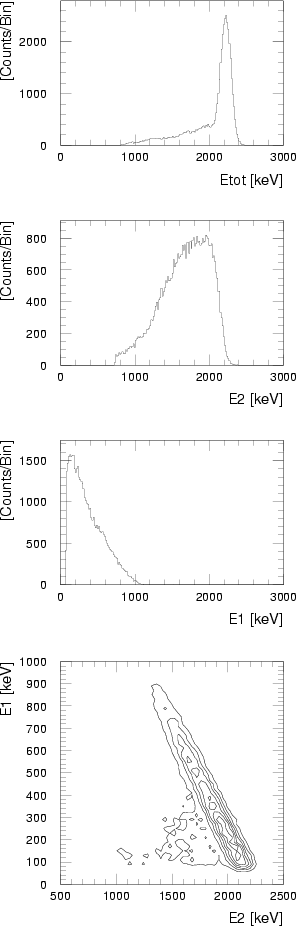 |
Figure 4:
The
,
E2, E1, and
E1-E2 distribution of instrumental 2.22 MeV
photons from 2D production for CDG event selections as determined
from Monte Carlo simulations |
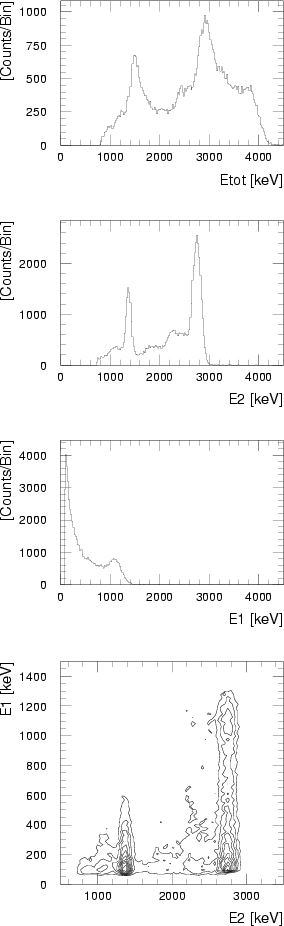 |
Figure 5:
The
,
E2, E1, and
E1-E2 distribution of instrumental 24Na
events for CDG data selections as determined from Monte Carlo
simulations |
Events from the instrumental line background produce conspicuous and characteristic features in energy space that can be exploited to distinguish them from the general (continuum) background. The ToF distributions of the line background and the continuum background are also different: the instrumental line background is concentrated in the forward peak region, while the continuum background in energy is throughout the ToF continuum as well as the ToF forward peak. In the following, the characteristics of single photon (type A) events and multiple photon or cascade (type C) events are illustrated with examples of (background) events from 2D and 24Na, respectively, both major contributors to the instrumental line background (see Sect. 4).
The instrumental 2.22 MeV photons emitted when 2D is produced in
the D1 scintillators (see Sect. 4.1) are single photon (type
A) background events. The
,
E2,
E1, and
E1-E2 distributions of
instrumental 2.22 MeV photons for CDG event selections (described in
Appendix A.1) as determined from Monte Carlo
simulations are depicted in Fig. 4. The
distribution exhibits a peak at the energy of the
primary photon, while the distributions in E2 and
E1 are broad and relatively featureless. In
E1-E2 space the event distribution of type
A events follows the diagonal
 ,
with
,
with
 MeV for 2D.
The distributions in
and
E1-E2 are the most important characteristics
of single photon background events.
MeV for 2D.
The distributions in
and
E1-E2 are the most important characteristics
of single photon background events.
The  -decay of 24Na results in the emission of two
photons with energies 1.37 MeV and 2.75 MeV causing type C line
background events (see Sect. 4.2). The -particle is
of minor importance for the generation of a background event. Since it
rarely escapes the support structure, it contributes to the background
only through secondary bremsstrahlung photons. The 24Na
signature in
,
E2, E1, and
E1-E2 as determined from Monte Carlo
simulations is shown, for CDG event selections (see
Appendix A.1), in Fig. 5. The
most important characteristic of 24Na, and any other isotope
emitting multiple photons, is the E2 distribution, which
exhibits peaks at the energies of each of the primary photons. In
E1 the only conspicuous feature is the Compton edge of the
1.37 MeV photon (the Compton edge of the 2.75 MeV photon is suppressed
by the CDG data selections). The
spectrum is more
complex and exhibits less pronounced, line-like features just above
the individual photon energies. These come from the absorption of one
photon in D2 with the other photon scattering in D1 with an energy
deposit near the D1 threshold. In addition, in
a
shoulder is present at about 3.9 MeV. This is analogous to the sum
peak in standard spectroscopy employing a single detector. Under CDG
data selections, this shoulder is due to the absorption of the
2.75 MeV photon in D2, with the 1.37 MeV photon scattering in D1 with
an energy deposit at the Compton edge. The 24Na event
distribution in
E1-E2 space is also very
characteristic: the events cluster along two bands parallel to the
E1 axis located in E2 at the energies of the
two decay photons. The band at 2.75 MeV in E2 extends in
E1 from the threshold up to the Compton edge of the
1.37 MeV photon. The band at 1.37 MeV in E2 is suppressed
by the CDG data selections.
-decay of 24Na results in the emission of two
photons with energies 1.37 MeV and 2.75 MeV causing type C line
background events (see Sect. 4.2). The -particle is
of minor importance for the generation of a background event. Since it
rarely escapes the support structure, it contributes to the background
only through secondary bremsstrahlung photons. The 24Na
signature in
,
E2, E1, and
E1-E2 as determined from Monte Carlo
simulations is shown, for CDG event selections (see
Appendix A.1), in Fig. 5. The
most important characteristic of 24Na, and any other isotope
emitting multiple photons, is the E2 distribution, which
exhibits peaks at the energies of each of the primary photons. In
E1 the only conspicuous feature is the Compton edge of the
1.37 MeV photon (the Compton edge of the 2.75 MeV photon is suppressed
by the CDG data selections). The
spectrum is more
complex and exhibits less pronounced, line-like features just above
the individual photon energies. These come from the absorption of one
photon in D2 with the other photon scattering in D1 with an energy
deposit near the D1 threshold. In addition, in
a
shoulder is present at about 3.9 MeV. This is analogous to the sum
peak in standard spectroscopy employing a single detector. Under CDG
data selections, this shoulder is due to the absorption of the
2.75 MeV photon in D2, with the 1.37 MeV photon scattering in D1 with
an energy deposit at the Compton edge. The 24Na event
distribution in
E1-E2 space is also very
characteristic: the events cluster along two bands parallel to the
E1 axis located in E2 at the energies of the
two decay photons. The band at 2.75 MeV in E2 extends in
E1 from the threshold up to the Compton edge of the
1.37 MeV photon. The band at 1.37 MeV in E2 is suppressed
by the CDG data selections.
For other isotopes, if the energy of one of a pair of cascade photons is below the D2 threshold, then the two photons produce a cascade (type C) event only if the lower-energy photon scatters in D1, and the higher-energy photon interacts in D2. The E2 and E1-E2 distribution of such a cascade photon pair is simple: there is only one photopeak in E2 and only one band in E1-E2.
Radioactive decays that result in the (simultaneous) emission of two
or more photons can produce line background events other than of type
C.
For example, an individual photon of the emitted
photon multiple can produce a type A event, provided all other
photons escape from the instrument without interacting in any of the
detectors.
As apparent in the
E1-E2 event distribution of
24Na, however, the
signatures corresponding to
the photon energies 1.37 MeV and 2.75 MeV are much weaker than the
cascade structure.
Monte Carlo simulations show that less than 10% of the
24Na background events are due to type A events.
This illustrates the fact that multiple photon decays in the D1
detector material are more efficient in generating a background event
than decays that result in the emission of a single photon only.
Copyright ESO 2001
![\begin{figure}
\par\includegraphics[width=8.8cm,clip]{H2362F3.eps}\end{figure}](/articles/aa/full/2001/10/aah2362/img15.gif)