

 Persei & Perseus OB2 (star 3)
 Puppis, Vela R2, Vela OB2 & Trumpler 10 (star 10)
 Cephei, Cepheus OB2 & Cepheus OB3 (star 22)
Per, Pup, and
Cep
Pup, and we discuss the likely formation
mechanisms. The results are summarized in Table 5.
Cephei, Cepheus OB2 & Cepheus OB3 (star 22)
Per, Pup, and
Cep
Pup, and we discuss the likely formation
mechanisms. The results are summarized in Table 5.
 4.8 Myr ago and predicted the radial velocity of the star (at
that time unknown) to be 18 km s-1. The discrepancy in
kinematic ages of AE Aur and
4.8 Myr ago and predicted the radial velocity of the star (at
that time unknown) to be 18 km s-1. The discrepancy in
kinematic ages of AE Aur and  Col (Sect. 4) and that of
53 Ari indicates that it is not related to the same event that created
AE Aur and Col (Sect. 4) but is another runaway from
the Orion star-forming region. Table 3 lists the
observables of 53 Ari
Col (Sect. 4) and that of
53 Ari indicates that it is not related to the same event that created
AE Aur and Col (Sect. 4) but is another runaway from
the Orion star-forming region. Table 3 lists the
observables of 53 Ari![[*]](/icons/foot_motif.gif) .
.
The Ori OB1 association has four subgroups: a, b, c,
and d (Blaauw 1964; Brown et al.
1994). We do not consider subgroup d (the Trapezium)
as a possible parent group of 53 Ari, since this subgroup is younger
than the runaway (Sect. 4). The ages of the other
subgroups are: 8-12 Myr for subgroup a, 2-5 Myr for subgroup
b, and 4 Myr for subgroup c (Warren & Hesser
1977a, 1977b; Brown et al. 1994).
We performed a set of simulations as in Sect. 2, retracing
orbits for each subgroup (a, b, c). The kinematic
age of 53 Ari from subgroup a is 4.3 Myr
(Fig. 12). This means that the subgroup was
6 Myr old when 53 Ari became a runaway star. This very likely
rules out the DES as the formation mechanism (see Sect. 1).
However, there is little direct evidence in favor of the BSS. The
helium abundance of 53 Ari is unknown and its observed rotational
velocity is small (
 km s-1), but
this could be caused by a near pole-on orientation. We did not find a
neutron star associated with 53 Ari, but our sampling of the nearby
compact objects is severely limited
(Sect. 2.1).
km s-1), but
this could be caused by a near pole-on orientation. We did not find a
neutron star associated with 53 Ari, but our sampling of the nearby
compact objects is severely limited
(Sect. 2.1).
If subgroup b is the parent association the kinematic age for
53 Ari is 4.8 Myr. This is comparable to the canonical age of
the subgroup, and excludes the BSS as a production mechanism for
53 Ari (see Sect. 1). If Ori OB1 b is the parent group
of 53 Ari then the kinematic age is 4.8 Myr and the formation
mechanism is most likely the DES. However, the most recent age
determination (Brown et al. 1994) gives  Myr. If
Ori OB1 b is indeed this young then the subgroup is younger than
53 Ari and cannot be the parent group.
Myr. If
Ori OB1 b is indeed this young then the subgroup is younger than
53 Ari and cannot be the parent group.
For subgroup c we find that the minimum separation between the
subgroup centre and the runaway was never smaller than 15 pc, while
the simulations for the other two subgroups a and b yield
minimum separations as small as 1 pc. The space motion of Ori OB1 is
mostly directed radially away from the Sun, and the proper motion
component is relatively small. The Hipparcos data did not allow de
Zeeuw et al. (1999) to discriminate between the different
subgroups in their selection procedure; they only give one proper
motion and radial velocity for the whole Orion complex. It is possible
that subgroup c has a motion that differs slightly from that of
the other two subgroups, so that it cannot be ruled out as a candidate
parent group. The age of subgroup c, 5 Myr, is similar to
the kinematic age of 53 Ari. By the argument given above this suggests
that if Ori OB1 c is the parent association of 53 Ari, then the
formation mechanism is most likely the DES.
In order to decide which of the Ori OB1 subgroups is the parent group of 53 Ari, we need to know the distances and velocities of the subgroups and the runaway star with a better accuracy than is now available. Figure 12 could then be used to pin down the parent group, and the mechanism which is responsible for the runaway nature of 53 Ari. Since subgroup a is the only one for which the BSS is indicated, finding a pulsar originating from subgroup aat the same time as 53 Ari would also clinch the issue.
Persei & Perseus OB2 (star 3)
Persei (HIP 18614) lies within the boundary of
the Per OB2 association on the sky. This positional coincidence, and
the low density of early-type stars near Per OB2, led Blaauw
(1944) to propose Per as a member of the association.
At that time it was thought that the large radial-velocity difference
between Per and Per OB2 (40 km s-1) was due to
uncertainties in the measurement of
 for
Per. However, when the radial velocity of Per was
confirmed, its membership of the Per OB2 association became doubtful
(Blaauw 1952a). In Paper I, Blaauw classified
Per as a runaway star from the Per OB2 association, which
naturally explains the discrepancy of the radial velocity of the star
and the association. Per was the first star to be classified as
runaway based on its
alone. Most other runaways
were recognized because their proper motions were directed away from
an association. The parent group, Per OB2, has an age of 7 Myr
(e.g., Seyfert et al. 1960; de Zeeuw & Brand
1985).
for
Per. However, when the radial velocity of Per was
confirmed, its membership of the Per OB2 association became doubtful
(Blaauw 1952a). In Paper I, Blaauw classified
Per as a runaway star from the Per OB2 association, which
naturally explains the discrepancy of the radial velocity of the star
and the association. Per was the first star to be classified as
runaway based on its
alone. Most other runaways
were recognized because their proper motions were directed away from
an association. The parent group, Per OB2, has an age of 7 Myr
(e.g., Seyfert et al. 1960; de Zeeuw & Brand
1985).
We adopt
 km s-1 for Per
(Bohannan & Garmany 1978;
Garmany et al. 1980;
Stone 1982;
Gies & Bolton 1986).
This value differs by 10 km s-1 from those quoted in the
Hipparcos Input Catalogue (67.1 km s-1, Turon et al. 1992) and the WEB catalogue (70.1 km s-1, Duflot et
al. 1995), which derive from the value listed in the
General Catalogue of Radial Velocities (70.1 km s-1, Wilson
1953). We take the radial-velocity error to be
5 km s-1; this is equal to the amplitude of the velocity
variations induced by the non-radial pulsations of Per (de Jong
et al. 1999). The rotational velocity and helium abundance
are
km s-1 for Per
(Bohannan & Garmany 1978;
Garmany et al. 1980;
Stone 1982;
Gies & Bolton 1986).
This value differs by 10 km s-1 from those quoted in the
Hipparcos Input Catalogue (67.1 km s-1, Turon et al. 1992) and the WEB catalogue (70.1 km s-1, Duflot et
al. 1995), which derive from the value listed in the
General Catalogue of Radial Velocities (70.1 km s-1, Wilson
1953). We take the radial-velocity error to be
5 km s-1; this is equal to the amplitude of the velocity
variations induced by the non-radial pulsations of Per (de Jong
et al. 1999). The rotational velocity and helium abundance
are
 km s-1 and
 ,
respectively (see also Table 3).
,
respectively (see also Table 3).
Our orbit calculations (Sect. 2) show that the kinematic
age of Per is 1 Myr (Fig. 13). At that time
the star was located 5 pc from the center of Per OB2, well
inside the association. Figure 13 also shows that the
present distance of the runaway is 360 pc, assuming 318 pc as the
distance of Per OB2 (de Zeeuw et al. 1999). This distance
for Per is consistent with the Hipparcos parallax at the
2 level.
We infer that the BSS is responsible for the runaway nature of
Per based on (i) the 6 Myr age of Per OB2 at the time that
Per was ejected, (ii) the high helium abundance of Per,
(iii) its blue straggler nature (Sect. 9), and (iv) the large
rotational velocity (see Sect. 1). Further evidence of a
supernova explosion in the Per OB2 association is provided by a shell
structure containing HI, dust, OH, CH, and other molecules (Sancisi
1970; Sancisi et al. 1974). This feature has been
interpreted as a supernova shell which is physically connected to the
Per OB2 association. We have not found a pulsar counterpart.
Per presently illuminates the California Nebula (NGC 1499),
resulting in an HII emission region. The distance of this nebula is
hard to determine (350-525 pc; Bohnenstengel & Wendker
1976; Sargent 1979; Klochkova & Kopylov
1985; Shull & van Steenberg 1985), but must be
similar to that of Per, i.e., 360 pc.
Puppis, Vela R2, Vela OB2 & Trumpler 10 (star 10)
Puppis (HIP 39429) is the brightest and nearest
single O star to the Sun. Its location outside any known association
and its large space velocity (60 km s-1) led Upton
(1971) to propose Pup as a runaway star. In spite of
the many groups of young, massive stars in the direction of
Pup, Upton could not make a unique identification of the
parent association. He proposed Vel OB2 as the most likely
candidate. In a recent study of the stars and ISM in the direction of
Vela, Sahu (1992) proposed the R association Vel R2 as a
possible parent for Pup, based on the retraced path of the
runaway on the sky. For our simulations we considered Vel OB2, Vel R2,
the open cluster NGC 2391, and the cluster/association
Tr 10 (de Zeeuw et al. 1999) which also lies in the same
direction as Vel R2.
Pup. The position
and velocity for the associations Vel OB2 and Tr 10 are adopted from
de Zeeuw et al. (1999). Only two of the Vel R2 members are
contained in the Hipparcos Catalogue. Their distances,
411-143+473 (HIP 43792) and
294-61+107 (HIP 43955),
have large uncertainties or do not agree well with the canonical
distance of Vel R2, 870 pc (Herbst 1975). We are
therefore unable to obtain meaningful phase-space coordinates of
Vel R2.
Pup. The distance difference between Vel R2 (870 pc) and
Pup  400 pc, its canonical distance) is too large. The
relative radial velocity between the star and association is
40 km s-1 (
400 pc, its canonical distance) is too large. The
relative radial velocity between the star and association is
40 km s-1 (
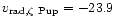 km s-1 and
 km s-1). The
differences in distance, 400 pc, and velocity,
40 km s-1, between Pup and Vel R2 yield a kinematic
age of 10 Myr. This is older than the expected life time of
Pup (van Rensbergen et al. 1996). Hence Vel R2 is
not likely to be the parent group.
km s-1). The
differences in distance, 400 pc, and velocity,
40 km s-1, between Pup and Vel R2 yield a kinematic
age of 10 Myr. This is older than the expected life time of
Pup (van Rensbergen et al. 1996). Hence Vel R2 is
not likely to be the parent group.
Our simulations also show that Vel OB2 is not the parent
association. The minimum separation between the association and the
runaway star is never smaller than 40 pc for reasonable association
distances. Since the association radius is, at maximum, 30 pc, we
conclude that Pup has never been inside the boundaries of
Vel OB2. We similarly rule out NGC 2391 as parent group.
The simulations for the Trumpler 10 group result in minimum
separations of  10 pc. The inferred kinematic age is 2 Myr
(Fig. 14). Ten parsec is comparable to the radius of
Tr 10, so we cannot unambiguously identify or exclude it as the parent
association. Furthermore, if Pup was in or near Tr 10, then
its current distance must be 250-350 pc (Fig. 14),
which is smaller than the canonical distance of 400 pc.
10 pc. The inferred kinematic age is 2 Myr
(Fig. 14). Ten parsec is comparable to the radius of
Tr 10, so we cannot unambiguously identify or exclude it as the parent
association. Furthermore, if Pup was in or near Tr 10, then
its current distance must be 250-350 pc (Fig. 14),
which is smaller than the canonical distance of 400 pc.
The Vela region contains many young stellar clusters, and suffers from
a fair amount of extinction (although Pup itself is almost
unreddened). It is therefore reasonable to assume that we have not yet
identified the parent group of Pup. Similar conclusions were
obtained by Vanbeveren et al. (1998), and Vanbeveren, De Loore
& Van Rensbergen (1998).
Cephei, Cepheus OB2 & Cepheus OB3 (star 22)
Cep (HIP 109556) was first classified as a runaway star by
Blaauw (Paper I). He noted that its position on the sky, the
direction of the proper motion, and the radial velocity were
consistent with an origin in the association Cep OB2 (see, e.g.,
Fig. 22 in de Zeeuw et al. 1999). This luminous
supergiant (O6I(n)f) is located below Cep OB2 (in Galactic
coordinates) and is traveling away from the Galactic plane and
Cep OB2. Several other stellar groups are located near Cep OB2, and of
these, Cep OB3 may also be a possible parent of Cep. We
consider both associations.
The data for Cep are given in Table 3. The
phase-space coordinates of Cep OB2 are adopted from de Zeeuw et al. (1999). Unfortunately, the Hipparcos data did not allow
these authors to obtain meaningful results for Cep OB3 which is at a
distance of 730 pc (Crawford & Barnes 1970). To
estimate the phase-space coordinates of Cep OB3 we used the mean
position, proper motion, and radial velocity for the Cep OB3 members
of Blaauw et al. (1959):
 ;
;
 mas yr-1;
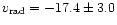 km s-1.
Cep. The simulations do result in small minimum separations
between the two, but only for
 pc
and a kinematic age of 9 Myr. These values do not agree with the
observed photometric (860 pc, Gies 1987) and trigonometric
distances (
505-95+153 pc, Hipparcos) of Cep, nor
with the age of the association (5-7 Myr, de Zeeuw et al. 1999). Moreover, Cep is a massive O supergiant, and its
lifetime cannot be more than a few million years.
pc
and a kinematic age of 9 Myr. These values do not agree with the
observed photometric (860 pc, Gies 1987) and trigonometric
distances (
505-95+153 pc, Hipparcos) of Cep, nor
with the age of the association (5-7 Myr, de Zeeuw et al. 1999). Moreover, Cep is a massive O supergiant, and its
lifetime cannot be more than a few million years.
When we run the simulations using Cep OB3 as the parent group we also
obtain minimum separations <10 pc. Figure 15 shows
that the expected distance of the runaway is now 450 pc and that
the kinematic age is 4.5 Myr. This is a little on the large side
for the nominal lifetime of a 40  star, but might not be
impossible. Cep OB3 consists of two subgroups with ages of 5.5
(subgroup b) and 7.5 Myr (subgroup a) (e.g., Jordi et al. 1996).
Considering the high helium abundance and large rotational velocity of
Cep, subgroup a is a likelier parent of the runaway
than subgroup b, since the age difference between the subgroup
and the runaway is 3 Myr for a. For subgroup b this is only 1 Myr,
leaving little time for binary evolution. We conclude that
Cep is likely to have become a runaway star as the result of
a supernova explosion in a binary system in subgroup a of
Cep OB3 4.5 Myr ago.
star, but might not be
impossible. Cep OB3 consists of two subgroups with ages of 5.5
(subgroup b) and 7.5 Myr (subgroup a) (e.g., Jordi et al. 1996).
Considering the high helium abundance and large rotational velocity of
Cep, subgroup a is a likelier parent of the runaway
than subgroup b, since the age difference between the subgroup
and the runaway is 3 Myr for a. For subgroup b this is only 1 Myr,
leaving little time for binary evolution. We conclude that
Cep is likely to have become a runaway star as the result of
a supernova explosion in a binary system in subgroup a of
Cep OB3 4.5 Myr ago.
© ESO 2001
![\begin{figure}\includegraphics[angle=0.0, width=8.8cm, clip=true, keepaspectratio=true]{10198_fig12.eps} \end{figure}](/articles/aa/full/2001/02/aa10198/img286.gif)
![\begin{figure}\includegraphics[angle=0.0, width=8.8cm, clip=true, keepaspectratio=true]{10198_fig13.eps} \end{figure}](/articles/aa/full/2001/02/aa10198/img292.gif)
![\begin{figure}\includegraphics[angle=0.0, width=8.8cm, clip=true, keepaspectratio=true]{10198_fig14.eps} \end{figure}](/articles/aa/full/2001/02/aa10198/img296.gif)
![\begin{figure}\includegraphics[angle=0.0, width=8.8cm, clip=true, keepaspectratio=true]{10198_fig15.eps} \end{figure}](/articles/aa/full/2001/02/aa10198/img298.gif)