

 Oph and PSR J1932+1059
Oph is a single O9.5Vnn star, and was first identified as a
runaway originating in the Sco OB2 association by Blaauw
(1952b). Based on its proper motion, which points away from
the association, its radial velocity, and the large space velocity
( 30 km s-1), Blaauw suggested that Oph might have
formed in the center of the association 3 Myr ago. Later
investigations (e.g., Paper I; Blaauw 1993;
van Rensbergen et al. 1996) showed that Oph either
became a runaway 1 Myr ago in the Upper Scorpius subgroup of
Sco OB2, or 2-3 Myr ago in the Upper Centaurus Lupus subgroup (cf. de Zeeuw et al. 1999).
30 km s-1), Blaauw suggested that Oph might have
formed in the center of the association 3 Myr ago. Later
investigations (e.g., Paper I; Blaauw 1993;
van Rensbergen et al. 1996) showed that Oph either
became a runaway 1 Myr ago in the Upper Scorpius subgroup of
Sco OB2, or 2-3 Myr ago in the Upper Centaurus Lupus subgroup (cf. de Zeeuw et al. 1999).
| HIP | HD | Name |  (
(
 ) ) |
 (
(
 ) ) |
 |
 |
 |
 |
 |
 |
SpT |
 |
 |
 |
N |
| [J1991.25] | [J1991.25] | [mas] | [mas yr-1] | [mas yr-1] | [km s-1] | [km s-1] | [km s-1] | [ ] ] |
[] |
[#] | |||||
| 3881 | 4727 |  And And |
0 49 48.83 | +41 04 44.2 |
 |
 |
 |
 |
32.1 | 80a | B5V+F8V | 6.9b | 1 | ||
14514 |
19374 | 53 Ari | 3 07 25.69 | +17 52 47.9 |
 |
 |
 |
 c c |
39.4 | 10d | B1.5V | 10.4 | 8.5 | 2 | |
|
18614 |
24912 |  Per Per |
3 58 57.90 | +35 47 27.7 |
 |
 |
 |
 e e |
64.9 | 204 | O7.5III | 33.8 | 33.5 | 0.18 | 3 |
| 22061 | 30112 | 4 44 42.16 | +0 34 05.4 |
 |
 |
 |
 |
86.5 | B2.5V | 8.6 | 7.5 | 4 | |||
|
24575 |
34078 | AE Aur | 5 16 18.15 | +34 18 44.0 |
 |
 |
 |
 |
113.3 | 25 | O9.5V | 15.9 | 21.1 | 0.09 | 5 |
| 26241 | 37043 |  Ori Ori |
5 35 25.98 | -05 54 35.6 |
 |
 |
 |
 f f |
8.0 | 71g | O9III+B1IIIh | 37.8i | 38.6 | ||
|
27204 |
38666 |  Col Col |
5 45 59.89 | -32 18 23.0 |
 |
 |
 |
 |
107.8 | 111 | O9.5V | 15.9 | 21.1 | 6 | |
| 29678 | 43112 | 6 15 08.46 | +13 51 03.9 |
 |
 |
 |
 |
63.0 | <25j | B1V | 11.5 | 12.0 | 7 | ||
| 38455 | 64503 | 7 52 38.65 | -38 51 46.2 |
 |
 |
 |
 |
41.4 | 212k | B2V | 9.4 | 8.0 | 8 | ||
| 38518 | 64760 | 7 53 18.16 | -48 06 10.6 |
 |
 |
 |
 |
31.1 | 220d | B0.5Iab | 25.0 | 35.1 | 9 | ||
| 39429 | 66811 | Pup |
8 03 35.07 | -40 00 11.5 |
 |
 |
 |
|
62.4 | 203 | O4I | 67.5 | 0.14l | 10 | |
| 42038 | 73105 | 8 34 09.60 | -53 04 17.5 |
 |
 |
 |
 |
31.3 | B3V | 7.9 | 7.0 | 11 | |||
| 46950 | 83058 | 9 34 08.80 | -51 15 19.0 |
 |
 |
 |
 |
32.1 | B1.5IV | 10.4m | 9.0 | 12 | |||
| 48943 | 86612 | 9 59 06.32 | -23 57 02.8 |
 |
 |
 |
 |
35.2 | 230d | B5V | 5.8 | 13 | |||
| 49934 | 88661 | 10 11 46.47 | -58 03 38.0 |
 |
 |
 |
 |
31.2 | 280d | B2IVnpe | 9.4m | 8.0 | 14 | ||
| 57669 | 102776 | 11 49 41.09 | -63 47 18.6 |
 |
 |
 |
 |
31.1 | 251n | B3V | 7.9 | 7.0 | 15 | ||
| 69491 | 124195 | 14 13 39.84 | -54 37 32.2 |
 |
 |
 |
 |
77.2 | B5V | 5.8 | 16 | ||||
| 76013 | 137387 |  Aps Aps |
15 31 30.82 | -73 23 22.4 |
 |
 |
 |
 |
69.0 | B1npe | 17 | ||||
|
81377 |
149757 | Oph |
16 37 09.53 | -10 34 01.7 |
 |
 |
 |
 |
23.5 | 348 | O9.5Vnn | 15.9 | 21.1 | 0.16 | 18 |
| 82868 | 152478 | 16 56 08.85 | -50 40 29.2 |
 |
 |
 |
 |
30.3 | B3Vnpe | 7.9 | 7.0 | 19 | |||
| 91599 | 172488 | 18 40 48.06 | -08 43 07.5 |
 |
 |
 |
 o o |
44.7 | B0.5V | 12.7 | 13.5 | 20 | |||
| 102274 | 197911 | 20 43 21.62 | +63 12 32.9 |
 |
 |
 |
 |
46.1 | B5 | 21 | |||||
|
109556 |
210839 |  Cep Cep |
22 11 30.58 | +59 24 52.3 |
 |
 |
 |
 |
74.0 | 214 | O6I | 40.0 | 64.6 | 0.17l | 22 |
| J0826+2637 | 8 26 51.31 | +26 37 25.6 |
 |
 |
 |
 |
 |
1.4p | 1 | ||||||
| J0835-4510 | 8 35 20.68 | -45 10 35.8 |
 |
 |
 |
0.09 | 0.01 | 1.4p | 2 | ||||||
| J1115+5030 | 11 15 38.35 | +50 30 13.6 |
 |
 |
 |
1.65 | 10.53 | 1.4p | 4 | ||||||
| J1932+1059 | 19 32 13.87 | +10 59 31.8 |
 |
 |
 |
0.22 | 3.10 | 1.4p | 8 | ||||||
| Gemingaq | 6 33 54.15 | +17 46 12.9 |  |
 |
 |
1.4p | 9 | ||||||||
from Slettebak et al.
(1997).
b: Total mass for the binary: B5V (
 )
+ F8V (
)
+ F8V (
 ).
c:
from Duflot et al. (1995). The
Hipparcos Input Catalogue radial velocity is incorrect.
d:
from Bernacca & Perinotto (1970).
e: We took the average
from Bohannan & Garmany
(1978), Garmany et al. (1980), Stone
(1982), and Gies & Bolton (1986).
f:
,
i.e., center of mass velocity, from Stickland et al. (1987).
g:
from Gies (1987).
h: Spectral type of the secondary of Ori from Stickland et
al.
i: Total mass for the binary Ori. The individual masses are
).
c:
from Duflot et al. (1995). The
Hipparcos Input Catalogue radial velocity is incorrect.
d:
from Bernacca & Perinotto (1970).
e: We took the average
from Bohannan & Garmany
(1978), Garmany et al. (1980), Stone
(1982), and Gies & Bolton (1986).
f:
,
i.e., center of mass velocity, from Stickland et al. (1987).
g:
from Gies (1987).
h: Spectral type of the secondary of Ori from Stickland et
al.
i: Total mass for the binary Ori. The individual masses are
 for the primary and
 for the secondary.
j:
from Morse et al. (1991).
k:
from Uesugi & Fukuda (1970).
l:
from Kudritzki & Hummer (1990).
m: Assumed mass for main-sequence star instead of luminosity class IV.
n:
from Brown & Verschueren (1997).
o:
from Gies & Bolton (1986).
p: We take the characteristic mass for a neutron star.
q: Position from Caraveo et al. (1998); parallax and
proper motion from Caraveo et al. (1996).
for the secondary.
j:
from Morse et al. (1991).
k:
from Uesugi & Fukuda (1970).
l:
from Kudritzki & Hummer (1990).
m: Assumed mass for main-sequence star instead of luminosity class IV.
n:
from Brown & Verschueren (1997).
o:
from Gies & Bolton (1986).
p: We take the characteristic mass for a neutron star.
q: Position from Caraveo et al. (1998); parallax and
proper motion from Caraveo et al. (1996).
If Oph is a BSS runaway, as suggested by its high helium
abundance (
 ,
corresponding to a mass fraction X =
0.577 of H) and large rotational velocity (348 km s-1), and if
the binary dissociated after the supernova explosion, we might be able
to identify the associated neutron star. None of the pulsars in
Fig. 2 was ever inside the Upper Centaurus Lupus
subgroup, but two could have originated from the Upper Scorpius
subgroup: PSR J1239+2453 and PSR J1932+1059
,
corresponding to a mass fraction X =
0.577 of H) and large rotational velocity (348 km s-1), and if
the binary dissociated after the supernova explosion, we might be able
to identify the associated neutron star. None of the pulsars in
Fig. 2 was ever inside the Upper Centaurus Lupus
subgroup, but two could have originated from the Upper Scorpius
subgroup: PSR J1239+2453 and PSR J1932+1059![[*]](/icons/foot_motif.gif) .
.
We first consider PSR J1239+2453. Its estimated distance is
560 pc. It passed within about 20 pc of the Upper Scorpius
region 1 Myr ago if and only if its (unknown) radial velocity is
large and positive (650 km s-1). With a tangential velocity
of 300 km s-1 (the proper motion is 114 mas yr-1), the
space velocity would have to be over 700 km s-1, which is
uncomfortably large. Furthermore, while 1 Myr is consistent with the
kinematic age for Oph, it is in conflict with the characteristic age
(
 Myr) of the pulsar. The latter is an uncertain age
indicator, but the difference between the two times is so large that
we consider it unlikely that PSR J1239+2453 was associated with
Oph. The pulsar is currently at a Galactic latitude of
Myr) of the pulsar. The latter is an uncertain age
indicator, but the difference between the two times is so large that
we consider it unlikely that PSR J1239+2453 was associated with
Oph. The pulsar is currently at a Galactic latitude of
 ,
i.e, at
,
i.e, at  pc above the Galactic plane. Typical
z-oscillation periods of pulsars are of order 100 Myr (e.g., Blaauw
& Ramachandran 1998), so that maximum height is reached
after
pc above the Galactic plane. Typical
z-oscillation periods of pulsars are of order 100 Myr (e.g., Blaauw
& Ramachandran 1998), so that maximum height is reached
after
 Myr. Taking the characteristic age at face value
suggests the pulsar is near its maximum height above the plane, had a
z-velocity of about 30 km s-1, and was not formed in the Upper
Scorpius association (age 5 Myr), but was born 25 Myr ago
in the Galactic plane outside the Solar neighbourhood.
Myr. Taking the characteristic age at face value
suggests the pulsar is near its maximum height above the plane, had a
z-velocity of about 30 km s-1, and was not formed in the Upper
Scorpius association (age 5 Myr), but was born 25 Myr ago
in the Galactic plane outside the Solar neighbourhood.
The path of the other pulsar, PSR J1932+1059 (earlier designation
PSR B1929+10), also passed the Upper Scorpius association some
1-2 Myr ago. The characteristic age of this pulsar is only
3 Myr, consistent with the kinematic age of Oph within
the uncertainties. The present z-velocity of the pulsar
(40 km s-1 away from the Galactic plane) predicts a maximum
distance away from the plane of 680 pc and
 Myr. The
pulsar is presently located only 10 pc below the plane. Since it
presumably formed close to the plane, this means that PSR J1932+1059
either formed recently or well over 50 Myr ago. Considering that both
the characteristic age and the typical pulsar ages (up to
50 Myr) (Blaauw & Ramachandran 1998) are significantly
smaller than 50 Myr, we conclude that the pulsar formed
recently. Upper Scorpius is the only site of star formation along the
past trajectory of the pulsar. We thus consider PSR J1932+1059 a
good candidate for the remnant of the supernova which caused the
runaway nature of Oph.
Myr. The
pulsar is presently located only 10 pc below the plane. Since it
presumably formed close to the plane, this means that PSR J1932+1059
either formed recently or well over 50 Myr ago. Considering that both
the characteristic age and the typical pulsar ages (up to
50 Myr) (Blaauw & Ramachandran 1998) are significantly
smaller than 50 Myr, we conclude that the pulsar formed
recently. Upper Scorpius is the only site of star formation along the
past trajectory of the pulsar. We thus consider PSR J1932+1059 a
good candidate for the remnant of the supernova which caused the
runaway nature of Oph.
Table 3 summarizes the data for Oph and PSR
J1932+1059. The radial velocity of the pulsar is unknown. The
pulsar proper motion listed by Taylor et al. (1993) was
calculated from timing measurements (Downs & Reichley 1983).
More accurate proper motions can be obtained from VLBI observations;
Campbell (1995) measured a provisional proper motion and
parallax of PSR J1932+1059 of
 mas yr-1 and
 mas, respectively, including a full covariance matrix.
These measurements are in good agreement with those of Taylor et al. (1993; see Table 3 and Fig. 5).
mas, respectively, including a full covariance matrix.
These measurements are in good agreement with those of Taylor et al. (1993; see Table 3 and Fig. 5).
Our hypothesis is that Oph and PSR J1932+1059 are the
remains of a binary system in Upper Scorpius which became unbound when
one of the components exploded as a supernova. Support for this
hypothesis would be to find both objects at the same position at the
same time in the past. Our approach is to calculate their past orbits
and simultaneously determine the separation between the two objects,
 ,
as a function of time,
,
as a function of time,  .
We define
as
.
We define
as
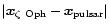 ,
where
,
where  is the position of object
j. We consider the time
is the position of object
j. We consider the time  at which
reaches a minimum to be the kinematic age. To take the errors in the
observables into account we calculate a large set of orbits, sampling
the parameter space defined by the errors. We use the Taylor et al. (1993) proper motion for the pulsar. The errors in the
positions of the runaway and the pulsar are negligible, and those in
the proper motions of the two objects and in the parallax of the
runaway are modest (
at which
reaches a minimum to be the kinematic age. To take the errors in the
observables into account we calculate a large set of orbits, sampling
the parameter space defined by the errors. We use the Taylor et al. (1993) proper motion for the pulsar. The errors in the
positions of the runaway and the pulsar are negligible, and those in
the proper motions of the two objects and in the parallax of the
runaway are modest ( %). However, the radial-velocity error of
Oph is considerable (5 km s-1). The distance to the
pulsar has a significant error, and its radial velocity is unknown.
Accordingly, we first determine the region in the
%). However, the radial-velocity error of
Oph is considerable (5 km s-1). The distance to the
pulsar has a significant error, and its radial velocity is unknown.
Accordingly, we first determine the region in the
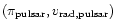 parameter space
for which the pulsar approaches the runaway when we retrace both
orbits. Sampling a grid in
while keeping the other parameters fixed,
we find that, for
parameter space
for which the pulsar approaches the runaway when we retrace both
orbits. Sampling a grid in
while keeping the other parameters fixed,
we find that, for
 mas and
 km s-1, the motions of the
pulsar and the runaway are such that their separation decreases as one
goes back in time.
km s-1, the motions of the
pulsar and the runaway are such that their separation decreases as one
goes back in time.
Adopting
 mas and
 km s-1, we calculate
three million orbits for the pulsar and the runaway. Considering that
the pulsar proper-motion errors might be underestimated (Campbell
et al. 1996; Hartman 1997), we increased them by a
factor of two. For each run we create a set of positions and
velocities for the runaway and the pulsar consistent with the
(modified 3
km s-1, we calculate
three million orbits for the pulsar and the runaway. Considering that
the pulsar proper-motion errors might be underestimated (Campbell
et al. 1996; Hartman 1997), we increased them by a
factor of two. For each run we create a set of positions and
velocities for the runaway and the pulsar consistent with the
(modified 3 )
errors on the observables. We also calculated the
orbit of the Upper Scorpius association back in time, using the mean
position and velocity derived by de Zeeuw et al. (1999,
their Table 2).
)
errors on the observables. We also calculated the
orbit of the Upper Scorpius association back in time, using the mean
position and velocity derived by de Zeeuw et al. (1999,
their Table 2).  of these simulations resulted in a minimum
separation between the pulsar and the runaway of less than 10 pc. In
of these simulations resulted in a minimum
separation between the pulsar and the runaway of less than 10 pc. In
 simulations the pulsar and the runaway had a minimum
separation less than 10 pc and were both situated within 10 pc of the
center of the association (the smallest minimum separation found was
0.35 pc). Thus, only a small fraction (0.14%) of the simulations is
consistent with the hypothesis that the pulsar and the runaway were
once, 1 Myr ago, close together within the Upper Scorpius
association. We now show that given the measurement uncertainties,
this low fraction is perfectly consistent with the two objects being
in one
location in the past.
simulations the pulsar and the runaway had a minimum
separation less than 10 pc and were both situated within 10 pc of the
center of the association (the smallest minimum separation found was
0.35 pc). Thus, only a small fraction (0.14%) of the simulations is
consistent with the hypothesis that the pulsar and the runaway were
once, 1 Myr ago, close together within the Upper Scorpius
association. We now show that given the measurement uncertainties,
this low fraction is perfectly consistent with the two objects being
in one
location in the past.
![\begin{figure}\includegraphics[angle=0.0, width=8.8cm, clip=true, keepaspectratio=true]{10198_fig03.eps} \end{figure}](/articles/aa/full/2001/02/aa10198/img232.gif) |
Figure 3:
Left: Distribution of minimum separations,
 ,
between Oph and
PSR J1932+1059. The solid line denotes the expected distribution of ,
between Oph and
PSR J1932+1059. The solid line denotes the expected distribution of
 ,
see Sect. 3.3. Right:
Distribution of the times
at which the minimum separation
was reached ,
see Sect. 3.3. Right:
Distribution of the times
at which the minimum separation
was reached |
Figure 3 shows the distribution of the minimum
separations,
,
and the kinematic ages,
,
of the
simulations mentioned above. The lack of
simulations which yield very small minimum absolute separations is due
to the three-dimensional nature of the problem. Consider the following
case: two objects are located at exactly the same position in space,
e.g., the binary containing the pulsar progenitor and the
runaway. However, the position measurement of each of these objects
has an associated typical error. The distribution of the absolute
separation between the objects, obtained from repeated measurements of
the positions of both objects, can be calculated analytically for a
Gaussian distribution of errors (see Appendix A). The solid line in
Fig. 3 shows the result for an adopted distance
measurement error of 2.5 pc, which agrees very well with our
simulations. The peculiar statistical properties of the sample of
successful simulations make it difficult to give a simple argument to
derive the value of 2.5 pc from the uncertainties in the kinematic
properties of the runaway and the pulsar. We suspect that the
disagreement between the solid line and histogram for separations
>6 pc is most likely due to a slight mismatch between the model and
the actual situation. Even so, Fig. 3 shows that due to
measurement errors, very few simulations will produce a small observed
minimum separation, even when the intrinsic separation is
zero.
Figure 4 shows the astrometric parameters of the pulsar
and the runaway at the start of the orbit integration, i.e., the
"present'' observables, for the simulations which result in a minimum
separation less than 10 pc occurring within Upper Scorpius. The
parameters of Oph show no correlations except between the
parallax and the radial velocity. This is expected due to the
degeneracy of these two quantities (a change in stellar distance,
depending on whether it increases or decreases the separation between
the star and the association, can be compensated for by a larger or
smaller radial velocity, respectively).
The parameters of the pulsar behave very differently. In addition to
the
vs.
correlation, we find that the
parallax is also correlated with both of the proper motion
components. As a result, the proper motion components are correlated
with each other. This means that only a subset of the full parameter
space defined by the six-dimensional error ellipsoid of the pulsar
fulfills the requirement that the pulsar and the runaway meet.
Furthermore, if they met, then we know the radial velocity of the
pulsar for each assumed value of its distance. A reliable distance
determination would thus yield an astrometric radial velocity. The
current best distance estimate of the pulsar derived from VLBI
measurements,
mas (Campbell 1995), predicts
a radial velocity of 100-200 km s-1. This radial velocity is
comparable to the tangential velocity: 100 km s-1 (for  mas).
mas).
The pulsar proper motions of the
successful simulations are
shown in Fig. 5, together with the proper-motion
measurements of Lyne et al. (1982) (dot-dash
line), Taylor et al. (1993) (solid line), and Campbell
(1995) (dashed line). The measurements show a reasonable
spread, reflecting the difficulty in obtaining pulsar proper motions,
but are consistent, within 3,
with the proper motions
predicted by the simulations.
The observed astrometric and spectroscopic parameters of Oph
and PSR J1932+1059 are consistent with the assumption that these
objects were very close together 1 Myr ago
(Fig. 3). At that time both were within the boundary
of Upper Scorpius (Fig. 6), which has a nuclear age of
5 Myr (de Geus et al. 1989).
Several characteristics of Oph and Upper Scorpius support the
interpretation that the runaway and the pulsar must have been produced
by the BSS. (i) The HI distribution in the direction of Upper Scorpius
shows an expanding shell-like structure. De Geus (1992)
argued that the energy output of the stellar winds of the massive
stars in Upper Scorpius is two orders of magnitudes too low to account
for the kinematics of the HI shell, and proposed that a supernova
explosion created the Upper Scorpius HI shell.
(ii) Based on the present-day mass function, de Geus showed that the
initial population of Upper Scorpius most likely contained one star or
binary more than the present population. The estimated mass of this
additional object is 40 .
Stars of this mass have
main-sequence lifetimes of 4 Myr, and end their lives in a
supernova explosion. Since the association has an age of 5 Myr,
the supernova explosion might have taken place 1 Myr ago.
(iii) The characteristics of Oph are indicative of close
binary evolution. The helium abundance is large, and the star has a
large rotational velocity (see Sect. 1).
These facts make it very likely that the same supernova event in Upper
Scorpius created PSR J1932+1059 and endowed Oph with its
large velocity.
![\begin{figure}\includegraphics[angle=0.0, width=8.8cm, clip=true, keepaspectratio=true]{10198_fig05.eps} \end{figure}](/articles/aa/full/2001/02/aa10198/img235.gif) |
Figure 5:
Proper motions of the pulsar PSR J1932+1059 at the
start of the
successful simulations (dots; see
Sect. 3.3), and the proper-motion measurements of the
pulsar: dot-dash line denotes Lyne et al. (1982), solid
line denotes Taylor et al. (1993), and the dashed line
denotes Campbell (1995). The contours indicate the 1, 2, and
3
confidence levels |
It could be that Oph and PSR J1932+1059 are not
related. This would imply that the pulsar originated in Upper Scorpius
1 Myr ago and that Oph obtained its large velocity
either in a separate BSS event in Upper Scorpius, or in Upper
Centaurus Lupus, 3 Myr ago, as suggested by van Rensbergen et al. (1996). In the latter case, it would also have to be
formed by the BSS, because of its high helium abundance, large
rotational velocity, and the 10 Myr difference between the age
of Upper Centaurus Lupus and the kinematic age of Oph
(Sect. 1). Given the small probability of finding a runaway
star and a pulsar with orbits that cross, and with both objects
at the point of intersection at the same time, we conclude
that Oph and PSR J1932+1059 were once part of the
same close binary in Upper Scorpius, providing the first direct
evidence for the generation of a single runaway star by the BSS.
![\begin{figure}\includegraphics[angle=0.0, width=8.8cm, clip=true, keepaspectratio=true]{10198_fig06.eps} \end{figure}](/articles/aa/full/2001/02/aa10198/img236.gif) |
Figure 6:
The orbits of Oph, PSR J1932+1059, and Upper
Scorpius. The present positions are denoted by a star for the
runaway, a filled circle for the pulsar, and by a filled square for
the association. The top panel shows the distance vs. Galactic longitude of the stars. The bottom panel shows the
orbits projected on the sky in Galactic coordinates. The small open
circles in the bottom panel denote the present-day positions of the
O, B, and A-type members of Upper Scorpius, taken from de Zeeuw et
al. (1999). The large circle denotes the position of the
association at the time of the supernova explosion, and has a 10 pc
radius. This figure assumes a set of space motions consistent with
the common origin hypothesis |
If Oph and PSR J1932+1059 were once part of a binary, then
we can derive a number of properties of this system. For example, the
true age of the pulsar must be the kinematic age of 1 Myr (as compared
to the characteristic age estimate of 3 Myr). It follows that, if no
glitches occurred, the pulsar had a period of 0.18 s at birth,
as compared to the current period of 0.22 s.
The velocity distribution of the pulsar population is much broader (a
few 100 km s-1) than that of the pulsar progenitors (a
few10 km s-1). The mechanism responsible for this
additional velocity (the "kick velocity''
100 km s-1) than that of the pulsar progenitors (a
few10 km s-1). The mechanism responsible for this
additional velocity (the "kick velocity''
 )
is not well understood (e.g., Lai 1999). The kick velocity
is most likely due to asymmetries in the core of a star just before,
or during, the supernova explosion.
)
is not well understood (e.g., Lai 1999). The kick velocity
is most likely due to asymmetries in the core of a star just before,
or during, the supernova explosion.
The simulations described in Sect. 3.3 provide the velocities
of the runaway star, the pulsar, and the association at the present
time. This makes it possible to determine
of the neutron star. For the
successful runs we find that the
average velocities with respect to Upper Scorpius are:
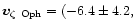
 ,
,
 km s-1 and
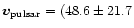 ,
,
 ,
,
 km s-1 in Galactic Cartesian coordinates (U,V,W).
To derive
we consider a binary with
components of mass M1 and M2 in a circular orbit, in which the
first component (star1) explodes as a supernova and creates a
neutron star. At the time of the explosion, star1 is the least
massive component of the binary, due to the prior mass transfer phase,
and is most likely a helium star. The rapidly expanding supernova
shell, with mass
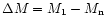 ,
where
,
where
 is the typical mass a neutron star, will quickly leave
the binary system. The shell has a net velocity equal to the orbital
velocity of star1 at the moment of the explosion (v1). A net
amount of momentum (
is the typical mass a neutron star, will quickly leave
the binary system. The shell has a net velocity equal to the orbital
velocity of star1 at the moment of the explosion (v1). A net
amount of momentum (
 )
is thus extracted from the
system and the binary reacts by moving in the opposite direction with
a velocity
)
is thus extracted from the
system and the binary reacts by moving in the opposite direction with
a velocity
 ,
the so-called
"recoil velocity''. The binary will remain bound after the explosion
because less than half of the total mass of the system is expelled
(M1 < M2; cf. Paper I). However, if the neutron
star receives a kick in the supernova explosion the binary might
dissociate, depending on the direction and magnitude of the kick
velocity. We simulate this by using a simple orbit integrator for two
bodies. We determine the semi-major axis and orbital velocities
assuming the binary has a circular orbit and masses
,
the so-called
"recoil velocity''. The binary will remain bound after the explosion
because less than half of the total mass of the system is expelled
(M1 < M2; cf. Paper I). However, if the neutron
star receives a kick in the supernova explosion the binary might
dissociate, depending on the direction and magnitude of the kick
velocity. We simulate this by using a simple orbit integrator for two
bodies. We determine the semi-major axis and orbital velocities
assuming the binary has a circular orbit and masses
 and
and
 ( Oph). We then change the mass of
star1 to
( Oph). We then change the mass of
star1 to  and add a kick-velocity to its orbital velocity. We
start the integration at this point and try to reproduce the observed
velocity of Oph, the pulsar, and the angle between the two
velocity vectors (35
and add a kick-velocity to its orbital velocity. We
start the integration at this point and try to reproduce the observed
velocity of Oph, the pulsar, and the angle between the two
velocity vectors (35 ). It turns out that a kick velocity of
order 350 km s-1 is needed in a direction almost opposite to the
orbital velocity of star1's prior to the explosion. This value is
in good agreement with the average pulsar kick velocity found by
Hartman (1997) and Hansen & Phinney (1997). The
current velocity of the pulsar, 240 km s-1, is more
than 100 km s-1 smaller than the kick it acquired. Our simulations
show that this deceleration is due to the gravitational pull of
Oph on the pulsar.
). It turns out that a kick velocity of
order 350 km s-1 is needed in a direction almost opposite to the
orbital velocity of star1's prior to the explosion. This value is
in good agreement with the average pulsar kick velocity found by
Hartman (1997) and Hansen & Phinney (1997). The
current velocity of the pulsar, 240 km s-1, is more
than 100 km s-1 smaller than the kick it acquired. Our simulations
show that this deceleration is due to the gravitational pull of
Oph on the pulsar.
The mass of Oph used in the above estimate is consistent with
the calibration of Schmidt-Kaler (1982). The more recent mass
calibration of Vanbeveren, Van Rensbergen & De Loore (1998)
suggests 21
(Table 3). This would increase the
inferred kick velocity to 400 km s-1.
© ESO 2001
 )
for the
pulsars, and the helium abundance (
)
for the
pulsars, and the helium abundance (
![\begin{figure}\includegraphics[angle=0.0, width=13.5cm, clip=true, keepaspectratio=true]{10198_fig04.eps} \end{figure}](/articles/aa/full/2001/02/aa10198/img233.gif)