

 Columbae
Blaauw & Morgan (1954) drew attention to the isolated stars
AE Aur (O9.5V) and Col (O9.5V/B0V), which move away from the
Orion star-forming region (e.g., McCaughrean & Burkert 2000)
in almost opposite directions with comparable space velocities of
 100 km s-1 (Fig. 11, stars 5 and 6 in
Table 3). Blaauw & Morgan suggested that "... the
stars were formed in the same physical process 2.6 million years ago
and that this took place in the neighborhood of the Orion Nebula.''
The past orbits of AE Aur and Col intersect on the sky near the
location of the massive highly-eccentric double-lined spectroscopic
binary
100 km s-1 (Fig. 11, stars 5 and 6 in
Table 3). Blaauw & Morgan suggested that "... the
stars were formed in the same physical process 2.6 million years ago
and that this took place in the neighborhood of the Orion Nebula.''
The past orbits of AE Aur and Col intersect on the sky near the
location of the massive highly-eccentric double-lined spectroscopic
binary  Ori (O9III+B1III, see Stickland et al. 1987). This led Gies & Bolton (1986) to suggest
that the two runaways resulted from a dynamical interaction also
involving Ori: "... Ori is the surviving binary
of a binary-binary
collision that ejected both AE Aur and Col.''
Ori (O9III+B1III, see Stickland et al. 1987). This led Gies & Bolton (1986) to suggest
that the two runaways resulted from a dynamical interaction also
involving Ori: "... Ori is the surviving binary
of a binary-binary
collision that ejected both AE Aur and Col.''
Table 3 lists the data for AE Aur, Col, and
Ori. We adopt Stickland's et al. (1987) radial
velocity for Ori (
 ). For the
radial-velocity errors for AE Aur and Col we use the largest
errors quoted in either the Catalogue de Vitesses Radiales Moyennes
Stellaires (Barbier-Brossat 1989), the Hipparcos Input
Catalogue (Turon et al. 1992), the Wilson-Evans-Batten
Catalogue (Duflot et al. 1995), or in the
SIMBAD database.
). For the
radial-velocity errors for AE Aur and Col we use the largest
errors quoted in either the Catalogue de Vitesses Radiales Moyennes
Stellaires (Barbier-Brossat 1989), the Hipparcos Input
Catalogue (Turon et al. 1992), the Wilson-Evans-Batten
Catalogue (Duflot et al. 1995), or in the
SIMBAD database.
To investigate the hypothesis that the three stellar systems, AE Aur,
Col, and Ori, were involved in a binary-binary
encounter, we retrace their orbits back in time to find the minimum
separation between them. As in Sect. 3, we explore the
parameter space determined by the errors of, and correlations between,
the observables.
Even with the unprecedented accuracy in trigonometric parallaxes
obtained by the Hipparcos satellite, the errors on the individual
distances are rather large:
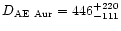 pc,
pc,
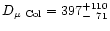 pc,
pc,
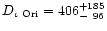 pc. We therefore first determine which
distances are most likely to agree with our hypothesis, and then study
the effect of the measurement errors on the other observables. For
each pair of stars, Fig. 7 shows contours of minimum
separation between the respective orbits as a function of their
present distances. The distances of the stars for which the orbits
have a small minimum separation are strongly correlated, i.e., if the
distance of star i increases that of star j also needs to increase
to obtain a small minimum separation. We therefore choose to show the
contours of constant minimum separation with respect to this
correlation. The vertical axes thus show offsets from the straight
line in the distance vs. distance plane defined by the equation in
the top right of each panel.
pc. We therefore first determine which
distances are most likely to agree with our hypothesis, and then study
the effect of the measurement errors on the other observables. For
each pair of stars, Fig. 7 shows contours of minimum
separation between the respective orbits as a function of their
present distances. The distances of the stars for which the orbits
have a small minimum separation are strongly correlated, i.e., if the
distance of star i increases that of star j also needs to increase
to obtain a small minimum separation. We therefore choose to show the
contours of constant minimum separation with respect to this
correlation. The vertical axes thus show offsets from the straight
line in the distance vs. distance plane defined by the equation in
the top right of each panel.
We start each simulation with a set of positions and velocities which
are in agreement with the observed parameters and their covariance
matrices (<3 ). Furthermore, we require the distances of the
stars to fall within the 10 pc minimum-separation contours of
Fig. 7. We then calculate the orbits of AE Aur,
Col, and Ori. We define the separation between the three
stellar systems,
). Furthermore, we require the distances of the
stars to fall within the 10 pc minimum-separation contours of
Fig. 7. We then calculate the orbits of AE Aur,
Col, and Ori. We define the separation between the three
stellar systems,
 ,
as the maximum deviation of
the objects from their average position, i.e.,
,
as the maximum deviation of
the objects from their average position, i.e.,
 for j = AE Aur,
Col, and Ori, where
for j = AE Aur,
Col, and Ori, where
 is the mean position and
  the position of star j. The time
  at which
reaches a minimum is considered to be the time
of the encounter, i.e., the kinematic age.
at which
reaches a minimum is considered to be the time
of the encounter, i.e., the kinematic age.
 pc with
  2-3 Myr. One of the
simulations resulted in a minimum separation of 0.019 pc which is
equal to
2-3 Myr. One of the
simulations resulted in a minimum separation of 0.019 pc which is
equal to  AU (Fig. 8). The small number of
simulations with small minimum separations is due to (i) the large
number of parameters involved (i.e., 18) and (ii) the
three-dimensional nature of the problem (cf. Sect. 3.3).
AU (Fig. 8). The small number of
simulations with small minimum separations is due to (i) the large
number of parameters involved (i.e., 18) and (ii) the
three-dimensional nature of the problem (cf. Sect. 3.3).
We have numerically determined the distribution of the minimum
separations
 of three points drawn from a
three-dimensional Gaussian error distribution (the analytic results of
Appendix A are valid only for two Gaussians). We randomly draw three
points from three spherical three-dimensional Gaussians (with standard
deviation )
and determine
.
The Gaussians have
the same mean positions. The resulting distribution for
of three points drawn from a
three-dimensional Gaussian error distribution (the analytic results of
Appendix A are valid only for two Gaussians). We randomly draw three
points from three spherical three-dimensional Gaussians (with standard
deviation )
and determine
.
The Gaussians have
the same mean positions. The resulting distribution for
 pc resembles the real one remarkably well (Fig. 8).
A distance uncertainty of four pc is consistent with the
2 km s-1 uncertainties in the velocities of the runaways
and Ori: 2 km s-1 over 2 Myr results in a
displacement of 4 pc. Thus, the data and their errors are
consistent with the hypothesis that 2.5 Myr ago AE Aur,
Col, and Ori were in the same small region of space.
pc resembles the real one remarkably well (Fig. 8).
A distance uncertainty of four pc is consistent with the
2 km s-1 uncertainties in the velocities of the runaways
and Ori: 2 km s-1 over 2 Myr results in a
displacement of 4 pc. Thus, the data and their errors are
consistent with the hypothesis that 2.5 Myr ago AE Aur,
Col, and Ori were in the same small region of space.
The nominal observed properties of the runaway stars AE Aur and
Col and the binary Ori are consistent with a common
origin 2.5 Myr ago. The most likely mechanism that created the
large velocities of the runaways and the high eccentricity of the
Ori binary is a binary-binary encounter, as suggested by Gies
& Bolton (1986). The normal rotational velocities of both
runaways (25 km s-1 and 111 km s-1) and the normal helium
abundance of AE Aur (Table 3, see Blaauw 1993,
Fig. 6) also suggest that these runaways were formed by the
dynamical ejection scenario. The helium abundance of Col is
unknown.
To find the cluster, or region of space, where the encounter between
AE Aur, Col, and Ori took place we assume that the
center of mass velocity of the three objects is identical to the mean
velocity
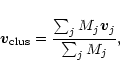
 of the parent cluster. Then
Col, and
Ori. For each star we
estimate the mass by interpolating the mass vs. spectral-type
calibration of Schmidt-Kaler (1982, Table 23). We obtain
 for AE Aur and Col, and
 and
and
 for the primary and secondary of Ori,
respectively (
for the primary and secondary of Ori,
respectively (
 for the binary system). We use the
cluster velocity (
)
and the mean position
of the three stellar systems at the moment of the encounter to
integrate the orbit of the ensemble of stars
Myr into the
future. The position and velocity at the end of this integration
should coincide with the present-day properties of the parent
cluster. We extend the Monte Carlo simulations described in
Sect. 4.3 to include the integration of the orbit of the
"cluster'' forward in time. Figures 9 and 10
summarize the results. Panel b of Fig. 10 shows
that the distances of the three stars and the predicted cluster
distance are tightly correlated (see also Fig. 7); all
distances increase when the cluster distance increases. A consequence
of this tight correlation is that as soon as the distance to one of
the objects is known, all other distances are fixed.
for the binary system). We use the
cluster velocity (
)
and the mean position
of the three stellar systems at the moment of the encounter to
integrate the orbit of the ensemble of stars
Myr into the
future. The position and velocity at the end of this integration
should coincide with the present-day properties of the parent
cluster. We extend the Monte Carlo simulations described in
Sect. 4.3 to include the integration of the orbit of the
"cluster'' forward in time. Figures 9 and 10
summarize the results. Panel b of Fig. 10 shows
that the distances of the three stars and the predicted cluster
distance are tightly correlated (see also Fig. 7); all
distances increase when the cluster distance increases. A consequence
of this tight correlation is that as soon as the distance to one of
the objects is known, all other distances are fixed.
![\begin{figure}\includegraphics[angle=0.0, width=\textwidth, clip=true, keepaspectratio=true]{10198_fig10.eps} \par\end{figure}](/articles/aa/full/2001/02/aa10198/img273.gif) |
Figure 10:
Properties of the parent cluster of the runaways AE Aur
and Col and the binary Ori. a) Proper
motions and their errors (grey circles) for all stars in the Tycho 2
Catalogue (filled triangles) within an area of 0
 4 by 0
4
centred on the Trapezium cluster. The large grey dot denotes the
average of the predicted cluster proper motion for the Monte Carlo
simulations. b) Distances of the runaway stars as a
function of the cluster distance in the Monte Carlo simulations. The
different grey scales are labeled in the panel. The filled circles and
their error bars denote the observed distances of the stars derived
from the Hipparcos parallaxes (prlx) and the open circles denote the
distances derived from photometry (phot) (Gies 1987). c)
the biases on the predicted cluster distance as discussed in
Sect. 4.5.1. The filled and open symbols denote the mean and
median, respectively, of the cluster distance distributions. The
circles include only the first bias, the aiming effect, and the
triangles include both the aiming effect and the ``incorrect''
Hipparcos parallax of
Col. For clarity, the circles and
triangles are displaced -3 and 3 pc, respectively. The dotted line
indicates the mean cluster distance based on the Monte Carlo
simulation 4 by 0
4
centred on the Trapezium cluster. The large grey dot denotes the
average of the predicted cluster proper motion for the Monte Carlo
simulations. b) Distances of the runaway stars as a
function of the cluster distance in the Monte Carlo simulations. The
different grey scales are labeled in the panel. The filled circles and
their error bars denote the observed distances of the stars derived
from the Hipparcos parallaxes (prlx) and the open circles denote the
distances derived from photometry (phot) (Gies 1987). c)
the biases on the predicted cluster distance as discussed in
Sect. 4.5.1. The filled and open symbols denote the mean and
median, respectively, of the cluster distance distributions. The
circles include only the first bias, the aiming effect, and the
triangles include both the aiming effect and the ``incorrect''
Hipparcos parallax of
Col. For clarity, the circles and
triangles are displaced -3 and 3 pc, respectively. The dotted line
indicates the mean cluster distance based on the Monte Carlo
simulation |
Two effects influence the mean cluster properties as predicted by the
Monte Carlo simulations. First, it is easier to hit a target from
close by than from far away, i.e., a larger range of velocities
(within the errors) is consistent with the encounter hypothesis when
the distance between the star and the encounter point is small (the
"aiming effect'').
We simulate this effect in the following way. We assume a range of
cluster distances, 350-500 pc. For each distance we use
Fig. 9 (the gray dots in the first row) to determine
the other phase-space coordinates of the parent (position on the sky,
proper motion, and radial velocity). With these "observables'' we
calculate the three-dimensional velocity of the cluster, corrected for
Solar motion, and determine its position at a time
(see first
row in Fig. 9) in the past. We neglect the variation
of the Galactic potential, ignore Galactic rotation, and use the
linear velocity, to speed up the calculations. This past position of
the cluster combined with the present three-dimensional positions of
AE Aur,
Col, and
Ori (based on the present positions on
the sky and the distances from Fig. 10 panel b)
gives the velocities of the three stellar systems today, using
as the time difference. These "observed'' properties are then
used as input for the Monte Carlo simulations described above to
investigate the influence of the aiming effect on the predicted
cluster distance. The circles in Fig. 10 panel c
display the bias in the cluster distance.
Secondly, the trigonometric distance of
Col,
pc, is smaller
(2)
than the observed photometric distance, 750 pc
(e.g., Gies 1987). The photometric distance is reliable
since Col is located in a region free of interstellar
absorption. This difference between the trigonometric distance and the
"real'' distance results in an additional bias towards smaller
distances for the stars and the cluster. In our Monte Carlo simulation
we draw the parallaxes, like all other observables, from a Gaussian
centred on the observed value and with a width equal to the observed
error. For the Hipparcos distance of Col this means that less
than 10% of the random realizations will be consistent with the
photometric distance![[*]](/icons/foot_motif.gif) . And because the distances of the
three stellar systems and the cluster are correlated (see
Fig. 10 panel b), the other stars also need to be
at smaller distances for the encounter to take place. This effect
will result in a mean cluster distance (the mean of the Monte Carlo
simulations) which is underestimated. We simulated this effect in a
similar manner as the aiming effect. The results on the mean cluster
distance in the Monte Carlo simulations, aiming effect and the
parallax of Col, are shown as the triangles in
Fig. 10 panel c.
. And because the distances of the
three stellar systems and the cluster are correlated (see
Fig. 10 panel b), the other stars also need to be
at smaller distances for the encounter to take place. This effect
will result in a mean cluster distance (the mean of the Monte Carlo
simulations) which is underestimated. We simulated this effect in a
similar manner as the aiming effect. The results on the mean cluster
distance in the Monte Carlo simulations, aiming effect and the
parallax of Col, are shown as the triangles in
Fig. 10 panel c.
Col, and Ori. The mean cluster distance from our
Monte Carlo simulations is 339 pc (right most panel in the second row
of Fig. 9). The cluster distance corrected for biases is
425-450 pc. Using this distance we determine the other
properties of the cluster (first row of Fig. 9), and
summarize them in Table 4. Figure 9
(right most panel of the first row) indicates that the encounter
happened 2.5 Myr ago; this obviously is a lower limit to the age of
the cluster. Figure 11 shows the region of the sky where the
parent cluster should be located: the Orion Nebula. The black contours
in the bottom panel show the distribution of  of the parent
cluster obtained from the Monte Carlo simulations.
of the parent
cluster obtained from the Monte Carlo simulations.
 |
||||
 |
425-450 | 425-450 | pc | |
 |
(84
0,-5
8) |
(83
9,-5
2) |
||
 |
(1.7,-0.8) | (1.7,-0.2) | mas yr-1 | |
|
(209
4,-19
4) |
(208
9,-19
2) |
||
 |
(1.3,1.2) | (0.9,1.4) | mas yr-1 | |
 |
28.3 | 27.6 | km s-1 |
2 Myr based on theoretical pre-main-sequence
tracks, and established that the first stars formed not more
than 5 Myr ago. Thus, the Trapezium is old enough to have
produced the runaways;
 stars pc-3 for the inner 0.1-0.3 pc (e.g.,
McCaughrean & Stauffer 1994; Hillenbrand & Hartmann
1998). These high stellar densities favor dynamical
interactions within the cluster core;
stars pc-3 for the inner 0.1-0.3 pc (e.g.,
McCaughrean & Stauffer 1994; Hillenbrand & Hartmann
1998). These high stellar densities favor dynamical
interactions within the cluster core;
 are in the centre. This concentration of massive
stars increases the probability for dynamical interactions
between these stars;
60% (Prosser
et al. 1994; Petr et al. 1998; Simon et al.
1999; Weigelt et al. 1999). This
means that enough binary systems are available for binary-binary
or binary-single-star interactions to become efficient in
expelling stars from the cluster.
are in the centre. This concentration of massive
stars increases the probability for dynamical interactions
between these stars;
60% (Prosser
et al. 1994; Petr et al. 1998; Simon et al.
1999; Weigelt et al. 1999). This
means that enough binary systems are available for binary-binary
or binary-single-star interactions to become efficient in
expelling stars from the cluster.
The mean astrometric properties and the radial velocity of the
Trapezium agree perfectly with those predicted by our Monte Carlo
simulation. The distance to the Trapezium is estimated to be
450-500 pc (Walker 1969; Warren & Hesser 1977a,
1977b, 1978; Genzel & Stutzki 1989); we
predict 425-450 pc. The observed radial velocity of the Trapezium is
23-25 km s-1 (Johnson 1965; Warren & Hesser
1977a, 1977b; Abt et al. 1991;
Morrell & Levato 1991); we predict 28 km s-1.
The absolute proper motion of the Trapezium is ill-determined, but is
known to be small (e.g., de Zeeuw et al. 1999). We
collected all stars, within a 0
4 by 0
4 region centred on the
Trapezium, based on the Tycho 2 Catalogue (Høg 2000), and
plot the proper motions in Fig. 10a. The proper
motions agree with the predicted cluster proper motion.
Table 4 shows that the predicted position on the sky of the
parent cluster does not fully agree with the position of the Trapezium
(see Fig. 11). Here it is important to remember that we
did not allow for any errors on the stellar masses used in
Eq. (2). We investigate the effect of mass errors by changing
the masses and running a new set of Monte Carlo simulations. We find
that (i) the results are insensitive to the mass of Ori: a
change as large as  5
5  produces no noticeable change in
the cluster properties, and (ii) the sky position of the parent
cluster and its proper motion depend on the mass ratio of AE Aur and
Col. Changing the mass of Col by
produces no noticeable change in
the cluster properties, and (ii) the sky position of the parent
cluster and its proper motion depend on the mass ratio of AE Aur and
Col. Changing the mass of Col by
 or the mass
of AE Aur by
or the mass
of AE Aur by
 shifts the predicted sky position of the
parent cluster to that of the Trapezium cluster
(Fig. 11). A mass change in the other direction,
for Col and
for AE Aur, creates a
similar shift in the opposite direction. There are indications from
spectral-type determinations that Col is indeed slightly less
massive than AE Aur. Most spectral-type determinations of Col
give O9.5V; however, Blaauw & Morgan (1954) and Paper I
quote B0V and Houk (1982) quotes B1IV/V.
shifts the predicted sky position of the
parent cluster to that of the Trapezium cluster
(Fig. 11). A mass change in the other direction,
for Col and
for AE Aur, creates a
similar shift in the opposite direction. There are indications from
spectral-type determinations that Col is indeed slightly less
massive than AE Aur. Most spectral-type determinations of Col
give O9.5V; however, Blaauw & Morgan (1954) and Paper I
quote B0V and Houk (1982) quotes B1IV/V.
We note that the calibration of Vanbeveren et al. (1998) gives a mass of 38.6
for Ori,
similar to that found with the Schmidt-Kaler calibration, but
increases the masses of AE Aur and Col to 21.1 .
This
does not change our results, as it is the ratio of the runaway masses
that determines the predicted current position of the parent cluster.
In summary, the position, distance, proper motion, and radial velocity
of the Trapezium cluster fall within the range predicted by our Monte
Carlo simulations. Furthermore, the youth, extreme stellar density,
mass segregation, and the high binary fraction make it the best
candidate for the parent cluster of the runaways AE Aur and Col
and the binary Ori. Finally, it is the only likely candidate
in this region of the sky.
© ESO 2001
![\begin{figure}\includegraphics[angle=0.0, width=8.8cm, clip=true, keepaspectratio=true]{10198_fig07.eps} \end{figure}](/articles/aa/full/2001/02/aa10198/img252.gif)
![\begin{figure}\includegraphics[angle=0.0, width=8.8cm, clip=true, keepaspectratio=true]{10198_fig08.eps} \end{figure}](/articles/aa/full/2001/02/aa10198/img262.gif)
 ,
of
,
of
 Monte Carlo simulations of the stellar encounter.
Right: The
Monte Carlo simulations of the stellar encounter.
Right: The
 pc (dotted
line), and
pc (dotted
line), and
 pc (dashed line). The
![\begin{figure}\includegraphics[angle=0.0, width=\textwidth, clip=true, keepaspectratio=true]{10198_fig09.eps} \end{figure}](/articles/aa/full/2001/02/aa10198/img267.gif)
 pc,
pc,
 pc, and
 pc
pc![\begin{figure}\includegraphics[angle=0.0, width=15.7cm, clip=true, keepaspectratio=true]{10198_fig11.eps}\vskip -0.5truecm
\end{figure}](/articles/aa/full/2001/02/aa10198/img285.gif)
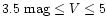 mag (cf. Fig. 1 in
Blaauw & Morgan 1954). The Orion constellation is indicated for
reference. Bottom: The predicted position of the parent
cluster (black contours) together with all stars in the Tycho
Catalogue (ESA 1997) in the field down to V = 12.4 mag. The size of
the symbols scales with magnitude; the brightest star is
mag (cf. Fig. 1 in
Blaauw & Morgan 1954). The Orion constellation is indicated for
reference. Bottom: The predicted position of the parent
cluster (black contours) together with all stars in the Tycho
Catalogue (ESA 1997) in the field down to V = 12.4 mag. The size of
the symbols scales with magnitude; the brightest star is