

The parent group is known for about a dozen "classical'' runaway stars
(Paper I; Blaauw 1993). The Hipparcos Catalogue
contains these stars, as well as many additional O and B stars which
were known in 1982 to have large radial velocities, including 153 of
the 162 runaway candidates in Hipparcos Proposal 141![[*]](/icons/foot_motif.gif) (de Zeeuw et al. 1999). Many of
these objects are located beyond
(de Zeeuw et al. 1999). Many of
these objects are located beyond  700 pc, where the Hipparcos
parallax measurement is of modest quality. For this reason we
restricted ourselves to a sample of nearby runaway stars, and added to
this the (few) nearby pulsars with measured proper motions.
700 pc, where the Hipparcos
parallax measurement is of modest quality. For this reason we
restricted ourselves to a sample of nearby runaway stars, and added to
this the (few) nearby pulsars with measured proper motions.
![\begin{figure}\includegraphics[angle=0.0, width=12.2cm, clip=true, keepaspectratio=true]{10198_fig01.eps} \end{figure}](/articles/aa/full/2001/02/aa10198/img35.gif) |
Figure 1:
a) Histogram of the space motions of the
sample of runaway stars defined in Sect. 2.1.
b) Distribution of pulsars from the Taylor et al. (1993)
catalogue with measured proper motions. The light grey histogram
shows all pulsars within 2 kpc and the dark grey histogram shows the
pulsar with accurate proper motions (
 ). The
latter, for D < 1 kpc, is the pulsar sample defined in
Sect. 2.1 ). The
latter, for D < 1 kpc, is the pulsar sample defined in
Sect. 2.1 |
We started with all 1118 O to B5 stars in the Hipparcos Catalogue
which have radial velocities listed in the Hipparcos Input Catalogue
(Turon et al. 1992). Next we only considered those stars
which have significant parallaxes (
 mas) and
proper motions (
mas) and
proper motions (
 ), and space velocities
larger than 30 km s-1 with respect to the standard of rest of the
runaway. For the last requirement we corrected the runaway velocity
for Solar motion and Galactic rotation (Dehnen & Binney
1997). The somewhat arbitrary choice of the velocity limit of
30 km s-1 minimizes the contamination of the sample by normal O
and B stars (Sect. 1). These criteria yield 54 runaway
candidates (five of which are classical runaways). This new sample does not
contain the nearby runaways
), and space velocities
larger than 30 km s-1 with respect to the standard of rest of the
runaway. For the last requirement we corrected the runaway velocity
for Solar motion and Galactic rotation (Dehnen & Binney
1997). The somewhat arbitrary choice of the velocity limit of
30 km s-1 minimizes the contamination of the sample by normal O
and B stars (Sect. 1). These criteria yield 54 runaway
candidates (five of which are classical runaways). This new sample does not
contain the nearby runaways  Oph and
  Per. The former is
not selected because its space velocity is smaller than 30 km s-1(although its velocity relative to its parent group Sco OB2 is larger,
cf. Sect. 3) and the latter is not selected because
Per. The former is
not selected because its space velocity is smaller than 30 km s-1(although its velocity relative to its parent group Sco OB2 is larger,
cf. Sect. 3) and the latter is not selected because
 .
However, since the runaway nature of these
two stars is well established (e.g., Paper I) we
included them in our sample, bringing the total to 56. The Hipparcos
numbers and space velocities of these 56 stars are listed in
Table 1. Panel a of Fig. 1
shows the histogram of the derived space velocities.
.
However, since the runaway nature of these
two stars is well established (e.g., Paper I) we
included them in our sample, bringing the total to 56. The Hipparcos
numbers and space velocities of these 56 stars are listed in
Table 1. Panel a of Fig. 1
shows the histogram of the derived space velocities.
We selected a sample of nearby pulsars from the Taylor, Manchester &
Lyne (1993) catalogue, as updated
on http://pulsar.princeton.edu/.
It contains 94 pulsars with known
proper motions and distances. Only seven of these meet our distance
(
 kpc) and proper motion (
)
constraints (see panel b of Fig. 1). Most
pulsar distances are derived from the dispersion measure. These
distances are unreliable, especially for nearby objects, since they
depend on the local properties of the ISM.
For one nearby pulsar, PSR J0953+0755, high precision VLBA
measurements became available recently (Brisken et al. 2000). We added this pulsar to our sample.
The eight pulsars are listed in Table 1, together with
Geminga, a nearby neutron star which is not a pulsar, for which an
accurate proper motion is known (Caraveo et al. 1996).
kpc) and proper motion (
)
constraints (see panel b of Fig. 1). Most
pulsar distances are derived from the dispersion measure. These
distances are unreliable, especially for nearby objects, since they
depend on the local properties of the ISM.
For one nearby pulsar, PSR J0953+0755, high precision VLBA
measurements became available recently (Brisken et al. 2000). We added this pulsar to our sample.
The eight pulsars are listed in Table 1, together with
Geminga, a nearby neutron star which is not a pulsar, for which an
accurate proper motion is known (Caraveo et al. 1996).
| Name |  |
b | HIP | HIC | D |
 |
 |
 |
Cand. |
| [deg.] | [deg.] | [#] | [#] | [pc] | [mas yr-1] | [mas yr-1] | [km s-1] | ||
| Collinder 359 | 29.75 | 12.54 | 10 | - | N* | ||||
| IC 4665 | 30.61 | 17.08 | 13 | 5 |  |
 |
 |
 |
Y |
| Stephenson 1 | 66.85 | 15.51 | 0 | - | N | ||||
| Roslund 5 | 71.40 | 0.25 | 13 | - | N* | ||||
| Stock 7 | 134.68 | 0.04 | 3 | - | N* | ||||
 Persei Persei |
Central part of the Per OB3 association, contained in the list of de Zeeuw et al. | ||||||||
| IC 0348 | Associated with Per OB2 | ||||||||
| Collinder 69 | 195.05 | -12.00 | 6 | - |  Ori cluster Ori cluster |
N* | |||
| NGC 1976 | Trapezium cluster: associated with Ori OB1 | ||||||||
| NGC 2232 | 214.36 | -47.65 | 10 | 3 |  |
 |
 |
 |
? |
| Collinder 121 | Contained in list of nearby associations of de Zeeuw et al. | ||||||||
| Collinder 140 | 245.18 | -7.87 | 14 | 4 |  |
 |
 |
 |
Y |
| Collinder 135 | 248.76 | -11.20 | 19 | 4 |  |
 |
 |
 |
Y |
| Pismis 5 | 259.39 | 0.86 | 0 | - | N | ||||
| Pismis 4 | 262.74 | -2.37 | 4 | 0 | N | ||||
| Trumpler 10 | Contained in list of nearby associations of de Zeeuw et al. | ||||||||
| IC 2391 | 270.36 | -6.88 | 24 | 13 |  |
 |
 |
 |
Y |
| vdB-Hagen 99 | 286.56 | -0.63 | 7 | 2 |  |
 |
 |
 |
? |
| IC 2602 | 289.60 | -4.90 | 25 | 8 |  |
 |
 |
 |
Y |
Our sample of nearby runaway stars and compact objects is severely
incomplete. The Hipparcos Catalogue is complete to V = 7.3-9 mag,
with the limit depending on Galactic latitude and spectral type (2163
of the 3622 O to B5 stars have V > 7.3 mag). The data available for
the O and B stars is inhomogeneous and incomplete, e.g., less than a
third of the O to B5 stars in the Catalog has a measured radial
velocity. We have excluded those with large
but
insignificant proper motions, as their retraced orbits are uncertain.
The beamed nature of the radio emission from pulsars hides many from
observation, and not all of those that do radiate in our direction
have been found. Of these, only a few have an accurately measured
proper motion and a reliable distance.
We adopt the positions and mean space motions of the OB associations
within 700 pc of the Sun as derived by de Zeeuw et al. (1999) from Hipparcos measurements. For the open clusters
we compiled a list from the WEBDA
catalogue (http://obswww.unige.ch/webda/), and consider only those which are
young ( Myr) and with distances less than 700 pc as likely
parent groups. The age requirement is comparable to the age of the
oldest runaways we consider here (B5V). Typical pulsar ages are less
than 50 Myr (e.g., Blaauw & Ramachandran 1998). This
selection yields nineteen open clusters (see
Table 2), of which five are already covered in the
study of the nearby associations by de Zeeuw et al. (1999).
To obtain the space motion of these clusters we use the WEBDA
member stars listed in the Hipparcos Catalogue to obtain reliable
astrometry, and those in the Hipparcos Input Catalogue to obtain the
radial velocity. In this way we are able to construct a more or less
reliable space motion for seven of the fourteen remaining open
clusters (those labeled "Y'' or "?'' in Table 2
which summarizes the results).
Myr) and with distances less than 700 pc as likely
parent groups. The age requirement is comparable to the age of the
oldest runaways we consider here (B5V). Typical pulsar ages are less
than 50 Myr (e.g., Blaauw & Ramachandran 1998). This
selection yields nineteen open clusters (see
Table 2), of which five are already covered in the
study of the nearby associations by de Zeeuw et al. (1999).
To obtain the space motion of these clusters we use the WEBDA
member stars listed in the Hipparcos Catalogue to obtain reliable
astrometry, and those in the Hipparcos Input Catalogue to obtain the
radial velocity. In this way we are able to construct a more or less
reliable space motion for seven of the fourteen remaining open
clusters (those labeled "Y'' or "?'' in Table 2
which summarizes the results).
Traditionally, the orbits of runaway stars have been traced back in
time using straight lines through space. This is sufficiently accurate
for identification of the parent group for times up to a few Myr and
distances less than a few hundred pc. To make sure we include the
effect of the Galactic potential, we use a fourth-order Runge-Kutta
numerical integration method, with a fixed time-step of  yr,
to calculate the orbit. The Galactic potential we use consists of (i)
a logarithmic potential for the halo, (ii) a Miyamoto-Nagai potential
for the disk, and (iii) a Plummer potential for the bulge of the
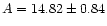
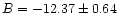
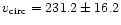
Galaxy. The potential predicts Oort constants A =
13.5 km s-1 kpc-1 and B = -12.4 km s-1 kpc-1and a circular velocity
yr,
to calculate the orbit. The Galactic potential we use consists of (i)
a logarithmic potential for the halo, (ii) a Miyamoto-Nagai potential
for the disk, and (iii) a Plummer potential for the bulge of the
Galaxy. The potential predicts Oort constants A =
13.5 km s-1 kpc-1 and B = -12.4 km s-1 kpc-1and a circular velocity
 km s-1 at
R0 = 8.5 kpc. These values agree with those which Feast &
Whitelock (1997) obtained using Hipparcos data:
km s-1 at
R0 = 8.5 kpc. These values agree with those which Feast &
Whitelock (1997) obtained using Hipparcos data:
 km s-1 kpc-1,
 km s-1 kpc-1,
 km s-1 at R0 = 8.5 kpc. Since the volume
covered in the orbit integration is typically a few hundred pc, and
the time of the integration is typically less than 10 Myr,
perturbations of the orbits caused by small-scale structure in the
disk are negligible.
km s-1 at R0 = 8.5 kpc. Since the volume
covered in the orbit integration is typically a few hundred pc, and
the time of the integration is typically less than 10 Myr,
perturbations of the orbits caused by small-scale structure in the
disk are negligible.
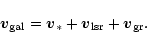
Before integrating the orbit, we correct the observed velocity
 for (i) the Solar motion with respect to the Local
Standard of Rest,
for (i) the Solar motion with respect to the Local
Standard of Rest,
 (Dehnen & Binney
1997), and (ii) the Galactic rotational velocity of the Local
Standard of Rest,
(Dehnen & Binney
1997), and (ii) the Galactic rotational velocity of the Local
Standard of Rest,
 (Binney & Tremaine
1987, p. 14). The stellar velocity
(Binney & Tremaine
1987, p. 14). The stellar velocity
 relative to the Galactic reference frame
is then given by
relative to the Galactic reference frame
is then given by
 |
(1) |
 ,
where
,
where  is
the trigonometric parallax. Since we use the individual parallax, we
cannot correct this distance for possible biases (e.g., Smith &
Eichhorn 1996).
is
the trigonometric parallax. Since we use the individual parallax, we
cannot correct this distance for possible biases (e.g., Smith &
Eichhorn 1996).
We calculate the past orbit of each of the 56 runaway stars listed in
Table 1 for 10 Myr. We do this
times for each
star, in order to sample the error ellipsoid of the measured
parameters, defined by the covariance matrix of the Hipparcos
astrometry and the error in the radial velocity measurement.
Retracing the orbit of a pulsar is more difficult, because the radial
velocity is unknown. We therefore cover a range of radial velocities
of
 km s-1 in the orbit
integrations for the pulsars. Figure 2 shows the
positions of the runaways and pulsars on the sky, together with their
orbits, retraced back for only 2 Myr so as not to confuse the diagram.
Three orbits are shown for each pulsar: for
km s-1 in the orbit
integrations for the pulsars. Figure 2 shows the
positions of the runaways and pulsars on the sky, together with their
orbits, retraced back for only 2 Myr so as not to confuse the diagram.
Three orbits are shown for each pulsar: for
 km s-1 (filled square),
 km s-1 (open square), and
 km s-1 (open star).
We also retrace the orbits of the set of nearby OB associations and open clusters defined in Sect. 2.2. These groups have typical linear dimensions of 10-30 pc. We consider a group to be a possible site of origin for a runaway or pulsar if the minimum separation between the runaway/pulsar and the group was less than 10 pc at some time in the past 10 Myr. With this definition, we find a parent group for 21 of the 56 runaways. These stars are indicated by the filled circles in Fig. 2, and include the seven classical runaways in the sample. We discuss them in detail in Sects. 3-6 below. Six of the nine neutron stars possibly traversed one of the nearby stellar groups; these are PSR J0826+2637, PSR J0835-4510, PSR J1115+5030, PSR J1239+2453, PSR J1932+1059, and Geminga (objects 1, 2, 4, 6, 8, and 9 in Fig. 2). We discuss them in Sects. 3 and 6, and identify the parent group for four of them. Table 3 summarizes the data for the 22 runaways, four pulsars, and Geminga. The pulsars and runaways for which we cannot identify a parent group are discussed further in Sect. 7.
![\begin{figure}\includegraphics[angle=0.0, width=14cm, clip=true, keepaspectratio=true]{10198_fig02.eps} \vskip -5mm
\end{figure}](/articles/aa/full/2001/02/aa10198/img88.gif) |
Figure 2:
Top: Sample of runaway stars defined in
Sect. 2.1, in Galactic cordinates. The open circles
denote the present positions of the runaways, and the arcs show
their past orbits, calculated for 2 Myr. The filled circles are the
runaways for which we can identify the parent association. The
numbers refer to the entries in Table 3. The asterisks
indicate two additional runaways (72 Col, HIP 94899 [left most of
the two asterisks]) discussed in Sect. 7. The grey
fields outline the nearby OB associations (de Zeeuw et al. 1999). From left to right and from top to bottom: Per OB3
( Persei), Per OB2, Cep OB3, Cep OB2, Cep OB6, Lac OB1,
Upper Scorpius, Upper Centaurus Lupus, Lower Centaurus Crux, Tr 10,
Vel OB2, Col 121, and Ori OB1. The open clusters are identified by
the filled light-grey circles for those with reliable positions and
velocities, and by the open, crossed circles for the remaining
clusters. The positions and designations of the clusters can be
found in Table 2. Bottom: Pulsar sample defined in
Sect. 2.1, in Galactic coordinates. The filled circles
indicate the present positions of the pulsars. The past orbits of
pulsars, calculated for 2 Myr, are shown for three different assumed
radial velocities: 0 km s-1 (filled squares),
200 km s-1 (open squares), -200 km s-1 (open stars).
The pulsars are labeled 1 through 8; 1: J0826+2637, 2:
J0835-4510 (Vela pulsar), 3: J0953+0755, 4: J1115+5030, 5:
J1136+1551, 6: J1239+2453, 7: J1456-6843, 8:
J1932+1059. Number 9 is the neutron star Geminga. The associations
and open clusters typically move comparatively little in 2 Myr |
© ESO 2001
 ,
the number of member stars contained in the
Hipparcos (HIP) and Hipparcos Input Catalogues (HIC), its distance,
proper motion, and radial velocity as obtained from the Hipparcos
data (D,
,
the number of member stars contained in the
Hipparcos (HIP) and Hipparcos Input Catalogues (HIC), its distance,
proper motion, and radial velocity as obtained from the Hipparcos
data (D,
![$[\mu_{\ell\ast},\mu_b]$](/articles/aa/full/2001/02/aa10198/img41.gif) ,
,