![[*]](/icons/foot_motif.gif)
A&A 447, 453-463 (2006)
DOI: 10.1051/0004-6361:20053418
A. Curir1 - P. Mazzei2 - G. Murante1
1 - INAF - Osservatorio Astronomico di Torino. Strada Osservatorio 20,
10025 Pino Torinese (Torino), Italy
2 -
INAF - Osservatorio Astronomico di Padova. Vicolo Osservatorio 5, 35122
Padova, Italy
Received 12 May 2005 / Accepted 30 September 2005
Abstract
Aims. We investigate the growth of bar instability in stellar disks embedded in a dark matter halo evolving in a fully consistent cosmological framework.
Methods. We perform seven cosmological simulations to emphasise the role of both the disk-to-halo mass ratio and of the Toomre parameter, Q, on the evolution of the disk.We also compare our fully cosmological cases with corresponding isolated simulations where the same halo is extracted from the cosmological scenario and evolved in physical coordinates.
Results. A long living bar, lasting about 10 Gyr, appears in all our simulations. In particular, disks expected to be stable according to classical criteria form weak bars. We argue that such a result is due to the dynamical properties of our cosmological halo which is far from stability and isotropy, typical of the classical halos used in the literature; it is dynamically active, has substructures and undergoes infall.
Conclusions. At least for mild self-gravitating disks, the study of the bar instability using isolated isotropic halos in gravitational equilibrium can lead to misleading results. Furthermore, the cosmological framework is needed to quantitatively investigate such an instability.
Key words: galaxies: evolution - galaxies: kinematics and dynamics - galaxies: spirals - galaxies: halos
Several works on bar instability in stellar disks have been reported using N-body spherical halos (Mayer & Wadsley 2004; Athanassoula et al. 1987; Patsis & Athanassoula 2000; Sellwood 1981; Debattista & Sellwood 2000).
Curir & Mazzei (1999) were the first to emphasise the role of both the geometry and the dynamical state of a live dark matter (DM) halo in enhancing the bar formation. Progressive efforts to improve models of the halo have been made (Athanassoula & Misiriotis 2002; Mazzei & Curir 2001), taking into account the information coming from the cosmological hierarchical clustering scenario of structure formation about density distribution and concentration of DM halos. In the meanwhile, the ever-growing available computing power has made it possible to start simulations of formation and evolution of galaxies in a fully cosmological context. The first works devoted to disk galaxies in such a scenario (Abadi et al. 2003; Governato et al. 2004) have shown that is very difficult to obtain pure disk galaxies mainly because of the high angular momentum loss of the gaseous component. Even with a careful choice of the hosting DM halo, the simulated galaxies appear to have over-massive bulges compared to their disks. Robertson et al. (2004) claim to have overcome most problems, however the bar instability has not yet been analysed in a cosmological framework. Furthermore, the high CPU cost of such simulations does not yet allow us to explore the role of several parameters related to the phenomenological treatment of the star formation rate and feedback, and the morphologies of the generated galaxies (Mazzei & Curir 2003; Mazzei 2003).
In this work we present the first attempt to analyse the growth of bar instability in a fully consistent cosmological scenario. We embed a pure stellar disk inside a cosmological halo selected in a suitable slice of the Universe and follow its evolution inside a cosmological framework. We explore how the bar instability behaves and the role of such a scenario. In particular we want to address, besides the role played by the disk-to-halo mass ratio, that of the dynamical state of such halo as given by its substructure and infall, or more generally by its evolution. Our model cannot be viewed as a general, "all-purpose'' galaxy evolution model, since the gradual formation and growth of the stellar disk is a fundamental component of the galaxy evolution itself. However our approach allows us to vary parameters like the disk-to-halo mass ratio and the disk temperature, as given by the Q parameter, to analyse the growth of the bar instability and its dependence on such parameters for the first time in a self-consistent cosmological framework. We analyse further the influence of the cosmological environment by comparing these results with those in an isolated scenario with the same halo.
The plan of the paper is the following: Sects. 2 and 3 describe technical details, in particular the recipe for the initial disk+halo system and our framework, focusing on the cosmological evolution and on the properties of the halo. In Sect. 4 we present the whole set of our disk+halo simulations; in Sect. 5 we describe our results in the cosmological context and the comparison with isolated runs. In Sect. 6 we give our discussion and in Sect. 7 our conclusions. In the Appendix we analyse the robustness of our results, checking for particle resolution and softening length effects.
 CDM cosmological model:
 = 0.3,
 = 0.7,
 ,
h = 0.7, where
is
the total matter of the Universe,
the
cosmological constant,
,
h = 0.7, where
is
the total matter of the Universe,
the
cosmological constant,  the normalisation of the power spectrum,
and h the value of the Hubble constant in units of
100 h-1 km s-1 Mpc-1.
The
box size of our simulation is
25 h-1 Mpc, which allows us
an adequate cosmological tidal field and no boundary effects
on our disk. The initial redshift is 20.
We employ the parallel N-body treecode GADGET (Springel et al. 2001).
Our initial condition code has been adapted from the setup code of ART
(Kravtsov et al. 1997; Kravtsov 1999); (courtesy of A. Klypin).
the normalisation of the power spectrum,
and h the value of the Hubble constant in units of
100 h-1 km s-1 Mpc-1.
The
box size of our simulation is
25 h-1 Mpc, which allows us
an adequate cosmological tidal field and no boundary effects
on our disk. The initial redshift is 20.
We employ the parallel N-body treecode GADGET (Springel et al. 2001).
Our initial condition code has been adapted from the setup code of ART
(Kravtsov et al. 1997; Kravtsov 1999); (courtesy of A. Klypin).
From this simulation
we identify the DM halos at z = 0 in the mass range
0.5-5 10
11 h -1
10
11 h -1
 with a standard
friends-of-friends algorithm.
We discard the halos belonging or near
overdense regions (see Sect. 3). Then we follow back
the simulation and discard those that undergo significant
mergers after a redshift of
with a standard
friends-of-friends algorithm.
We discard the halos belonging or near
overdense regions (see Sect. 3). Then we follow back
the simulation and discard those that undergo significant
mergers after a redshift of  5.
We select one suitable DM halo with a mass
5.
We select one suitable DM halo with a mass
 1011
1011
 (at z = 0). We
resample it with the multi-mass technique
described in Klypin et al. (2001). The particles of the DM halo, and those
belonging to a sphere with a radius 4 h-1 Mpc, are followed
to their Lagrangian position and resampled to an equivalent resolution of
10243 particles.
The total number of DM particles in the high resolution region
is 1216512 which corresponds to a DM mass resolution of
(at z = 0). We
resample it with the multi-mass technique
described in Klypin et al. (2001). The particles of the DM halo, and those
belonging to a sphere with a radius 4 h-1 Mpc, are followed
to their Lagrangian position and resampled to an equivalent resolution of
10243 particles.
The total number of DM particles in the high resolution region
is 1216512 which corresponds to a DM mass resolution of

 .
The needed high frequency power is added without modifying
the low-frequency Fourier phases of the CDM power spectrum
in our low resolution run. The high resolution zone is surrounded by three
shells with lower and lower resolution, the lowest one including all the
remaining (not resampled) particles among the initial 1283 set.
.
The needed high frequency power is added without modifying
the low-frequency Fourier phases of the CDM power spectrum
in our low resolution run. The high resolution zone is surrounded by three
shells with lower and lower resolution, the lowest one including all the
remaining (not resampled) particles among the initial 1283 set.
The size of the initial Lagrangian region is large enough to resolve with high
resolution not only the DM halo, but also its accreting
sub-halos.
The high-resolution DM halo is followed
to the redshift z=0. We checked that no lower
resolution particles (intruders) are ever present at a radius lower than
2 h-1 Mpc from its centre. This corresponds
to the particle with the minimum gravitational energy.
Our approach allows us to account for the cosmological tidal field acting on the DM halo and to accurately follow the evolution of the selected halo in a self-consistent way.
We carried out two sets of simulations embedding the galactic disk in the halo at the redshifts z=2 and z=1 respectively. The first choice corresponds to 10.24 Gyr down to z=0 in our chosen cosmology, the second one to 7.71 Gyr.
Details of our model disk are presented elsewhere (e.g. Curir & Mazzei 1999). Here we
summarise the main features of the disk.
The spatial distribution of the star particles follows the
exponential surface density law:
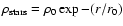 where r0 is the disk scale length,
r0=4 h-1 kpc, and
where r0 is the disk scale length,
r0=4 h-1 kpc, and  is the surface central density. The disk is truncated at five scale lengths with
a radius:
is the surface central density. The disk is truncated at five scale lengths with
a radius:
 kpc. To obtain each disk particle's position according
to the assumed density distribution, we used the rejection method (Press et al. 1986).
kpc. To obtain each disk particle's position according
to the assumed density distribution, we used the rejection method (Press et al. 1986).
The vertical coordinate is extracted from a Gaussian distribution with a standard
deviation equal to 1% of the disk radius. Circular velocities are assigned
analytically to disk particles accounting for the global (disk+cosmological halo) potential,
 .
The radial velocity dispersion
.
The radial velocity dispersion
 is assigned through a Toomre
parameter Q. Q is
initially constant at all disk radii and is it defined as
is assigned through a Toomre
parameter Q. Q is
initially constant at all disk radii and is it defined as
 ,
where
,
where  is the epicyclic
frequency, and
is the epicyclic
frequency, and  the surface density of the disk.
According to the isothermal sheet approximation, the ratio of radial to
vertical dispersion is fixed and constant through the disk, moreover the azimuthal dispersion is linked to the radial dispersion via the
epicyclic approximation (Hernquist 1993).
The final velocity distributions are Gaussian,
with the dispersions given above.
the surface density of the disk.
According to the isothermal sheet approximation, the ratio of radial to
vertical dispersion is fixed and constant through the disk, moreover the azimuthal dispersion is linked to the radial dispersion via the
epicyclic approximation (Hernquist 1993).
The final velocity distributions are Gaussian,
with the dispersions given above.
Assigning a constant initial Q, we can easily classify our disks on the basis of the initial temperature. We explore two values of Q: 1.5, which corresponds to a warm disk, and 0.5, to a cold disk. The average Q value of stars in the Milky Way is estimated between 1 and 3 (Binney & Tremaine 1987), however the evolution of such a parameter starting from high z is not known.
Our model of a galaxy is very simplified. Neither gas nor star formation is introduced since we aim to focus on the gravitational effect of the halo on the disk and to have hints on the gravitational feedback of the disk itself on the halo. Moreover, our technique is such that the CPU cost of one simulation, while large, is still much lower than the cost of a galaxy formation simulation like that by Abadi et al. (2003), even if our force and mass resolution are comparable. Thus our work could give insights into self-consistent galaxy formation scenarios.
In the following we summarise the main steps of our approach:
 = 3
= 3
 is extracted from
the high resolution simulation; its bulk velocity and the position of
its centre are recorded.
is chosen to ease the comparison of our results with previous numerical work on disk stability, e.g. Curir & Mazzei (1999)
and Mazzei & Curir (2001).
Note that
is extracted from
the high resolution simulation; its bulk velocity and the position of
its centre are recorded.
is chosen to ease the comparison of our results with previous numerical work on disk stability, e.g. Curir & Mazzei (1999)
and Mazzei & Curir (2001).
Note that
 and
and
 ;
;
 and the gravitational
potential
and the gravitational
potential  are calculated, inside
 ;
and rotating in a plane perpendicular to
,
is generated;
;
and rotating in a plane perpendicular to
,
is generated;
 ,
corresponds to a
radius,
,
corresponds to a
radius,
 kpc, which involves
84 720 halo particles.
The nearest DM halo
more massive than
kpc, which involves
84 720 halo particles.
The nearest DM halo
more massive than
 is
is
 1900 h-1 kpc away from the centre of our halo;
the less massive one, with a mass of
1900 h-1 kpc away from the centre of our halo;
the less massive one, with a mass of
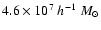 ,
is
215 h-1 kpc away. Moreover, the behaviour of
the density contrast,
,
is
215 h-1 kpc away. Moreover, the behaviour of
the density contrast,  ,
is
monotonically decreasing with the radius, and
falls below
unity at
550 h-1, 450 h-1, 350 h-1 physical kpc away from the centre of our
halo at z=0, z=1 and z=2 respectively.
Therefore, we conclude that the selected halo lies in an
under-dense environment.
,
is
monotonically decreasing with the radius, and
falls below
unity at
550 h-1, 450 h-1, 350 h-1 physical kpc away from the centre of our
halo at z=0, z=1 and z=2 respectively.
Therefore, we conclude that the selected halo lies in an
under-dense environment.
![\begin{figure}
\par\includegraphics[angle=-90,width=8.8cm,clip]{3418f1a.eps}\par...
...ace*{3mm}
\includegraphics[angle=-90,width=8.8cm,clip]{3418f1b.eps}
\end{figure}](/articles/aa/full/2006/08/aa3418-05/img41.gif) |
Figure 1: Accretion history of our selected DM halo as a function of the redshift: top panel from redshift z=40 to z=0, bottom panel from z=5 to z=0; solid (red) line shows the mass of the most massive progenitor of the halo, long-dashed (green) line that of the second most massive progenitor, dotted (magenta) line the total mass of progenitors (the most massive excluded), and short-dashed (blue) line the total mass of field particles. |
| Open with DEXTER | |
The accretion history of our halo has been
calculated as follows. Starting from redshift z1=0, we identified DM halos
using the public halo finder SKID
(Stadel 2001) at the redshift
 ,
corresponding to our previous simulation output.
We then define as progenitor of our halo a SKID group at the redshift
z2, if at least a fraction f=30% of its particles come from the halo at the redshift z1. We also identify as accreting field particles
all the DM
particles not belonging to any SKID group but belonging to the halo. We then
iterate the procedure, using the simulation output corresponding to the
redshift
,
corresponding to our previous simulation output.
We then define as progenitor of our halo a SKID group at the redshift
z2, if at least a fraction f=30% of its particles come from the halo at the redshift z1. We also identify as accreting field particles
all the DM
particles not belonging to any SKID group but belonging to the halo. We then
iterate the procedure, using the simulation output corresponding to the
redshift
 ;
the progenitors are now all the groups that have at least a
fraction f of particles coming from progenitors at z1 or from the accreting
field particles, and so on for the earlier redshifts. We check that the
qualitative behaviour of the accretion history is not dependent on the
value of f (we also tested f=20% and f=50%) and on the parameters used in
SKID (we use a typical object size
;
the progenitors are now all the groups that have at least a
fraction f of particles coming from progenitors at z1 or from the accreting
field particles, and so on for the earlier redshifts. We check that the
qualitative behaviour of the accretion history is not dependent on the
value of f (we also tested f=20% and f=50%) and on the parameters used in
SKID (we use a typical object size
 kpc but also the effect of
3 h-1 kpc and 6 h-1 kpc have been explored).
From Fig. 1, we note that the halo suffers its
last major merger (i.e. a merger between two progenitors whose masses have a
ratio which is not larger than 3) at z=9.
After
kpc but also the effect of
3 h-1 kpc and 6 h-1 kpc have been explored).
From Fig. 1, we note that the halo suffers its
last major merger (i.e. a merger between two progenitors whose masses have a
ratio which is not larger than 3) at z=9.
After  ,
the most important contribution to its mass comes from accreting field
particles.
This contribution declines after
,
the most important contribution to its mass comes from accreting field
particles.
This contribution declines after  becoming less important. At
 ,
the total accreting mass
is smaller than the mass of the larger sub-halo.
Thus we conclude that our halo undergoes no significant merger during
the time it hosts our stellar disk, nor immediately before.
,
the total accreting mass
is smaller than the mass of the larger sub-halo.
Thus we conclude that our halo undergoes no significant merger during
the time it hosts our stellar disk, nor immediately before.
The properties of the selected halo at three relevant redshifts are listen in
Table 1.
Its density profile is well-fitted by a NFW form (Navarro et al. 1996,1997)
at  .
The concentration,
.
The concentration,
 here defined as
 ,
has a high value, 18.1, confirming that this halo does "form''
at quite high redshift (see e.g. Wechsler et al. (2002) for a discussion about
the link between concentration and assembly history of the halo).
The dimensionless spin parameter of the halo is defined as:
,
has a high value, 18.1, confirming that this halo does "form''
at quite high redshift (see e.g. Wechsler et al. (2002) for a discussion about
the link between concentration and assembly history of the halo).
The dimensionless spin parameter of the halo is defined as:
 (Bullock et al. 2001)
where J is the angular momentum inside a sphere of radius R and V is the halo
circular velocity, V2=GM/ R. Its values in Table 1
are near to
the average ones for our cosmological model
(
(Bullock et al. 2001)
where J is the angular momentum inside a sphere of radius R and V is the halo
circular velocity, V2=GM/ R. Its values in Table 1
are near to
the average ones for our cosmological model
(
 ;
Maller et al. 2002)
;
Maller et al. 2002)
Table 1: DM halo properties.
.
We used a time-step criterion based on the local dynamical time (criterion "3''
of the GADGET code), which provides
 time-steps from
z=2 to z=0 (except one case, simulation 5 of Table 2.
The most CPU-expensive of our simulations needed 5000 CPU
hours to be completed on the SP4 computer (CINECA computing center).
time-steps from
z=2 to z=0 (except one case, simulation 5 of Table 2.
The most CPU-expensive of our simulations needed 5000 CPU
hours to be completed on the SP4 computer (CINECA computing center).
Table 2: Simulations: initial values.
The main parameters and the initial properties of this set of simulations
are listed
in Table 2.
A global stability criteria for bar instability in a disk galaxy
is the one analysed in Efstathiou et al. (1982). The parameters
 and
and
 (where vm is the maximum
value of the disk rotational curve, rm the corresponding radius,
(where vm is the maximum
value of the disk rotational curve, rm the corresponding radius,
 and M is the disk mass) have been defined.
Efstathiou et al. (1982) stated the criterion
and M is the disk mass) have been defined.
Efstathiou et al. (1982) stated the criterion
 over the range
 for a disk
model being stable to bar formation. The values of these parameters
are reported in Table 2.
for a disk
model being stable to bar formation. The values of these parameters
are reported in Table 2.
Simulations c1, c2 and c3 in Table 2 refer to a cold disk
(Q=0.5). In simulation c1, at the final time (i.e. z=0)
the baryon fraction inside
 ,
,
 ,
is 44% less than its initial value, 0.53.
The final baryon fraction of simulation c2 is
,
is 44% less than its initial value, 0.53.
The final baryon fraction of simulation c2 is  0.16, compared
with its initial value, 0.28.
Simulation c3 provides
0.16, compared
with its initial value, 0.28.
Simulation c3 provides
 at z=0, 50% less than its initial value.
Simulations c4 and c5
provide the same final baryon fractions as the corresponding simulations with
the lower Toomre's parameter.
at z=0, 50% less than its initial value.
Simulations c4 and c5
provide the same final baryon fractions as the corresponding simulations with
the lower Toomre's parameter.
Simulation c6 and c7, which explore the role of the initial redshift on the bar instability, provide similar final values of the baryon's fraction as the corresponding simulations c2 and c3. Neither the Toomre parameter nor the initial redshift affect the evolution of this ratio which is driven by the mass of the stellar disk. While the baryon fraction of simulation c1 is too high to be consistent with the cosmological value 0.166 (Ettori 2003), all the other simulations give baryon fractions in the allowed range. We however emphasise that the aim of the current work is not to build a realistic galaxy model, but to study the effect of different halo-to-disk mass ratios on the onset of the bar instability. We verify that the inclusion of the disk does not result in significant changes in the accretion history of the DM halo.
Table 3: Simulations: final results.
Finally, in order to disentangle the effect of the geometry and of the spin of an isolated halo we also performed two simulations using a Navarro Frenk and White (NFW) halo having the same virial radius and mass as our cosmological one. The initial and final values of these two simulations are listed in the two last lines of Tables 2 and 3.
 to 0.015 in terms of fraction of stars/spatial resolution
within the total number-density of stars in the map.
Following Curir & Mazzei (1999), we define, as a measure of the bar strength, the
maximum value of
the axial ratio, Sm=b/a (Table 3):
a strong bar corresponds to
to 0.015 in terms of fraction of stars/spatial resolution
within the total number-density of stars in the map.
Following Curir & Mazzei (1999), we define, as a measure of the bar strength, the
maximum value of
the axial ratio, Sm=b/a (Table 3):
a strong bar corresponds to
 or to an
ellipticity,
or to an
ellipticity,
 ,
larger than 0.4.
,
larger than 0.4.
![\begin{figure}
\par\includegraphics[width=8.4cm,clip]{3418f3.eps}
\end{figure}](/articles/aa/full/2006/08/aa3418-05/img90.gif) |
Figure 2: Evolution of isodensity contours of simulation c1 at 11 fixed levels (see Sect. 5). The size of all the frames is 20 h-1 physical kpc, here and in all the following figures in which isodensity contours are shown. |
| Open with DEXTER | |
![\begin{figure}
\par\includegraphics[width=8.6cm,clip]{3418f4.eps}
\end{figure}](/articles/aa/full/2006/08/aa3418-05/img91.gif) |
Figure 3: Evolution of density contours of simulation c2 as described in Fig. 2. |
| Open with DEXTER | |
![\begin{figure}
\par\includegraphics[width=8.6cm,clip]{3418f5.eps}
\end{figure}](/articles/aa/full/2006/08/aa3418-05/img92.gif) |
Figure 4: Evolution of isodensity contours of simulation c3 as described in Fig. 2. |
| Open with DEXTER | |
Therefore the halo-to-disk ratio has a significant influence on the stellar disk at z=0.
The Q parameter does not influence the final (z=0) morphologies of our
less massive disks, always showing disk-like shapes
(Fig. 8).
This suggests that the cold intermediate mass case is
peculiar as far as
the peanut shape is concerned. Such a feature has been
recognized by Combes & Sanders (1981) as caused by vertical orbital resonances.
Figure 9
shows the isodensity contours of
simulation c4.
In this simulation the higher value of
the Q parameter stabilises the disk against
the local Jeans instability and the bar appears later than in
the corresponding cold case (simulation c2).
![\begin{figure}
\par\includegraphics[width=8.8cm,clip]{3418f6.eps}
\end{figure}](/articles/aa/full/2006/08/aa3418-05/img93.gif) |
Figure 5: Face-on, side-on and edge-on view of isodensity contours of simulation c1 at z=0. |
| Open with DEXTER | |
![\begin{figure}
\includegraphics[width=8.8cm,clip]{3418f7.eps}
\end{figure}](/articles/aa/full/2006/08/aa3418-05/img94.gif) |
Figure 6: Face-on, side-on and edge-on view of isodensity contours of simulation c2 at z=0. |
| Open with DEXTER | |
![\begin{figure}
\par\includegraphics[width=8.8cm,clip]{3418f8.eps}
\end{figure}](/articles/aa/full/2006/08/aa3418-05/img95.gif) |
Figure 7: Face-on, side-on and edge-on isodensity contours at z=0 of simulation c4 in Table 2. |
| Open with DEXTER | |
![\begin{figure}
\par\includegraphics[width=8.8cm,clip]{3418f9a.eps}\par\vspace*{3mm}
\includegraphics[width=8.8cm,clip]{3418f9b.eps}
\end{figure}](/articles/aa/full/2006/08/aa3418-05/img96.gif) |
Figure 8: Face-on, side-on and edge-on isodensity contours at z=0 of simulation c3 ( top panels) and c5 ( bottom panels) in Table 2. |
| Open with DEXTER | |
Therefore warmer disks are more stable against lopsided
instability than the corresponding cold cases.
Inside warmer and less massive disks, bars in bars,
namely bar features at different isodensity levels, nested with twisting
major axes, are also shown.
![\begin{figure}
\par\includegraphics[width=8.6cm,clip]{3418f10.eps}
\end{figure}](/articles/aa/full/2006/08/aa3418-05/img97.gif) |
Figure 9: Evolution of isodensity contours of simulation c4 as described in Fig. 2. |
| Open with DEXTER | |
![\begin{figure}
\par\includegraphics[width=8.8cm,clip]{3418f11.eps}
\end{figure}](/articles/aa/full/2006/08/aa3418-05/img98.gif) |
Figure 10: Face on, side-on and edge-on isodensity contours of simulation c6 at z=0. |
| Open with DEXTER | |
Isodensity contours of simulation c6 (Fig. 10),
are similar to those of the corresponding simulation c2
(Fig. 6),
which however starts at z=2.
Morphologies of both simulations c6 and c7 show thinner disks than simulations c4 and c5
given their shorter evolutionary time
( 7.7 Gyr instead of 10.24 Gyr).
![\begin{figure}
\par\includegraphics[width=8.8cm,clip]{3418f12.eps}
\end{figure}](/articles/aa/full/2006/08/aa3418-05/img100.gif) |
Figure 11: Isodensity contours, in particular face-on, side-on and edge-on views of the inner bar of simulation c7 at z=0. |
| Open with DEXTER | |
Figure 12 shows that in simulation c1 the strength of the bar increases with time. The length of the bar depends on the redshift too: it grows until z=0.5, and then shrinks to z=0.
By comparing Figs. 13 and 14, which show the
ellipticity profiles of
simulations c2 and c4 respectively,
![\begin{figure}
\par\includegraphics[width=8.8cm,clip]{3418f13.eps}
\end{figure}](/articles/aa/full/2006/08/aa3418-05/img101.gif) |
Figure 12: Ellipticity as a function of the major axis, a (in physical kpc), of simulation c1 at different redshifts: z=0 continuous line, z=0.25 long-dashed line, z=0.5 long and short dashed line, z=0.75 dot-dashed line, z=1 short dashed line, z=1.25 dotted line. |
| Open with DEXTER | |
The embedding redshift does not have a major impact on the bar strength. Its more important effect is the change of the bar length which can be related to the larger time span of simulation c2 (or c3) with respect to simulation c6 (or c7). Therefore, the halo evolution between z=2 and z=1 does not seriously affect the disk instability, at least for the cold disk cases.
Combes & Sanders (1981) have defined the bar strength at radius Rby using the parameter:
 where
where
![$F_{\rm T}^{\rm max}=[{\partial \Phi(R,\theta)}/{\partial \theta}]_{\rm max}$](/articles/aa/full/2006/08/aa3418-05/img103.gif) is
the maximum amplitude of tangential force at radius R and
is
the maximum amplitude of tangential force at radius R and
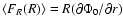 is
the mean axisymmetric radial force, at the same R, derived from the m=0component of the gravitational potential.
We evaluated the components of the gravitational force on a
suitable two dimensional grid using the method described by Buta & Block (2001).
However the information provided by such an approach could be affected by
spiral arm torques and by some asymmetry in the bar itself (Buta & Block 2001).
Nevertheless, we succeeded in monitoring the behaviour of such a parameter
for simulations c2, c4 and c6 (Fig. 15).
The cold cases end up with
almost the same value of
is
the mean axisymmetric radial force, at the same R, derived from the m=0component of the gravitational potential.
We evaluated the components of the gravitational force on a
suitable two dimensional grid using the method described by Buta & Block (2001).
However the information provided by such an approach could be affected by
spiral arm torques and by some asymmetry in the bar itself (Buta & Block 2001).
Nevertheless, we succeeded in monitoring the behaviour of such a parameter
for simulations c2, c4 and c6 (Fig. 15).
The cold cases end up with
almost the same value of  even if their evolution starts from different
redshifts. The warmer case, instead, maintains a smaller
value of the bar strength during all the evolution, in agreement with results
obtained by using the ellipticity parameter.
Table 3 shows that the final values (i.e. at z=0) of the
bar strength evaluated with both these methods are consistent.
According to the classification of
Buta & Block (2001), we assign class 1 to our less massive barred galaxies
if their evolution starts from z=2 (i.e. simulations c3 and c5),
class 2 if they evolve from z=1 (i.e. simulation c7),
and class 4 to all the other ones (i.e. simulations c1, c2, c4 and c6).
even if their evolution starts from different
redshifts. The warmer case, instead, maintains a smaller
value of the bar strength during all the evolution, in agreement with results
obtained by using the ellipticity parameter.
Table 3 shows that the final values (i.e. at z=0) of the
bar strength evaluated with both these methods are consistent.
According to the classification of
Buta & Block (2001), we assign class 1 to our less massive barred galaxies
if their evolution starts from z=2 (i.e. simulations c3 and c5),
class 2 if they evolve from z=1 (i.e. simulation c7),
and class 4 to all the other ones (i.e. simulations c1, c2, c4 and c6).
![\begin{figure}
\par\includegraphics[width=8.8cm,clip]{3418f14.eps}
\end{figure}](/articles/aa/full/2006/08/aa3418-05/img105.gif) |
Figure 13: Ellipticity as a function of major axis, a, of simulation c2 at different redshifts; symbols are as in Fig. 12. |
| Open with DEXTER | |
![\begin{figure}
\par\includegraphics[width=8.8cm,clip]{3418f15.eps}
\end{figure}](/articles/aa/full/2006/08/aa3418-05/img106.gif) |
Figure 14: Ellipticity as function of the major axis, a, for simulation c4 at different redshifts; symbols are as in Fig. 12. |
| Open with DEXTER | |
![\begin{figure}
\par\includegraphics[width=8.8cm,clip]{3418f16.eps}
\end{figure}](/articles/aa/full/2006/08/aa3418-05/img107.gif) |
Figure 15: Evolution of bar strength after z=1 evaluated using the gravitational torque (see text) for the simulations c2 (full line), c4 (dotted line), and c6 (dashed line). |
| Open with DEXTER | |
![\begin{figure}
\par\includegraphics[width=8.8cm,clip]{3418f17.eps}
\end{figure}](/articles/aa/full/2006/08/aa3418-05/img108.gif) |
Figure 16:
Radial density profiles of the DM halo in simulations c5 (dashed
lines) and i2 (solid lines) at
redshifts
z=0, 0.5, 1.0, 1.5 from top to bottom for simulation c5 and at the
equivalent evolutionary times for simulation i2. The three
couples of profiles below have been divided by
102, 104, 106 for
clarity. We also show a NFW density profile having a concentration
parameter
 (dotted line), obtained as a two parameter
best-fit of the density profile of simulation c5 at
z=0. Length units are in physical kpc.
(dotted line), obtained as a two parameter
best-fit of the density profile of simulation c5 at
z=0. Length units are in physical kpc. |
| Open with DEXTER | |
In Fig. 16 we compare the halo radial density profiles of
simulations c5 and i2. The density of the halo
evolving in isolation becomes initially steeper, then it gradually flattens in
the centre. In the outer regions, where the support of the cosmological
environment is now lacking, the halo slowly loses matter toward bigger
scales and the profile steadily steepens.
On the other hand, the halo evolving in the cosmological environment
continues to accrete mass and small substructures from larger scales. Such
accretion is still significant up to redshift
 at least
(Fig. 1).
Even if the dynamical evolution of the halo is different in
cosmological and isolated simulations, the bar
in the disk does form and evolves in a similar way.
Thus we make the hypothesis that the common features of the two numerical
experiments,
namely the dynamical evolution and the anisotropy of the mass distribution,
are the main engine for the bar instability.
The large scale cosmological environment becomes a second order effect
in the less massive disks. However the material accreting on the halo,
which has been cut off with the
halo segregation in a isolated system, plays a crucial role in the
degree of the disk instability if
the disk is not completely DM dominated.
We conclude that the use of isolated halos in gravitational equilibrium for
the study of the bar instability can give misleading results.
at least
(Fig. 1).
Even if the dynamical evolution of the halo is different in
cosmological and isolated simulations, the bar
in the disk does form and evolves in a similar way.
Thus we make the hypothesis that the common features of the two numerical
experiments,
namely the dynamical evolution and the anisotropy of the mass distribution,
are the main engine for the bar instability.
The large scale cosmological environment becomes a second order effect
in the less massive disks. However the material accreting on the halo,
which has been cut off with the
halo segregation in a isolated system, plays a crucial role in the
degree of the disk instability if
the disk is not completely DM dominated.
We conclude that the use of isolated halos in gravitational equilibrium for
the study of the bar instability can give misleading results.
Taking into account our previous work in such an isolated non-cosmological framework (Curir & Mazzei 1999; Mazzei & Curir 2001), we derive that live unrelaxed halos correspond to the most "realistic'' approach available to simplify the picture. Even if the caveat outlined above cannot be forgotten, the dynamical state of the halo, as outlined in our work for the first time, plays a fundamental role in triggering and fuelling such an instability.
In order to disentangle the role of the halo's cosmological features like the
prolate geometry and the spin
on the instability, and to test the resolution effect,
we produced an isolated halo with the same virial mass, radius and number
of particles as our cosmological halo at z=0, but with an isotropic NFW
radial density profile.
The procedure is described by Hernquist (1993).
We used a rejection technique to sample the density profile and we then assign a
velocity to each particle following a local Maxwellian velocity dispersion.
We checked that after 7 Gyr of evolution, the radial density profile of the halo is not
changed, except for the "evaporation'' of some particles dwelling in its outskirts.
We then embedded a disk having the same mass, radius and Q as
in our simulation c5 and c3. These two simulations are labelled in
Tables 2 and 3 as i5 and i4.
According to the classical theory (Sect. 4.1), in simulation i5 the
bar instability would be inhibited. We successfully reproduced this result
with our live NFW halo (Fig. 17). Therefore the bar instability in
simulation c5 is a genuine effect of the cosmological evolution and there is no
evidence for a role of numerical noise.
Moreover in simulation i5 the reaction of the
DM halo to the disk immersion has not triggered a long-lived bar
instability (see Fig. 17).
![\begin{figure}
\par\includegraphics[width=8.8cm,clip]{3418f21c.eps}\par\vspace*{...
...}\par\vspace*{3mm}
\includegraphics[width=8.8cm,clip]{3418f21a.eps}
\end{figure}](/articles/aa/full/2006/08/aa3418-05/img110.gif) |
Figure 17: Evolution of isodensity contours of the simulation i5 at different evolutionary times: from top to bottom, t=5 Gyr, t=7.5 Gyr and t=10 Gyr; xy, yz and xz projections from left to right (see text (Sect. 7) for more details). |
| Open with DEXTER | |
 ratio
in Table 2.
Critical threshold values against m=1 and m=2 instability for this
ratio have been calibrated by Athanassoula et al. (1987). They claim
a value around 0.81 for the
ratio to inhibit the lopsided instability (i.e. m=1)
and around 2.2 to suppress the m=2 swing amplification instability. Even if these values are derived in a very simply framework,
i.e. a isolated spherical and analytical DM halo, they are widely used
in the literature (Elmegreen et al. 2003; Bottema 2003),
therefore we will refer to this parameter to analyse our initial
condition, in addition to the Efstathiou et al. parameter introduced in
Sect. 4.1.
ratio
in Table 2.
Critical threshold values against m=1 and m=2 instability for this
ratio have been calibrated by Athanassoula et al. (1987). They claim
a value around 0.81 for the
ratio to inhibit the lopsided instability (i.e. m=1)
and around 2.2 to suppress the m=2 swing amplification instability. Even if these values are derived in a very simply framework,
i.e. a isolated spherical and analytical DM halo, they are widely used
in the literature (Elmegreen et al. 2003; Bottema 2003),
therefore we will refer to this parameter to analyse our initial
condition, in addition to the Efstathiou et al. parameter introduced in
Sect. 4.1.
Looking at Table 2, simulations c1, c2, c4 and c6, which develop strong final bars (Table 3), are in the instability region for both these criteria. In particular in simulation c1, which also is below the threshold of lopsided instability (Athanassoula et al. 1987), the signatures of such an instability are clearly shown in the first phases of its evolution (Fig. 2). On the other hand simulations c3, c5 and c7 are stable according to both the criteria above. Nevertheless a weaker bar appears and lasts until the end of such simulations. Therefore the classical parameters are not good markers of the onset of the bar instability. In particular, when the self-gravity of the disk is negligible, i.e. the disk is DM dominated, the halo structure generated by the cosmology plays a crucial role in triggering such a instability.
Our findings agree with results of
Mayer & Wadsley (2004) in the isolated framework. They found that stellar systems with disk-to-halo mass
ratios of 0.1 become bar unstable, regardless of the halo concentration
and the Q value, inside
halos built up with suitable structural parameters derived
from  -CDM cosmology, like their circular velocity at
,
-CDM cosmology, like their circular velocity at
,
 ,
the NFW density profile and the spin parameter
(0.06 and 0.1). We point out that Mayer & Wadsley (2004) do not take into account
cosmological evolution for their halos.
With the same disk-to-halo mass ratio Athanassoula (2002) found
that such a instability is totally inhibited
inside isotropic, non rotating halos with different density profiles
(Eq. (1) of Athanassoula 2002),
in agreement with the result of our simulation i5
(Sect. 7).
This last result, together with those of simulations performed with different
numbers of disk particles and with different softening lengths (Sect. 7)
suggests that the development of long-living bars seen in our simulations is a
genuine physical effect and not a numerical artifact.
,
the NFW density profile and the spin parameter
(0.06 and 0.1). We point out that Mayer & Wadsley (2004) do not take into account
cosmological evolution for their halos.
With the same disk-to-halo mass ratio Athanassoula (2002) found
that such a instability is totally inhibited
inside isotropic, non rotating halos with different density profiles
(Eq. (1) of Athanassoula 2002),
in agreement with the result of our simulation i5
(Sect. 7).
This last result, together with those of simulations performed with different
numbers of disk particles and with different softening lengths (Sect. 7)
suggests that the development of long-living bars seen in our simulations is a
genuine physical effect and not a numerical artifact.
Bar instability in the DM dominated cases is strongly affected by the halo models. Moreover structural details of the halo, related to the cosmological framework, drive morphological features of the stellar disk. Mayer & Wadsley (2004) found a central bulge after 7 Gyr which does not appear in our corresponding case. However such a bulge shows up in our intermediate self-gravitating case (simulation i1 in Table 2). This feature is also emphasised in the work by Athanassoula & Misiriotis (2002) and Athanassoula (2003) for a disk-to-halo mass ratio of 0.2, using the same halo presented in Athanassoula (2002) with the higher halo concentration.
Our results here are in good qualitative agreement
with those by Curir & Mazzei (1999) concerning their simulations 3, 4, 7 and 8, with the same
disk-to-halo mass ratio as in simulation c1 of Table 2, and also
with their simulations 5 and 6
which correspond to a disk-to-halo mass ratio 0.2.
However, their simulations 3 and 4
correspond to a relaxed halo, whereas 5, 6, 7 and 8
to a unrelaxed halo. In particular the
initial values of their simulations 5
and 6 are respectively above and very near the 2.2 threshold value of bar instability, nevertheless the bar
lasts until the end of their simulations (1.5 Gyr).
Their simulations 1 and 2, which correspond to a
relaxed dynamical state of a halo with disk-to-halo mass ratio 0.2, emphasise however a very different behaviour as far as the
bar instability is concerned: the bar forms initially but degenerates then in a
dense nucleus.
Thus we argue that an unrelaxed dynamical state for
isolated halo systems is more suitable to mimic a realistic
"cosmological'' halo, characterised by evolution, substructure and in-fall.
This finding is important, since a vast
majority of the work on the bar instability assumes a
gravitationally stable halo.
The mass anisotropy and the dynamical evolution of the DM halo have a crucial effect in enhancing and fuelling the bar instability, also in cases where ad hoc halo models provided stability predictions (e.g. Athanassoula 2003). The large-scale effects, such as the continuous matter infall on the halo and the infall of substructures during the whole time-span of the simulation, influence the bar strength and the details of its structure.
Acknowledgements
Simulations were performed on the CINECA IBM SP4 computer (Bo, Italy), thanks to the INAF-CINECA grants cnato43a/inato003 "Evolution of disk galaxies in cosmologicalcontexts'', and on the Linux PC Cluster of the Osservatorio Astronomico di Torino. We wish to thank for useful discussions: T. Abel, S. Bonometto, A. Burkert, E. D'Onghia, F. Governato, A. Klypin & V. Springel.
 (Sect. 4.2).
After this period, a new disk having
the same mass ratio is embedded, in equilibrium with the gravitational
potential of the halo. We evolved this
system up to the final time, T=10.24 Gyr. This simulation is presented in
Tables 2 and 3 as simulation i3.
The presence of a very
strong bar is seen during all the evolution.
In Fig. A.1 we compare the evolution of the
maximum bar ellipticity and of the corresponding semi-major axis length for
simulation i3 and i1, in which the disk was added impulsively.
We conclude that the
reaction of the DM halo to the disk immersion, and the following
counter-reaction
of the disk to the increased halo concentration, are not the most important
ingredient in producing the long-lasting bar we observe.
(Sect. 4.2).
After this period, a new disk having
the same mass ratio is embedded, in equilibrium with the gravitational
potential of the halo. We evolved this
system up to the final time, T=10.24 Gyr. This simulation is presented in
Tables 2 and 3 as simulation i3.
The presence of a very
strong bar is seen during all the evolution.
In Fig. A.1 we compare the evolution of the
maximum bar ellipticity and of the corresponding semi-major axis length for
simulation i3 and i1, in which the disk was added impulsively.
We conclude that the
reaction of the DM halo to the disk immersion, and the following
counter-reaction
of the disk to the increased halo concentration, are not the most important
ingredient in producing the long-lasting bar we observe.
![\begin{figure}
\par\includegraphics[width=8.8cm,clip]{3418f18.eps}
\end{figure}](/articles/aa/full/2006/08/aa3418-05/img115.gif) |
Figure A.1: Evolution of the ellipticity ( top panel) and of the bar length ( bottom panel) of simulations i1 (dashed line) and i3 (full line). |
With a fixed number of star particles,
their mass varies by a factor of 10 in our simulations (Table 2). This can bring a
different numerical scatter between star and DM particles.
Problems connected with the resolution could be the
occurrence of a bar instability triggered by numerical noise, which causes a poor
sampling of the density field in the central part of the halo, and
the numerical heating, which also depends on the number of particles involved
(Lacey & Ostriker 1985), could artificially weaken the bar instability.
Therefore we run isolated tests with different number of star
particles (N= 9400, 18 800, 56 000, 560 000). The results are slightly
dependent on the mass resolution of disk particles (Fig. A.2).
In particular the disk with 10 times more particles than our fiducial
case keeps the bar feature, showing a more defined bar structure due to
the higher resolution.
We conclude that,
even if there is a slight dependence of the details of the bar structure on
the mass resolution of star particles, our main result, i.e. the
occurrence of a long lasting bar instability even with this disk-to-halo mass
ratio which would be classically stable, it is not caused by a
resolution effect.
We are currently performing new cosmological simulations (as in Sect. 4.1)
with higher mass resolution:
a new halo consisting of 282 134 particles at z=2 (compare with Table 1)
and a stellar disk of 280 000 particles. The disk-to-halo mass
ratio, defined as in Sect. 4, is 1/10. The halo has a spin
 ,
a viral mass of
,
a viral mass of
 at z=0 and a "quiet'' mass accretion history, similar to
that of the DM halo used in this work.
Using such a halo, evolving in a different cosmological environment,
we aim not only to improve the mass resolution of simulations in the
cosmological framework but also
to check how our results depend on the properties of the halo.
Fig. A.3 shows that a bar is present
for such a very light disk also with the higher resolution.
at z=0 and a "quiet'' mass accretion history, similar to
that of the DM halo used in this work.
Using such a halo, evolving in a different cosmological environment,
we aim not only to improve the mass resolution of simulations in the
cosmological framework but also
to check how our results depend on the properties of the halo.
Fig. A.3 shows that a bar is present
for such a very light disk also with the higher resolution.
![\begin{figure}
\par\includegraphics[width=8.8cm,clip]{3418f20.eps}
\end{figure}](/articles/aa/full/2006/08/aa3418-05/img120.gif) |
Figure A.3: xy, yz and xz projections from left to right after 7 Gyr for the high resolution cosmological run with disk-to-halo mass ratio 0.1. See text (Sect. 7) for more details. |
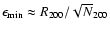 ,
to prevent strong
discreteness effects. From Table 1, this value corresponds
to
,
to prevent strong
discreteness effects. From Table 1, this value corresponds
to
 kpc at z=0 and
 kpc at z=2.
Thus we run three simulations of the
same isolated disk+halo system as in simulation i2 using three different
softening lengths: 0.36 h-1, 0.5 h-1 and
0.65 h-1 kpc. In Fig. A.4 we show the isodensity contours
at times corresponding to redshifts z=1 and z=0 in the cosmological
framework. The bar shapes and
strengths are similar at z=1, where comparable inner bars (as given by two inner
levels) are shown. We note the same similarities at z=0 with the exception of
simulation with lower softening length, which shows more round inner contours.
We conclude
that, as far as the bar instability is concerned, varying the stellar
softening within such range does not have a significant effect on the
results.
kpc at z=2.
Thus we run three simulations of the
same isolated disk+halo system as in simulation i2 using three different
softening lengths: 0.36 h-1, 0.5 h-1 and
0.65 h-1 kpc. In Fig. A.4 we show the isodensity contours
at times corresponding to redshifts z=1 and z=0 in the cosmological
framework. The bar shapes and
strengths are similar at z=1, where comparable inner bars (as given by two inner
levels) are shown. We note the same similarities at z=0 with the exception of
simulation with lower softening length, which shows more round inner contours.
We conclude
that, as far as the bar instability is concerned, varying the stellar
softening within such range does not have a significant effect on the
results.
![\begin{figure}
\par\includegraphics[width=8.8cm,clip]{3418f19a.eps}\par\vspace*{...
...vspace*{1.5mm}
\includegraphics[width=8.8cm,clip]{3418f19d.eps}\par
\end{figure}](/articles/aa/full/2006/08/aa3418-05/img117.gif)
 of isolated simulations i2 with
different number of star particles, 9400, 18 800, 56 000 and 560 000 from top to
bottom; xy, yz and xz projections are from left to right.
of isolated simulations i2 with
different number of star particles, 9400, 18 800, 56 000 and 560 000 from top to
bottom; xy, yz and xz projections are from left to right.![\begin{figure}
\par\includegraphics[width=8.8cm,clip]{3418f22.eps}
\end{figure}](/articles/aa/full/2006/08/aa3418-05/img124.gif)