

In practice, it is not an effortless task to test a prediction for an AG's spectrum extending, as in the upper panel of Fig. 1, to all measured wavelengths from radio to X-rays. The problem is not related to the model, but to the data. First, the corrections due to absorption, particularly in the host galaxy, are frequency-dependent and notoriously difficult to ascertain with confidence. Second, the integration times employed in the radio observations are long, so that the theoretical prediction varies within the time window, and so do the optical energy flux densities, measured over much shorter periods, as well as some of the radio observations themselves. Unavoidably, this will make our spectral figures look a bit peculiar, with two theoretical curves bracketing the expectations, and various observational points at the same frequency.
We study the AG light-curves and broad-band spectra of all
GRBs with known-redshift whose AG was measured both in the
radio and optical bands![[*]](/icons/foot_motif.gif) .
.
Our predictions are given by Eq. (8),
fit to the optical and radio observations.
The fitted parameters are the overall
normalization,  ,
,
 ,
the
deceleration parameter
,
the
deceleration parameter  (whose meaning and role are
reviewed in Appendix A) and the CB self absorption frequency
(whose meaning and role are
reviewed in Appendix A) and the CB self absorption frequency  of
Eq. (23). We found in DDD 2001 that p is very narrowly
distributed around its theoretical value p=2.2, and we
fix it to that value for all GRBs in the current analysis.
Thus, the total number of parameters in our broad-band fits
is the same as we used in
DDD 2001 to describe just the R-band light-curve.
of
Eq. (23). We found in DDD 2001 that p is very narrowly
distributed around its theoretical value p=2.2, and we
fix it to that value for all GRBs in the current analysis.
Thus, the total number of parameters in our broad-band fits
is the same as we used in
DDD 2001 to describe just the R-band light-curve.
The values of the parameters, listed in Table 3, are very similar
to those deduced in DDD
2001 by fitting only the R-band optical data with the high- limit of
Eq. (8). The small differences are due
not only to the use of radio data and optical bands other than R,
but also to the inclusion of the effects of the injection bend in the CB
synchrotron AG global formula, Eq. (8), and (to a small
extent) to the use of a fixed p=2.2. The results show that the theory
agrees with observations both at radio and optical wavelengths.
For some GRBs a slightly
better fit to the radio data is obtained if the absorption frequency
is best fitted to the radio data alone or if a fitted power-law
dependence on time is used for the CB opacity instead of
Eq. (23), with all other parameters taken from the global fit.
Because of scintillations, and of the very detail-dependent character of our
prediction for the time dependence of a CB's opacity,
it is difficult to assess whether or not
the slightly improved
limit of
Eq. (8). The small differences are due
not only to the use of radio data and optical bands other than R,
but also to the inclusion of the effects of the injection bend in the CB
synchrotron AG global formula, Eq. (8), and (to a small
extent) to the use of a fixed p=2.2. The results show that the theory
agrees with observations both at radio and optical wavelengths.
For some GRBs a slightly
better fit to the radio data is obtained if the absorption frequency
is best fitted to the radio data alone or if a fitted power-law
dependence on time is used for the CB opacity instead of
Eq. (23), with all other parameters taken from the global fit.
Because of scintillations, and of the very detail-dependent character of our
prediction for the time dependence of a CB's opacity,
it is difficult to assess whether or not
the slightly improved  values are significant or not.
Notice in Table 3 that the distributions of parameters are fairly
narrow, in particular for  .
Of particular interest, since
it can be predicted, is the distribution in
.
Of particular interest, since
it can be predicted, is the distribution in
 .
Since AGs are discovered at optical and X-ray frequencies,
the angular distribution is that of the high frequency limit of
Eq. (8). For small ,
.
Since AGs are discovered at optical and X-ray frequencies,
the angular distribution is that of the high frequency limit of
Eq. (8). For small ,
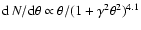 .
This distribution has a maximum at
.
This distribution has a maximum at
 and a median at
  0.5. In Table 3 there are four cases
with
0.5. In Table 3 there are four cases
with
 below the median and five above. The
worst ``outlier'' in
is much less so in
.
The conclusion that this distribution is perfectly compatible
with the expectation can also be reached from Fig. 39 of
DDD 2001, whose results were obtained from only
optical data, but for which the statistics is a bit better.
below the median and five above. The
worst ``outlier'' in
is much less so in
.
The conclusion that this distribution is perfectly compatible
with the expectation can also be reached from Fig. 39 of
DDD 2001, whose results were obtained from only
optical data, but for which the statistics is a bit better.
We first discuss the broad-band spectra and light curves of three representative GRBs: 000301c, 000926 and 991216. The optical AG of GRB 000301c is practically unextinct, that of GRB 000926 has strong extinction in the host galaxy (e.g., Fynbo et al. 2001) and that of GRB 991216 has strong extinction both in the host galaxy and in ours (e.g., Halpern et al. 2000). We discuss GRBs 991208, 000418, 000510, 990123 and 970508 in slightly less detail. The apparently special case of GRB 980425 is discussed separately in the next chapter.
For this GRB we fit the radio data of Berger et al. (2000)
and the optical data of Garnavich et al. (2000b), Jensen et al.
(2001), Masetti et al. (2000), Rhoads & Fruchter (2001) and
Sagar et al. (2001). Our results for the light curves at all observed
optical and radio frequencies are gathered in Fig. 5,
which is representative of the trends seen in all GRBs.
The narrowly spaced lines in the figure are the optical light curves
for - from top to bottom - the K, J, I, R, V, B and U bands.
Their very satisfactory comparison with data is reported in
Fig. 6. The results for the
radio AG are the more spaced lines in Fig. 5, which
correspond - from top to bottom at the figure's left side - to
frequencies of 1.43, 4.86, 8.46, 15, 22.5, 100, 250 and 350 GHz.
Their very satisfactory comparison with observations is reported
in Figs. 7 to 10. Notice that all
features of the
data have precisely the trends summarized in Fig. 5.
In Figs. 11 and 12 we present the
complementary information, by comparing
our fits with the observations for the radio-to-optical spectra
of GRB 000301c in four radio time-integration brackets;
1 to 5, 5 to 10, 10 to 20, and 20 to 30 days.
The pronounced peaks are at (observer's) frequencies
for which the opacity of Eq. (23) is
 .
The injection bend at a higher
frequency is clearly visible, it is responsible for the agreement
between the radio and optical magnitudes and frequency trends.
The two curves in these figures, and many later ones, refer to the
expectation at the two times which bracket the actual radio observation.
The results are quite satisfactory.
.
The injection bend at a higher
frequency is clearly visible, it is responsible for the agreement
between the radio and optical magnitudes and frequency trends.
The two curves in these figures, and many later ones, refer to the
expectation at the two times which bracket the actual radio observation.
The results are quite satisfactory.
![\begin{figure}
\includegraphics[width=7.4cm,clip]{MS2654f5.eps}
\end{figure}](/articles/aa/full/2003/13/aa2654/img207.gif) |
Figure 5: Results of a fit to radio and optical observations of the light curves of GRB 000301c. The narrowly spaced lines refer - from top to bottom - to the K, J, I, R, V, B and U bands. The more widely spaced lines refer - from top to bottom at the figure's left side - to frequencies of 1.43, 4.86, 8.46, 15, 22.5, 100, 250 and 350 GHz. The comparison with data is shown in Figs. 6 to 12. |
We have made a global fit to the NIR/optical data (Di Paola et al. 2000; Fynbo et al. 2001, Harrison et al. 2001; Price et al. 2001; Sagar et al. 2001) and the radio data (Harrison et al. 2001) on this GRB. In Fig. 13 we compare the fitted CB-model predictions with the measured light curves for the I, R, V, B and U bands, after subtraction of the host galaxy and SN contributions (DDD 2001). The theoretical predictions were corrected for galactic extinction E(B - V)=0.0235 (Schlegel et al. 1998) and for the estimated extinction in the host galaxy, E(B - V)=0.40 (Harrison et al. 2001). In Figs. 14 to 16 we present the radio light curves for six frequencies ranging from 98.48 to 1.43 GHz.
In Figs. 17 to 19 we make the complementary comparison of theory and observations for the radio-to-optical spectra, in six time intervals extending from 0.8 to 100 days. The results, in spite of the crude estimate of extinction in the host galaxy and the scintillations so clearly visible in the radio light curves, are satisfactory.
The NIR/optical data for this GRB are from Halpern et al. (2000) and Garnavich et al. (2000a); the radio data from Frail et al. (2000b). In Fig. 20 we present the comparison between the measured light curves for the K, J, I, R bands, after subtraction of the host galaxy and SN contributions (DDD 2001), and the fitted CB model predictions. The predictions were corrected for extinction in the host galaxy and ours, as estimated by Halpern et al. (2000): E(B - V)=0.40. In Figs. 21 to 23 we present the radio light curves at six frequencies from 350 to 1.43 GHz. In Figs. 24 to 26 we make the complementary comparison of theory and observations for the radio to optical spectra, in six time intervals extending from 0.44 to 80 days. The results are once again satisfactory.
We fit the NIR/optical data (Castro-Tirado et al. 2001; Sagar et al. 2000) and the radio data (Galama et al. 2000) on the AG of GRB 991208. In Fig. 27 we present the comparison between the measured light curves for the I, R, V and B bands, and the fitted CB model predictions, after subtraction of the host galaxy and SN contributions (DDD 2001). The theoretical predictions were corrected only for the small galactic extinction E(B - V)=0.016 (Schlegel et al. 1998) in the direction of this GRB, there being no spectral evidence for optical extinction in the host galaxy. In Figs. 28 to 31 we also present the radio light curves at 100, 86.14, 30, 22.49, 14.97, 8.46, 4.86 and 1.43 GHz. In Figs. 32 and 33 we make the complementary comparison for the radio to optical spectra in three time intervals extending from 2 to 14.3 days. The results are satisfactory.
The NIR/optical data are from Klose et al. (2000) and the radio data from Berger et al. (2001a). In Fig. 34 we compare the fitted CB-model predictions with the measured light curves for the R-band, after subtraction of the host galaxy and SN contribution (DDD 2001). The theoretical predictions were corrected for galactic extinction and for extinction in the host galaxy as estimated by Berger et al. (2001a): E(B - V)=0.40. In Figs. 35 and 36 we also present the radio light curves at 22.5, 15, 8.46 and 4.86 GHz. In Fig. 37 we make the complementary comparison for the radio to optical spectra, in two time intervals extending from 9.5 to 100 days. The results are satisfactory.
The NIR/optical data were gathered by Beuermann et al. (1999), Harrison et al. (1999) and Stanek et al. (1999) and the radio data by Harrison et al. (1999). In Fig. 38 we present the comparison between the measured light curves for the I, R, V, B bands, after subtraction of the host galaxy and SN contribution (DDD 2001), and the fitted CB model predictions, corrected for Galactic extinction ( E(B - V)=0.203, Schlegel et al. 1998) and for extinction in the host galaxy as estimated by Stanek et al. (1999). In Figs. 39 and 40 we present the radio light curves at 13.7, 8.6 and 4.8 GHz. In Figs. 40 and 41 we also make the complementary comparison of theory and observations for the radio to optical spectra three time intervals extending from 1 to 40 days. The agreement between theory and observations is very good although its significance is limited by the sparse radio data.
We have fit the NIR/optical data (Castro Tirado 1999; Fruchter et al. 1999;
Galama et al. 1999; Holland et al. 2000; Kulkarni et al. 1999a)
and the radio data (Galama et al. 1999; Kulkarni et al. 1999b)
for this GRB. In Fig. 42 we present the comparison between
the fitted CB model predictions - assuming a constant ISM density after 0.1
observer's days and after subtraction of the host galaxy and SN contributions -
with the measured light curves for the K, I, R, V, B and U bands.
The theoretical predictions were corrected for the small Galactic extinction
in the GRB direction (
E(B - V)=0.016, Schlegel et al. 1998) but not for
extinction in the host
galaxy, since there is no spectral evidence for significant extinction
there. In Fig. 43 we present the radio light curves at
15 and 8.46 GHz. In Figs. 44 to 45 we make the complementary comparison of theory and
observations for the radio to optical spectra,
in four time intervals extending from 0.1 to 20 days.
The agreement between theory and observations is good despite
the limited available data on the radio AG and its
modulation by scintillations.
The optical (and X-ray) AG of GRB 970508 is the only one so far that has
been seen to rise and fall very significantly (e.g.,
Garcia et al. 1998; Galama et al. 1998b; Pedersen et al. 1998;
Schaefer et al. 1997; Sokolov et al. 1998; Zharikov et al. 1998). In DDD
2001 we have shown
that a CB model fit to this AG fails, if one assumes - like in all our other
fits - a constant ISM density. However, we have argued there that GRB
progenitors are presumably located in super-bubbles of 0.1 to 0.5 kpc
size. There may be instances in which the jet of CBs, after travelling for
such a distance, does not continue onwards to a similarly low-density halo
region, but encounters a higher-density domain. Indeed, we have shown that
a fairly satisfactory fit to the optical (and X-ray) AG is obtained
upon assuming an upwards jump in density by a factor
2.2 at  day after burst.
This jump occurs before the first available
data points on the radio AG (Galama et al. 1998a; Frail et al. 2000b).
Therefore, we have fitted the optical data and the radio data
with the ISM density profile that was fitted
to the R-band light curve.
day after burst.
This jump occurs before the first available
data points on the radio AG (Galama et al. 1998a; Frail et al. 2000b).
Therefore, we have fitted the optical data and the radio data
with the ISM density profile that was fitted
to the R-band light curve.
In Fig. 46 we present the comparison between the measured light curve for the I, R, V and B bands after subtraction of the host galaxy and SN contribution (DDD 2001). The theoretical predictions were corrected for the small galactic extinction in the GRB direction ( E(B - V)=0.016, Schlegel et al. 1998) but not for extinction in the host galaxy, since there is no spectral evidence for significant extinction there. In Figs. 47 and 48 we also present the radio light curves at 8.46, 4.86 and 1.43 GHz. In Figs. 48 to 50 we make the complementary comparison of theory and observations for the radio to optical spectra, in five time intervals extending from 0.12 to 470 days. The results are quite satisfactory.
In DDD 2001 we demonstrated that, in the CB model, the spectral index
in the optical to X-ray domain could be extracted from the
time-dependence of the optical
light curves. The fits resulted in
 for
all GRBs of known redshift. This result is in good agreement
with the observed late spectral observations.
We have learned in this section that the CB model also provides an
excellent description of the AG spectra in the broader band that
includes the radio data. Only one new parameter, ,
is
involved in the extension to the broader band. And this fitted
parameter and the injection bend - at its predicted frequency and
time-dependent position - bring about
the agreement between the different magnitudes and spectral trends
of the radio and optical domains.
for
all GRBs of known redshift. This result is in good agreement
with the observed late spectral observations.
We have learned in this section that the CB model also provides an
excellent description of the AG spectra in the broader band that
includes the radio data. Only one new parameter, ,
is
involved in the extension to the broader band. And this fitted
parameter and the injection bend - at its predicted frequency and
time-dependent position - bring about
the agreement between the different magnitudes and spectral trends
of the radio and optical domains.
In some of our fits to broad band spectra, such as the earliest data on GRBs 000301c, 991216 and 990123 in the upper panels of Figs. 11, 24 and 44, respectively, the theoretical curve is an underestimate of the low-energy spectral intensity. In other cases, such as GRBs 000926, 991208 and 980425, the spectral fits are excellent at all times. The lowest frequencies and earliest times are the most dependent on our simplifications concerning the GRB geometry, density profile, self-absorption, cumulation and limb-darkening. We would have been surprised if these simplifications worked even better than they do, and the fits do improve if we remove our approximation of a fixed spectral index p=2.2. But our aim in this paper is not to obtain spectacularly good fits, but to demonstrate that, even in the simplest approximations, the CB model provides a good description of the broad-band data. The analysis of the lowest radio frequencies at the earliest times brings forth a plethora of details that are not of fundamental interest: our ultimate goal is not to understand these details, but to investigate what the origin of GRBs actually is.
Copyright ESO 2003