

 is usually considered a good
indicator of the efficiency of the dynamo mechanism in the generation
and amplification of the stellar magnetic fields, and consequently of
the stellar magnetic activity. However, while the rotation period can
be directly measured,
is usually considered a good
indicator of the efficiency of the dynamo mechanism in the generation
and amplification of the stellar magnetic fields, and consequently of
the stellar magnetic activity. However, while the rotation period can
be directly measured,
 is usually empirically
determined (Noyes et al. 1984; Stepien 1994) or derived from
theoretical models (Gilliland 1985; Kim & Demarque 1996; Pizzolato et al. 2001).
is usually empirically
determined (Noyes et al. 1984; Stepien 1994) or derived from
theoretical models (Gilliland 1985; Kim & Demarque 1996; Pizzolato et al. 2001).
The study of the relationship between X-ray emission and rotation in
different mass ranges (or spectral classes), described in the previous
section, allowed us to clearly separate saturated stars from
non-saturated stars and, therefore, it made possible a new
determination of an empirical X-ray-based Rossby number. In
order to evaluate this parameter for all the stars in our sample we
have determined an empirical X-ray-derived function of the stellar
mass,
 ,
and we have used this function as an empirical time scale in place of
,
and we have used this function as an empirical time scale in place of
 ,
the convective
turnover time. In this section we show how the ratio
,
the convective
turnover time. In this section we show how the ratio
 effectively provides us with a unique,
mass-independent prediction of the X-ray emission level, for both
saturated and non-saturated stars, a property which makes
effectively provides us with a unique,
mass-independent prediction of the X-ray emission level, for both
saturated and non-saturated stars, a property which makes  possibly preferable to
 .
.
 instead of the rotation period, where
is a
mass-dependent function derived from the observational data available.
instead of the rotation period, where
is a
mass-dependent function derived from the observational data available.
Our work is characterized by two improvements with respect to the
Stepien (1994) work: (i) a larger sample, including more stars in all
rotation ranges and more low-mass stars, and (ii) a quantitative
separation of the two X-ray emission regimes, a crucial point for the
determination of the mass dependent function
.
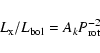
We have first considered the family of power laws:
 |
(1) |
A single relationship for all the stars in our sample can be obtained
by scaling:
 |
(2) |
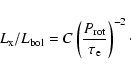
can be obtained
as
(Ak/C)1/2, with C= const., so that
 |
(3) |
 can be dubbed "X-ray
empirical Rossby number" and denoted by .
An important
point is that, by using this empirically-derived Rossby number, we may
effectively describe the activity level, represented by
can be dubbed "X-ray
empirical Rossby number" and denoted by .
An important
point is that, by using this empirically-derived Rossby number, we may
effectively describe the activity level, represented by
 ,
as a single mass-independent function of the parameter ,
taking into account both the rotation and any effect
linked to differences in internal stellar structure for stars of
different masses (Fig. 9).
,
as a single mass-independent function of the parameter ,
taking into account both the rotation and any effect
linked to differences in internal stellar structure for stars of
different masses (Fig. 9).
![\begin{figure}
\par\includegraphics[width=8.8cm,clip]{MS2680f10.eps}
\end{figure}](/articles/aa/full/2003/01/aa2680/img138.gif) |
Figure 9: X-ray to bolometric luminosity ratio vs. empirical Rossby number for all the stars in our sample. The meaning of the symbols is the same as in Fig. 3. |
It is to be mentioned, however, that the adopted procedure does not
permit to determine absolute values of
 ,
but only the
functional dependence of such an empirical time scale on the stellar
mass; the function
must be properly scaled in order to
be compared with other empirical or model-derived convective turnover
times. The value of
listed in Table 3 for each mass range was obtained by applying a
constant scaling factor such that the value of
for
solar-mass stars matches the Noyes's semi-empirical prediction of the
convective turnover time of the Sun. The relationship between this
and the stellar mass has been used to calculate the
values of
plotted in Fig. 9.
,
but only the
functional dependence of such an empirical time scale on the stellar
mass; the function
must be properly scaled in order to
be compared with other empirical or model-derived convective turnover
times. The value of
listed in Table 3 for each mass range was obtained by applying a
constant scaling factor such that the value of
for
solar-mass stars matches the Noyes's semi-empirical prediction of the
convective turnover time of the Sun. The relationship between this
and the stellar mass has been used to calculate the
values of
plotted in Fig. 9.
In Fig. 10 we show a comparison between the function
and the theoretical convective turnover time,
,
derived from two stellar structure models, the model by
Kim & Demarque (1996) and the more recent model by Ventura et al.
(1998). The latter was employed for the computation of the
characteristic turnover time also for stars with
 ,
including fully-convective stars with
,
including fully-convective stars with
 and
and
 .
Both models give a global estimate of this
time scale by integrating over the whole convective region.
For ease of comparison the function
in Fig. 10 is scaled in such a way that our empirical time
scale for a solar-mass star coincides with the theoretical convective time
predicted by Ventura et al. (1998). We find that the empirically
X-ray-derived function
follows
for stars in
the mass range 0.6-1.2; for lower-mass stars, the empirical timescale
is still in agreement with the model convective time, even if the paucity
of stars with
.
Both models give a global estimate of this
time scale by integrating over the whole convective region.
For ease of comparison the function
in Fig. 10 is scaled in such a way that our empirical time
scale for a solar-mass star coincides with the theoretical convective time
predicted by Ventura et al. (1998). We find that the empirically
X-ray-derived function
follows
for stars in
the mass range 0.6-1.2; for lower-mass stars, the empirical timescale
is still in agreement with the model convective time, even if the paucity
of stars with
 days makes the comparison particularly
critical.
days makes the comparison particularly
critical.
![\begin{figure}
\par\includegraphics[width=8.8cm,clip]{MS2680f11.eps}
\end{figure}](/articles/aa/full/2003/01/aa2680/img143.gif) |
Figure 10:
Comparison between our empirically-determined
(asterisks), and theoretical predictions by Kim & Demarque
(dash-dotted line) and by Ventura et al. (1998) (dashed line).
Horizontal lines cover the mass ranges considered, while the asterisks
are placed at the median of the masses of the corresponding bin. |
In order to compare our empirical time scale with the values computed
with the Noyes et al. (1984) formula, we have completed our analysis
by deriving
also as a function of the B-V color, using
the results reported in Sect. 3.3. In Fig. 11 we have plotted the Noyes function and our
empirical
 ,
properly scaled as in Table 3. The two formulations are very similar for
0.5<B-V<1.0, and our data confirm the Noyes's prediction
also in the B-V range 1.0-1.4, where the Noyes study was based on
the data of 5 stars only (dashed line in Fig. 11).
For B-V>1.4 we find an indication of increasing
as already seen in Fig. 10 for stars with
.
,
properly scaled as in Table 3. The two formulations are very similar for
0.5<B-V<1.0, and our data confirm the Noyes's prediction
also in the B-V range 1.0-1.4, where the Noyes study was based on
the data of 5 stars only (dashed line in Fig. 11).
For B-V>1.4 we find an indication of increasing
as already seen in Fig. 10 for stars with
.
![\begin{figure}
\par\includegraphics[width=8.8cm,clip]{MS2680f12.eps}
\end{figure}](/articles/aa/full/2003/01/aa2680/img144.gif) |
Figure 11:
Comparison between empirically-determined
(asterisks), scaled
 (squares), and the Noyes et al. (1984) semi-empirical formulation (thin solid and dashed line).
 |
 vs.
relationship, for non-saturated
stars. Does the
vs.
relationship
represent a real improvement?
vs.
relationship, for non-saturated
stars. Does the
vs.
relationship
represent a real improvement?
The scaling:
 |
(4) |
 |
(5) |
is equivalent to
,
except for a constant scaling factor, where
 was computed as the mean value of the bolometric luminosities of the
stars in each color bin. The above argument suggests that for stars in the
non-saturated regime the two relationships
vs.
and
vs.
are equivalent.
was computed as the mean value of the bolometric luminosities of the
stars in each color bin. The above argument suggests that for stars in the
non-saturated regime the two relationships
vs.
and
vs.
are equivalent.
On the other hand, for saturated stars, the X-ray luminosity is related
only to
.
From this point of view, we can argue that there
is no need to invoke a Rossby number:
is the only
parameter required to described the behavior of the non-saturated
stars, while
is the crucial parameter in the saturated
regime.
An alternative interpretation can be sustained by noting that the
vs.
relationship describes
adequately both saturated and non-saturated stars. From this second
point of view, we are left with one open issue: if we accept
as a fundamental dimensionless parameter of the dynamics of plasma
flows in the stellar interiors, determining also the efficiency of the
dynamo action, then the stellar activity level is best represented by
the ratio
,
but why the X-ray emission level
should be determined by the bolometric luminosity?
In any case, the observed agreement between the functional forms of
and
seems to indicate a
possible physical link between the stellar bolometric luminosity and
the "effective" time scale relevant for the dynamo action. Future
investigations on fully-convective late M-type dwarfs or stars in
evolutionary phases across the Hertzsprung gap, will allow us to test
in more detail whether stellar activity in these stars can be described
in the same framework as in main sequence stars.
A final point is illustrated in Fig. 12 which shows
an interesting almost linear relationship between our empirical
convective turnover time and the rotation period at which the
saturated X-ray emission is reached. This plot suggests that the
saturation is triggered when a critical value of the ratio
between these two time scales is reached, and this value is almost
independent from the stellar mass, at least for main-sequence stars.
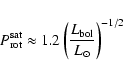
Moreover, since
scales as
,
also
 scales in the same way; to a good approximation:
 |
(6) |
![\begin{figure}
\par\includegraphics[width=8.8cm,clip]{MS2680f13.eps}
\end{figure}](/articles/aa/full/2003/01/aa2680/img148.gif) |
Figure 12: Relationship between our empirical time scale and the rotation period at which the saturated X-ray emission is reached. |
Copyright ESO 2003