

In order to study the relationship between activity and rotation on a
solid basis we have selected a sample of 259 solar-type dwarfs in the
color range
0.5<B-V<2.0, consisting of 110 field stars and 149 stars
belonging to the Pleiades ( 100 Myr), Hyades (700 Myr),
 Persei (50 Myr), IC 2602 (30 Myr) and IC 2391
(30 Myr) open clusters. It represents a significant extension of
the sample (70 stars) used by Stepien (1994) for an investigation
similar - in some respects - to the one carried out in the present
work; in particular, our sample is characterized by a better coverage of
stars in the low-mass end of the HR diagram (B-V>1.4).
Persei (50 Myr), IC 2602 (30 Myr) and IC 2391
(30 Myr) open clusters. It represents a significant extension of
the sample (70 stars) used by Stepien (1994) for an investigation
similar - in some respects - to the one carried out in the present
work; in particular, our sample is characterized by a better coverage of
stars in the low-mass end of the HR diagram (B-V>1.4).
All the selected stars were observed with ROSAT, but the main selection
constraint was the availability of photometrically-measured rotational
periods (with few exceptions described below); in fact, this sample covers
the period range
 days almost uniformly up to
 .
We have rejected stars known as close binary systems in order to
reduce as much as possible the contamination on both X-ray luminosity and
rotation due to stellar companions. All the selected field dwarfs and
cluster stars are listed in Tables 1 and 2,
respectively; for each star, these tables contain the stellar ID, Hipparcos
distance, B-V color, V magnitude, rotation period, X-ray emission data,
stellar mass and the original references.
.
We have rejected stars known as close binary systems in order to
reduce as much as possible the contamination on both X-ray luminosity and
rotation due to stellar companions. All the selected field dwarfs and
cluster stars are listed in Tables 1 and 2,
respectively; for each star, these tables contain the stellar ID, Hipparcos
distance, B-V color, V magnitude, rotation period, X-ray emission data,
stellar mass and the original references.
In order to take into account the effect on the B-V color due to the
interstellar absorption, we have assumed a constant reddening value 0.04 for all the Pleiades stars, 0.1 for Persei, 0.006 for IC 2391 and 0.04 for IC 2602 members, as already done in previous works (Micela et al. 1999; Randich et al. 1996; Patten & Simon 1996; Prosser et al.
1996, respectively). The B-V colors listed in Table 2 are
the de-reddened colors (B-V)0. Hyades members and field stars are much
closer to us and hence their colors are not significantly affected by
reddening. A color-magnitude diagram for all the stars in the sample is shown in
Fig. 1.
![\begin{figure}
\par\includegraphics[width=8.8cm,clip]{MS2680f1.eps}
\end{figure}](/articles/aa/full/2003/01/aa2680/img24.gif) |
Figure 1: Color-magnitude diagram for all 259 selected stars. Squares and crosses indicate cluster members and field stars respectively, while the solid line represents the zero-age-main-sequence location by Siess et al. (2000). |
In the B-V color range 0.5-1.4, most of the
stars are located near the theoretical zero-age-main-sequence (Siess et al. 2000), with the exception of few members of the IC 2602 cluster
and few field stars lying significantly above the main-sequence
location: these outliers could be binary systems still present in the
sample, pre-main-sequence stars, or field stars starting their
evolution across the Hertzsprung gap. We do not have any a priori
reason to exclude these stars from our sample, since the X-ray emission
from both pre-main-sequence stars and evolved stars with B-V>0.5 (corresponding
to a mass
 on the main-sequence) very likely has the
same coronal origin as in other solar-type dwarfs where a magnetic
dynamo mechanism is at work (see Pizzolato et al. 2000, for evolved
stars); "anomalously'' high X-ray emission levels could be expected
only for close binary systems not yet recognized as such.
For
1.4<B-V<1.6, the locus traced by cluster members appears to be
systematically above that traced by field stars, because these
low-mass cluster members are still in a pre-main-sequence phase of stellar
evolution.
Again, in the assumption that the X-ray emission from the
younger pre-main-sequence stars has a common magnetic origin with the other
sources, we have decided to keep these objects in our sample, carrying
on our analysis on the most extended sample as possible.
on the main-sequence) very likely has the
same coronal origin as in other solar-type dwarfs where a magnetic
dynamo mechanism is at work (see Pizzolato et al. 2000, for evolved
stars); "anomalously'' high X-ray emission levels could be expected
only for close binary systems not yet recognized as such.
For
1.4<B-V<1.6, the locus traced by cluster members appears to be
systematically above that traced by field stars, because these
low-mass cluster members are still in a pre-main-sequence phase of stellar
evolution.
Again, in the assumption that the X-ray emission from the
younger pre-main-sequence stars has a common magnetic origin with the other
sources, we have decided to keep these objects in our sample, carrying
on our analysis on the most extended sample as possible.
Finally, it is worth noticing that the low-mass end of our H-R diagram
(B-V>1.6) is occupied only by field stars because of the lack of
rotational periods for late M-type dwarfs in clusters.
All the stars selected for this study were detected with ROSAT. The X-ray
luminosities and part of the X-ray to bolometric luminosity ratios have
been retrieved from the original papers![[*]](/icons/foot_motif.gif) . In particular,
we have adopted the published
. In particular,
we have adopted the published
 for those stars
belonging to the Pleiades, Persei, IC 2602 and IC 2391 open
clusters, and for the field M dwarfs of our sample selected from Delfosse
et al. (1998). The bolometric luminosities of such cluster stars have
been computed by using the Johnson's (1966) data for B-V<1.34, while
the Monet et al. (1992) transformation between the bolometric correction
and the V-I color has been used for all the cluster members (including
the two Hyades stars) redder then B-V=1.34. Then, we have verified that
the bolometric luminosities computed via the Monet et al. (1992)
transformation and those derived with the bolometric correction curve vs. (R-I)C color used by Delfosse et al. (1998) differ by less than 2%.
For this reason, we have decided to adopt the calibration of Delfosse et al. (1998) also for the other field stars of the sample having
B-V>1.34, for which we have obtained the (R-I)C values from the
Kron R-I listed in the CNS3 catalogue (Gliese & Jahreiss 1991),
by means of the Bessel (1983) transformation.
Finally, for all the field stars with B-V<1.34 in our sample and for the
Hyades cluster members with similar colors we have estimated the bolometric
correction from the B-V color with the transformations by Flower (1996).
In fact, comparison between the bolometric luminosities based on the
Johnson's (1966) calibration and those obtained by using the Flower (1996)
calibration shows a measured scatter also lower than 2%.
for those stars
belonging to the Pleiades, Persei, IC 2602 and IC 2391 open
clusters, and for the field M dwarfs of our sample selected from Delfosse
et al. (1998). The bolometric luminosities of such cluster stars have
been computed by using the Johnson's (1966) data for B-V<1.34, while
the Monet et al. (1992) transformation between the bolometric correction
and the V-I color has been used for all the cluster members (including
the two Hyades stars) redder then B-V=1.34. Then, we have verified that
the bolometric luminosities computed via the Monet et al. (1992)
transformation and those derived with the bolometric correction curve vs. (R-I)C color used by Delfosse et al. (1998) differ by less than 2%.
For this reason, we have decided to adopt the calibration of Delfosse et al. (1998) also for the other field stars of the sample having
B-V>1.34, for which we have obtained the (R-I)C values from the
Kron R-I listed in the CNS3 catalogue (Gliese & Jahreiss 1991),
by means of the Bessel (1983) transformation.
Finally, for all the field stars with B-V<1.34 in our sample and for the
Hyades cluster members with similar colors we have estimated the bolometric
correction from the B-V color with the transformations by Flower (1996).
In fact, comparison between the bolometric luminosities based on the
Johnson's (1966) calibration and those obtained by using the Flower (1996)
calibration shows a measured scatter also lower than 2%.
All rotation periods used in the following analysis are derived from
photometric measurements (see references in Tables 1 and 2) except
for 16 M-type field stars in Delfosse et al. (1998), for which the periods are calculated from  data and
accurate determinations of the stellar radii (Beuermann et al. 1999).
These stars are marked with an arrow on the rotation period in all the
relevant figures of this paper.
data and
accurate determinations of the stellar radii (Beuermann et al. 1999).
These stars are marked with an arrow on the rotation period in all the
relevant figures of this paper.
In Fig. 2 we show the rotation periods vs. B-V color
for the whole sample: the low-velocity field dwarfs and the
high-velocity cluster stars improve the completeness of our sample
with respect to previous works, from the point of view of the covered
range of rotation periods, especially for
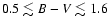 .
.
![\begin{figure}
\par\includegraphics[width=8.8cm,clip]{MS2680f3.eps}
\end{figure}](/articles/aa/full/2003/01/aa2680/img29.gif) |
Figure 3:
X-ray luminosity vs. rotation period of field
dwarfs (crosses) and cluster stars (squares). Leftward arrows indicate
field stars with periods derived from
data. |
![\begin{figure}
\par\includegraphics[width=8.8cm,clip]{MS2680f4.eps}
\end{figure}](/articles/aa/full/2003/01/aa2680/img30.gif) |
Figure 4: X-ray to bolometric luminosity ratio vs. rotation period for field dwarfs (crosses) and cluster stars (squares). The meaning of the leftward symbols is the same as in Fig. 3. |
Copyright ESO 2003
![\begin{figure}
\par\includegraphics[width=8.8cm,clip]{MS2680f2.eps}
\end{figure}](/articles/aa/full/2003/01/aa2680/img27.gif)