

 and an empirical Rossby number
  can be obtained
for main sequence late-type stars having different masses or spectral types (i.e. different properties of the convection zone). The importance of our result
rests on the inclusion - for the first time with respect to past works by
Noyes et al. (1984) and by Stepien (1994) - of very late-type stars with
can be obtained
for main sequence late-type stars having different masses or spectral types (i.e. different properties of the convection zone). The importance of our result
rests on the inclusion - for the first time with respect to past works by
Noyes et al. (1984) and by Stepien (1994) - of very late-type stars with
 ,
comprising some fully convective stars. For the first
time we have also determined the functional dependence on the stellar mass
of an empirically X-ray-derived characteristic time scale,
,
comprising some fully convective stars. For the first
time we have also determined the functional dependence on the stellar mass
of an empirically X-ray-derived characteristic time scale,
 ,
and, independently, we have carried out our analysis also with the B-V color.
,
and, independently, we have carried out our analysis also with the B-V color.
However, the clear observational link between
and the empirical Rossby number does not imply by itself the
interpretation of the mass-dependent quantity
 as a
convective time. For this reason, we have performed a comparison
between our empirical time scale and the theoretical values of the
convective turnover time,
as a
convective time. For this reason, we have performed a comparison
between our empirical time scale and the theoretical values of the
convective turnover time,
 .
We have confirmed that the
function
is very similar to
for stars
in the entire mass range considered (Fig. 10).
For fully-convective late-type stars with
.
We have confirmed that the
function
is very similar to
for stars
in the entire mass range considered (Fig. 10).
For fully-convective late-type stars with
 ,
we have
shown that
is still consistent with the corresponding
values predicted by theoretical models. This is a new and significant
result, because of insufficient data in previous works for such a
comparison.
,
we have
shown that
is still consistent with the corresponding
values predicted by theoretical models. This is a new and significant
result, because of insufficient data in previous works for such a
comparison.
Another important point is that the function
 turns
out to have the same functional shape as
turns
out to have the same functional shape as
 ,
in the
range
0.5<B-V<1.5. For this reason we can assert that for
non-saturated stars the
,
in the
range
0.5<B-V<1.5. For this reason we can assert that for
non-saturated stars the  vs.
vs.
 relationship is equivalent to the relationship
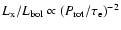 .
.
The analysis developed to investigate the physical meaning of an
empirical X-ray-derived Rossby number has forced us to revisit the
relationship between X-ray emission and rotation. Our results show
that the coronal X-ray emission increases roughly as a power law of the
stellar rotation period independently of the stellar mass or spectral
class, thus demonstrating that the stellar rotation dominates over
convection in the magnetic dynamo operating in non-saturated late-type
dwarfs, including stars with
.
On the other hand, the X-ray emission level from saturated stars depends
only on
 ,
and hence it appears to be dependent on the
characteristics of the stellar structure.
,
and hence it appears to be dependent on the
characteristics of the stellar structure.
In this contest, the most important result is that, independently of the
X-ray emission indicator used in our study, the X-ray emission saturation
occurs below a critical rotation period,
 ,
increasing with decreasing stellar mass, in a way that we have
quantitatively estimated.
,
increasing with decreasing stellar mass, in a way that we have
quantitatively estimated.
Equivalently, we have also demonstrated that
scales as
:
this link suggests that the saturation of
the X-ray emission in late-type main sequence stars can be considered as
an effect depending on the properties of the convective region as well as
an effect depending on the total energy budget available in the star. We
believe that in the near future the study of the activity-rotation
connection in samples of stars having different evolutionary stages will
enable us to test on a more solid basis the relationship between the
characteristic time scale
and the bolometric luminosity,
thus contributing to complete our current picture of the stellar magnetic
activity.
Acknowledgements
The authors acknowledge partial support for this work from Agenzia Spaziale Italiana, Ministero dell'Università e della Ricerca Scientifica e Tecnologica and CNAA. F. D'Antona is also gratefully acknowledged for clarifying discussions, and we also thank the referee S. Randich for her useful comments and suggestions.
Copyright ESO 2003