In this section we give basic information about the equation of state that is currently used in our simulations of stellar core collapse and supernovae.
We employ the equation
of state (EoS) of Lattimer & Swesty (1991) with a value of
 for the incompressibility modulus of bulk nuclear
matter. The other parameters can be found in the paper of Lattimer & Swesty (1991).
Since this EoS assumes
matter to be in nuclear statistical equilibrium (NSE) it is
applicable only for sufficiently high temperatures and densities.
A more general equation of state, which consistently extends
to lower temperatures and densities not being available, we have
supplemented the EoS of Lattimer & Swesty (1991)
with an EoS that describes a mixture of ideal gases of nucleons and
nuclei with given abundances, plus ideal gases of electrons and
positrons of arbitrary degeneracy and relativity, plus photons
(Janka 1999).
The latter EoS includes Coulomb lattice corrections for the pressure,
energy density, entropy, and adiabatic index.
for the incompressibility modulus of bulk nuclear
matter. The other parameters can be found in the paper of Lattimer & Swesty (1991).
Since this EoS assumes
matter to be in nuclear statistical equilibrium (NSE) it is
applicable only for sufficiently high temperatures and densities.
A more general equation of state, which consistently extends
to lower temperatures and densities not being available, we have
supplemented the EoS of Lattimer & Swesty (1991)
with an EoS that describes a mixture of ideal gases of nucleons and
nuclei with given abundances, plus ideal gases of electrons and
positrons of arbitrary degeneracy and relativity, plus photons
(Janka 1999).
The latter EoS includes Coulomb lattice corrections for the pressure,
energy density, entropy, and adiabatic index.
In general, the regime of NSE is bounded from below by a complicated
hyperplane in
 -space.
For our purposes, however, it is sufficient to assume that
the transition between the two regimes (and thus the two equations
of state) takes place at a fixed value of the density
-space.
For our purposes, however, it is sufficient to assume that
the transition between the two regimes (and thus the two equations
of state) takes place at a fixed value of the density  :
If the density of a fluid element fulfils the condition
:
If the density of a fluid element fulfils the condition

 ,
the temperature in a supernova
core is usually large enough (
,
the temperature in a supernova
core is usually large enough (
 MeV) to ensure that NSE
holds.
Therefore the EoS of Lattimer & Swesty (1991) can be used at such conditions.
If the density drops below the value ,
the non-NSE equation of
state is invoked.
Since both EoSs employ a similar description of the physical
properties of stellar matter at densities in the range between
107
and 108
,
the merging of them across the
MeV) to ensure that NSE
holds.
Therefore the EoS of Lattimer & Swesty (1991) can be used at such conditions.
If the density drops below the value ,
the non-NSE equation of
state is invoked.
Since both EoSs employ a similar description of the physical
properties of stellar matter at densities in the range between
107
and 108
,
the merging of them across the
 -plane at
is sufficiently smooth as far as, e.g., the pressure, internal energy
density and chemical potentials as functions of density are concerned.
-plane at
is sufficiently smooth as far as, e.g., the pressure, internal energy
density and chemical potentials as functions of density are concerned.
A particular complication, however, arises with the chemical
composition of the stellar plasma.
Lattimer & Swesty (1991) describe the baryonic part of the EoS as a mixture of
nucleons,  -particles and a heavy nucleus with in general
non-integer mass and charge numbers (A,Z).
The latter is considered
to be representative of a mixture of heavy nuclei that coexist at
given
.
Assuming NSE, the corresponding number densities of the
nuclear constituents and the mass and charge numbers of the
representative heavy nucleus are given as a function of the local values
of
-particles and a heavy nucleus with in general
non-integer mass and charge numbers (A,Z).
The latter is considered
to be representative of a mixture of heavy nuclei that coexist at
given
.
Assuming NSE, the corresponding number densities of the
nuclear constituents and the mass and charge numbers of the
representative heavy nucleus are given as a function of the local values
of  ,
T, and
,
T, and
 .
At the transition from NSE to non-NSE, the nuclear composition
freezes out and one would ideally want to retain the baryonic abundances
as given by the EoS of Lattimer & Swesty (1991) at .
While this is no
problem in case of a Lagrangian hydrodynamics code, where the grid
cells follow the evolution of individual fluid elements with specific
information about the chemical composition attributed, the use of an
Eulerian or moving grid requires a more complicated numerical
procedure. Here, additional advection equations (similar to
Eq. (4)) for the different nuclear components must be
integrated to trace the temporal evolution of the composition on the
whole numerical grid. With a finite, fixed number of such conservation
equations to be solved in the code, one cannot allow for an arbitrarily
large ensemble of different nuclear species with non-integer mass and
charge numbers, as provided at freeze-out from NSE at
by the
EoS of Lattimer & Swesty (1991). Instead, we predefine a discrete set of nuclei
.
At the transition from NSE to non-NSE, the nuclear composition
freezes out and one would ideally want to retain the baryonic abundances
as given by the EoS of Lattimer & Swesty (1991) at .
While this is no
problem in case of a Lagrangian hydrodynamics code, where the grid
cells follow the evolution of individual fluid elements with specific
information about the chemical composition attributed, the use of an
Eulerian or moving grid requires a more complicated numerical
procedure. Here, additional advection equations (similar to
Eq. (4)) for the different nuclear components must be
integrated to trace the temporal evolution of the composition on the
whole numerical grid. With a finite, fixed number of such conservation
equations to be solved in the code, one cannot allow for an arbitrarily
large ensemble of different nuclear species with non-integer mass and
charge numbers, as provided at freeze-out from NSE at
by the
EoS of Lattimer & Swesty (1991). Instead, we predefine a discrete set of nuclei
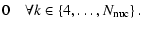
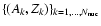 at the beginning of the
simulation, with k=1 for neutrons, k=2 for protons, k=3 for
-particles and
at the beginning of the
simulation, with k=1 for neutrons, k=2 for protons, k=3 for
-particles and
 for a number of
suitably chosen heavy nuclei. When the conditions in a computational
cell change from NSE to non-NSE, we must map the NSE
composition
for a number of
suitably chosen heavy nuclei. When the conditions in a computational
cell change from NSE to non-NSE, we must map the NSE
composition
 as given by the EoS of
Lattimer & Swesty (1991) to our discrete sample of species
with the constraints of charge
neutrality and baryon number conservation.
as given by the EoS of
Lattimer & Swesty (1991) to our discrete sample of species
with the constraints of charge
neutrality and baryon number conservation.
The following procedure turned out to yield very satisfactory
results. It is applied at each time step and in cells of the
computational grid, which are close to a possible breakdown of NSE
(i.e. which are close to ). Applying this procedure also in
grid cells where NSE still holds and the EoS of Lattimer & Swesty (1991) is
used, makes sure that the compositional information is available for a
transition to the non-NSE regime, if the freeze-out condition
(
 )
is reached during a hydrodynamic time step.
First we identify the densities of neutrons and -particles
with their NSE values:
)
is reached during a hydrodynamic time step.
First we identify the densities of neutrons and -particles
with their NSE values:
 ,
,
 .
For given density
and electron
fraction
,
the number densities of protons and nuclei,
.
For given density
and electron
fraction
,
the number densities of protons and nuclei,  and
n(Aj,Zj), respectively, can then be determined from the
requirements of charge neutrality and baryon number conservation.
The index (Aj,Zj) points to a particular nucleus
and
n(Aj,Zj), respectively, can then be determined from the
requirements of charge neutrality and baryon number conservation.
The index (Aj,Zj) points to a particular nucleus
 ,
which is chosen from the set of non-NSE nuclei.
It is associated with the representative heavy nucleus
,
which is chosen from the set of non-NSE nuclei.
It is associated with the representative heavy nucleus
 according to the conditions:
which is closest to
concerning its mass
number. A unique solution requires that no isobars exist in the
ensemble. The second and third conditions guarantee that
 and
and
 .
.
Both the EoS of Lattimer & Swesty (1991) and the non-baryonic part of our
low-density equation of state are stored in tabular form for our
calculations. Our table of the EoS of Lattimer & Swesty (1991)
has 180 and 120
logarithmically spaced entries within the density range

 and the temperature
range
and the temperature
range
 ,
respectively,
and 50 equally spaced entries for
,
respectively,
and 50 equally spaced entries for
 .
Similarly, the table for the
lepton plus photon EoS Janka (1999) has 441 entries for
10-10
.
Similarly, the table for the
lepton plus photon EoS Janka (1999) has 441 entries for
10-10
 and 141 entries
for
and 141 entries
for
 .
Intermediate values are obtained by trilinear interpolation
in
.
Intermediate values are obtained by trilinear interpolation
in  ,
,
 ,
and bilinear
interpolation in
,
and bilinear
interpolation in
 ,
,
respectively.
,
,
respectively.
Using EoSs in a discretized form we have performed the test
calculation suggested by Swesty (1996, Sect. 4) for exploring the
accuracy of the EoS evaluation.
From our tests we can exclude any serious "unphysical
entropy production or loss in otherwise adiabatic flows''
(Swesty 1996).
For several combinations of initial values for
and s that are
typical of conditions encountered in core-collapse simulations, we
found the
deviations from adiabaticity to be negligibly small. The relative
change of the entropy per baryon was less than 10-3 for a
density increase by a factor of 104.
-particles to heavy nuclei can change the baryonic composition
in the regime below the transition density (
 )
from the EoS of Lattimer & Swesty (1991) to the low-density EoS.
We take into account complete burning of carbon, nitrogen, oxygen,
magnesium and silicon as well as nuclear
dissociation and recombination in approximate ways.
)
from the EoS of Lattimer & Swesty (1991) to the low-density EoS.
We take into account complete burning of carbon, nitrogen, oxygen,
magnesium and silicon as well as nuclear
dissociation and recombination in approximate ways.
When the condition for silicon burning applies, which is taken to be
 K (Hix & Thielemann 1999; Mezzacappa et al. 2001), we simply add
up the local mass fractions of
K (Hix & Thielemann 1999; Mezzacappa et al. 2001), we simply add
up the local mass fractions of
![$\element[][28]{Si}$](/articles/aa/full/2002/46/aa2451/img773.gif) and
and
![$\element[][56]{Ni}$](/articles/aa/full/2002/46/aa2451/img774.gif) :
:
![$X^{n+1}_{\element[][56]{Ni}}=X^{n}_{\element[][56]{Ni}}+
X^{n}_{\element[][28]{Si}}$](/articles/aa/full/2002/46/aa2451/img775.gif) ,
and set
,
and set
![$X^{n+1}_{\element[][28]{Si}}=0$](/articles/aa/full/2002/46/aa2451/img776.gif) .
Analogously, we treat the burning of
.
Analogously, we treat the burning of
![$\element[][12]{C}$](/articles/aa/full/2002/46/aa2451/img777.gif) to
to
![$\element[][24]{Mg}$](/articles/aa/full/2002/46/aa2451/img778.gif) with a threshold temperature of
with a threshold temperature of
 K
and of
K
and of
![$\element[][16]{O}$](/articles/aa/full/2002/46/aa2451/img780.gif) ,
,
![$\element[][20]{Ne}$](/articles/aa/full/2002/46/aa2451/img781.gif) ,
to
at
,
to
at
 K
(Woosley et al. 2002).
K
(Woosley et al. 2002).
When the density drops into the range
and the
temperature fulfills
 K at the same time the baryonic
composition is adjusted to account for the photo-disintegration of
nuclei and the recombination of free nucleons and -particles
to
.
We distinguish between three different
regimes (I-III), separated by curves
K at the same time the baryonic
composition is adjusted to account for the photo-disintegration of
nuclei and the recombination of free nucleons and -particles
to
.
We distinguish between three different
regimes (I-III), separated by curves
 in the
-T-plane (see Fig. B.1):
in the
-T-plane (see Fig. B.1):
 is derived from the equations of
Saha equilibrium assuming a mixture of half (by mass)
is derived from the equations of
Saha equilibrium assuming a mixture of half (by mass)
![$\element[][56]{Fe}$](/articles/aa/full/2002/46/aa2451/img787.gif) and half -particles and
free neutrons.
and half -particles and
free neutrons.
![\begin{figure}
\includegraphics[width=9cm,clip]{ms2451f27.eps}\end{figure}](/articles/aa/full/2002/46/aa2451/img788.gif) |
Figure B.1:
Area in the -T-plane in the vicinity of the transition
between the EoS of Lattimer & Swesty (1991) and the low-density EoS.
The transition density
is indicated by the vertical dash-dotted line.
The curves
and
 bound three separate
regions (I-III) in the
-T-plane, where different prescriptions are used for
determining the nuclear composition in the low-density regime.
Region I contains heavy nuclei and possibly free nucleons, in region
II the composition is determined by -particles and free
nucleons, and in region III all nuclei and -particles are
dissolved.
Below the temperature marked by the solid horizontal line
the recombination of -particles and free nucleons is
suppressed.
The threshold temperatures of the different burning reactions are
given by the horizontal dotted lines.
bound three separate
regions (I-III) in the
-T-plane, where different prescriptions are used for
determining the nuclear composition in the low-density regime.
Region I contains heavy nuclei and possibly free nucleons, in region
II the composition is determined by -particles and free
nucleons, and in region III all nuclei and -particles are
dissolved.
Below the temperature marked by the solid horizontal line
the recombination of -particles and free nucleons is
suppressed.
The threshold temperatures of the different burning reactions are
given by the horizontal dotted lines. |
is defined by half the mass being in
-particles and half in free nucleons (see Shapiro & Teukolsky 1983, Chap. 18).
In detail the nuclear composition in the three regions is obtained
from the following prescriptions:
 ,
all free nucleons and a fraction
,
all free nucleons and a fraction
 of possibly existing -particles in a
corresponding grid cell are assumed to form
.
Pairing a suitable number of free neutrons and protons we therefore
set for the new composition:
of possibly existing -particles in a
corresponding grid cell are assumed to form
.
Pairing a suitable number of free neutrons and protons we therefore
set for the new composition:
 ,
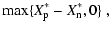
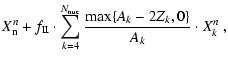
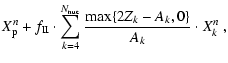
-particles are formed by the disintegration of heavy
nuclei and the recombination of free nucleons. The new composition is
given by:
,
-particles are formed by the disintegration of heavy
nuclei and the recombination of free nucleons. The new composition is
given by:
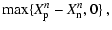
 |
= |  |
|
 |
= |  |
|
![$\displaystyle X^{n+1}_{\element[][4]{He}}$](/articles/aa/full/2002/46/aa2451/img795.gif) |
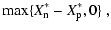
= | ![$\displaystyle X^{*}_{\element[][4]{He}}+2\cdot\min\{X^{*}_{\rm n},X^{*}_{\rm p}\}~,$](/articles/aa/full/2002/46/aa2451/img802.gif) |
|
| Xn+1k | = |  |
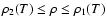
 is the degree of dissociation
of heavy nuclei which is determined as outlined below.
is the degree of dissociation
of heavy nuclei which is determined as outlined below.
 ,
all heavy nuclei and a fraction
,
all heavy nuclei and a fraction
 of the -particles is disintegrated into
free nucleons:
of the -particles is disintegrated into
free nucleons:
Nuclear transmutations release (or consume) nuclear binding energy. Consequences of this effect should be taken into account in the hydrodynamical simulation. Since our EoS defines the internal energy density such that contributions from nuclear rest masses are included, the conversion between nuclear binding energy and thermal energy will automatically lead to corresponding changes of the temperature, pressure, entropy etc. of the stellar gas.
The factors  ,
,
 and
and
 are
equal to unity in the corresponding regions I, II or III, respectively
of the -T-plane but vary between 0 and 1 at the boundary
curves (Eqs. (B.2), (B.3)). This means that
the composition changes take place only on the curves
and .
The degree of dissociation or
recombination (expressed by the values
are
equal to unity in the corresponding regions I, II or III, respectively
of the -T-plane but vary between 0 and 1 at the boundary
curves (Eqs. (B.2), (B.3)). This means that
the composition changes take place only on the curves
and .
The degree of dissociation or
recombination (expressed by the values
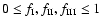 )
is limited by
the available internal energy.
Starting out with given internal energy density (at a fixed value of
)
and taking into account temperature variations due to changes
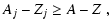
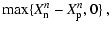
of the nuclear composition, the numerical algorithm maximizes
,
or
,
while keeping the
temperature on the boundary curves until the dissociation or
recombination is complete.
)
is limited by
the available internal energy.
Starting out with given internal energy density (at a fixed value of
)
and taking into account temperature variations due to changes
of the nuclear composition, the numerical algorithm maximizes
,
or
,
while keeping the
temperature on the boundary curves until the dissociation or
recombination is complete.
Copyright ESO 2002




![$\displaystyle (1-f_{\rm I})\cdot
X^{n}_{\element[][4]{He}} ~,$](/articles/aa/full/2002/46/aa2451/img796.gif)
![$\displaystyle X^{n+1}_{\element[][56]{Ni}}$](/articles/aa/full/2002/46/aa2451/img797.gif)
![$\displaystyle X^{n}_{\element[][56]{Ni}}
+f_{\rm I}\cdot X^{n}_{\element[][4]{He}}
+2\cdot\min\{X^{n}_{\rm n},X^{n}_{\rm p}\} ~.$](/articles/aa/full/2002/46/aa2451/img798.gif)


![$\displaystyle X^{*}_{\element[][4]{He}}$](/articles/aa/full/2002/46/aa2451/img808.gif)
![$\displaystyle X^{n}_{\element[][4]{He}}+f_{\rm II}\cdot
2\sum_{k=4}^{N_{\rm nuc}}\frac{\min\{A_k-Z_k,Z_k\}}{A_k}\cdot X^{n}_{k} ~.$](/articles/aa/full/2002/46/aa2451/img809.gif)
![$\displaystyle X^{n}_{\rm n}
+f_{\rm III}\cdot\frac{1}{2}X^{n}_{\element[][4]{He}}
+\sum_{k=4}^{N_{\rm nuc}}
\frac{A_k-Z_k}{A_k}\cdot X^{n}_{k} ~,$](/articles/aa/full/2002/46/aa2451/img813.gif)
![$\displaystyle X^{n}_{\rm p}
+f_{\rm III}\cdot\frac{1}{2}X^{n}_{\element[][4]{He}}
+\sum_{k=4}^{N_{\rm nuc}}
\frac{Z_k}{A_k}\cdot X^{n}_{k} ~,$](/articles/aa/full/2002/46/aa2451/img814.gif)
![$\displaystyle (1-f_{\rm III})\cdot X^{n}_{\element[][4]{He}}~,$](/articles/aa/full/2002/46/aa2451/img815.gif)