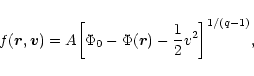
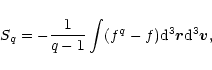
Recently, Taruya & Sakagami (2002) have investigated the stability of polytropic spheres within the framework of generalized thermodynamics. It has been argued by Tsallis and co-workers that ordinary statistical mechanics and thermodynamics does not describe correctly systems with long-range interactions, which are in essence non extensive. A family of functionals of the form
 .
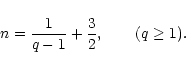
This new formalism has been applied in various domains of physics, astrophysics, fluid mechanics, biology, economy etc. and it extends the results obtained with ordinary statistical mechanics. In the case of self-gravitating systems, it was shown by Plastino & Plastino (1993) that the extremalization of the Tsallis entropy at fixed mass and energy yields a polytropic equation of state of the form (1). The parameter q is related to the index n of the polytrope by the relation
.
This new formalism has been applied in various domains of physics, astrophysics, fluid mechanics, biology, economy etc. and it extends the results obtained with ordinary statistical mechanics. In the case of self-gravitating systems, it was shown by Plastino & Plastino (1993) that the extremalization of the Tsallis entropy at fixed mass and energy yields a polytropic equation of state of the form (1). The parameter q is related to the index n of the polytrope by the relation
 depending on the index of the
configuration. In the limit
depending on the index of the
configuration. In the limit
 ,
the Antonov result
,
the Antonov result
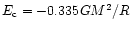 obtained with the Boltzmann entropy is
recovered. Furthermore, they showed that the onset of instability
coincides with the point of minimum energy in the series of
equilibrium in agreement with standard turning point analysis (e.g.,
Katz 1978). For n<5, there is no critical value of energy and the
polytropic configurations are stable. These results differ from those
obtained in the present paper where it is found that the index marking
the transition from stability to instability is n=3 (in agreement
with standard theorems of stellar pulsations). The origin of this
discrepency is certainly related to the inequivalence of statistical
ensembles in extended thermodynamics, like in ordinary thermodynamics,
for self-gravitating systems (see, e.g., Padmanabhan 1990; Chavanis
2002c; Chavanis et al. 2002). Taruya & Sakagami work in the
microcanonical ensemble and maximize Tsallis entropy at fixed mass and
energy. On the contrary, in our study, we keep the polytropic
temperature
obtained with the Boltzmann entropy is
recovered. Furthermore, they showed that the onset of instability
coincides with the point of minimum energy in the series of
equilibrium in agreement with standard turning point analysis (e.g.,
Katz 1978). For n<5, there is no critical value of energy and the
polytropic configurations are stable. These results differ from those
obtained in the present paper where it is found that the index marking
the transition from stability to instability is n=3 (in agreement
with standard theorems of stellar pulsations). The origin of this
discrepency is certainly related to the inequivalence of statistical
ensembles in extended thermodynamics, like in ordinary thermodynamics,
for self-gravitating systems (see, e.g., Padmanabhan 1990; Chavanis
2002c; Chavanis et al. 2002). Taruya & Sakagami work in the
microcanonical ensemble and maximize Tsallis entropy at fixed mass and
energy. On the contrary, in our study, we keep the polytropic
temperature
 constant, which corresponds to the
canonical description. It would be of interest to study the
maximization of Tsallis free energy at fixed mass and temperature to
see if it provides the same conditions of stability as our dynamical
approach based on the Navier-Stokes equations. For the Boltzmann
entropy, a clear connexion was found between dynamical stability and
thermodynamical stability in the canonical ensemble (Semelin et al. 2001; Chavanis 2002a) and it is desirable to check whether this
connexion is preserved by Tsallis generalized thermodynamics. This
requires in particular to define properly the notion of temperature
and free energy in the generalized sense.
constant, which corresponds to the
canonical description. It would be of interest to study the
maximization of Tsallis free energy at fixed mass and temperature to
see if it provides the same conditions of stability as our dynamical
approach based on the Navier-Stokes equations. For the Boltzmann
entropy, a clear connexion was found between dynamical stability and
thermodynamical stability in the canonical ensemble (Semelin et al. 2001; Chavanis 2002a) and it is desirable to check whether this
connexion is preserved by Tsallis generalized thermodynamics. This
requires in particular to define properly the notion of temperature
and free energy in the generalized sense.
In Figs. 8-11, we have represented the equilibrium
phase diagram (for different values of n) obtained in the framework
of extended thermodynamics, interpreting the parameter  as a generalized
inverse temperature. The temperature-energy curve is defined
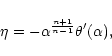
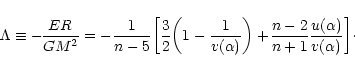
in a parametric form by the equations
as a generalized
inverse temperature. The temperature-energy curve is defined
in a parametric form by the equations
presents a maximum but not the energy. Therefore, the polytropes are always stable in the microcanonical ensemble but they are unstable in the canonical ensemble after the turning point. It can be noted that the unstable region has a negative specific heat
 (in the generalized sense). For n>5, the temperature and the energy both present an infinite number of extrema. For
  ,
there are crossing points at which two solutions have the same value of temperature and energy but a different density contrast (to our knowledge, this is the first time such a situation is reported). The polytropes are unstable in the canonical ensemble after the first turning point of temperature and they are unstable in the microcanonical ensemble after the first turning point of energy. These results are strikingly similar to those obtained with the classical Boltzmann entropy
,
there are crossing points at which two solutions have the same value of temperature and energy but a different density contrast (to our knowledge, this is the first time such a situation is reported). The polytropes are unstable in the canonical ensemble after the first turning point of temperature and they are unstable in the microcanonical ensemble after the first turning point of energy. These results are strikingly similar to those obtained with the classical Boltzmann entropy
 .
.
It is interesting that the results obtained for isothermal gas spheres
described by ordinary thermodynamics (Boltzmann entropy) can be
extended to polytropic configurations by introducing a generalized
functional (Tsallis entropy). This makes this new formalism of
interest. However, we would like to make two comments. (i) First of all,
Tsallis entropy does not describe polytropic gaseous stars
although it yields an equation of state of the polytropic form. Indeed,
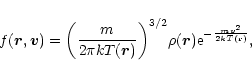
Tsallis entropy predicts in addition a distribution function of
the form
 (recall that, for convective
equilibrium, the entropy is uniform not the temperature). In view of
these remarks, the connexion between generalized thermodynamical
stability (in the canonical ensemble) and dynamical stability with
respect to Navier-Stokes equations is not obvious. It is however
expected to be true since the condition of dynamical stability is
consistent with the turning point argument of thermodynamical
stability. (ii) Tsallis entropy could describe a particular class of
stellar systems, apparently not observed in nature, known as stellar
polytropes (see Binney & Tremaine 1987). These systems have the same
structure as polytropic gas spheres in physical space but not in phase
space (the equivalence only occurs for a polytropic index
(recall that, for convective
equilibrium, the entropy is uniform not the temperature). In view of
these remarks, the connexion between generalized thermodynamical
stability (in the canonical ensemble) and dynamical stability with
respect to Navier-Stokes equations is not obvious. It is however
expected to be true since the condition of dynamical stability is
consistent with the turning point argument of thermodynamical
stability. (ii) Tsallis entropy could describe a particular class of
stellar systems, apparently not observed in nature, known as stellar
polytropes (see Binney & Tremaine 1987). These systems have the same
structure as polytropic gas spheres in physical space but not in phase
space (the equivalence only occurs for a polytropic index  ,
i.e. for an isothermal configuration). This distinction is important
because isolated stellar polytropes are always stable with respect to
the Vlasov (or collisionless Boltzmann) equation (see Binney &
Tremaine 1987) while isolated polytropic stars are unstable with
respect to the Navier-Stokes equations for
,
i.e. for an isothermal configuration). This distinction is important
because isolated stellar polytropes are always stable with respect to
the Vlasov (or collisionless Boltzmann) equation (see Binney &
Tremaine 1987) while isolated polytropic stars are unstable with
respect to the Navier-Stokes equations for  .
Generalized
thermodynamics could be developed (at least formally) for this particular
class of stellar systems.
.
Generalized
thermodynamics could be developed (at least formally) for this particular
class of stellar systems.
However, generalized thermodynamics is often presented as a way of
solving the "problems'' associated with the use of the Boltzmann
entropy in systems with long-range interactions and we would like to
criticize this interpretation. For self-gravitating systems, the
"problems'' usually reported are the absence of global entropy
maximum (resulting in the "infinite mass problem'' and the
"gravothermal catastrophe''), the negative specific heats, the
inequivalence of statistical ensembles and the absence of
a thermodynamical limit. It should be noted that the Tsallis
entropy displays the same phenomena, at least for values of q<9/7(i.e. n>5) considered by Taruya & Sakagami (2002). On the other
hand, these relatively unusual phenomena should not cause surprise if
one recognizes that self-gravitating systems are relatively
exceptional among N-body systems. For example the "infinite mass
problem'' (see, e.g., Binney
& Tremaine 1987) is just a mathematical curiosity.
There is no justification in maximizing entropy in an infinite
domain even if an entropy maximum exists. Due to kinetic effects, the
relaxation is incomplete and the ergodic hypothesis
which sustains the statistical analysis is necessarily restricted to a finite region of space. This incomplete relaxation is qualitatively
discussed by Lynden-Bell (1967) in his statistical description of the
"violent relaxation'' of collisionless stellar systems (e.g.,
elliptical galaxies). A similar limitation occurs in the context of
two-dimensional turbulence to understand the confinement of vortices
that form after a rapid merging (see, e.g., Chavanis & Sommeria 1998
and in particular Brands et al. 1999 for a discussion of
Tsallis entropy in fluid dynamics). This incomplete relaxation can be
described by kinetic equations of the form proposed by Chavanis et
al. (1996) with a space dependant diffusion coefficient. Convincing
numerical evidence of this kinetic confinement has been given by Robert &
Rosier (1997) in two-dimensional turbulence. In addition, in
astrophysics, specific processes (e.g., the evaporation of stars,
tidal effects, etc.) must be taken into account and can restrict the
domain of applicability of statistical mechanics. These limitations
are usually accounted for by introducing truncated models like the
Michie-King model for globular clusters or the models proposed by
Stiavelli & Bertin (1987) or Hjorth & Madsen (1993) for elliptical
galaxies. These models lead to composite configurations with an
isothermal core and a polytropic envelope. With these modifications
(justified by precise physical arguments), ordinary statistical
mechanics provides in general a good explanation of astrophysical
phenomena and is consistent with observations. Note that the
above-mentioned truncated models differ from pure polytropes, so that
they cannot be justified by generalized thermodynamics![[*]](/icons/foot_motif.gif) . On the other
hand, the "gravothermal catastrophe'' (Lynden-Bell & Wood 1968)
should not throw doubt on the validity of statistical mechanical
arguments applied to self-gravitating systems. On the contrary, it is
gratifying that standard thermodynamics is consistent with the natural
tendency of self-gravitating systems to undergo a gravitational
collapse (Jeans instability). The gravothermal catastrophe has been
confirmed by sophisticated numerical simulations (see, e.g., Larson
1970; Cohn 1980) based on standard kinetic theory
(Landau-Fokker-Planck equations) and it is expected to be at work in
globular clusters. The existence of negative specific heats in the
microcanonical ensemble (and the resulting inequivalence of
statistical ensembles) is a direct consequence of the Virial theorem
for self-gravitating systems and is not in contradiction with ordinary
thermodynamics (Lynden-Bell & Lynden-Bell 1977; Padmanabhan
1990). Finally, self-gravitating systems have a well-defined (albeit
unusual) thermodynamical limit in which the number of particles Nand the volume R3 go to infinity keeping N/R fixed (see, e.g.,
de Vega & Sanchez 2001).
. On the other
hand, the "gravothermal catastrophe'' (Lynden-Bell & Wood 1968)
should not throw doubt on the validity of statistical mechanical
arguments applied to self-gravitating systems. On the contrary, it is
gratifying that standard thermodynamics is consistent with the natural
tendency of self-gravitating systems to undergo a gravitational
collapse (Jeans instability). The gravothermal catastrophe has been
confirmed by sophisticated numerical simulations (see, e.g., Larson
1970; Cohn 1980) based on standard kinetic theory
(Landau-Fokker-Planck equations) and it is expected to be at work in
globular clusters. The existence of negative specific heats in the
microcanonical ensemble (and the resulting inequivalence of
statistical ensembles) is a direct consequence of the Virial theorem
for self-gravitating systems and is not in contradiction with ordinary
thermodynamics (Lynden-Bell & Lynden-Bell 1977; Padmanabhan
1990). Finally, self-gravitating systems have a well-defined (albeit
unusual) thermodynamical limit in which the number of particles Nand the volume R3 go to infinity keeping N/R fixed (see, e.g.,
de Vega & Sanchez 2001).
Therefore, we are tempted to believe that ordinary statistical mechanics is still relevant to describe self-gravitating systems (and two-dimensional vortices). An isothermal distribution corresponds to the most probable distribution reached by a system after a complex evolution during which microscopic information is lost. Accordingly, it maximizes the Boltzmann entropy, which is a measure of the number of microstates associated with a given macrostate (see, e.g., Ogorodnikov 1965; Lynden-Bell 1967). This definition of the entropy does not depend whether the particles are in interaction or not. The effects of non-locality and non-extensivity intervene only when the entropy is maximized at fixed energy. It is implicitly assumed, however, that all accessible microstates are equiprobable, which is the fundamental postulate of statistical mechanics, and that the system converges at equilibrium towards the most probable (macroscopic) distribution. Generalized thermodynamics is interesting to extend standard results of thermodynamics to a larger class of functionals which possess nice mathematical properties, but it should not be presented (in our point of view) as an improvement or a replacement of classical thermodynamics.
We agree with Tsallis and co-workers that the kinetic theory of
self-gravitating systems (see, e.g., Kandrup 1981) and two-dimensional
vortices (see, e.g., Chavanis 2001) encounters some problems due to the
occurence of memory effects, spatial delocalization and logarithmic
divergences in the diffusion coefficient. For these reasons, and also
for the problems of incomplete relaxation (lack of ergodicity)
mentioned previously, the system may not necessarily reach the maximum
entropy state described by the Boltzmann distribution, even in the
mixing region. The deviation from the Boltzmann distribution is never
too severe (see, e.g., the isothermal core of globular clusters and of
elliptical galaxies) so that ordinary statistical mechanics provides a
fairly good prediction from any initial condition. It may happen
that the effective equilibrium distribution can be fitted by the
q-distribution proposed by Tsallis and co-workers better than by the
Boltzmann distribution. This is the case for some examples of
statistical equilibrium in two-dimensional turbulence (see the
discussion of Brands et al. 1999). However, this agreement may
be fortuitous rather than dictated by a general physical principle
since there is a parameter q in the theory which, in practice, must
be adjusted in each case. The fit can only improve
since this family of distribution includes the Boltzmann distribution
as a particular limit (q=1). In fact, it is advocated by Tsallis
(private communication) that the q-parameter is not free but uniquely
determined by the microscopic dynamics of the system. It can be
relatively easy to determine if the system is simple enough but it can
also be very hard to determine in the case of complex systems like
those involved in fluid mechanics and stellar dynamics. In that case,
it must be regarded as a fitting parameter. Unfortunately, the power
of prediction of the Tsallis theory is limited as long as a precise
prescription for determining q is not given. Tsallis entropy could
be considered, however, as a heuristic attempt to take into
account non-ergodic effects in complex systems. In view of these
remarks, it would be of interest to see if the non Markovian and non-local
generalized kinetic equations proposed by Kandrup (1981) in
stellar dynamics and by Chavanis (2001) in vortex dynamics allow for
a stationary distribution of the form conjectured by Tsallis, instead
of the Boltzmann distribution. From our point of view, we believe that
they do not select any "universal'' distribution except in the
approximation where (i) memory effects are ignored (ii) a local
approximation is made (in the stellar context) (iii) ergodicity is
assumed, in which case the classical Boltzmann distribution is
obtained. It is hard to believe that extremely complicated effects of
non ergodicity, spatial delocalization and memory can be encapsulated
in a simple functional with a prescribed value of q. However, if it
can be proved that these generalized kinetic equations rigorously
converge towards a Tsallis distribution with  ,
this would of
course be a strong argument in favour of generalized
thermodynamics. Unfortunately, the study of these generalized kinetic
equations seems of considerable difficulty and will demand an extended
effort.
,
this would of
course be a strong argument in favour of generalized
thermodynamics. Unfortunately, the study of these generalized kinetic
equations seems of considerable difficulty and will demand an extended
effort.
Copyright ESO 2002
![\begin{figure}
\par\includegraphics[width=8.8cm,clip]{el2P.eps}\end{figure}](/articles/aa/full/2002/17/aa1920/img172.gif)
![\begin{figure}
\par\includegraphics[width=8.8cm,clip]{el4P.eps}\end{figure}](/articles/aa/full/2002/17/aa1920/img173.gif)
![\begin{figure}
\par\includegraphics[width=8.8cm,clip]{el6P.eps}\end{figure}](/articles/aa/full/2002/17/aa1920/img174.gif)
![\begin{figure}
\par\includegraphics[width=8.8cm,clip]{el10P.eps}\end{figure}](/articles/aa/full/2002/17/aa1920/img175.gif)