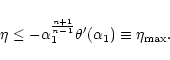
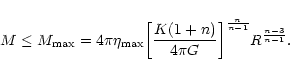
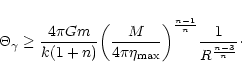
Polytropic stars are characterized by an equation of state of the form
 are constants. The index n of the polytrope is defined by the relation
 ). In that case,
is the ratio of specific heats
cp/cV at constant pressure and volume. For a monoatomic gas,
). In that case,
is the ratio of specific heats
cp/cV at constant pressure and volume. For a monoatomic gas,
 .
The equation of state (1) also describes a polytropic equilibrium characterized by a uniform specific heat
.
The equation of state (1) also describes a polytropic equilibrium characterized by a uniform specific heat
 .
In this more general situation
.
In this more general situation
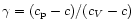 .
Convective equilibrium is recovered for c=0 and isothermal equilibrium is obtained in the limit of infinite specific heat
.
Convective equilibrium is recovered for c=0 and isothermal equilibrium is obtained in the limit of infinite specific heat
 .
A power law relation between the pressure and the density is also the limiting form of the equation of state describing a gas of cold degenerate fermions (Chandrasekhar 1932). In that case, the constant K can be expressed in terms of fundamental constants. In the classical limit
,
n=3/2 and
.
A power law relation between the pressure and the density is also the limiting form of the equation of state describing a gas of cold degenerate fermions (Chandrasekhar 1932). In that case, the constant K can be expressed in terms of fundamental constants. In the classical limit
,
n=3/2 and
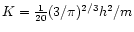 (where h is the Planck constant) and in the relativistic limit
 ,
n=3 and
,
n=3 and
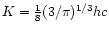 (where c is the speed of light). Historically, the index
appears in the classical theory of white dwarf stars initiated by Fowler (1926) and the index
is related to the limiting mass of Chandrasekhar (1931).
(where c is the speed of light). Historically, the index
appears in the classical theory of white dwarf stars initiated by Fowler (1926) and the index
is related to the limiting mass of Chandrasekhar (1931).
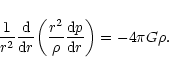
The condition of hydrostatic equilibrium for a spherically symmetrical distribution of matter reads
 is the gravitational potential. Using the Gauss theorem
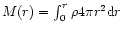 is the mass contained within the sphere of radius r, we can derive the fundamental equation of equilibrium (Chandrasekhar 1932)
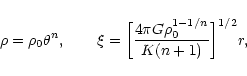
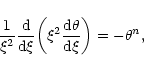
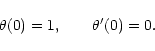
 is the central density, we can reduce the condition of hydrostatic equilibrium to the Lane-Emden equation (Chandrasekhar 1932)
 ,
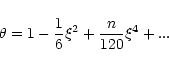
we can expand the function
,
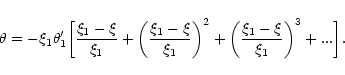
we can expand the function  in Taylor series. The first terms in this expansion are given by
 at large distances deserves a more
specific discussion. For 1<n<5, the density falls off to zero at a
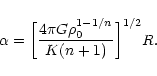
finite radius R, identified as the radius of the star. If we denote
by
at large distances deserves a more
specific discussion. For 1<n<5, the density falls off to zero at a
finite radius R, identified as the radius of the star. If we denote
by  the value of the normalized distance at which
  then, for
 ,
we have
,
we have
 .
For
.
For
 ,
,
 .
Since
.
Since
 at large distances, these
configurations have an "infinite mass'', which is clearly
unphysical. In the following, we shall restrict these configurations to a
"box'' of radius R, as in the classical Antonov
problem. Therefore, Eq. (7) must be solved for
at large distances, these
configurations have an "infinite mass'', which is clearly
unphysical. In the following, we shall restrict these configurations to a
"box'' of radius R, as in the classical Antonov
problem. Therefore, Eq. (7) must be solved for
 with
with
 is a measure of the central density .
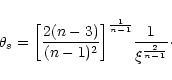
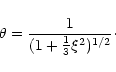
The case n=5 is special. For this index, the Lane-Emden equation can be solved analytically and yields the result:
is a measure of the central density .
The case n=5 is special. For this index, the Lane-Emden equation can be solved analytically and yields the result:
![\begin{figure}
\par\includegraphics[width=8.8cm,clip]{profilesP.eps}\end{figure}](/articles/aa/full/2002/17/aa1920/img40.gif) |
Figure 1: Density profiles of polytropes with index n=3,5,6. The dashed line corresponds to the singular solution (9). |
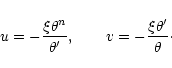
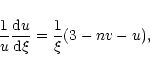
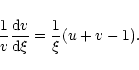
As in the analysis of isothermal gas spheres, it will be convenient in the following to introduce the Milne variables (u,v) defined by (Chandrasekhar 1932):
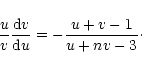
 and using Eq. (7), we get
.
It starts from the point
(u,v)=(3,0) with a slope
and using Eq. (7), we get
.
It starts from the point
(u,v)=(3,0) with a slope
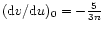 as
.
For 1<n<5, the curve is monotonous and tends to
as
.
For 1<n<5, the curve is monotonous and tends to
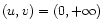 as
.
More precisely, using Eq. (11), we have
as
.
More precisely, using Eq. (11), we have
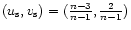 ,
corresponding to the singular solution (9), as
tends to infinity. All polytropic spheres must necessarily lie on this curve. For bounded polytropic spheres,
must be terminated at the box radius .
For n=5, the Milne variables are related according to
,
corresponding to the singular solution (9), as
tends to infinity. All polytropic spheres must necessarily lie on this curve. For bounded polytropic spheres,
must be terminated at the box radius .
For n=5, the Milne variables are related according to
![\begin{figure}
\par\includegraphics[width=8.8cm,clip]{uv4P.eps}\end{figure}](/articles/aa/full/2002/17/aa1920/img50.gif) |
Figure 2: The (u,v) plane for polytropes with index 1<n<5. The construction is made explicitly for n=4. |
![\begin{figure}
\par\includegraphics[width=8.8cm,clip]{uv6P.eps}\end{figure}](/articles/aa/full/2002/17/aa1920/img52.gif) |
Figure 4: The (u,v) plane for polytropes with index n>5. The construction is made explicitly for n=6. |
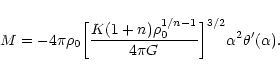
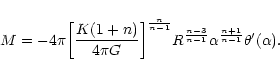
For polytropes confined within a box of radius R, there exists a well-defined relation between the mass M of the configuration and the central density
(through the parameter ). Starting from the relation
,
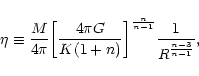
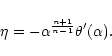
using Eq. (13), we obtain after some rearrangements
in necessarily
restricted by the inequality
 .
For the limiting
value
.
For the limiting
value
 ,
corresponding to an isolated polytrope satisfying
,
corresponding to an isolated polytrope satisfying
 ,
we have
,
we have
 ,
defined by Eq. (19), has been tabulated by
Chandrasekhar (1932). The definition (24) of
,
defined by Eq. (19), has been tabulated by
Chandrasekhar (1932). The definition (24) of  and the
relation (25) between
and
are consistent with
the formulae derived in the case of an isothermal gas (see
Chavanis 2002a). This connexion is particularly relevant if we interpret
the constant K as a polytropic temperature
and the
relation (25) between
and
are consistent with
the formulae derived in the case of an isothermal gas (see
Chavanis 2002a). This connexion is particularly relevant if we interpret
the constant K as a polytropic temperature
 (see
Chandrasekhar 1932, p. 86). For
(see
Chandrasekhar 1932, p. 86). For
 ,
,
 and the parameter
reduces to the corresponding one for isothermal spheres
(
and the parameter
reduces to the corresponding one for isothermal spheres
(
 ,
,
 ,
,
 ).
).
![\begin{figure}\par\includegraphics[width=8.8cm]{alphaetaP.eps}\end{figure}](/articles/aa/full/2002/17/aa1920/img70.gif) |
Figure 5: Mass-density profiles for polytropic configurations with index n=2,3,4,5,6. A mass peak appears for the first time for the critical index n=3. |
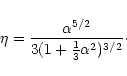
The function
 is represented in Fig. 5 for
different values of the polytropic index n. Instead of ,
we could have used the density contrast
is represented in Fig. 5 for
different values of the polytropic index n. Instead of ,
we could have used the density contrast
 is equivalent to
 and
and
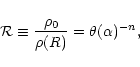
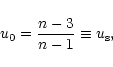
 refers to the singular solution (9). For
 ,
we recover the condition u0=1 previously derived for isothermal configurations (Chavanis 2002a). The values of
for which
is extremum are given by the intersection(s) between the solution curve in the (u,v) plane and the line u=us (see Figs. 2-4). For 1<n<3,
,
we recover the condition u0=1 previously derived for isothermal configurations (Chavanis 2002a). The values of
for which
is extremum are given by the intersection(s) between the solution curve in the (u,v) plane and the line u=us (see Figs. 2-4). For 1<n<3,
 and there is no intersection. The mass-density relation is therefore monotonous. For
 ,
the curve
presents a single maximum at
,
the curve
presents a single maximum at
 .
For n=3, this maximum is reached at the extremity of the curve (
.
For n=3, this maximum is reached at the extremity of the curve (
 ). For n=5,
 and the function
is explicitly given by
is located at
and the function
is explicitly given by
is located at
 .
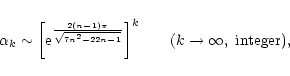
Finally, for n>5, the mass-density relation presents an infinite number of damped oscillations since the line defined by Eq. (28) passes through the center of the spiral in the (u,v) plane. If we denote by
.
Finally, for n>5, the mass-density relation presents an infinite number of damped oscillations since the line defined by Eq. (28) passes through the center of the spiral in the (u,v) plane. If we denote by
 the locii of the extrema of
,
these values asymptotically follow the geometric
progression
,
we recover the ratio
the locii of the extrema of
,
these values asymptotically follow the geometric
progression
,
we recover the ratio
 corresponding to classical isothermal configurations (Semelin et al. 1999; Chavanis 2002a).
From the above results, it is clear that restricted polytropic spheres with index  can exist only for
,
we recover the limiting mass
 above which an isothermal sphere cannot sustain self-gravity (see, e.g., Chavanis 2002b). Alternatively, for a given mass M and radius R, the inequality (31) implies the existence of a minimum value of the polytropic temperature
 .
Indeed,
is restricted by the inequality
,
we recover the critical temperature
.
Indeed,
is restricted by the inequality
,
we recover the critical temperature
 below which an isothermal sphere is expected to collapse (Lynden-Bell & Wood 1968). This critical point, corresponding to
,
appears for the first time for the index n=3. This observation will take a deeper physical significance in the stability analysis performed in the following section. For
below which an isothermal sphere is expected to collapse (Lynden-Bell & Wood 1968). This critical point, corresponding to
,
appears for the first time for the index n=3. This observation will take a deeper physical significance in the stability analysis performed in the following section. For  ,
the mass-density profile is monotonous and
,
the mass-density profile is monotonous and
 .
The total mass (resp. temperature) of confined polytropes is always smaller (resp. larger) than the corresponding one for isolated polytropes. However, this bound does not correspond to a condition of extremum
but rather to the impossibility of constructing polytropes with
.
The total mass (resp. temperature) of confined polytropes is always smaller (resp. larger) than the corresponding one for isolated polytropes. However, this bound does not correspond to a condition of extremum
but rather to the impossibility of constructing polytropes with
 (since
can become negative).
(since
can become negative).
Copyright ESO 2002




![\begin{figure}
\par\includegraphics[width=8.8cm,clip]{uv5P.eps}\end{figure}](/articles/aa/full/2002/17/aa1920/img51.gif)