

The blue continuum, the relatively weak, high excitation emission lines and the relative long-term stability in brightness suggest that RX J1643.7+3402 belongs to the novalike class of cataclysmic variables (CVs). These objects are believed to transfer mass at a rate high enough so that they are stuck permanently in outburst, thus preventing the instabilities associated with dwarf novae. The spectrum shown in Fig. 2 resembles that of V795 Her (Casares et al. 1996; Dickinson et al. 1997), DW UMa (Shafter et al. 1988), LX Ser (Young et al. 1981) and V442 Oph (Hoard et al. 2000) and looks very similar to that of V533 Her (Thorstensen & Taylor 2000). All these systems belong to the SW Sex sub-group of novalike CVs. The distinctive characteristics of SW Sex stars are (1) single-peaked emission lines, particularly He II  4686, instead of the double-peaked lines typical of a Keplerian disk, (2) gross asymmetries in the emission lines from the disk, so that they do not reflect the motion of the white dwarf,
(3) about two-thirds of the systems (11 out of 16) display eclipses of the accretion disk by the low-mass late-type companion, (4) peculiar absorption features in most lines at a phase opposite the eclipse, near maximum blueshift of the Balmer emission lines, (5) frequently, high-velocity S-waves in the Balmer emission lines, and (6) orbital periods grouped mostly in the 3-4-h range, but with two objects in the period "gap" and one having an 8-h period. The two SW Sex stars with the shortest periods, V442 Oph (P = 2
4686, instead of the double-peaked lines typical of a Keplerian disk, (2) gross asymmetries in the emission lines from the disk, so that they do not reflect the motion of the white dwarf,
(3) about two-thirds of the systems (11 out of 16) display eclipses of the accretion disk by the low-mass late-type companion, (4) peculiar absorption features in most lines at a phase opposite the eclipse, near maximum blueshift of the Balmer emission lines, (5) frequently, high-velocity S-waves in the Balmer emission lines, and (6) orbital periods grouped mostly in the 3-4-h range, but with two objects in the period "gap" and one having an 8-h period. The two SW Sex stars with the shortest periods, V442 Oph (P = 2
 98) and V795 Her (P = 2
60) are non-eclipsing systems (Hoard et al. 2000; Casares et al. 1996).
98) and V795 Her (P = 2
60) are non-eclipsing systems (Hoard et al. 2000; Casares et al. 1996).
The "trailed" spectra of Fig. 11 show phase-dependent absorption reminiscent of that characterizing the SW Sex stars (see Thorstensen et al. 1991). However, the absorption we see is strongest in the phase range 0.3-0.6, near the positive-to-negative cross-over point for the H emission-line velocities, whereas in SW Sex stars the absorption is normally strongest near the phase of maximum approach velocity, approximately one-half cycle away from the eclipses seen in most of these systems. As no eclipses have been detected in our photometry we cannot determine the relation between the radial velocities and the binary system orientation, but the relative difference in the times of appearance of the strongest absorption in SW Sex type stars and in our object, roughly one-quarter of an orbital cycle, is very large and does not depend on any particular phase convention. The UBV colors measured for RX J1643.7+3402 are very similar to those reported for the non-eclipsing systems V442 Oph and V795 Her (see the compilation by Hoard 1998), perhaps a consequence of their accretion disks being viewed at lower inclinations.
There is currently no single agreed-upon explanation for the SW Sex phenomenon, but it appears that the accretion disks of these systems have a complicated structure. For example, the flared-out disk in DW UMa (Knigge et al. 2000) masks parts of the disk surface at any given time and can thus explain the gross asymmetries and the single-peaked profiles of the emission lines (with an additional contribution from a disk wind) while substantial stream-disk overflow (Hellier 1998) may explain the absorption in the line cores, when the gas stream is seen projected onto the disk surface. The high-velocity S-wave emission features may be due to stream re-impact in an area near the disk center, where the Keplerian velocities are highest (Hellier & Robinson 1994). The detailed interpretation of these S-waves is under debate. Casares et al. (1996) consider the strong red and the weak blue wings in the V795 Her system as two separate components, perhaps related to accretion onto a magnetic white dwarf which is rotating synchronously, while Dickinson et al. (1997) explain the two wings of that system as parts of a very broad emission S-wave with a sympathetically phased red-shifted superimposed absorption S-wave. In RX J1643.7+3402 only the blue wing is seen in emission. The H
profile shown in the right panel of Fig. 9 is similar to those observed in V795 Her.
The role of magnetic fields in explaining the characteristics of SW Sex stars has been discussed, among others, by Horne (1999) who introduced the idea of a disk-anchored magnetic propeller. More recently, the discovery of variable circular polarization in LS Peg (Rodriguez-Gil et al. 2001) indicates that magnetic accretion plays an important role in these systems. They suggested that SW Sex systems may just be intermediate polars with high accretion rates.
RX J1643.7+3402 shares several characteristics with SW Sex stars, such as single-peaked instead of double-peaked emission lines, asymmetric profiles, high-velocity S-waves (although in this system we only see the blue part of this S-wave) and absorption features in the line cores. It has, in particular, many properties in common with V795 Her, including similar spectroscopic period, rapid photometric behavior and superhump modulation. The 0.2 phase lag we find between the high-velocity S-wave and the main emission component for both He II and H
has also been found in the SW Sex system V1315 Aql (Hellier 1996). This phase lag has been interpreted as arising from the difference in the location, within the disk, of the two emission regions: the high velocity component coming from the inner disk (re-impact area?) and the lower velocity component from a more external location (hot spot?). The phasing of the absorption features in RX J1643.7+3402, which are strongest when the main emission velocities change from recession to approach, is nevertheless different from that in SW Sex systems, where they appear close to the time of maximum approach velocity, suggesting a different geometry in the accretion stream disk-overflow.
575 or 2
885, both within the period "gap" (Shafter 1992), which although sparsely populated, contains several novalike systems. The photometric modulation detected on most nights (of  0.1 mag amplitude in V) at a probable period of 2
595 (but the
0.1 mag amplitude in V) at a probable period of 2
595 (but the  1 c/d aliases are not excluded), different from either of the spectroscopic periods, could be explained as a superhump modulation. In many dwarf novae, but also in novalike variables, photometric modulations are seen with a period different from the spectroscopic period (Taylor et al. 1998). This phenomenon is known as the superhump phenomenon and corresponds to the light variations of a precessing elongated accretion disk. In the case of dwarf-novae the superhumps appear only in outburst but, in novalike systems, the phenomenon is persistent and has been called "permanent" superhumps. While most superhump periods are longer than the orbital period ("positive" superhumps), some appear at a shorter period ("negative" superhumps). It has been suggested that the former arise from the prograde motion of the line of apsides of an elongated disk, while the latter appear to imply a tilted, elongated disk displaying retrograde motion of the line of nodes (Patterson et al. 1997).
Patterson (1999) has reported that among a sample of 18 non-dwarf nova systems, 7 show positive superhumps, 4 show negative superhumps and 7 show both kinds. Essentially all novalike systems with
 -h show positive superhumps. Only novalike systems show negative superhumps and, amongst these, four are SW Sex systems. Patterson also shows that the fractional period excess
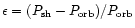 shows a correlation with orbital period, with negative superhumpers showing a period excess about one-half that for positive superhumpers. For the spectroscopic periods reported here, these correlations would predict
 +0.07 for a positive superhump and
 0.03 for a negative one. The values we apparently find, +0.008 or -0.10, are significantly different. Further observations will reveal the true orbital period of RX J1643.7+3402 and should allow a more detailed characterization of the optical modulation.
While rapid variability is typical of most cataclysmic variables, the behavior we see in this object seems unusual, since the variations show a large amplitude (0.1 to 0.2 mag) and each peak in brightness seems well separated from its neighbor. Rapid variations of a similar character have been reported in the case of V795 Her (Zhang et al. 1991). These variations have been variously interpreted in the literature as (1) oscillations of the disk boundary layer, (2) reprocessing of X-rays in "blobs" of optically thick material orbiting within the accretion disk, and (3) accretion of "blobs" onto the magnetic poles of a magnetized white dwarf. Longer observing runs are needed to obtain more accurate information on the characteristics of the rapid variations in RX J1643.7+3402.
The average value for the EW of the H
emission line for this object is 2.8 Å. The correlation between the absolute visual magnitude and the H
EW derived by Patterson (1984) for cataclysmic variables suggests that the absolute magnitude might be brighter than
MV = +6. Assuming negligeable absorption, this yields a lower limit for the distance of 210 pc. For novalike systems Warner (1995) discusses the correlation between absolute visual magnitude and orbital period. For the period reported here this correlation yields
 ,
consistent with the previous estimate. Since these values refer to a standard inclination angle of
,
consistent with the previous estimate. Since these values refer to a standard inclination angle of
 ,
the correction in this case is probably small since no eclipses are detected. The entry in the ROSAT bright source catalogue gives a PSPC (0.1-2.4 keV) count rate of 0.05
0.01 counts-1 and a hardness ratio HR1 of 0.62
0.22. Using the conversion factor given by Fleming et al. (1995) the X-ray flux is
,
the correction in this case is probably small since no eclipses are detected. The entry in the ROSAT bright source catalogue gives a PSPC (0.1-2.4 keV) count rate of 0.05
0.01 counts-1 and a hardness ratio HR1 of 0.62
0.22. Using the conversion factor given by Fleming et al. (1995) the X-ray flux is
 erg cm-2s-1. We note that V795 Her has also been detected by ROSAT at approximately the same flux level (Rosen et al. 1995). Assuming the distance derived above and no X-ray absorption this yields a very approximate 0.1-2.4 keV X-ray luminosity of
 ergs-1, which is near the lower end of the range observed for CVs (van Teeseling & Verbunt 1994; van Teeseling et al. 1996). The X-rays may be produced in the boundary layer between the white dwarf and the accretion disk but more X-ray data are needed to investigate the origin of the emission.
Copyright ESO 2002