

 ,
,
 m pixel Thomson CCD. The spectra were flux calibrated using the standard star BD+28
 4211 (Stone 1977). The continuum is very blue; several emission lines are present, the strongest being H
 ,
H
,
H ,
He II
,
He II  4686, He I 6678 and the "Bowen blend" emission feature at
  4645 Å.
During the period 22-28 September 2000 more detailed spectroscopic observations were carried out with the CARELEC spectrograph (Lemaître et al. 1989) attached to the Cassegrain focus of the OHP 1.93-m telescope. We used a 600 lmm-1 grating resulting in a dispersion of 66 Å mm-1. The detector was a
 ,
,
 m pixel EEV 42-20 CCD. Exposure times were generally 10 min. Seven columns of the CCD (3
 )
were extracted. The slit width was 2
)
were extracted. The slit width was 2
 1, corresponding to a projected slit width on the detector of 52
  m i.e. 3.8 pixels. The resolution, as measured on the night sky lines, was 3.4 Å FWHM. The wavelength range was 4280-6100 Å. The spectra were wavelength calibrated using an Ar lamp and flux calibrated using the standard stars Feige15, BD+284211 and EG247, taken from Oke (1974) and Stone (1977). To obtain accurate velocity measurements, we applied wavelength corrections by measuring the [O I] 5577 night sky line on each spectrum (the corrections were in the range -1.3, -0.4 Å).
The profiles of all emission lines are complex and variable. Some H
profiles have a flat top, others display a shoulder while a few show a clear central absorption; we derived radial velocities using our own software, as described in Gonçalves et al. (1999), by fitting each profile with a main emission component and a minor unresolved Gaussian absorption (see Sect. 5). This procedure derives velocity information essentially from the line flanks. The radial velocities for the main emission component vary between -205 and +125 kms-1.
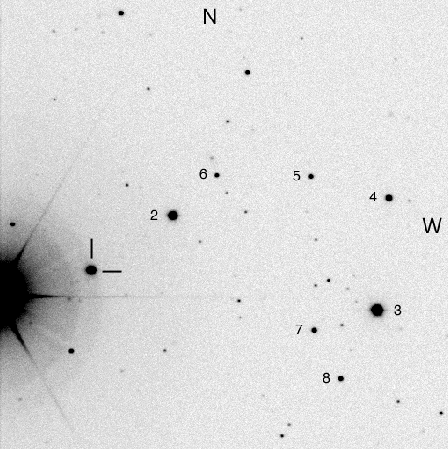 |
Figure 1:
Finding chart for RX J1643.7+3402. This is a 30-s  exposure
taken on September 23, 2000 with the OHP 1.2-m telescope.
The field of view is
exposure
taken on September 23, 2000 with the OHP 1.2-m telescope.
The field of view is  arcmin. The variable is
indicated by two tick marks. Magnitudes and colors for numbered field stars
are given in Table 2. Stars 2 and 3 were used as comparisons. The bright star
(V=6) at left is HD 151087. arcmin. The variable is
indicated by two tick marks. Magnitudes and colors for numbered field stars
are given in Table 2. Stars 2 and 3 were used as comparisons. The bright star
(V=6) at left is HD 151087. |
| Line | EW (Å) |
H |
1.6 |
| Bowen Blend | 2.0 |
| He II 4686 |
2.5 |
| He I 4713 |
0.12 |
| H |
2.8 |
| He I 4921 |
0.33 |
| He I 5016 |
0.32 |
| C IV 5804 |
0.62 |
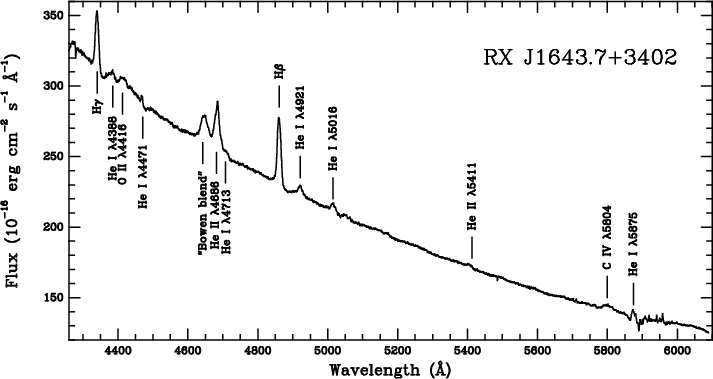
We coadded all our spectra (see Fig. 2). The resulting spectrum shows, in addition to the lines seen on the low resolution BAO spectra, several He I lines (4388, 4471, 4713, 4921, 5016 and 5875 Å) and an additional He II line (5411 Å); there is also a weak, broad (33 Å FWHM) C IV 5804 emission line (this is in fact a doublet at 5801.5 and 5812.1 Å). Table 1 gives the equivalent widths (EW) of the main emission lines measured on this spectrum. Blends of atmospheric water vapor absorption lines are present between 5680 and 5800 Å and between 5870 and 6000 Å.
We obtained photometric observations of the RX J1643.7+3402 field on nine nights (18-27 September 2000) using the OHP 1.2-m telescope and a CCD
 camera. The pixel size is 24 m which projects to 0
7 on the sky. Most of the frames used for monitoring the brightness were 30 s V-band exposures. The effective time resolution (exposure time + read-out time) was 113 s on the first four nights, but on subsequent nights we used a single
camera. The pixel size is 24 m which projects to 0
7 on the sky. Most of the frames used for monitoring the brightness were 30 s V-band exposures. The effective time resolution (exposure time + read-out time) was 113 s on the first four nights, but on subsequent nights we used a single
 detector quadrant ( arcmin field of view), which resulted in a read-out time of 30 s and an effective time resolution of 60 s. The longest runs possible at this time of year were about 2.5 to 3 h long. Total or partial simultaneous coverage with the spectroscopic observations at the 1.93-m was achieved on six nights (22-27 September). Dome flat-fields were obtained using controlled daylight illumination. All necessary data reduction was done using the ESO-MIDAS software package.
0.1 mag slow modulation, there are rapid variations of 0.1 to 0.2 magnitude amplitude repeating with a time scale of 15 min.
Observations using the entire
 system filter set were secured on September 23, together with frames of standards in M 13 (Forbes & Dawson 1986; Arp & Johnson 1955) for photometric calibration.
| Name | V | U-B | B-V |
 |
 |
| Star 2 | 12.97 | -0.03 | +0.54 | +0.32 | +0.26 |
| Star 3 | 12.16 | +0.94 | +1.04 | +0.61 | +0.44 |
| Star 4 | 14.74 | +0.89 | +1.08 | +0.59 | +0.48 |
| Star 5 | 16.30 | -0.21 | +0.43 | +0.34 | +0.29 |
| Star 6 | 16.68 | +0.04 | +0.66 | +0.39 | +0.31 |
| Star 7 | 16.43 | +1.18 | +1.56 | +1.02 | +1.01 |
| Star 8 | 16.14 | +0.55 | +0.87 | +0.46 | +0.38 |
 0.02 and 0.05 mag, depending on the magnitude. Two different measurements of RX J1643.7+3402 were obtained for each color index, except U-B.
The results are given in Table 3. The rapid variability seen in the data of Fig. 3 may have slightly affected the derived colors since measurements in any pair of filters were taken one minute apart (5 min in the case of the U filter).
0.02 and 0.05 mag, depending on the magnitude. Two different measurements of RX J1643.7+3402 were obtained for each color index, except U-B.
The results are given in Table 3. The rapid variability seen in the data of Fig. 3 may have slightly affected the derived colors since measurements in any pair of filters were taken one minute apart (5 min in the case of the U filter).
Copyright ESO 2002
 ,
and the main emission lines discussed in the text (the total exposure time is 387 min).
,
and the main emission lines discussed in the text (the total exposure time is 387 min).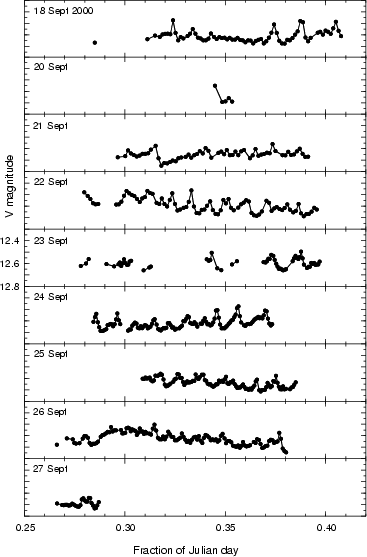
 595) reported in the text can be discerned best on the nights of September 18, 22, 24 and 26.