

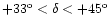
 )
of the First Byurakan Survey (FBS) which was aimed at the detection of blue stellar objects (Abrahamian & Mickaelian 1996, and references therein). To check the completeness of this sample we cross-correlated the sources in the ROSAT RASS X-ray survey (Voges et al. 1999) with the objects in the USNO-A2.0 catalog (Monet et al. 1996) brighter than O(USNO) = 16.0 and found a few bright additional QSO candidates. One of them, near RX J1643.7+3402, is a bright starlike object at a galactic latitude of +40
)
of the First Byurakan Survey (FBS) which was aimed at the detection of blue stellar objects (Abrahamian & Mickaelian 1996, and references therein). To check the completeness of this sample we cross-correlated the sources in the ROSAT RASS X-ray survey (Voges et al. 1999) with the objects in the USNO-A2.0 catalog (Monet et al. 1996) brighter than O(USNO) = 16.0 and found a few bright additional QSO candidates. One of them, near RX J1643.7+3402, is a bright starlike object at a galactic latitude of +40
 2, located 82
 to the west of the bright F2 star HD 151087 (see Fig. 1). Its J2000 coordinates, measured on the Digitized Sky Survey, are:
  = 16
= 16 43
43 45
45
 71 and
 02
02 39
39
 9; it is located 7
2 from the X-ray position. This identification was first proposed by Bade et al. (1998), but since the digitized spectrum from the Hamburg objective-prism survey plate was saturated no information on the nature of the object was published, and later also by Rutledge et al. (2000) who used a statistical cross-identification technique. The observations reported in this paper show it to be a cataclysmic variable.
9; it is located 7
2 from the X-ray position. This identification was first proposed by Bade et al. (1998), but since the digitized spectrum from the Hamburg objective-prism survey plate was saturated no information on the nature of the object was published, and later also by Rutledge et al. (2000) who used a statistical cross-identification technique. The observations reported in this paper show it to be a cataclysmic variable.
Copyright ESO 2002